My husband, Liam, and I have been married for four years. Eight months ago, our lives changed in the most beautiful and exhausting way possible when we welcomed our first child, Noah.
Becoming a mother was something I had dreamed about, but nothing could have prepared me for how completely it would transform my everyday life. I loved Noah more than I could ever explain. His little smiles, his sleepy expressions, the way his fingers wrapped around mine, and even the moments when he cried for no apparent reason had become part of my world.
But motherhood also brought changes I hadn’t expected.
The nights were shorter. My mornings began earlier. Some days, I barely had time to finish a cup of coffee before Noah needed something. My body had changed, too, and although I was grateful for what it had done, I was still learning how to feel comfortable in it.
My old jeans no longer fit the way they used to. My stomach was softer, my hips were different, and there were moments when I looked in the mirror and needed a few seconds to recognize the woman looking back.
Some days, those changes bothered me.
Other days, I was too busy caring for my baby to give them much thought.
I was trying to be patient with myself. I was learning that recovering from pregnancy wasn’t a race and that becoming a mother didn’t mean I had to stop being myself.
Unfortunately, my mother-in-law, Barbara, seemed to have a very different opinion.
Barbara had always been someone who cared deeply about appearances. She liked everything organized, coordinated, polished, and perfectly presented. Her house always looked as though someone had just finished photographing it for a magazine.
She paid attention to clothing, decorations, table settings, and even the colors people wore to family gatherings.
At first, I thought it was simply her personality.
But over time, I began to understand that her interest in appearances went much further than enjoying beautiful things.
She seemed to believe that everything and everyone around her should fit into the picture she had created in her mind.
I had seen her criticize Liam’s sister, Rachel, for wearing a green dress to a birthday dinner because, according to Barbara, the shade didn’t photograph well.
When Liam and I announced our engagement, Barbara’s first suggestion wasn’t to celebrate with us or ask how we felt.
Instead, she told me I should get my nails done before the engagement photographs.
She said it with a smile, as though she were offering helpful advice.
That was Barbara’s particular talent.
She could say something deeply hurtful in the sweetest possible voice, then look genuinely confused when someone appeared offended.
Since Noah was born, most of her comments had gradually shifted toward my appearance.
At first, they seemed like ordinary remarks.
“Breastfeeding usually helps the weight come off,” she once told me.
Another time, while looking at a photograph from a family gathering, she said, “You must be excited to get back into your old clothes.”
When I reached for a second cookie at her house, she smiled and added, “Careful. Those add up faster than you think.”
I tried to ignore these comments.
I reminded myself that I didn’t need to argue with every unpleasant remark. I didn’t want every family gathering to become uncomfortable, and I certainly didn’t want Liam to feel caught between his wife and his mother.
But the comments kept coming.
One evening, after another uncomfortable visit, I finally told Liam how much they bothered me.
We were driving home, and Noah was asleep in his car seat behind us.
I looked out the passenger window for a moment before speaking.
“Your mom needs to stop commenting on what I eat and how my body looks.”
Liam glanced at me.
“I know,” he replied. “I’ll talk to her.”
I wanted to believe him.
I didn’t ask exactly what he planned to say. I didn’t demand that he confront her in a particular way. I simply wanted him to understand that I needed his support.
The comments didn’t stop.
And because Liam never brought up the conversation again, I eventually assumed that whatever he had said hadn’t changed anything.
I didn’t realize how much worse things were about to become.
Yesterday was Barbara and Richard’s fortieth wedding anniversary.
Barbara had been preparing for the celebration for months. She talked about it constantly, discussing the decorations, the guest list, the dinner arrangements, and the professional photographer she had hired for the following morning.
Around twenty relatives and family friends were invited.
There would be siblings, cousins, aunts, uncles, and people who had known Barbara and Richard for decades.
Barbara had even arranged an elaborate display of old family photographs in the dining room.
There were pictures from their wedding, holidays, birthdays, family vacations, and celebrations from different stages of their marriage.
She wanted everything to be perfect.
Especially the photographs.
I almost decided not to attend.
Noah had been particularly fussy that afternoon, and I was exhausted. I had spent much of the day taking care of him, feeding him, changing him, and trying to settle him whenever he became upset.
The thought of getting dressed, driving across town, and spending an entire evening around a large group of people felt overwhelming.
But Liam reminded me that the anniversary was important to his parents.
“We don’t have to stay all night,” he told me. “We can go for dinner, congratulate them, and leave whenever you feel tired.”
I agreed.
Before we left, I stood in front of the bedroom mirror, adjusting my dress.
I had chosen a dark blue wrap dress.
It wasn’t expensive or particularly fancy, but it was one of the first outfits I’d purchased since Noah’s birth that made me feel comfortable and confident.
For a moment, I looked at myself and smiled.
Liam came up behind me.
“You look beautiful,” he said.
I turned toward him.
“Really?”
He smiled.
“Really. That color looks wonderful on you.”
For once, I believed him without questioning it.
We arrived shortly afterward.
The house was already full of guests. Conversations were taking place in almost every room, and the smell of the anniversary dinner filled the hallway.
Barbara greeted us near the entrance.
She hugged Liam, kissed Noah on the forehead, and then looked at me.
Her eyes moved over my dress.
“Oh, blue,” she said.
I waited for her to continue.
She tilted her head slightly.
“That’s actually very slimming.”
Liam immediately stiffened beside me.
“Mom.”
Barbara looked surprised.
“What? It’s a compliment.”
I felt the familiar discomfort return.
I could have answered her. I could have told her that I hadn’t asked for an opinion about my body.
Instead, I took a breath and handed Noah to Richard, who was already reaching out to hold his grandson.
“Happy anniversary,” I said.
Richard smiled warmly.
“Thank you. It’s wonderful to have you all here.”
For a little while, things seemed normal.
We greeted relatives, exchanged congratulations, and listened to stories about Barbara and Richard’s early years together.
Barbara was in her element.
She moved between guests, making sure everyone had a drink, adjusting decorations, and checking that the dining room looked exactly as she wanted.
At one point, she reminded everyone that the professional family photographs would take place the next morning.
“We’ve waited so long to organize this,” she said. “I want everyone looking their best.”
A few relatives laughed politely.
I didn’t think much of it at the time.
Eventually, dinner was ready.
The table looked beautiful.
There were white plates, polished silverware, folded napkins, candles, and a large arrangement of flowers in the center.
The food smelled incredible.
There was prime rib, garlic mashed potatoes, roasted vegetables, and baskets of warm dinner rolls.
After a long day, I was genuinely hungry.
Barbara had insisted on serving everyone herself.
She explained that she wanted the plates arranged properly because presentation was important.
We watched as she carried food from the kitchen.
Richard received a generous portion of prime rib with mashed potatoes.
Liam received the same.
Rachel received prime rib, potatoes, and vegetables.
The other relatives were served similar portions.
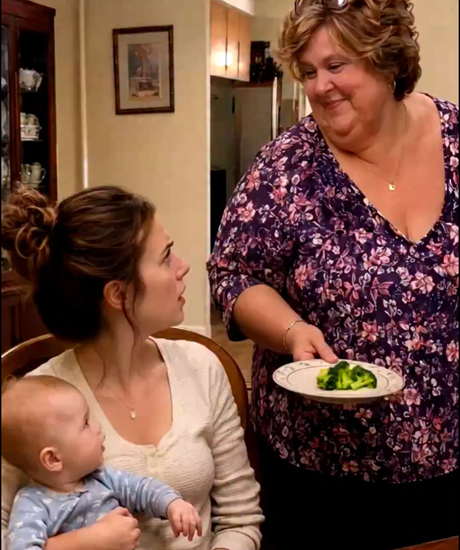
Then Barbara approached me.
She was carrying a small white porcelain plate.
She placed it in front of me.
I looked down.
There were four pieces of plain steamed broccoli.
Nothing else.
No potatoes.
No meat.
No roasted vegetables.
Just four small green florets sitting in the middle of an otherwise empty plate.
For a moment, I genuinely thought there had been some kind of mistake.
I looked toward the kitchen, expecting her to return with the rest of my food.
But Barbara remained standing beside my chair.
“Barbara?” I asked quietly.
She smiled.
“We just want you looking your best for the family photos this year.”
She said it loudly enough for everyone at the table to hear.
Not privately.
Not discreetly.
She announced it as though she had made a perfectly reasonable decision that everyone would naturally understand.
The conversations stopped.
Forks paused halfway to mouths.
A cousin looked down at his plate.
Rachel slowly turned toward her mother.
Liam stopped moving.
For several seconds, nobody said anything.
I could feel my face becoming hot.
I looked at the four pieces of broccoli again.
Then I looked around the table.
Twenty people had just watched my mother-in-law explain that I wasn’t being served the same dinner because she wanted me to look better in photographs.
My first instinct was to disappear.
I wanted to pretend I hadn’t heard her.
I wanted someone else to make a joke, change the subject, or say something that would allow everyone to continue eating.
But then I felt something change inside me.
Perhaps it was the exhaustion of the previous eight months.
Perhaps it was the frustration of hearing one comment after another about my body.
Or perhaps I had simply reached the point where remaining silent felt worse than speaking.
I slowly pushed my chair back.
The sound of its legs scraping against the floor seemed unusually loud.
Barbara’s smile became uncertain.
I picked up the small plate.
Then I walked around Noah’s high chair and placed it directly in front of Liam.
He looked at the broccoli.
Then he looked at me.
“Do you think this is what I should be eating?” I asked.
“Claire…” he began.
“No. I’m asking you a question.”
I kept my voice steady.
“Do you think your wife should sit at this table with four pieces of broccoli while everyone else eats a proper dinner because your mother doesn’t think I look good enough for her photographs?”
Barbara let out a nervous laugh.
“Oh, for heaven’s sake. It was meant to be lighthearted.”
I didn’t look at her.
I was watching Liam.
He wasn’t meeting my eyes.
And suddenly, the broccoli wasn’t even the most important thing in the room.
“Liam,” I said, “what did your mother tell you?”
His expression changed.
He swallowed.
“I’m sorry.”
Those two words made my stomach tighten.
“What did you know?”
He glanced around the table.
“Can we not do this here?”
I looked at him in disbelief.
“Your mother just served me four pieces of broccoli in front of twenty people. We’re already doing this here.”
Rachel quietly spoke from across the table.
“She’s right.”
Liam lowered his eyes.
“A couple of weeks ago, Mom called me,” he said. “She was worried about how you would look in the photographs.”
I stared at him.
“And you knew?”
“I told her to leave it alone.”
Before I could respond, Barbara interrupted.
“No, you didn’t.”
Liam turned toward her.
“Mom.”
She folded her arms.
“You said you understood that photographs last forever.”
I slowly looked back at my husband.
“Did you tell her it was okay to talk about my body?”
“No.”
“Then why didn’t you tell me what she was planning?”
He didn’t answer.
That silence hurt more than I expected.
For months, I had been asking him to help me establish a boundary with his mother.
He knew her comments were upsetting me.
He knew she had been talking about my weight.
And apparently, he knew she was worried about the family photographs.
Yet he had allowed me to walk into that dinner without knowing what was waiting for me.
Barbara threw up her hands.
“I did not insult you. I was trying to help.”
I finally turned toward her.
“Help me do what?”
Her eyes briefly moved toward my stomach.
“Barbara,” Richard said quietly.
She ignored him.
“We’re taking professional photographs tomorrow. I’ve spent a lot of money organizing everything. Liam told me you were already unhappy with your weight.”
I turned toward my husband.
“You told her that?”
His face lost its color.
“It came up.”
“What came up, Liam?”
I could hardly believe what I was hearing.
“Something I told you privately because I was struggling with my body after having our baby?”
He looked uncomfortable.
“I wasn’t gossiping about you.”
But that wasn’t the point.
I had trusted him with something personal.
I had told him about my insecurities because I believed I could be honest with my husband without worrying that my feelings would eventually become a topic of discussion with someone else.
And now his mother was using those very insecurities to justify humiliating me.
I felt exposed.
Not because of my appearance.
Because someone I trusted had shared something that wasn’t his to share.
Then Barbara spoke again.
“I already fixed the issue with the positioning anyway.”
Rachel leaned forward.
“Mom.”
I looked at Barbara.
“What positioning?”
For the first time that evening, she appeared uncertain.
She glanced toward Richard, then back at me.
“I was going to have you stand slightly behind Liam, with Noah in front. It’s flattering. Photographers do it all the time.”
I felt my chest tighten.
“You planned to hide me?”
“No one said hide.”
“You arranged the photographs so I would be standing behind everyone else?”
“Claire, you’re taking this the wrong way.”
“You decided where I should stand because you don’t like how my body looks after having your grandson.”
Nobody moved.
The room became completely silent again.
I looked down at the small plate of broccoli sitting in front of Liam.
Then I looked at the anniversary display beside Barbara.
Her framed wedding photograph stood in the center.
The gold lettering underneath read:
FORTY YEARS.
Beside it was the schedule for the professional photographs she had organized so carefully.
I picked up the broccoli plate.
Barbara frowned.
“What are you doing?”
I walked over to the display and placed the plate carefully beside the framed photograph.
“Fixing your picture,” I said.
She stared at me.
“What?”
“You don’t have to worry about where to hide me tomorrow, Barbara. I won’t be there.”
Her expression changed immediately.
“Don’t be childish.”
“I’m not.”
I walked back toward Noah’s high chair.
“And neither will my son.”
That was when Barbara seemed to realize I was serious.
“Wait. You’re taking the baby?”
I looked at her.
“Yes.”
“But Noah needs to be in the photographs.”
I held my son a little closer.
“So I don’t belong in your perfect family picture, but my baby does?”
“I never said you don’t belong.”
“You planned to hide me behind Liam.”
“Because you’re being sensitive about your figure.”
I shook my head.
“I wasn’t sensitive about my figure until you turned dinner into a public judgment about my appearance.”
Barbara looked toward Liam.
“Say something.”
I turned to him.
“Liam, I’m leaving with Noah. You can stay if you want. But if you do, understand what you’re choosing.”
He started to speak.
“Claire—”
“No. I’ve asked you to deal with this before. You kept telling yourself that avoiding conflict was keeping the peace.”
Barbara interrupted.
“I refuse to be blamed because your wife is emotional.”
Liam finally stood up.
“Stop.”
Barbara looked at him.
“Liam?”
“No, Mom. She’s right.”
He took a breath and looked around the table.
“I knew you were talking about her weight. I knew you were planning the photographs around it, and I told myself that staying out of it would keep things calm.”
He shook his head.
“All I did was leave Claire to deal with you alone.”
Barbara looked genuinely shocked.
“I was only trying to help.”
Liam continued.
“If Claire isn’t welcome in this family exactly as she is, then neither Noah nor I will be in those photographs.”
Her mouth opened.
“You cannot be serious.”
“I am.”
“This is our fortieth anniversary!”
“I know.”
“Your father and I will never have this anniversary again.”
Liam looked at her.
“And Claire will never get tonight back.”
For a moment, Barbara had no response.
Then Richard pushed his chair away from the table.
His expression was serious.
“Barbara, what were you thinking?”
She looked at him in disbelief.
“Not you too.”
“You served the mother of your grandson four pieces of broccoli in front of the entire family.”
“I was encouraging her.”
“No,” Rachel said. “You were humiliating her.”
One of the other relatives quietly nodded.
“Yeah. That wasn’t right.”
Barbara looked around the table.
She seemed genuinely surprised that nobody was rushing to defend her.
“I have done everything for this family,” she said.
Richard sighed.
“This isn’t about everything you’ve ever done. It’s about what you did tonight.”
Her eyes began to fill with tears.
For a moment, I felt the familiar urge to comfort her.
That instinct was so automatic that it almost surprised me.
For years, I had tried to smooth things over whenever Barbara became upset.
I had apologized when I hadn’t done anything wrong.
I had changed the subject when she made uncomfortable remarks.
I had convinced myself that keeping everyone happy was more important than acknowledging how I felt.
But standing there with Noah in my arms, I realized that I couldn’t keep doing that.
Liam walked around the table and picked up the diaper bag.
“Let’s go,” he said.
Barbara’s voice became quieter.
“Liam, please.”
He stopped near the doorway.
“Tomorrow’s photograph is important to me,” she said.
He looked back at her.
“So is my wife.”
Then he walked out.
I followed him.
We didn’t speak much during the first few minutes of the drive.
Noah eventually fell asleep in his car seat.
The streetlights passed across the windshield, and the silence inside the car felt very different from the silence at dinner.
At the anniversary celebration, everyone had been silent because they were uncomfortable.
Now, neither of us knew exactly what to say.
Eventually, Liam spoke.
“I really am sorry.”
I kept looking out the window.
“I know.”
He shook his head slightly.
“No, I don’t think you do.”
I turned toward him.
He kept both hands on the steering wheel.
“I’ve always dealt with my mom by letting her talk until she runs out of energy. Then I change the subject. It worked when it was just me.”
He paused.
“But then I married you, and I kept doing the same thing while she aimed it at you.”
I didn’t interrupt.
“I thought I was avoiding conflict,” he continued. “I was actually handing it to you.”
That was the first thing he had said that evening that made me feel he truly understood what had happened.
I looked down at my hands.
After a moment, I asked him something I had been thinking about since dinner.
“Did you agree with her about my weight?”
His answer came immediately.
“No.”
He glanced at me.
“I think you’re beautiful. I always have.”
I looked away.
“But I also understand why hearing that from me might not fix anything right now,” he added.
I appreciated that he didn’t expect a compliment to erase what had happened.
We drove in silence for another minute.
Then I spoke.
“I need something to change, Liam.”
“It will.”
“Not promises. Actual boundaries.”
He nodded.
“You won’t have to be the one confronting her anymore. She’s my mother. I should have handled this before it got anywhere near you.”
I didn’t tell him that everything was suddenly fine.
It wasn’t.
But I could hear that he was beginning to understand the difference between apologizing for an argument and taking responsibility for allowing something to happen.
When we got home, we carried Noah inside.
He was still asleep, completely unaware of the tension that had surrounded his parents that evening.
Liam placed the diaper bag near the sofa while I settled Noah into his crib.
For a few minutes, I stood beside him, watching his tiny chest rise and fall.
I thought about the family photographs Barbara had planned.
I thought about the four pieces of broccoli.
And I thought about how easily a person could begin believing that the way someone else treated them was a reflection of their actual worth.
I didn’t want Noah growing up believing that love depended on appearances.
I didn’t want him learning that people should be made to feel small so that somebody else’s picture could look perfect.
And I certainly didn’t want him growing up watching his mother apologize for taking up space.
The following morning, the professional photographs went ahead without us.
Rachel later sent Liam a picture from the session.
Barbara and Richard stood in the center.
The other relatives were arranged around them in coordinated shades of cream, navy, and gray.
Everyone appeared polished and carefully positioned.
There was a noticeable empty space on Liam’s side of the family where we were supposed to be.
Barbara had received the photographs she had spent months organizing.
The decorations were beautiful.
The clothes matched.
The lighting was perfect.
But Liam, Noah, and I were not there.
I looked at the photograph for a long moment.
Then I put my phone down.
I didn’t feel victorious.
I didn’t feel the need to celebrate anyone’s disappointment.
I simply felt that, for once, I had chosen not to participate in something that made me feel unwelcome.
Later that day, after Noah had gone down for a nap, I stood in front of the bathroom mirror.
I looked at my reflection.
For months, I had been treating the changes in my body as evidence that I hadn’t completely become myself again.
I had sometimes wondered when my old clothes would fit, when my stomach would look familiar, or when I would stop noticing every little difference.
But that morning, I saw something I hadn’t allowed myself to see for a long time.
My body had changed because my life had changed.
I had carried a child.
I had given birth.
I had spent months caring for a tiny person who depended on me for almost everything.
None of that made me less worthy of respect.
Barbara had looked at me and seen something that needed to be hidden behind another person.
But her opinion didn’t have to become mine.
I heard Liam enter the bathroom behind me.
He walked closer and rested his chin gently on my shoulder.
We looked at our reflections together.
Then he said, “For what it’s worth, blue really is your color.”
I looked at him through the mirror.
“That’s what your mother said.”
His eyes widened.
“Oh, God.”
I couldn’t help laughing.
For the first time since the anniversary dinner, the tension between us softened.
Liam started laughing too.
It wasn’t because the situation had suddenly become unimportant.
It was because, after everything that had happened, we could finally recognize how absurd the original comment had been.
A few days later, Liam and I talked again about what needed to happen next.
He agreed that he would be responsible for communicating boundaries to his mother.
He also understood that an apology would not automatically restore the trust that had been damaged.
If Barbara wanted to repair our relationship, she would need to acknowledge what she had done without blaming my feelings, my appearance, or the fact that I had spoken up in front of other people.
We didn’t make any dramatic announcements.
We didn’t organize another family confrontation.
We simply agreed that our home and our relationship would not be places where someone’s appearance could be used as a reason to humiliate them.
I still don’t know exactly what Barbara thinks about that evening.
Perhaps she believes I overreacted.
Perhaps she regrets the way she handled the dinner.
Perhaps she is still more concerned about the missing people in her family photograph than the reason they weren’t there.
But I know what I learned.
For a long time, I thought keeping the peace meant staying quiet.
I thought being a good daughter-in-law meant ignoring comments that hurt me.
I thought being a supportive wife meant making it easier for Liam to avoid difficult conversations with his mother.
I was wrong.
A family photograph can capture a moment, but it cannot decide who deserves to belong.
A carefully arranged table can look beautiful, but it means very little if the people sitting around it aren’t treated with kindness.
And four pieces of broccoli will never determine a woman’s worth.
Barbara wanted everyone to look perfect in her anniversary photographs.
In the end, she got the polished picture she had planned.
She simply had to accept that the people she had tried to arrange were allowed to make their own decisions.
And for the first time in a long time, I stopped trying to make myself smaller just to fit into somebody else’s idea of a perfect family.