The first time my granddaughter asked for a second helping of dinner, I thought it was a good sign.
She had barely touched her potatoes, and most of the chicken was still sitting on her plate. For weeks, she had been eating very little, often pushing her food around without taking more than a few bites.
So when seven-year-old Lily looked up at me and quietly asked, “Grandma, can I have some more?” I felt a small wave of relief.
“Of course, sweetheart,” I replied. “But you still have some on your plate.”
She looked down, moved one potato with her fork, and then asked something I wasn’t expecting.
“Can I have another piece to save for later?”
I smiled and gave her a little more food.
I didn’t think much about it.
Not that evening.
Not even when I found the first plate hidden beneath her pillow.
But by the time I discovered the empty plate the following morning, I began to understand that something unusual was happening in my granddaughter’s little world.
And when I finally watched the recording from the camera I had installed in her bedroom, I realized that the truth was very different from anything I had imagined.
It was 2:43 in the morning when the answer appeared on my phone.
But to understand why a seven-year-old girl had been secretly saving dinner, I have to explain what had happened in our family.
My daughter Selena had been involved in a serious accident.
She survived, but her recovery was going to take time. The doctors explained that she would need treatment, rest, and several weeks of careful monitoring.
There were good days when she could speak to us on the phone and reassure us that she was feeling stronger.
There were also difficult days when she was too exhausted to have visitors.
For me, those days were frightening.
For Lily, they were confusing.
She was only seven years old.
She knew that her mother was in the hospital, but she didn’t understand why the person who usually tucked her into bed, prepared her breakfast, and kissed her forehead every morning could suddenly be absent.
Her father had died when she was still a baby.
She had grown up knowing that her mother was the person she could always depend on.
And now her mother was somewhere she couldn’t reach.
I was sixty-three years old, and suddenly I found myself responsible for a little girl who needed more reassurance than I knew how to give.
Lily arrived at my house carrying a small pink backpack, a pair of pajamas, and her favorite stuffed rabbit.
The rabbit was old and slightly worn.
One of its ears had been twisted so many times that it never stayed completely straight.
She carried it everywhere.
When she came through my front door, she didn’t cry.
She simply looked around and asked whether she could sleep in the bedroom near the garden.
“Of course,” I told her.
“Can I keep the little lamp on?”
“Absolutely.”
“And can Rabbit sleep beside me?”
I smiled.
“Rabbit can sleep wherever you want.”
She nodded, as though we had just settled the most important arrangements in the world.
I thought she was handling everything surprisingly well.
Looking back, I realize that I confused her quietness with acceptance.
Children don’t always express fear in the ways adults expect.
Sometimes they become unusually helpful.
Sometimes they stop asking questions.
And sometimes they begin taking responsibility for things that should never have been theirs to carry.
I didn’t understand that yet.
I only knew that I wanted to make her stay as comfortable as possible.
I kept breakfast at eight.
I made her favorite pancakes on Saturdays.
I bought the strawberry yogurt she liked and made sure there were cookies in the kitchen.
Every evening, I prepared dinner and tried to make the house feel familiar.
Selena had always loved our Sunday dinners.
Even before the accident, she usually sat in the same chair beside the window.
So I continued setting three places at the table.
One for me.
One for Lily.
And one for Selena.
The first evening Lily noticed, she stopped beside the table.
She looked at the third plate for several seconds.
“Is that Mommy’s?”
“Yes, sweetheart.”
“Are we waiting for her?”
I wasn’t prepared for the question.
“Not tonight, honey. But we can keep her place ready.”
Lily nodded and carefully adjusted the napkin beside the empty chair.
I thought it was a sweet gesture.
I didn’t realize how important that empty place had become to her.
The first few days passed quietly.
Lily helped me wash vegetables, arranged the cookies on a plate, and sometimes sat beside me while I read messages from the hospital.
Whenever I received an update about Selena, I tried to sound positive.
“Mommy is getting good care.”
“The doctors are helping her.”
“She is working hard to get stronger.”
All of those things were true.
But I also knew that there were questions I couldn’t answer.
When would Selena come home?
Would she be able to return to her normal routine?
Would everything be the same again?
I didn’t know.
And because I didn’t know, I sometimes avoided the conversations altogether.
I thought I was protecting Lily.
I was beginning to understand that silence could sometimes make a child’s imagination even louder.
The first strange incident happened on a Tuesday evening.
I had prepared roasted chicken, mashed potatoes, and green beans.
Lily ate slowly, as usual.
She cut her chicken into tiny pieces and moved the potatoes around her plate.
When I asked whether she liked the meal, she nodded.
“It’s good, Grandma.”
“Would you like some more?”
She looked at her plate.
Then she looked at me.
“Can I have another piece for later?”
“For later?”
She nodded.
I was distracted by a message from the hospital, so I didn’t ask many questions.
I simply gave her another small piece of chicken and continued reading.
That night, after Lily had gone to bed, I entered her room to put away a clean towel.
Something caught my attention.
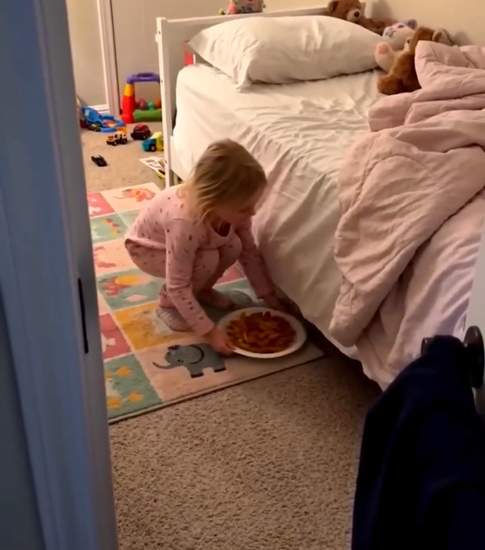
A plate was partially hidden beneath her pillow.
I pulled it out carefully.
On it was the piece of chicken I had given her earlier.
A napkin was folded over it.
I stared at the plate, wondering why she had put food there instead of leaving it in the kitchen.
The next morning, I waited until she came downstairs.
“Lily, sweetheart, did you leave something under your pillow?”
Her face changed immediately.
She looked at the floor.
“Yes.”
“Why?”
She held the stuffed rabbit closer to her chest.
“I was saving it.”
“For what?”
She didn’t answer.
I tried to keep my voice gentle.
“Honey, food shouldn’t stay under your pillow. It can spoil, and we don’t want you getting sick.”
She nodded.
I took the plate to the kitchen and threw the food away.
She watched me without saying anything.
Then she quietly returned to her room.
I thought the matter was finished.
I was wrong.
The following morning, I discovered another plate.
This time, it was beneath the bed.
There was half a sandwich on it.
The bread had become dry around the edges, and the paper napkin had slipped onto the floor.
I picked it up and carried it to the kitchen.
At breakfast, I decided to ask her about it again.
“Sweetheart, are you waking up hungry during the night?”
She shook her head.
“Do you want me to leave some food in the refrigerator so you can have it whenever you like?”
She shook her head again.
I sat across from her.
“Then why are you keeping food in your bedroom?”
Lily rubbed the sleeve of her pajamas between her fingers.
“Do we have more bread?”
I paused.
“Yes, honey. We have plenty.”
She nodded and returned to her cereal.
I began to feel uneasy.
It wasn’t the food itself that worried me.
It was the way she looked at me whenever I asked about it.
She seemed afraid that I would take something away from her.
Over the next several days, the situation became even stranger.
A cookie disappeared from the kitchen.
Then half a sandwich.
One evening, I found an empty paper plate beneath her bed.
There were only a few crumbs left.
I asked Lily whether she had eaten during the night.
She said no.
I asked whether she had given the food to somebody.
She looked away.
I checked the kitchen carefully.
I inspected the pantry, the cupboards, and the spaces behind the refrigerator.
For a moment, I even wondered whether we had mice.
There were no droppings, no torn packages, and no signs of pests.
I eventually contacted an exterminator.
He came to the house, inspected the kitchen, and checked the bedrooms.
He found nothing unusual.
After he left, I returned to Lily’s room.
The bed was neatly made.
Her rabbit was sitting against the pillow.
The window overlooking the garden was slightly open.
I closed it, checked the latch, and went downstairs.
I couldn’t shake the feeling that something was happening while I was asleep.
And because I couldn’t understand what it was, I started paying closer attention.
One evening, I decided to conduct a little experiment.
I prepared two slices of homemade pizza for Lily.
She ate one and looked at the second.
“Can I take this with me?”
“Of course.”
She placed it on a paper plate and carried it upstairs.
I waited until she was asleep before checking her room.
The pizza was beneath the bed.
I didn’t touch it.
I simply left it there.
At midnight, I checked the kitchen.
At two in the morning, I woke up and listened carefully.
The house was quiet.
I didn’t hear footsteps.
I didn’t hear a door opening.
I didn’t hear anything moving in the hallway.
When I returned to the bedroom, I couldn’t sleep.
I kept wondering whether Lily was getting up while I wasn’t looking.
Perhaps she was eating the food secretly.
Perhaps she was giving it to someone.
Perhaps there was something happening outside the house.
The following morning, I went into her room.
The paper plate was empty.
Completely empty.
There were no pieces of pizza left.
Only a few crumbs and a small greasy mark.
I stood there holding the plate.
I was no longer simply curious.
I was worried.
At breakfast, Lily barely touched her toast.
I sat beside her.
“Sweetheart, we need to talk about the food.”
Her hands immediately tightened around the edge of her chair.
“Please don’t make me stop.”
I looked at her.
“Stop what, honey?”
She began crying.
Not the small tears children sometimes shed when they are tired.
She cried with the kind of fear that made my heart tighten.
“If I stop, someone will be hungry.”
I leaned closer.
“Who will be hungry, sweetheart?”
She shook her head.
I asked again, carefully.
“Is somebody coming into your room?”
She wiped her cheeks.
Nothing.
“Are you giving the food to somebody?”
She lowered her eyes.
Still nothing.
I wanted to comfort her, but I also needed to know whether she was safe.
That afternoon, I made a decision.
I purchased a small motion-activated camera.
I placed it on a bookshelf facing the bed, making sure it recorded only the bedroom area.
I told Lily about it.
I didn’t want her to believe I was secretly watching her.
“This camera will help me understand what’s happening at night,” I explained. “I won’t leave it there forever. I just want to make sure everything is safe.”
She stared at the little black device.
“Will you take it away afterward?”
“Yes, sweetheart.”
“When?”
“Once we understand what’s happening.”
She nodded slowly.
That evening, she carried another small plate upstairs.
I watched her disappear down the hallway.
Then I checked my phone.
Selena had sent a message.
She was feeling a little stronger.
I showed Lily the message, and we recorded a short reply together.
She told her mother about the cookies we had baked.
She described a cartoon she had watched.
She even showed Selena the stuffed rabbit.
But she didn’t mention the food.
She didn’t mention the empty plates.
And she didn’t mention the person—or whatever she believed was visiting her room.
Before bedtime, she asked me a question.
“When is Mommy coming home?”
I sat beside her.
“I don’t know the exact day yet, sweetheart. But the doctors are helping her, and we are going to keep visiting.”
She looked toward the hallway.
Then she asked whether I could leave the light on.
I kissed her forehead.
“Of course.”
The next morning, my phone showed a motion alert.
There was one recording.
It had been captured at 2:43 a.m.
I opened it while sitting at the kitchen table.
At first, nothing happened.
Lily was sleeping beneath her pink blanket.
Her stuffed rabbit was beside her pillow.
The room was dark.
I watched for several seconds.
Then the blanket moved.
I leaned closer to the screen.
Something small appeared beneath the edge of the bed.
At first, I thought it might be a toy.
Then I saw a nose.
A little brown nose.
A moment later, a scruffy terrier slowly emerged from beneath the bed.
I stopped breathing for a second.
The dog moved toward the paper plate.
He lowered his head and began eating the leftover potatoes.
His collar caught the camera’s light.
It was blue.
Faded.
And I recognized it immediately.
“No,” I whispered.
I replayed the recording.
The dog turned slightly.
There was a pale patch beneath one floppy ear.
I knew that patch.
I had seen it many times before.
“Biscuit?”
Biscuit belonged to Mr. Bennett, our elderly neighbor who lived two houses down.
Before Selena’s accident, my daughter often helped him walk the dog.
Mr. Bennett had arthritis, and some days he found longer walks difficult.
Selena would take Biscuit around the neighborhood whenever she could.
Lily loved going with them.
She carried a small bag of dog treats and always wanted to hold the leash.
When Selena was injured, Biscuit had disappeared.
We had searched the nearby streets.
Mr. Bennett had asked neighbors whether anyone had seen him.
I remembered the worry in his voice when he spoke about his missing dog.
And now, somehow, Biscuit had been eating beneath my granddaughter’s bed.
I watched the recording again.
The dog finished the food, nudged the plate with his nose, and disappeared toward the window.
I put my phone down.
Then I went straight to Lily’s bedroom.
She was sitting on the bed, brushing her hair.
I checked the window.
The latch wasn’t properly secured.
The corner of the screen had pulled loose.
On the windowsill, I noticed a few dusty marks.
Small paw prints.
I looked at Lily.
“Sweetheart, have you been opening this window?”
She stopped brushing.
“For him.”
I sat beside her.
“For Biscuit?”
She looked at me.
“You saw him?”
I nodded.
Her expression changed.
For the first time in days, she looked relieved.
“He’s hungry, Grandma.”
I took her hand.
“How long has he been coming here?”
She looked toward the garden.
“I found him behind the shed.”
“When?”
“A few days after Mommy went to the hospital.”
She explained that she had been playing outside when she noticed something moving behind the flowerpots.
At first, she thought it was a stray animal.
Then Biscuit stepped into the light.
She recognized him immediately.
He looked thinner than before.
His fur was dusty, and his collar was loose.
She wanted to call me.
But she remembered something I had said during a stressful phone conversation.
A few days earlier, someone had asked whether I could take on another responsibility.
I had been tired, worried about Selena, and overwhelmed by hospital calls.
I had answered that I couldn’t look after anything else right now.
I hadn’t been speaking to Lily.
I hadn’t even realized she was listening.
But she had heard me.
And she had understood the words differently.
She believed I would send Biscuit away.
So she started bringing him food.
At first, she left small pieces near the shed.
Then Biscuit began approaching the garden window.
She discovered that if the window was slightly open, he could reach the room.
She started saving pieces of dinner.
The chicken.
The potatoes.
The sandwiches.
The cookies.
Everything she thought he might eat.
And every night, she waited until the house was quiet.
I looked at her, struggling to understand how much responsibility she had placed on her own small shoulders.
“Why didn’t you tell me, Lily?”
She lowered her eyes.
“You would have sent him away.”
I wanted to explain that I would never have punished her for helping an animal.
But before I could speak, she said something that stopped me.
“Mommy promised she would help him.”
I looked at her.
“What do you mean?”
She twisted the ear of her stuffed rabbit.
“Mommy promised Mr. Bennett that she would walk Biscuit when he couldn’t.”
I remembered that promise.
Selena had always tried to help people.
She had never liked seeing someone struggle alone.
Lily remembered those moments.
She remembered walking beside her mother.
She remembered holding the leash.
She remembered her mother saying that Biscuit needed someone to look after him.
Then Selena had been injured.
Biscuit had disappeared.
And Lily had decided that someone needed to take her mother’s place.
She had been trying to keep a promise she was too young to understand fully.
“Mommy got hurt,” she whispered. “And Biscuit got lost.”
I pulled her gently into my arms.
“Sweetheart, you don’t have to do all of Mommy’s jobs.”
She didn’t answer.
I continued.
“You are seven years old. Your job is to be a little girl. To play, learn, eat your dinner, and let the grown-ups help when something is difficult.”
She looked at me.
“But he was hungry.”
“I know.”
“And nobody knew where he was.”
“I know, honey.”
She started crying again.
I held her close.
Then she asked the question that hurt me more than anything else.
“Daddy never came back. What if Mommy doesn’t come back either?”
For a moment, I couldn’t speak.
I had spent so much time trying to make everything seem normal that I had forgotten something important.
Lily had already experienced a terrible loss.
Her father had died when she was a baby.
Now her mother was injured, and the child who had already learned what absence meant was afraid of losing the only parent she had known.
I gently moved her hair away from her face.
“I know you’re scared, sweetheart. I am scared sometimes too.”
She looked at me carefully.
“Really?”
“Yes. But your mother is receiving medical care, and her doctors are helping her recover. We will take things one day at a time.”
She rested her head against my shoulder.
I continued.
“You don’t have to earn your mother’s return by looking after everyone. You don’t have to be brave every minute. And you don’t have to keep secrets to protect the people you love.”
She held her rabbit tightly.
“Can Biscuit still have dinner?”
I smiled through my tears.
“Yes. But we’re going to do it safely, and we’re going to ask Mr. Bennett to help us.”
For the first time in several days, Lily smiled.
Not a big smile.
Just a small one.
But it was enough to make the room feel lighter.
I removed the camera that afternoon.
I didn’t need it anymore.
We repaired the window screen and secured the latch.
Then Lily and I went outside with a bowl of fresh water.
She carried it carefully with both hands.
I brought a little food suitable for Biscuit.
We walked toward the old shed.
At first, there was no sign of him.
Lily crouched near the flowerpots.
“Biscuit?” she called softly.
Something moved behind the shed.
A moment later, a small brown dog appeared.
His fur was dusty.
His ears were lowered.
And his blue collar was still hanging loosely around his neck.
Lily’s face lit up.
“There you are!”
Biscuit approached slowly.
He sniffed her hand, then wagged his tail.
She laughed.
It was the first time I had heard her laugh so freely since she arrived.
I called Mr. Bennett immediately.
When he answered, I explained that we had found Biscuit.
There was a long silence.
Then his voice became emotional.
“You found him?”
“Yes. He’s here with us.”
“I’ve been looking everywhere.”
“We’ll wait for you.”
A little while later, Mr. Bennett arrived carrying Biscuit’s leash and familiar food bowl.
The moment the dog heard his voice, he lifted his head.
Then he hurried toward him.
Mr. Bennett lowered himself carefully onto the garden bench and reached out.
Biscuit pressed his nose into the man’s hand.
For several seconds, neither of them moved.
Then Mr. Bennett looked at Lily.
“Have you been looking after him?”
She nodded.
“He was hungry.”
He smiled sadly.
“Thank you for caring about him.”
Lily looked down.
“Mommy said she would help you.”
Mr. Bennett’s expression softened.
“I know she did, sweetheart.”
He rubbed Biscuit gently behind the ear.
“And you’ve been trying to keep her promise?”
Lily nodded again.
I placed my hand on her shoulder.
“We’ll share the helping from now on.”
Mr. Bennett thanked us and promised to arrange a veterinary examination.
I explained that Biscuit had been eating food left beneath the bed.
I also mentioned the chicken drumstick.
We agreed that a veterinarian should check him and advise us about what foods were safe.
The examination took place that same day.
Biscuit was thinner than he should have been, but the veterinarian found no urgent problem.
We were relieved.
Mr. Bennett arranged proper meals and checked the garden gate.
I repaired the damaged screen and made sure Lily understood that she should never try to bring an animal into the house without telling an adult.
I didn’t want her to stop being kind.
I wanted her to understand that kindness also needed care and safety.
A few days later, we visited Selena at the hospital.
Lily had been waiting for this visit.
She carried her stuffed rabbit and a little drawing she had made.
When Selena saw her, she smiled.
“There’s my girl.”
Lily hurried toward the bed, then stopped to be careful.
She gave her mother a gentle hug.
For a few minutes, they talked about school, cartoons, and the cookies we had baked.
Then Lily became quiet.
“Mommy, I need to tell you something.”
Selena looked at her.
“What is it, sweetheart?”
Lily explained everything.
The missing dog.
The food beneath the bed.
The window.
The camera.
The late-night visits.
And the promise.
Selena listened without interrupting.
When Lily finished, her eyes were wet.
She reached for her daughter’s hand.
“Have you been doing my jobs?”
Lily nodded.
“Somebody had to.”
Selena gently rubbed her thumb over Lily’s small fingers.
“Oh, sweetheart.”
She paused.
“You don’t have to do everything I do. Grandma can help me keep my promises.”
Lily looked at her mother.
“So I can just help a little?”
Selena smiled.
“A little is plenty.”
I pulled my chair closer to the bed.
“Your mother is right. You don’t have to carry the whole world on your shoulders.”
Lily leaned against Selena’s arm.
For a while, none of us said anything.
We simply sat together.
Recovery wasn’t immediate.
There were more appointments, difficult days, and moments when Selena needed extra rest.
Sometimes visits had to be postponed.
Sometimes phone calls were shorter than Lily wanted.
But something changed after that conversation.
I stopped pretending that everything was fine.
When Lily asked whether her mother was having a difficult day, I answered honestly and gently.
When she felt disappointed, I allowed her to be disappointed.
I stopped expecting her to cheer me up whenever I looked worried.
And I started asking questions that didn’t require her to give me the answer she thought I wanted.
“How are you feeling today?”
“Is there anything you’re worried about?”
“Would you like to talk, or would you rather sit together?”
Slowly, she began speaking more openly.
She told me when she missed her mother.
She told me when she was frightened at night.
She even admitted that sometimes she felt angry because she couldn’t understand why everything had changed.
I listened.
I didn’t rush to correct her feelings.
And I learned that sometimes a child doesn’t need a perfect explanation.
Sometimes a child needs someone willing to sit beside them while they ask difficult questions.
Mr. Bennett also kept his promise.
He brought Biscuit over when he could, always with his leash and proper food.
Lily loved seeing him.
She would ask whether he had eaten.
She would check that his water bowl was full.
But she no longer felt responsible for secretly feeding him.
She knew that the adults were helping.
Eventually, Selena returned home.
She needed to continue her recovery, follow medical advice, and attend appointments.
But she was home.
The first evening, Lily helped me prepare dinner.
She washed the vegetables and arranged the napkins.
I watched her carefully as she placed the plates on the table.
One for me.
One for herself.
And one for her mother.
She straightened the napkin beside Selena’s chair.
Then she stepped back to inspect the table.
Selena entered the dining room slowly.
When she saw the third plate, she smiled.
“You saved my place?”
Lily nodded.
“I wanted it ready.”
Selena reached for her hand.
“Thank you, sweetheart.”
We sat down together.
For the first time in weeks, the empty chair was no longer empty.
Dinner was simple.
Chicken, potatoes, and vegetables.
Lily ate a few bites, then looked toward the serving bowl.
“Grandma, can you pass the potatoes?”
I handed her the bowl.
She served herself a little more.
Then she looked at her mother.
“Mommy, do you want some too?”
Selena smiled.
“Yes, please.”
Lily carefully passed the bowl.
I watched the two of them sitting together.
The third plate was no longer a symbol of someone missing.
It was simply a place at the table.
And when Lily finished dinner, she didn’t ask to hide anything beneath her bed.
She placed her plate in the kitchen and returned to her chair.
Then she looked at me.
“Grandma?”
“Yes, sweetheart?”
“Can we make sure Biscuit has dinner tomorrow?”
I smiled.
“Of course. Mr. Bennett has his food ready, and we can visit them after school.”
She nodded happily.
Then she leaned against her mother’s shoulder.
That evening, I thought about all the things I had misunderstood.
I had thought Lily was hiding food because she was being secretive.
I had thought she was refusing to answer because she was afraid of getting into trouble.
I had thought she was handling her mother’s absence better than I was.
But she had been carrying worries that were much bigger than her little hands.
She wasn’t simply saving leftovers.
She was trying to keep a promise.
She was trying to protect a dog she believed had been forgotten.
And perhaps, in her own way, she was trying to hold on to a piece of the life she had known before the accident.
I had been so focused on finding the missing food that I had nearly missed the little girl who was asking for help without knowing how to ask.
That night, I walked past her bedroom.
Her stuffed rabbit was resting against the pillow.
The window was securely closed.
There were no plates beneath the bed.
I stood in the doorway for a moment and listened to her breathing.
Then I turned off the hallway light.
I understood something I wished I had understood sooner.
Children do not always tell us what is frightening them.
Sometimes they show us through small habits, unusual questions, forgotten meals, and things they quietly carry from one room to another.
And sometimes, when a child asks for seconds, the most important question isn’t whether she is hungry.
It is whether she is trying to feed someone else.
That little girl had spent nights worrying about a lost dog, a hospitalized mother, and a promise she believed she had to keep.
She didn’t need another responsibility.
She needed permission to be seven years old.
And from that evening forward, I made sure she knew she had it.