I never imagined that the most intimidating doctor in the entire hospital would eventually become the person my dying son looked forward to seeing more than anyone else.
When I first met him, I couldn’t understand why the hospital had assigned someone who looked like he belonged in a motorcycle club to care for a twelve-year-old boy fighting for his life.
His arms were covered in tattoos. Some disappeared beneath the sleeves of his medical coat, while others extended toward his neck. He was tall, broad-shouldered, and had a shaved head. His serious expression made him look like someone who rarely smiled.
I remember watching him approach my son’s hospital bed and thinking that he was probably the last person my little boy needed.
But I was wrong.
I was wrong about the doctor, wrong about the men who would eventually walk into my son’s hospital room wearing leather vests, and wrong about what my son needed most during the final months of his life.
Because sometimes, the people who look the least familiar are the ones who show us the deepest kindness.
And sometimes, a child who has very little time left can teach adults something they spend their entire lives trying to understand.
My name is Bridget, and my son Drew was twelve years old when our lives changed forever.
He was a bright, curious boy who loved video games, silly jokes, science experiments, and asking questions that I rarely knew how to answer.
He had a habit of talking through entire movies, predicting what would happen next and becoming extremely offended whenever his predictions turned out to be wrong.
He also had an enormous fascination with motorcycles.
Whenever we heard one passing on the street, he would stop whatever he was doing and rush toward the window.
He could recognize different sounds and would sometimes try to guess the model before the motorcycle disappeared around the corner.
He collected pictures of motorcycles and kept them in a folder on his tablet.
He had even created a list of places he wanted to visit when he was older.
At the top of that list was a long motorcycle trip along the coast.
He wanted to see the ocean, feel the wind against his face, and experience what he called the freedom of the open road.
He also wanted a dog.
A big one, preferably.
And he had already decided that its name would be Rocket.
I used to laugh whenever he told me about these plans.
“One thing at a time, Drew,” I would say.
He would grin and respond, “I’m planning ahead, Mom. That’s what responsible people do.”
I never imagined that one day those ordinary conversations would become some of the most precious memories I had.
I had raised Drew alone for most of his childhood.
His father had gradually disappeared from our lives when Drew was still young. There had been promises of visits, occasional birthday cards, and conversations about things they would do together someday.
But someday never seemed to arrive.
I tried not to speak badly about his father.
I wanted Drew to have the freedom to love him, even when that relationship brought disappointment.
Still, there were moments when I wished I could give my son the kind of family he saw in other children’s homes.
I worked hard, took care of everything, and tried to make sure he never felt that he was missing anything important.
But there was one thing I could never replace.
A father who actually showed up.
Then came the diagnosis.
I still remember the hospital room, the smell of disinfectant, the soft sound of machines, and the way the two doctors looked at each other before explaining the latest results.
They told me that Drew’s cancer had continued spreading despite the treatments.
The available options were no longer capable of stopping its progression.
They spoke gently, carefully choosing their words.
But I understood what they were telling me.
They estimated that Drew might have approximately three months left.
Three months.
I remember looking at the calendar on the wall, almost expecting someone to explain that there had been a mistake.
Three months was barely enough time to finish a school term.
It wasn’t enough time for a summer vacation, a birthday celebration, or even a small collection of ordinary family memories.
My son was supposed to have decades ahead of him.
He was supposed to grow taller, become a teenager, complain about school, make friends, fall in love, and eventually discover what kind of person he wanted to become.
Instead, I was sitting beside his hospital bed trying to understand how a child could have so many dreams and so little time.
When the doctors finished speaking, I nodded.
I asked a few questions.
I thanked them.
And then I went into the bathroom, closed the door, and cried until I could barely stand.
I didn’t want Drew to see me falling apart.
He had already noticed that something was wrong.
Children often understand much more than adults want to admit.
When I returned, he was looking at me.
“Mom?”
“Yes, sweetheart?”
“Are they going to give me more medicine?”
I sat beside him and took his hand.
“We’re going to make sure you’re comfortable, okay?”
He studied my face for a few seconds.
Then he nodded.
I knew he understood more than he was saying.
A few days later, Dr. Harris joined his medical team.
The first time I saw him, I was visiting with my mother.
He entered the room carrying a medical folder and introduced himself in a calm, confident voice.
“Good morning. I’m Dr. Harris. I’ll be working with Drew’s team.”
He extended his hand.
I shook it politely.
His grip was firm, and his expression was serious.
After he left, my mother leaned closer to me.
“Did you see his arms?”
I looked toward the door.
“What about them?”
“Those tattoos. I’ve never seen a doctor who looks like that.”
I didn’t answer.
The truth was that I had noticed them too.
I wondered why someone with such an intimidating appearance had chosen to work with children.
But my opinion began changing during his second visit.
Instead of standing beside the bed and talking directly to me, Dr. Harris pulled a chair closer to Drew.
He looked directly at my son.
“How are we doing today, champ?”
Drew raised an eyebrow.
“Depends. Are you bringing more needles?”
Dr. Harris pretended to think about it.
“Not personally. I’m trying to improve my reputation around here.”
Drew laughed.
It was a genuine laugh, the kind that made his entire face brighten.
I hadn’t heard that sound in several days.
For a moment, the hospital room felt different.
It didn’t feel like a place where everyone was waiting for bad news.
It felt like a place where my son was simply a twelve-year-old boy having a conversation with someone who understood his humor.
From that day forward, Dr. Harris made a point of spending a few extra minutes with Drew whenever his responsibilities allowed.
He remembered the video game Drew was playing.
He asked whether the main character had finally completed a difficult mission.
He remembered the name of a school friend Drew had mentioned and asked whether they had called recently.
He even learned which hospital meals Drew disliked most.
One afternoon, he entered the room carrying a tray.
“Today’s special,” he announced.
Drew looked at the plate.
“That looks suspicious.”
“It’s food.”
“That’s what you say.”
Dr. Harris laughed.
“You’re becoming difficult to impress.”
“Then bring better food.”
I stood near the window, smiling.
These conversations might have seemed insignificant to someone else.
But to me, they were priceless.
My son was smiling again.
He was asking questions, making jokes, and looking forward to someone’s visits.
And slowly, Dr. Harris became one of the most important people in his daily routine.
Still, I noticed something else.
The two of them had developed a particular interest in motorcycles.
Sometimes I would return from the cafeteria and find them discussing engines, helmets, long-distance rides, and the differences between various motorcycle models.
One afternoon, I heard Drew insisting that a motorcycle could beat a sports car.
“Depends on the track,” Dr. Harris answered.
“That’s cheating. You can’t change the question.”
“Sounds like you need to ask better questions.”
Drew laughed so loudly that a nurse passing the door smiled.
I watched them for a moment.
There was something beautiful about seeing my son so engaged in a conversation.
But there was also something painful.
Dr. Harris seemed to understand a part of Drew that I had spent years trying to understand.
My boy wasn’t simply interested in motorcycles.
He was fascinated by the people who rode them.
He liked the idea of belonging to a group.
He admired the leather vests, the symbols, the long journeys, and the stories that seemed to connect one rider to another.
He had once told me that motorcycle clubs looked like families.
I had smiled at the time.
Now I wondered whether he was searching for something he had missed throughout his childhood.
One afternoon, I entered the room and found Drew and Dr. Harris whispering.
Their heads were close together, and Drew was trying desperately not to laugh.
When they noticed me, the conversation stopped.
“What are you two planning?”
Drew looked at the doctor.
Then he looked at me.
“Nothing.”
“That doesn’t sound convincing.”
Dr. Harris smiled.
“Doctor-patient confidentiality.”
I raised an eyebrow.
“Should I be worried?”
“Not at all,” he replied.
Drew pulled the blanket closer and grinned.
“Mom, you’ll find out tomorrow.”
I wanted to ask more questions, but Drew seemed unusually excited.
I decided not to spoil whatever they were planning.
That evening, however, I tried again.
“Drew, I hope you aren’t asking the doctor to do anything inappropriate.”
He looked at me with an expression of complete disbelief.
“Mom, I can barely walk to the bathroom. What dangerous thing could I possibly be doing?”
I sighed.
“That’s not what I meant.”
“I know.”
He reached for his tablet.
“Just trust me.”
I wanted to trust him.
More than anything, I wanted to give him the freedom to enjoy whatever happiness he could find.
But I had also learned that life could take away the things you loved without warning.
I was afraid of disappointment.
I was afraid of another broken promise.
And I was especially afraid of watching my son become attached to something that might disappear.
The following afternoon, I understood why they had been whispering.
I was sitting beside Drew when I heard several voices gathering outside the room.
There were heavy footsteps, laughter, and someone asking whether they had found the correct door.
I looked toward the entrance.
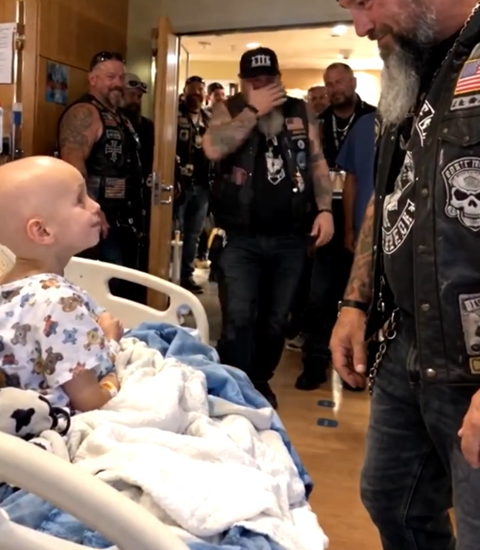
Then twelve men wearing leather motorcycle vests walked inside.
For a second, I couldn’t move.
They were enormous compared with the nurses and hospital staff.
Some had gray beards.
Others had long hair.
Their arms were covered in tattoos, and several carried helmets.
One held a folded leather vest.
Another carried a small package.
I immediately stood up.
“Excuse me. What’s happening?”
Before anyone could answer, Drew pushed himself higher against his pillows.
His eyes widened.
“No way!”
Dr. Harris stepped forward.
“Well, champ, I think we have some visitors.”
Drew looked from one man to another.
His expression was pure disbelief.
One of the bikers stepped forward.
He was an older man with a gray beard, a warm smile, and a deep voice.
“My name’s Wade,” he said. “And we’ve heard a lot about you.”
Drew looked at him.
“About me?”
“Apparently, you’re a serious motorcycle expert.”
Drew smiled.
“I’m still learning.”
“That’s how it starts.”
Wade held up the small black leather vest.
It was carefully made, with silver lettering embroidered across the back.
Drew’s name was written across the top.
Underneath were two simple words.
HONORARY BROTHER.
Drew stared at it.
For several seconds, he didn’t say anything.
Then he looked at Wade.
“Is that really mine?”
Wade nodded.
“Absolutely. We heard you wanted to be part of a motorcycle club.”
Drew looked at Dr. Harris.
The doctor smiled.
“Go ahead, champ.”
Wade carefully helped Drew put the vest on.
It was a little large, but that only made it look more like the real thing.
The men began applauding.
Some whistled.
One raised his helmet.
Drew looked down at the silver letters and ran his fingers over the embroidery.
“Honorary Brother,” he whispered.
Then he looked up.
“Does that mean I’m actually part of the club?”
Wade crouched beside him.
“It means you’re one of us.”
“But I don’t have a motorcycle.”
Wade smiled.
“That’s not what makes someone a brother.”
He paused before continuing.
“Our club has always believed that being there for one another matters more than what you ride or what you own. You don’t need a motorcycle to belong. You need people who are willing to stand beside you.”
Drew’s eyes filled with tears.
He tried to hide them by looking toward the window.
But I had already started crying.
I looked at Dr. Harris.
He stood beside the bed with his arms folded, smiling quietly.
For the first time, I didn’t see an intimidating doctor covered in tattoos.
I saw a man who had taken the time to discover what mattered to a frightened twelve-year-old boy.
And I was grateful.
Before the visitors left, Drew noticed something resting on a nearby chair.
It was another leather vest.
This one looked much older.
The leather was faded, and the seams showed years of use.
There were patches on the back, some worn almost beyond recognition.
Drew pointed toward it.
“Doc?”
Dr. Harris turned.
“Yeah?”
“Is that yours?”
The doctor’s smile disappeared.
He looked at the vest for a moment.
Then he nodded.
“It used to be.”
Drew studied him.
“Why don’t you wear it?”
Dr. Harris didn’t answer immediately.
“That’s a long story, buddy.”
Drew looked disappointed.
“But you said bikers look after each other.”
Wade glanced at the doctor.
The room became quieter.
Dr. Harris gently touched Drew’s shoulder.
“We’ll talk about that another day.”
I noticed the change in his expression.
Something about the old vest had brought back a memory he wasn’t ready to discuss.
After the bikers left, I found Dr. Harris standing near the nurses’ station.
I approached him.
“Can I ask you something?”
“Of course.”
“Why did Drew look so upset when you refused to wear that vest?”
He looked toward the room.
“It’s complicated.”
“I understand that, but he’s becoming attached to you. I don’t want him getting hurt.”
Dr. Harris listened without interrupting.
I continued.
“My son has already experienced enough disappointment. His father made promises for years and never kept most of them. I don’t want another person becoming important to him and then disappearing.”
His expression softened.
“Bridget, I understand why you’re concerned.”
“I’m serious.”
“So am I.”
He paused.
“I would never intentionally make promises to Drew that I couldn’t keep.”
I studied his face.
There was something in his voice that made me believe he meant it.
But I still didn’t understand the old vest.
That evening, Drew was still admiring his new leather vest.
He kept touching the silver letters and smiling.
“Mom?”
“Yes?”
“Do you like it?”
“I love it.”
“Do you think I look like a real biker?”
I laughed.
“You look very official.”
He smiled.
Then his expression changed.
“Do you remember when Dad said he’d take me riding?”
I stopped folding the clothes beside his bed.
“Yes, sweetheart.”
He looked down at the vest.
“I was little. I think I was six.”
I nodded.
His father had owned an old motorcycle years earlier.
I remembered how excited Drew had been whenever he saw it.
He used to stand beside it and ask endless questions.
His father had once promised that when Drew was older, they would take a long ride together.
It was a promise Drew had never forgotten.
“I used to think that if I learned enough about motorcycles, he’d come back,” Drew said quietly.
I sat beside him.
“What do you mean?”
He shrugged.
“I thought maybe if I liked the same things he liked, he’d want to spend time with me.”
My heart tightened.
“Drew, sweetheart…”
“It’s okay, Mom.”
“No, it isn’t.”
He looked at me.
“I know you don’t like talking about him.”
I felt something break inside me.
For years, whenever Drew mentioned his father, I had tried to redirect the conversation.
I thought I was protecting him.
I thought that if I reminded him how much love he had at home, he would stop thinking about the person who had chosen not to be there.
But perhaps I had been making him feel that missing his father was something he needed to hide.
I reached for his hand.
“You can miss your dad, Drew.”
He looked at me.
“Even if you’re angry with him?”
“Even if I’m angry with him. You don’t have to feel the same way I do. And you never have to hide your feelings to protect mine.”
He remained quiet.
Then he touched the vest again.
“Dr. Harris says good bikers look after their brothers.”
“That’s what he says?”
Drew nodded.
“I think that’s why I like his friends. They came here even though they didn’t have to.”
I squeezed his hand.
“You’re right, sweetheart.”
That night, after Drew fell asleep, I thought about everything he had told me.
I had spent so much time trying to make up for his father’s absence that I had overlooked how deeply he still felt it.
I couldn’t give him the past he wanted.
But perhaps I could give him the freedom to talk about it.
The following morning, Wade returned to the hospital.
He carried a folder filled with photographs from the motorcycle club.
Drew was sleeping, so Wade and I sat in the family waiting area.
I thanked him for what the men had done.
He waved away my gratitude.
“Your boy deserves something to smile about.”
I smiled.
Then I asked about Dr. Harris.
Wade looked down at his coffee.
“Harris used to be one of the most dependable guys in our club.”
“What happened?”
Wade took a moment before answering.
“His younger brother died.”
I looked at him.
“His brother?”
“Yeah. They were very close. They grew up together, rode together, and spent most of their free time with the club.”
Wade explained that Dr. Harris had been working long hours at the hospital while his brother was dealing with a serious illness.
He had convinced himself that he could take time off later.
There would be another weekend.
Another trip.
Another opportunity to spend time together.
But his brother’s condition worsened.
And then he died.
“Harris never really came back after that,” Wade said.
I looked toward the corridor.
“He stopped riding?”
“Stopped coming around. He kept the vest, but he couldn’t bring himself to wear it.”
“Why?”
Wade sighed.
“Because every time he saw the guys, he remembered his brother. And he blamed himself for not spending more time with him.”
I felt a strange sadness.
I had assumed the doctor was simply a private person.
I hadn’t realized that he carried such a heavy memory.
Wade continued.
“His brother never blamed him. Not once. But sometimes the hardest person to forgive is yourself.”
I thought about the old vest.
Suddenly, Drew’s disappointment made more sense.
Later that afternoon, I found Dr. Harris sitting beside my son’s bed.
Drew was sleeping.
The doctor was looking at the small leather vest hanging near the window.
I quietly entered.
“Wade told me about your brother.”
Dr. Harris looked up.
“He did?”
I nodded.
“I’m sorry.”
He looked at Drew before answering.
“My brother was nineteen when he died.”
He paused.
“I was older. Already working here. I thought I had more time.”
I pulled a chair closer.
“What was he like?”
For the first time, Dr. Harris smiled in a way I hadn’t seen before.
“He was impossible.”
I laughed softly.
“That sounds familiar.”
“He was always making plans. Always convincing everyone that the next trip would be the best one yet.”
He looked at the old vest.
“We used to ride whenever we could get away. Sometimes we’d spend an entire weekend traveling without knowing exactly where we’d end up.”
“What happened when he became sick?”
“I kept working. I told myself I needed to finish certain things first. I thought there would be time to take a few days off.”
He swallowed.
“There wasn’t.”
I didn’t know what to say.
After a moment, I spoke.
“My son has spent years missing someone who’s still alive.”
Dr. Harris looked at me.
“And I’ve spent years trying to pretend that his father doesn’t matter.”
He nodded slowly.
“Sometimes people leave a space that doesn’t disappear just because we stop talking about it.”
I looked toward Drew.
“Yes. I’m beginning to understand that.”
For a while, neither of us spoke.
Then I asked him something.
“Did your brother ever tell you to stop riding?”
Dr. Harris shook his head.
“No. He loved those trips. He would’ve hated knowing I stopped because of him.”
“Then perhaps he wouldn’t want you to stay away forever.”
The doctor looked at me.
I didn’t push him.
Some wounds don’t disappear because someone says the right words.
But I hoped he would remember them.
Two days later, the hospital approved a short outdoor gathering.
Drew had a better morning, and his medical team agreed that a brief visit outside could be arranged with the necessary support.
The bikers were excited.
Wade called to confirm the arrangements.
They would bring their motorcycles, keep the gathering respectful, and make sure Drew could enjoy the occasion without becoming exhausted.
I thought the ceremony would simply be a chance for my son to see the motorcycles up close.
But before we went outside, Wade approached me.
He was holding the old leather vest.
“Bridget, there’s something you should know.”
I looked at it.
“What happened?”
“Your boy asked me to bring this.”
I stared at him.
“Drew?”
Wade nodded.
“He’s been planning something.”
I looked toward my son.
He was sitting in his wheelchair, wearing his honorary vest.
“How did he arrange that?”
Wade explained that Dr. Harris had introduced them during a phone call while they were organizing the motorcycle visit.
During one of the conversations, Drew had asked Wade about the doctor’s old vest.
He had also learned more about Dr. Harris’s younger brother.
Then he had made a request.
He wanted the bikers to help him convince Dr. Harris to wear the old vest again.
“He told me that the doctor had made him feel special,” Wade said. “He wanted to do something that would make the doctor feel special too.”
I couldn’t speak.
My son knew he was dying.
He knew that his own days were limited.
Yet he had spent some of his energy thinking about how to help someone else.
Wade looked at me.
“Your boy said something I’ll remember for a long time.”
“What?”
“He said that Dr. Harris had helped him feel like he still had something to look forward to. He wanted the doctor to have something to look forward to as well.”
I turned away because I could feel the tears coming.
I had spent so much time thinking about everything my son was losing.
I hadn’t fully understood how much he was still capable of giving.
Outside, the motorcycles were arranged in two neat rows near the hospital entrance.
Their polished surfaces reflected the sunlight.
The bikers stood nearby, talking quietly and waiting for Drew.
When the wheelchair came through the doors, several of them smiled and waved.
Drew looked around in complete amazement.
There were motorcycles of different colors and styles.
Some were large touring bikes.
Others were smaller and more traditional.
He examined each one as if he had entered a museum dedicated entirely to his favorite subject.
Wade approached him.
“Well, young man, which one catches your eye?”
Drew looked around.
Then he pointed toward a dark blue motorcycle with polished chrome.
“That one.”
Wade smiled.
“Excellent choice.”
“Is it yours?”
“Sure is.”
“How long have you had it?”
Wade began explaining how he had maintained it over the years.
Drew listened carefully, asking questions about the engine and the design.
The other bikers joined the conversation.
For several minutes, the hospital seemed far away.
There were no medical charts, no difficult conversations, and no reminders of what might happen next.
There was simply a boy surrounded by people who shared his enthusiasm.
Wade eventually presented him with a small patch bearing the club’s emblem.
Drew held it carefully.
“Where should I put this?”
“Somewhere special,” Wade answered.
Drew looked at his vest.
“Right here.”
The men laughed.
Then they gathered around his wheelchair for a photograph.
I stood a short distance away, trying to remember every detail.
The sunlight.
The motorcycles.
My son’s smile.
The sound of his laughter.
I wanted to keep that moment forever.
But the ceremony wasn’t finished.
Drew suddenly looked toward Dr. Harris.
“Hey, Doc?”
The doctor stepped closer.
“What’s up, champ?”
“There’s something else.”
Wade picked up the old leather vest and brought it forward.
Dr. Harris immediately recognized it.
His expression changed.
“Drew…”
My son looked at him.
“You told me bikers don’t leave their brothers behind.”
Dr. Harris nodded.
“That’s right.”
“Then why did you leave yours?”
Nobody spoke.
The question was simple.
But it carried years of pain.
Dr. Harris crouched beside the wheelchair.
“Buddy, it’s not that simple.”
Drew nodded.
“I know.”
He looked at the vest.
“But you still remember him, right?”
The doctor swallowed.
“Every day.”
“Then putting this on won’t make you forget him.”
Dr. Harris looked down.
I watched his hands.
For a moment, I thought he would refuse again.
Then Drew continued.
“Maybe he’d like knowing you’re still friends with everybody.”
The doctor closed his eyes briefly.
When he opened them, his expression had changed.
He slowly reached for the vest.
“You know something, Drew?”
“What?”
“My brother would’ve liked you.”
Drew smiled.
“Would he have let me join the club?”
Dr. Harris laughed softly.
“He would’ve made you president.”
The bikers smiled.
Wade stepped forward and helped straighten the old vest.
Dr. Harris carefully slipped his arms into it.
For the first time in years, he was wearing something that had once represented a part of his life he thought he had lost.
Wade placed a hand on his shoulder.
Then the other bikers made room for him in their circle.
Nobody gave a speech.
Nobody needed to.
Sometimes the most important moments happen without anyone knowing what to say.
Drew looked at me.
“Mom?”
“Yes, sweetheart?”
“There’s fourteen of us now.”
I looked around.
Then I laughed through my tears.
“You’re counting yourself, aren’t you?”
“Obviously.”
Everyone laughed.
Dr. Harris looked at Drew.
“You’re an official member now, champ.”
Drew nodded proudly.
“Good. Because I have some ideas for the club.”
Wade raised an eyebrow.
“Should we be worried?”
“Probably.”
The laughter continued.
And I realized that something extraordinary had happened.
The bikers had come to the hospital to give my son a reason to smile.
But my son had given something back.
He had helped a grieving man take a small step toward the life he had abandoned.
In the weeks that followed, Drew’s condition gradually became more difficult.
Some mornings he had enough energy to talk for hours.
On other days, he barely wanted to open his eyes.
The doctors and nurses continued helping us manage his symptoms and keep him as comfortable as possible.
Dr. Harris still visited whenever his responsibilities allowed.
Sometimes he brought photographs from previous motorcycle trips.
He showed Drew pictures of mountain roads, quiet countryside, and places near the ocean.
Drew would ask questions.
“How fast were you going here?”
“Not as fast as you think.”
“That’s what everyone says.”
Other times, Dr. Harris would sit quietly beside him.
They didn’t always need to talk.
The bikers also stayed in touch.
Wade sent postcards and photographs.
Some of the men visited when Drew felt well enough for company.
They never demanded attention or expected him to entertain them.
They simply showed up.
One afternoon, my mother entered the room and found two enormous bikers sitting beside Drew’s bed.
One was holding a small toy motorcycle.
The other was listening carefully while Drew explained the rules of his favorite video game.
My mother stood in the doorway.
She looked at the men, then at my son.
After a moment, she smiled.
Later, she pulled me aside.
“I suppose we were wrong about those tattoos.”
I smiled.
“Very wrong.”
She nodded.
“They’re good men.”
“They are.”
And I thought about how easily I had judged Dr. Harris when he first walked into the room.
I had seen the tattoos.
I had noticed his size.
I had made assumptions based on his appearance.
But I hadn’t known anything about his kindness, his grief, or the way he treated a child who needed someone to listen.
Drew lived almost three months after we received the original prognosis.
Those months were not easy.
There were difficult mornings, painful conversations, and moments when I wished more than anything that I could change the course of his illness.
But there were also moments of happiness.
There were photographs.
There were jokes.
There were visits from people who had become part of our lives.
And there was the small black leather vest hanging near his bed.
One evening, Drew asked me to bring it closer.
I carefully lifted it from the chair and placed it where he could see the silver letters.
He smiled.
“Mom?”
“Yes?”
“Do you think they’ll remember me?”
I sat beside him.
“Who, sweetheart?”
“The bikers.”
I took his hand.
“Of course they will.”
“Even when I’m not here?”
I felt my throat tighten.
“Especially then.”
He looked toward the vest.
“Wade said I can always be part of the club.”
I smiled.
“He’s right.”
Then he asked a question I had been dreading.
“Mom, are you going to be okay?”
I wanted to tell him that everything would be fine.
I wanted to promise that I would never cry again and that losing him wouldn’t break my heart.
But I couldn’t make promises I didn’t know how to keep.
So I told him the truth.
“I’m going to miss you more than anything in this world.”
He nodded slowly.
“That’s okay.”
He looked at me.
“But you have friends now.”
I kissed his hand.
“Yes, I do.”
“And you’re part of the club too.”
I laughed softly.
“I suppose I am.”
He smiled.
“Good.”
A few days later, Drew died peacefully with me holding his hand.
There are no words that can adequately describe what it feels like to lose your child.
The hospital room became quiet.
The conversations stopped.
The small routines that had filled our days suddenly disappeared.
I no longer had someone asking me to bring a charger, find a particular game, or explain why the hospital food tasted different every day.
I no longer had someone waiting for the next visit from Dr. Harris.
I had spent months preparing myself for the possibility of losing my son.
But nothing could prepare me for the silence that followed.
After the funeral, I returned home and stood in Drew’s room for a long time.
His things were still there.
His games.
His books.
His photographs.
And the small collection of motorcycle pictures he had gathered over the years.
I found the list of places he wanted to visit.
The ocean was still at the top.
The dog named Rocket was still on the list.
And the motorcycle trip remained unfinished.
I sat on his bed and cried.
For several days, I struggled to answer the phone.
I didn’t know what to say to people.
I didn’t want anyone to tell me that everything happened for a reason.
I didn’t want explanations.
I simply wanted my son back.
Then Wade called.
He didn’t ask me to attend a gathering.
He didn’t tell me to be strong.
He simply asked how I was doing.
I told him the truth.
“Not very well.”
He remained quiet for a moment.
Then he said, “You don’t have to pretend with us, Bridget.”
Those words stayed with me.
Over the following weeks, the bikers continued checking on me.
Sometimes Wade called.
Sometimes another member sent a photograph.
Dr. Harris also reached out.
His messages were simple.
He asked whether I was eating, whether I needed anything, and whether I wanted company.
He never tried to replace the role he had played in Drew’s life.
He understood that our relationship had changed.
He was no longer simply the doctor who had cared for my son.
He was someone who had known Drew, laughed with him, listened to him, and shared moments that I would remember forever.
Six weeks after Drew’s death, Wade invited me to attend a memorial ride organized in his honor.
I hesitated.
I wasn’t sure whether I could face the motorcycles.
I wasn’t sure whether seeing the men who had made my son so happy would comfort me or make the loss even more painful.
But eventually, I decided to go.
I brought Drew’s small leather vest with me.
When I arrived, the motorcycles were lined up beneath a clear blue sky.
The bikers were standing together.
Some wore their usual leather vests.
Others carried photographs of Drew.
Dr. Harris stood beside Wade.
He was wearing his old vest.
The same one he had refused to put on during that first hospital visit.
When he saw me, he walked over.
For a moment, neither of us spoke.
Then he looked at the small vest in my arms.
“How are you holding up?”
I smiled sadly.
“One day at a time.”
He nodded.
“I understand.”
I looked at his vest.
“You kept wearing it.”
He touched the leather.
“Yeah.”
He paused.
“I think I finally understood what Drew was trying to tell me.”
I looked toward the other bikers.
“I brought his vest. I thought perhaps the club should keep it.”
Wade approached us.
He shook his head gently.
“Bridget, that vest belongs with you.”
“But he was one of you.”
Wade smiled.
“He was. And he always will be. But you’re his mother. You should have it.”
I held the vest closer.
Then Wade showed me a photograph mounted inside the club’s meeting room.
It was a picture from the day of the hospital ceremony.
Drew was sitting in his wheelchair, wearing his honorary vest.
Dr. Harris stood beside him in his old leather vest.
Wade and the other bikers surrounded them.
Drew was smiling.
Not a small, tired smile.
A huge smile.
The kind that made his eyes almost disappear.
Underneath the photograph were the words:
OUR BROTHER, ALWAYS.
I reached out and touched the edge of the frame.
For a moment, I could almost hear Drew laughing.
I remembered how excited he had been when the bikers entered his room.
I remembered the way he had touched the silver letters on his vest.
I remembered the pride in his voice when he announced that there were fourteen members of the group.
And I remembered the question he had asked Dr. Harris.
“Then why did you leave yours?”
It had been such a simple question.
But it had helped a grieving man understand that remembering someone didn’t mean abandoning the rest of life.
I had spent so many years believing that being a good mother meant giving Drew everything he needed.
I thought I had to be strong enough for both parents.
I thought I had to fill every empty space.
I thought love meant protecting him from every disappointment.
But Drew taught me something I hadn’t understood before.
Love doesn’t always come from the people we expect.
Sometimes it comes from strangers who become friends.
Sometimes it comes from people who show up without being asked.
And sometimes, the most meaningful thing we can give another person is simply our presence.
I looked at the photograph again.
Dr. Harris stepped beside me.
“Ready?” he asked.
I looked down at Drew’s vest, folded carefully in my arms.
Then I looked at the men waiting outside.
Twelve bikers had once walked into my son’s hospital room, and I had nearly asked security to remove them.
I had been frightened by their appearance.
I had misunderstood their intentions.
And I had no idea that those men would eventually become part of my family.
Dr. Harris stood beside them, wearing the vest he had once been too heartbroken to put on.
For the first time in months, I felt something other than sadness.
It wasn’t happiness.
It wasn’t acceptance.
It was the quiet realization that my son had left something behind that was bigger than the illness that took him.
He had left friendships.
He had brought people together.
He had reminded a grieving doctor that life could still contain meaningful moments.
And he had shown his mother that she didn’t have to face every difficult day alone.
I took a deep breath.
“Yes,” I said. “I think Drew would want us to go.”
The engines started one by one.
Their sound filled the open space.
I held Drew’s vest close and watched the men prepare for the memorial ride.
And as the motorcycles began moving forward, I finally understood something my son had learned long before I did.
Family isn’t always defined by blood.
Sometimes it’s defined by the people who show up, keep their promises, remember your name, and stand beside you when life becomes difficult.
Drew had wanted a motorcycle.
He had wanted a father who would take him riding.
He had wanted a dog, an ocean, and a future filled with ordinary adventures.
He didn’t get all the things he dreamed about.
But in his final months, he found something he had been searching for without fully understanding it.
He found people who made him feel that he belonged.
And somehow, in the middle of his own goodbye, he helped someone else find his way back home.
I will always miss my son.
Nothing can change that.
But whenever I remember the twelve bikers walking into his hospital room, I no longer see a group of intimidating strangers.
I see the people who gave Drew a reason to smile.
I see the people who kept showing up.
And I see the doctor who learned from a twelve-year-old boy that it is never too late to reconnect with the people who matter.
That day, I walked beside them carrying my son’s little leather vest.
And for the first time since losing Drew, I wasn’t afraid to let someone walk beside me.