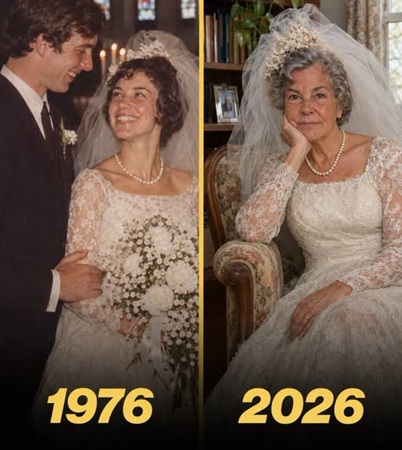
I never imagined that a single morning could change the direction of my entire life. Yet, when I was just 22 years old, I experienced something that stayed with me for the next five decades. The man I believed I would spend the rest of my life with abandoned me in front of 80 wedding guests, leaving me standing at the altar in my wedding dress, holding a bouquet of flowers and wondering what I had done wrong.
I spent years trying to understand what had happened. Eventually, I stopped searching for answers, built a new life, married a wonderful man, and raised three beautiful children. I learned what it meant to be loved without having to question someone’s intentions. I became a mother, a grandmother, and a woman who understood that life could still be beautiful after heartbreak.
I genuinely believed that the chapter involving my first fiancé had been closed forever.
Then, fifty years later, someone knocked on my front door.
The young man standing outside introduced himself as Daniel. He wore a dark jacket and carried a small, worn cardboard box with both hands. There was something serious about his expression, and before he even finished speaking, I sensed that he hadn’t come to discuss an ordinary family matter.
“Good afternoon, ma’am. My name is Daniel. I’m an attorney, and I represent a man named Henry.”
For a moment, I couldn’t respond.
Henry.
I hadn’t heard that name spoken directly to me in decades.
I had spent so many years trying not to think about him that hearing it unexpectedly felt like someone had opened a door I had carefully kept shut.
“Henry?” I finally asked.
Daniel nodded.
“Yes. Henry asked me to deliver something to you personally. He’s very ill, and he wants you to have this.”
I looked at the box.
Then I looked at Daniel.
“I don’t understand why he would be sending me anything after all these years.”
Daniel lowered his eyes for a moment.
“He believes you deserve to know the truth about what happened before your wedding.”
My hand tightened around the dish towel I was holding.
Behind me, the kitchen timer was still ticking. I had been preparing cookies for my grandchildren, expecting an ordinary afternoon filled with familiar household sounds.
Instead, a stranger had arrived carrying the name of the man who had once broken my heart.
“I don’t think there’s anything left to discuss,” I replied. “Whatever happened between Henry and me belongs to the past.”
“I understand,” Daniel said gently. “But he specifically asked me to make sure you received this box. You don’t have to open it, and you don’t have to see him. I only promised to deliver it.”
I stood silently for several seconds.
Part of me wanted to close the door immediately. Another part, the part that had once waited outside a church until sunset, wanted to know why.
Finally, I stepped aside.
“Come in. But I want you to explain exactly why you’re here.”
We walked into the kitchen, and I offered him a chair. Daniel placed the box on the table between us.
He explained that Henry was his uncle and that he had been helping him organize his personal affairs.
“Henry has been talking about you for some time,” he said. “He told me that he made a terrible mistake when you were both young. Recently, he decided that he couldn’t leave this world without giving you an explanation.”
I looked at the box again.
“Fifty years is a very long time to wait for an explanation.”
“I know.”
I slowly removed the lid.
Inside were several old photographs, a yellowed wedding invitation, a few folded documents, and a thin envelope.
My name was written on the front.
Margaret.
I recognized the handwriting immediately, or at least I thought I did.
My fingers began to tremble.
I carefully opened the envelope and unfolded the letter.
The first sentence made my stomach tighten.
“Henry, I need to be honest with you before we make a mistake.”
I continued reading.
The writer claimed that she didn’t love Henry the way he loved her. She suggested that she was marrying him because of the financial security his family could provide. She even implied that she never intended to become a devoted wife and that their marriage was simply an arrangement that suited her circumstances.
At the bottom of the page was my name.
Margaret.
I stared at it.
Then I read the letter again, hoping I had misunderstood something.
But the words remained the same.
“Where did this come from?” I asked.
Daniel leaned forward slightly.
“Henry kept it for many years.”
“I never wrote this.”
“I know.”
I looked at him sharply.
“What do you mean, you know?”
“Henry now knows that the letter was not written by you.”
For a moment, I couldn’t speak.
I had never written anything like that. I had loved Henry sincerely. I had imagined growing old beside him, sharing a home, raising children, and building a family.
I had loved him long before he had enough money to buy me an engagement ring.
His family had always been wealthier than mine, but that difference had never mattered to me.
At least, it hadn’t mattered until his mother became involved in our relationship.
To understand why that letter affected me so deeply, I had to remember the girl I was before everything happened.
I first met Henry when I was 16.
He was the kind of young man who didn’t need to make grand promises to show that he cared. He remembered small details, waited outside the school library when I stayed late, and walked me home even when the weather was unpleasant.
Sometimes, we would spend an entire afternoon talking about ordinary things.
He knew I loved books, and he often brought me something he thought I might enjoy.
I knew he worked hard at his father’s business and that he sometimes worried about disappointing his family.
We were young, but our feelings were sincere.
As the years passed, our relationship became more serious.
However, there was one person who never seemed happy about it.
Henry’s mother, Evelyn.
She came from a wealthy family and believed her son deserved a wife who shared their social position.
I came from a modest household. My father worked long hours, and my mother had spent years taking whatever honest work she could find to support our family.
Evelyn never said directly that I wasn’t good enough for her son, but she rarely missed an opportunity to remind me of the difference between our circumstances.
During one of my first visits to her house, she asked several questions about my father’s occupation.
Then she asked whether my mother intended to continue working.
I answered politely, although I felt uncomfortable.
When I helped clear the dinner table, Evelyn made another comment.
“Henry has always had expensive tastes. I sometimes wonder where he gets them.”
I understood what she meant.
I didn’t respond.
Later, Henry apologized.
“Please don’t take everything my mother says personally. She believes she should decide every important thing in my life.”
I wanted to believe him.
When he proposed, I accepted without hesitation.
He gave me a beautiful ring, but what mattered most was the way he looked at me when he asked me to become his wife.
I believed we were choosing each other, regardless of what anyone else thought.
His mother disagreed.
She suggested postponing the wedding until Henry had become more established in his father’s business. She also suggested that he reconsider whether marriage was the right decision at that stage of his life.
Henry refused.
We chose a spring wedding and began preparing for the ceremony.
My mother helped me sew my wedding dress. We spent several evenings adjusting the fabric, checking the hem, and making sure everything was exactly right.
My father was especially excited.
He didn’t have much money, but he wanted the day to be beautiful. He made arrangements with relatives, helped organize transportation, and reminded me repeatedly that I deserved to be happy.
The morning of the wedding, I woke up before sunrise.
I could barely eat breakfast because I was so nervous.
My mother helped me get dressed, and my father stood nearby, trying to hide how emotional he was.
“Are you ready, sweetheart?” he asked.
I smiled.
“I’ve been ready for years.”
When we arrived at the church, everything looked exactly as I had imagined.
The flowers were arranged near the altar. Guests were finding their seats, and familiar faces greeted me with warm smiles.
Henry stood at the front wearing a dark suit.
When he saw me entering the church, his eyes appeared to fill with tears.
That moment remained one of the most confusing memories of my life.
He looked happy.
He looked like a man who wanted to marry me.
My father walked me down the aisle and gently placed my hand in Henry’s.
For a brief moment, I believed nothing could possibly go wrong.
Then the minister began the ceremony.
Everything proceeded normally until the moment when Henry was asked whether he would take me as his wife.
He looked at me.
His expression changed.
Then he stepped backward.
“I don’t!”
The words echoed through the church.
I thought I had misunderstood him.
“Henry?” I whispered.
But he didn’t answer.
He turned away and hurried down the aisle.
The guests began whispering. Someone stood up. My mother called his name, and I heard several chairs moving as people tried to understand what had happened.
I remained where I was.
I couldn’t move.
My wedding bouquet felt impossibly heavy in my hands.
I expected him to turn around.
I expected him to come back and explain that something had frightened him or that there had been some terrible misunderstanding.
But he never returned.
I stood in that church wearing the dress my mother had helped me make, surrounded by people who had come to celebrate a marriage that would never happen.
I waited until most of the guests had left.
Eventually, my father approached me.
He didn’t ask questions. He simply placed his arm around my shoulders.
Outside, the afternoon was getting colder.
By sunset, I was still struggling to understand what had happened.
In the weeks that followed, the questions became unbearable.
Some people suggested that Henry had discovered something about my past.
Others suggested that I had done something to make him change his mind.
One relative even suggested that perhaps I had hidden an important secret from him.
I knew none of those explanations was true, but I had no way to defend myself because I didn’t know what had happened.
Henry never contacted me.
His mother never offered an explanation.
Eventually, I realized that waiting for someone who had chosen to disappear was destroying my ability to move forward.
Six months later, I left town and moved to Chicago.
I had two suitcases, a small amount of savings, and a determination to start again.
I found work at a diner and rented a modest room above a grocery store.
The first months were difficult.
Sometimes, after finishing my shift, I returned to my room and cried because I felt completely alone.
But gradually, life became more manageable.
I began making friends, learned my way around the city, and discovered that there were still reasons to smile.
Then I met Robert.
He was a regular customer at the diner and usually arrived on Thursday evenings.
He ordered coffee and pie, read the newspaper, and always thanked me with a warm smile.
Unlike some people I had dated, Robert never made me feel that I needed to prove my worth.
He was patient, thoughtful, and genuinely interested in the person I was.
After several months, he invited me to dinner.
I accepted.
Our relationship developed slowly.
One evening, I finally told him about Henry and the wedding.
I expected him to become uncomfortable or ask me to forget the entire experience.
Instead, he listened quietly.
When I finished, he asked one question.
“Do you think you still love him?”
I looked down at my hands.
“I don’t know. Sometimes I think I loved the person I believed he was. But I don’t know who he really became that day.”
Robert nodded.
“Then we don’t have to rush anything.”
That was one of the reasons I eventually fell in love with him.
He understood that trust couldn’t be demanded. It had to be built.
We married in a small ceremony surrounded by close friends and relatives.
Our life wasn’t perfect, but it was real.
We raised three children, celebrated their birthdays, attended school events, helped them through difficult moments, and eventually watched them build families of their own.
Robert worked hard, and we learned to manage our household together.
We experienced ordinary disagreements, unexpected expenses, family celebrations, and the countless small moments that make a marriage meaningful.
He never made me feel ashamed of my past.
He never treated my old heartbreak as something that made me less deserving of happiness.
When our youngest child left home, Robert and I began enjoying a quieter stage of life.
We visited our children, spent time with our grandchildren, and developed little routines that made our days comfortable.
Then, four years ago, Robert passed away.
Losing him was one of the hardest experiences of my life.
Even after many years together, I still sometimes reached for a second cup when preparing coffee.
His photograph remained on the mantel, beside a small handmade bowl our granddaughter had given us.
He was gone, but the life we had built together remained part of me.
That was the life I thought about while sitting across from Daniel in my kitchen.
I looked again at the forged letter.
“Tell me what happened,” I said.
Daniel opened another folder.
“Henry’s mother gave him this letter on the morning of your wedding.”
I felt my stomach tighten.
“She told him I had written it?”
“Yes. She claimed she had discovered it among some belongings you had left at their house.”
I shook my head.
“I was home with my mother that evening. We were finishing my wedding dress.”
Daniel nodded.
“Henry eventually discovered that the letter was fabricated.”
He removed several additional pages from the folder.
They were old sheets of lined paper, yellowed with age.
The first contained several attempts to reproduce my handwriting.
The writer had practiced forming my capital letters, copying the way I crossed my T’s, and imitating the small details that made my writing recognizable.
Another page contained repeated examples of phrases I commonly used.
The final sheet appeared to be an early draft of the letter.
I stared at the papers.
“She practiced writing like me?”
“That is what the documents suggest,” Daniel replied.
I couldn’t believe what I was seeing.
Someone had taken the time to study my handwriting, reproduce my writing style, and create a letter designed to make Henry believe I had never loved him.
And that person was his own mother.
Daniel explained that Henry had discovered the documents twelve years earlier, after his mother passed away.
While sorting through her belongings, he found a locked desk containing old papers, correspondence, and the handwriting drafts.
He recognized his mother’s handwriting in the notes.
He also found the stationery that appeared to have been used for the forged letter.
Henry became suspicious and eventually arranged for a handwriting specialist to examine the documents.
According to the report Daniel had brought, the examination supported the conclusion that the practice sheets and the letter had been written by the same person.
I placed the papers on the table.
For fifty years, I had wondered whether I had somehow failed to notice something important about the man I loved.
Now I was discovering that someone had deliberately created a false story about me.
“Did Henry know the truth when he found these papers?” I asked.
“Yes.”
“When?”
“Twelve years ago.”
I looked at Daniel.
“Twelve years?”
He nodded.
My husband was still alive then.
Our children were grown, and our grandchildren were beginning their own lives.
Henry had known that I had never written the letter.
He had known that his mother had deceived him.
And he had remained silent.
I felt a new kind of disappointment.
“Why didn’t he contact me?”
Daniel hesitated.
“He asked someone to locate you. They eventually found a photograph from your thirtieth wedding anniversary. You were standing beside Robert, surrounded by your family.”
I looked toward the mantel.
Robert’s photograph was still there.
Daniel continued.
“Henry told me that when he saw that photograph, he realized you had built a happy life. He thought contacting you would only reopen a painful chapter.”
I let out a quiet breath.
“So he decided I didn’t deserve to know?”
“He believed he was sparing you.”
I shook my head.
“That’s not the same thing.”
“No,” Daniel admitted.
I looked at the documents again.
Henry had spent decades believing a lie. When he finally discovered the truth, he chose silence because he was afraid of what I might say.
It was another decision made without giving me the opportunity to speak for myself.
“Did he expect me to forgive him?” I asked.
“He hopes you’ll hear him out. But he specifically told me not to pressure you.”
I asked Daniel to leave the box.
After he departed, I sat alone in the kitchen for a long time.
The cookies had cooled.
The afternoon sunlight was moving across the table, and the house was unusually quiet.
I thought about the young woman who had once stood in a church wondering why the man she loved had abandoned her.
I wished I could go back and tell her that she had done nothing wrong.
I wished I could tell her that one person’s rejection would not determine the rest of her life.
Most importantly, I wished she had known that she would eventually meet someone who loved her without making her question herself.
That evening, my daughter Laura arrived with her children.
The house quickly filled with conversation and laughter.
The grandchildren wanted to decorate the cookies, and I helped them spread icing over the little stars and circles.
For a while, I almost forgot about the box.
But later, after everyone had gone home, I returned to the kitchen and took out the old wedding invitation I had kept for fifty years.
It was still in the same small envelope.
I placed it beside the forged letter.
Two pieces of paper.
One represented the future I had once imagined.
The other represented the lie that had destroyed it.
I wondered whether hearing Henry’s explanation would bring me peace or simply create more questions.
Two days later, I called Daniel.
“I would like to speak with Henry.”
Daniel arranged a visit at the care facility where Henry was staying.
Before leaving home, I spent several minutes deciding what to wear.
I wasn’t going to visit him as the young woman who had once waited for him at the altar.
I was going as Margaret, a woman who had lived an entire lifetime since then.
When I arrived, a member of the staff directed me to his room.
Henry was sitting beside the window.
He had become very thin. His hair was almost completely white, and an oxygen tube rested beneath his nose.
For a moment, I struggled to connect the man in front of me with the young man I remembered.
Then he looked up.
“Margaret.”
I stopped near the doorway.
“Hello, Henry.”
He tried to smile.
“Thank you for coming.”
I pulled a chair closer and sat down.
Neither of us spoke immediately.
There were fifty years of memories between us, but I didn’t know where to begin.
Finally, Henry broke the silence.
“I know you received the box.”
“Yes.”
“I’m sorry.”
I looked directly at him.
“For which part?”
He lowered his eyes.
“All of it.”
I took a breath.
“Then let’s begin with the wedding.”
He nodded.
Henry explained that his mother had approached him that morning and shown him the letter.
She told him that I had written it because I was ashamed to admit that I didn’t love him.
She claimed I was interested in his family’s financial position and that I had been pretending to care about him.
He said he had initially refused to believe her.
But she continued presenting details and insisting that she had discovered the letter among my belongings.
Eventually, his anger overcame his judgment.
“Why didn’t you come to me?” I asked.
Henry looked at me.
“I was hurt. I thought you had made a fool of me.”
“And you decided the best response was to humiliate me in front of everyone?”
He nodded slowly.
“I was young, angry, and foolish.”
“That doesn’t explain why you never asked me a single question.”
He looked down at his hands.
“I know.”
I waited.
Then he admitted something I had never expected to hear.
He said that when he stood at the altar, he had already convinced himself that I had betrayed him.
He had decided that refusing to marry me publicly would make him feel less powerless.
He had wanted me to experience the humiliation he believed I had caused him.
I felt a deep sadness hearing those words.
For fifty years, I had imagined countless explanations.
Perhaps he had become frightened.
Perhaps his mother had threatened him.
Perhaps he had discovered something about me.
But the truth was that he had made a decision based on a lie and allowed his anger to guide him.
“Your mother deceived you,” I said. “But you still chose what to do afterward.”
“I know.”
“And when you discovered the truth twelve years ago, you chose silence again.”
Henry’s eyes filled with tears.
“I was afraid.”
“Of what?”
“That you would hate me. That you would tell me I had no right to contact you. That you would ask why I had waited so long.”
I looked at him for several seconds.
“Henry, you didn’t protect me by staying away. You protected yourself from having to face my questions.”
He nodded.
“I understand that now.”
I told him about Robert.
I explained that my husband had been a wonderful man who had given me a life filled with love, patience, and companionship.
I told him about our three children and six grandchildren.
I described the ordinary happiness of family dinners, birthdays, holidays, and quiet mornings.
Henry listened without interrupting.
“I’m glad you found someone who loved you properly,” he said.
“He did,” I answered.
Henry then told me that he had never married.
I felt a brief sadness for the life he had lived, but I understood that his choices were his own.
I wasn’t there to imagine what might have happened if we had married.
That possibility had disappeared long ago.
I was there because I wanted the truth.
“Henry, I want you to understand something,” I said. “I didn’t come here to reopen our relationship or to wonder what our lives might have been. I came because I spent too many years wondering whether I had done something wrong.”
He nodded.
“I understand.”
“Now I know I didn’t write that letter. I know your mother created it. And I know you believed her without asking me.”
He took a slow breath.
“My mother forged the letter. I believed her. I chose to humiliate you at the altar. And when I discovered the truth, I was too afraid to face you. I am deeply sorry, Margaret.”
For the first time since entering the room, I felt that the conversation had reached the place I needed it to reach.
I stood up.
“I forgive you for believing someone you trusted, even though you should have questioned what she told you. But I cannot excuse the way you treated me, and I cannot pretend that the years of silence didn’t matter.”
Henry nodded.
“I don’t expect you to.”
“I have a family. I have memories I cherish. I had a wonderful husband, and I built a life I am proud of. I don’t want to reopen the past.”
He looked toward the window.
“I understand.”
I moved toward the door, then stopped for a moment.
“I hope you’re comfortable here, Henry. And I hope you find peace.”
His voice was quiet.
“Thank you for coming.”
I left the facility and drove home before sunset.
The journey felt strangely different from the drive I had made so many years earlier after the wedding.
Back then, I had been a young woman carrying unanswered questions and a broken heart.
Now I was an older woman who finally knew what had happened.
I didn’t feel the need to call Henry again.
I didn’t feel the need to punish him.
And I certainly didn’t feel that the life I had built with Robert needed to be measured against the life I might have had with someone else.
When I entered my kitchen, I placed the forged letter beside the wedding invitation one last time.
I looked at both documents.
Then I carefully returned them to the cardboard box and closed the lid.
I didn’t throw them away.
They were part of my history, but they no longer controlled my thoughts.
A little later, I picked up the telephone and called Laura.
“Are you still bringing the children over on Sunday?” I asked.
“Of course, Mom. Why?”
“I thought I would make Robert’s favorite cookies.”
Laura laughed.
“You make those almost every Sunday.”
“I know. But this time, I want the children to help me.”
She promised they would come.
After hanging up, I looked at Robert’s photograph on the mantel.
For a moment, I remembered the way he used to stand beside me in the kitchen, stealing cookies before they had completely cooled.
I smiled.
Fifty years earlier, I had believed that losing Henry meant losing the future I had dreamed about.
I eventually learned that life could offer something different, something I had never expected, and something just as meaningful.
The truth about Henry had arrived very late, but it had not taken away the happiness I had experienced.
I had loved, been loved, raised children, welcomed grandchildren, and shared decades with a man who never made me feel that I had to earn his respect.
That was my real story.
And I was grateful for every part of it.
Still, one question remains: Was Margaret right to forgive Henry but refuse to visit him again, even though he was seriously ill and might not have much time left?
Should she have given him another opportunity to talk, or was one honest conversation enough after fifty years of unanswered questions?
There is no simple answer. Forgiveness does not always mean reconciliation, and understanding someone’s regrets does not automatically mean allowing them back into your life.
What would you have done in Margaret’s place? Would you have visited Henry one final time, as she did, or would you have chosen not to reopen a chapter that had taken so many years to close?