For ten years, I believed I knew the story of my daughter’s final months. I believed she had fallen in love with a boy who wasn’t ready to become a father. I believed he had walked away when she needed him most. And I believed that, after everything that happened, I had no choice but to raise the little boy she left behind and become both his grandmother and the closest thing he would ever have to a parent.
For ten years, that was the explanation I carried with me.
It wasn’t a perfect explanation, but it was the only one I had.
My daughter, Teagan, had been eighteen when she became pregnant. She died shortly after giving birth, and I never got the chance to ask her all the questions I had been holding inside.
Her son, Lucas, survived.
He became my entire world.
I learned how to pack school lunches, how to recognize the difference between a real fever and a child pretending to be sick, how to tie baseball cleats, and how to make pancakes that were always a little too thick.
I learned how to answer difficult questions with a smile, even when the answers hurt.
But there was one question I could never answer.
“Grandma, who was my dad?”
Every time Lucas asked, I gave him the same response.
“I don’t know, sweetheart.”
I thought I was protecting him.
I never imagined that, ten years later, someone would arrive with a letter written in my daughter’s own handwriting and make me question almost everything I thought I knew.
It happened on the anniversary of Teagan’s death.
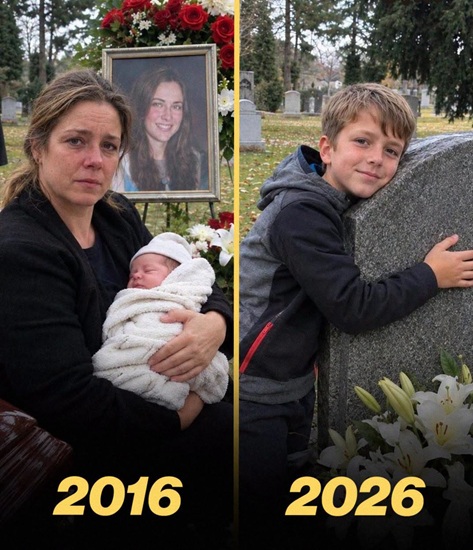
I had gone to the cemetery with a small bouquet of flowers. Lucas was with me, although he had wandered toward the parking area to look for something in the car.
I was standing in front of my daughter’s grave when I noticed a woman approaching.
She looked to be in her late fifties or early sixties. She carried a small handbag and walked slowly, as though she wasn’t entirely certain whether she should come closer.
At first, I assumed she was visiting another grave.
Then she stopped beside me.
“Elizabeth?”
I turned.
“Yes?”
She looked at the name engraved on the headstone before returning her attention to me.
“I’ve been hoping to speak with you.”
There was something in her voice that made me uncomfortable.
“Do I know you?”
She shook her head.
“Not personally. But I knew your daughter.”
I immediately looked at her more carefully.
“My daughter?”
“Teagan.”
The way she said the name made my chest tighten.
“How did you know her?”
The woman reached into her handbag and removed a sealed envelope.
“I made your daughter a promise. Now it’s time you knew the truth.”
For a moment, I couldn’t understand what she was saying.
Then I noticed the handwriting on the front.
Elizabeth.
It was unmistakably Teagan’s handwriting.
My fingers began to tremble.
“Where did you get this?”
The woman hesitated.
“She gave it to me.”
“When?”
“The day her baby was born.”
I stared at her.
“You’re telling me you’ve had a letter from my daughter for ten years?”
She lowered her eyes.
“Yes.”
I felt as though the ground beneath my feet had shifted.
Before I could ask another question, I heard Lucas calling from the bottom of the hill.
“Grandma! Look what I found!”
He was running toward us, holding a birthday card he had made for his mother.
The woman glanced at him.
“Please,” she whispered. “Don’t open that letter in front of him.”
I looked back at her.
“Who are you?”
“My name is Trudy. I was one of the nurses at the hospital where Teagan gave birth.”
I wanted to demand an explanation, but Lucas was already approaching.
Trudy gently placed the envelope in my hand.
“My telephone number is written on the back. Please read it before you decide what to think of me.”
Then she walked away.
I stood there holding the letter while my grandson reached for my hand.
“Grandma, are you okay?”
I forced a smile.
“I’m fine, sweetheart.”
But nothing about that afternoon felt fine.
Not anymore.
Teagan had always been independent.
Even as a child, she disliked being told what to do. She was thoughtful, stubborn, funny, and sometimes so determined to handle everything herself that she forgot other people wanted to help.
When she told me she was pregnant, I remember sitting across from her at the kitchen table.
She was eighteen.
I was frightened.
Not because I didn’t want the baby, but because I knew how difficult life could become for a young mother without support.
“Does the father know?” I asked.
Teagan looked down at her hands.
“Yes.”
“Is he going to help you?”
“Mom, please.”
“I’m asking because I’m worried.”
“I know.”
“What’s his name?”
She sighed.
“I don’t want to talk about him right now.”
“Why not?”
“Because every time I try to tell you something, you ask another question.”
I leaned back in my chair.
“Teagan, you’re having a child. I need to know what’s happening.”
“I can handle this myself.”
“You shouldn’t have to handle everything yourself.”
She looked at me for a long moment.
Then she stood.
“Please stop making this harder.”
I watched her walk away.
At the time, I thought she was shutting me out.
I thought she was being stubborn.
I never considered that she might have been frightened and simply unable to explain what was happening inside her.
As the pregnancy progressed, our conversations became shorter.
I asked about appointments.
She answered.
I asked whether she needed anything.
She said she was fine.
I asked about the father.
She changed the subject.
I didn’t understand that every unanswered question might have made her feel more alone.
Then came the day Lucas was born.
I remember the hospital waiting room more clearly than almost anything else in my life.
The clock seemed unusually loud.
I kept checking my phone, even though there was no reason to believe a message would suddenly appear.
When the doctor finally approached me, I knew from his expression that something was wrong.
He sat beside me.
“I’m very sorry,” he said.
I looked at him.
“What happened?”
“We did everything we could.”
My mind immediately went to the baby.
“Is the baby alive?”
He nodded.
“Your grandson is alive. He’s receiving the care he needs.”
I began crying.
Then I asked the question I was afraid to hear answered.
“And Teagan?”
The doctor looked down.
My daughter had died.
I don’t remember how long I sat there.
I remember the walls, the chairs, the smell of disinfectant, and the feeling that the world had continued moving while mine had stopped.
A nurse eventually brought Lucas to me.
He was so small.
His fingers curled around mine, and I remember thinking that he had no idea what had happened.
He would never hear his mother’s voice.
He would never know the way she laughed when something genuinely surprised her.
He would never remember how she looked when she was concentrating.
But I promised myself that he would grow up knowing he had been loved.
I didn’t know how I would do it.
I only knew that I had to.
That evening, after Lucas had gone to bed, I placed Teagan’s envelope on the kitchen counter.
I couldn’t bring myself to open it immediately.
For ten years, I had imagined all the things my daughter might have wanted to tell me.
Perhaps she had written about Lucas.
Perhaps she had apologized for our arguments.
Perhaps she had simply wanted to leave something behind.
But the woman’s words kept returning to me.
“I made your daughter a promise.”
I finally opened the envelope.
A photograph slipped onto the counter.
It showed Teagan standing beside a teenage boy.
I recognized him almost immediately.
He had visited our house twice during the pregnancy.
He was quiet, polite, and always seemed uncomfortable when adults asked him questions.
In the photograph, he was holding an old baseball glove.
I turned the picture over.
There was no name.
Then I unfolded the letter.
“Mom,
I know you’re probably frustrated with me because I haven’t told you everything.
I know you think I don’t trust you.
That isn’t why I’ve been quiet.
He knows about the baby.
He wanted to stay. He told me he wanted to be part of our lives. But wanting something and being ready for it aren’t always the same thing.
His family keeps telling him that having a child now will ruin everything he planned.
He keeps worrying about disappointing them.
I told him he shouldn’t come back just because he feels guilty.
If he comes back, I need him to choose us because he wants to, not because someone forces him.”
I stopped reading.
My hands were shaking.
For ten years, I had believed that the boy simply didn’t care.
But according to my daughter, the situation had been more complicated.
I continued.
“You keep asking me who he is.
But I wish you would ask me why I’m scared.
I’m scared of becoming a mother before I’ve figured out how to become an adult.
I’m scared of making mistakes.
I’m scared that everyone will look at me differently.
And I’m scared that I’ll disappoint you.
I know you want to help. I know you love me.
Sometimes I just need you to listen before you try to solve everything.”
I lowered the letter.
Suddenly, I remembered a night from the final months of her pregnancy.
Teagan had walked into the kitchen while I was sorting through bills.
“Mom, can I ask you something?”
I hadn’t looked up.
“If this is about the father again, I really can’t do this tonight.”
She stood quietly.
I remember hearing her take a breath.
Then she said, “Never mind.”
She turned and walked away.
For ten years, I had remembered that moment as another example of her refusing to talk.
Now I wondered what she had actually wanted to ask.
I picked up my phone and called the number Trudy had written on the envelope.
She answered after several rings.
“Hello?”
“It’s Elizabeth.”
There was a pause.
“I wondered when you might call.”
“You had this letter for ten years.”
“I know.”
“You knew my daughter was gone, and you kept something she wanted me to have.”
Trudy didn’t interrupt.
I continued.
“You don’t get to decide what I can handle. You don’t get to decide what my grandson should know.”
“I understand.”
“No, I don’t think you do.”
I looked at the photograph again.
“Where can I meet you?”
The following afternoon, we met at a small diner.
Trudy was already seated in a booth near the back.
I placed the photograph between us.
“Tell me everything you remember.”
She folded her hands.
“Teagan was very young. She was frightened, but she was also thinking about the baby constantly.”
“Why did she give you the letter?”
“She asked me to keep it safe.”
“Why?”
“She told me that if something went wrong and the baby’s father didn’t come, I should make sure you received it.”
I looked away.
“Did she think she was going to die?”
“No, Elizabeth. She didn’t know that would happen. She was eighteen, preparing to give birth, and trying to make sure the people she loved understood her.”
That distinction hurt.
My daughter hadn’t been writing a farewell because she knew what was coming.
She had simply been trying to communicate.
I pointed toward the photograph.
“Is this the father?”
Trudy studied it.
“I believe so, but I can’t be certain of his name.”
“Then what else do you know?”
She hesitated.
“After Teagan died, a young man came to the maternity floor asking for her.”
My heart began beating faster.
“What?”
“He was asking whether he could see her.”
“Did you speak to him?”
“Not directly. I noticed him near the corridor. Later, I realized he looked like the boy Teagan had described.”
I gripped the edge of the table.
“What happened?”
Trudy looked uncomfortable.
“He saw you leaving with Lucas.”
“And?”
“He walked away.”
I stared at her.
“You watched him leave?”
“Yes.”
“And you never told me?”
“No.”
I felt anger rising again.
“Why?”
She looked down at her hands.
“I told myself you were already dealing with too much grief. I thought giving you another painful question would make things worse.”
“You decided that for me.”
“Yes.”
“You decided what my grandson should know.”
Trudy nodded.
“I know.”
For a moment, neither of us spoke.
Then I asked the question that mattered most.
“Why are you telling me now?”
Trudy took a deep breath.
“I retired several months ago. For years, I told myself I was protecting a grieving family. But after I left the hospital, I realized I was also protecting myself from admitting that I had made a mistake.”
I looked at her.
“Ten years is a very long time to keep someone else’s truth.”
“I know.”
I took the letter and photograph.
Then I left.
That night, I couldn’t sleep.
I kept thinking about the young man who had stood somewhere in that hospital corridor.
Had he been frightened?
Had he wanted to see Lucas?
Had he simply been too ashamed to come closer?
I didn’t know.
And I wasn’t going to invent answers just because I wanted an explanation.
The following afternoon, I opened the storage box containing Teagan’s belongings.
It had been years since I had looked through it.
Inside were photographs, school programs, birthday cards, and little objects that had once seemed ordinary but now felt precious.
I found the silver bracelet she wore almost every day.
Then I found another photograph of the same boy.
The baseball glove was visible beneath his arm.
Underneath the photograph was a torn notebook page.
It contained a short list.
Buy diapers.
Finish thank-you cards.
Ask Mom about night classes.
Tell Mom.
Tell Mom.
I read the last two lines several times.
My daughter had been planning to tell me something.
Perhaps she had intended to explain the father.
Perhaps she had wanted to ask for help.
Perhaps she had simply wanted to tell me how frightened she was.
I would never know.
“Grandma?”
I turned.
Lucas was standing in the doorway.
He looked at the open box.
“Is that Mom’s stuff?”
“Yes, sweetheart.”
He came closer and sat beside me.
I handed him a school photograph.
He smiled.
“I look like her.”
“You do.”
“Especially the eyebrows.”
I laughed softly.
“Those are definitely hers.”
Then Lucas noticed the photograph of the boy.
“Who’s that?”
I hesitated.
“Someone your mother knew.”
“Was he her friend?”
“I think so.”
Lucas studied the picture.
“Why did she keep his photograph?”
I didn’t have a good answer.
He looked at me.
“Grandma, did that lady tell you something?”
I nodded.
“She did.”
“Is it about my dad?”
I took a breath.
“I’m trying to understand everything before I explain it to you.”
Lucas looked disappointed.
“You always say you don’t know.”
“Because I didn’t know.”
“But now you know something.”
He was right.
I reached for his hand.
“Yes. And I promise I won’t keep you wondering forever.”
He nodded slowly.
I could see that he wanted more answers.
I wanted to give them to him.
But I also wanted to make sure that whatever I told him was honest.
That evening, I returned to the photograph and examined the background.
There was an old school emblem on the wall.
I recognized the school.
I remembered that Teagan had attended a few events there with friends.
I searched through the old programs in the box until I found a class photograph.
Beneath it were several names.
One of them matched the boy’s first name.
It took time to find the right person.
There were several profiles with similar names, and I wasn’t sure which one belonged to him.
Eventually, I found a profile with a photograph that looked familiar.
I didn’t know whether he would answer.
Still, I wrote a short message.
“My name is Elizabeth. I’m Teagan’s mother. I need to speak with you about something from ten years ago.”
I put my phone down.
Two hours passed.
Then a reply appeared.
“Lucas?”
I stared at the single word.
He knew.
We arranged to meet the next morning.
I arrived early.
When he entered the café, I recognized him immediately.
He was no longer the teenage boy in the photograph.
He was a grown man now, with tired eyes and a nervous expression.
He sat across from me.
For a moment, neither of us spoke.
Then I placed the photograph on the table.
“You knew Teagan.”
He nodded.
“Yes.”
“You knew she was pregnant.”
“Yes.”
“You knew about Lucas.”
He swallowed.
“Yes.”
I looked directly at him.
“Then why weren’t you there?”
He stared at his coffee.
“I was there.”
My stomach tightened.
“What do you mean?”
“I came to the hospital.”
“Trudy said you were asking for Teagan.”
He nodded.
“I wanted to see her.”
“What happened?”
He took a breath.
“My parents had spent months telling me that becoming a father at eighteen would destroy my future. They wanted me to finish school, go to college, and follow the plan they had made for me.”
“And what did you want?”
“I wanted Teagan. I wanted the baby. But I was scared.”
“That explains why you were frightened at eighteen. It doesn’t explain the next ten years.”
He closed his eyes briefly.
“I know.”
I waited.
He continued.
“After Teagan told me not to come back until I was ready to choose for myself, I went home. I thought I could somehow make everything right once I had figured out what to do.”
“Did you know she had died?”
“Not when I left.”
“But you found out.”
“Yes.”
“And you saw me carrying Lucas.”
He nodded.
“I saw you.”
“What did you do?”
“I panicked.”
I leaned forward.
“And the following day?”
He didn’t answer.
“The following week?”
Silence.
“The following year?”
His eyes filled.
“I kept telling myself that I had already ruined everything. I thought you would hate me. I thought Lucas would be better off without someone who had already failed him.”
I shook my head.
“You don’t get to make that decision for a child.”
“I know.”
“You could have written. You could have called. You could have asked whether he was safe.”
“I know.”
“You weren’t eighteen forever.”
He looked down.
“Every year made it harder to explain why I hadn’t come back. Eventually, I convinced myself that staying away was easier than facing what I had done.”
I believed that he was ashamed.
But understanding his shame didn’t erase the years Lucas had spent wondering.
“Does Lucas know who I am?” he asked.
“He knows he has a father. He doesn’t know your name.”
He looked up.
“Can I meet him?”
I studied his face.
“Not because you suddenly feel guilty. Not because you want to make yourself feel better.”
“I understand.”
“If you want to be part of his life, you need to understand that this is about him. Not you.”
He nodded.
“What should I do?”
“Write him a letter.”
“A letter?”
“Tell him who you are. Tell him what happened. Tell him why you stayed away. Don’t blame Teagan. Don’t blame your parents. Don’t ask him to forgive you.”
He looked at me for a long moment.
“All right.”
“And remember something. Being his biological father doesn’t automatically make you the person he trusts.”
“I understand.”
I stood.
“Then show him you understand.”
Two days later, an envelope appeared at my front door.
Lucas’s name was written across the front.
I held it for a long time.
It felt strange to receive something addressed to my grandson from a man he had never met.
I opened it carefully.
Inside was a handwritten letter.
The first paragraph read:
“Lucas,
My name is Daniel. I am the man who helped bring you into this world, and I know that is a difficult thing to read when you have never met me.
I want you to know that I knew about you before you were born.
I was frightened when I was eighteen. I allowed other people to influence decisions that should have been mine. I told myself I needed more time.
After your mother died, I saw you at the hospital.
I had an opportunity to come forward, but I didn’t take it.
I cannot change that.
I am not writing because I expect you to forgive me. You don’t owe me that.
I am writing because you deserve an honest explanation.
If you ever want to meet me, I would be grateful for the opportunity. If you aren’t ready, I will respect that.
I hope you know that your mother mattered to me.
And I hope you know that none of this was your fault.”
I read the letter twice.
He hadn’t asked for immediate forgiveness.
He hadn’t blamed Teagan.
He hadn’t tried to make himself sound like a victim.
That didn’t mean I trusted him.
It meant he had finally taken one small step toward being honest.
Before giving the letter to Lucas, I called Trudy.
I wanted to ask her one more thing.
We arranged to meet the following afternoon.
This time, I didn’t sit across from Trudy with anger as my only reason for being there.
I wanted to understand my daughter’s final hours.
“Was Teagan frightened?” I asked.
Trudy nodded.
“Yes.”
“Was she alone?”
“No. There were people with her.”
I felt my throat tighten.
“Did she ask for me?”
Trudy looked at me gently.
“Yes.”
I lowered my eyes.
“What did she say?”
“She worried that she hadn’t bought enough diapers.”
I laughed through my tears.
“That sounds exactly like her.”
Trudy smiled.
“She also talked about you.”
I looked up.
“What did she say?”
“She said you made pancakes too thick and refused to admit it.”
For the first time in days, I laughed properly.
Even in those final hours, my daughter had found a way to make fun of me.
“Was she angry with me?” I asked.
Trudy shook her head.
“She was worried. She was overwhelmed. But she knew you loved her.”
I looked down at my hands.
“I spent so much time asking who the father was. I should have spent more time asking what she needed.”
Trudy didn’t rush to answer.
Then she said something I have remembered ever since.
“She didn’t give me that letter because she wanted you to feel guilty. She gave it to me because she wanted you to understand her.”
I sat quietly.
For ten years, I had remembered Teagan as a daughter who refused to talk to me.
Now I was beginning to understand that perhaps she had been trying to talk all along.
I had simply been too focused on getting answers to hear the questions she was afraid to ask.
Before leaving, I asked one final thing.
“Did she know I loved her?”
Trudy answered immediately.
“Yes. She knew.”
I closed my eyes.
That was the first answer in ten years that made me feel a little closer to my daughter rather than further away from her.
That evening, Lucas found the photograph on the kitchen table.
He looked at it.
Then he looked at me.
“That’s him, isn’t it?”
I turned off the faucet, dried my hands, and sat across from him.
“Yes, sweetheart.”
He picked up the photograph.
“Is he my dad?”
“He is your biological father.”
Lucas was quiet.
“Did he know about me?”
“Yes.”
“Then why wasn’t he here?”
I took a breath.
“He was young and frightened when your mother was pregnant. He listened to his family instead of making his own decision. Later, when he had the chance to come back, he was afraid to face what he had done.”
Lucas looked down.
“Did Mom want him to come?”
“She wanted him to choose to be part of your life because he truly wanted to.”
“Did he?”
“Not when he should have.”
Lucas nodded slowly.
Then he asked something I hadn’t expected.
“Do you hate him?”
I thought carefully.
“I was angry with him for a very long time.”
“Are you still?”
“I understand more now. But understanding someone doesn’t mean forgetting what happened.”
He considered that.
Then he asked, “Does he want to meet me?”
I nodded.
“He wrote you a letter.”
Lucas looked at the envelope.
“Can I read it?”
“Of course.”
I placed it in front of him.
He read slowly, stopping several times to think about certain sentences.
When he finished, he placed it back on the table.
“Do I have to meet him?”
“No.”
“But can I?”
I looked at my grandson.
Every protective instinct inside me wanted to delay the moment.
For ten years, Lucas and I had built a life together.
I knew his favorite breakfast.
I knew which subjects made him excited.
I knew when he was pretending to be happy and when he genuinely was.
I was afraid that allowing another person into his life might change everything.
But then I remembered Teagan’s letter.
“You kept asking me who he was, but you never asked why I was scared.”
I didn’t want to make the same mistake with Lucas.
“Yes,” I told him. “If you want to meet him, we can arrange it.”
Lucas looked relieved.
“Can it be somewhere I know?”
“Where would you like?”
He thought for a moment.
“The baseball field.”
I smiled.
“Then the baseball field it is.”
The first meeting took place on a Saturday afternoon.
Lucas chose the location because he felt comfortable there.
His father arrived early.
He stood near the fence, holding an old leather baseball glove.
When Lucas saw him, he stopped walking.
“That’s the glove from the picture.”
Daniel looked down.
“Yes.”
“You kept it?”
“I did.”
Lucas approached slowly.
“Why?”
Daniel hesitated.
“Because it reminded me of a time when I thought I could have been part of your life.”
Lucas studied him.
Then he introduced himself.
“I’m Lucas.”
Daniel nodded.
“I know. It’s good to finally meet you.”
Lucas pointed toward the baseball field.
“Are you any good?”
Daniel gave a nervous laugh.
“Not particularly.”
“Then why do you have a glove?”
“Owning one and being good at baseball are two different things.”
Lucas smiled.
They began throwing the ball.
At first, the throws were awkward.
Daniel threw one too high.
Lucas missed it.
The ball rolled several feet away.
“Sorry,” Daniel said.
Lucas shrugged.
“It’s okay.”
Daniel walked over, picked up the ball, and handed it back.
“That was my mistake.”
They continued.
I watched from a few yards away.
I didn’t try to join their conversation.
I didn’t try to make the afternoon more emotional than it needed to be.
It was enough that Lucas was comfortable.
After a while, he asked Daniel something I couldn’t hear.
Daniel crouched to speak with him.
I felt myself taking a step forward.
Then I stopped.
Lucas was talking.
Daniel was listening.
And for the first time, I allowed myself to watch without trying to control every moment.
The meeting lasted less than an hour.
When it was time to leave, Lucas waved goodbye.
Daniel didn’t ask for a hug.
He didn’t ask Lucas to call him Dad.
He simply said, “Thank you for meeting me.”
Lucas nodded.
“Maybe we can throw the ball again sometime.”
Daniel smiled.
“I’d like that.”
Things didn’t suddenly become perfect after that afternoon.
Real life doesn’t work that way.
Daniel didn’t become a trusted parent overnight.
Lucas didn’t immediately know what to call him.
And I didn’t suddenly forget ten years of disappointment.
But there were small changes.
The first week, Daniel called once.
The next week, he called again.
Sometimes Lucas wanted to talk.
Sometimes he didn’t.
Daniel accepted both answers.
He never appeared without asking first.
He never pressured Lucas to forgive him.
He never spoke badly about Teagan.
I watched carefully.
Not because I wanted to punish him forever, but because I had a responsibility to protect the little boy who had trusted me with his childhood.
Trust had to be earned.
It couldn’t be demanded.
And it certainly couldn’t be created by one emotional afternoon at a baseball field.
Three weeks later, on a Sunday morning, Lucas was sitting at the kitchen table eating pancakes.
I had made them too thick again.
He was pouring syrup over them when he casually mentioned something.
“Daniel wants to come to my game on Saturday.”
I placed the syrup bottle on the table.
“Do you want him there?”
Lucas nodded.
“Yeah.”
“Then he can come.”
He looked at me carefully.
“You’re not going to be upset?”
“No, sweetheart.”
“Even if I want to see him again?”
I reached across the table and straightened his napkin.
“Especially if you want to see him again.”
Lucas smiled.
Then he went back to eating.
A few moments later, he looked up.
“Grandma?”
“Yes?”
“Do you think Mom would have liked him being there?”
I paused.
I couldn’t answer for Teagan.
I couldn’t pretend to know exactly what she would have wanted after everything that had happened.
But I could tell Lucas what I knew.
“I think your mother wanted you to be loved. She wanted the people in your life to make good choices and show up when you needed them.”
Lucas nodded.
“Okay.”
Then he took another bite of his pancake.
I looked around the kitchen.
At the photographs on the wall.
At the little baseball schedule attached to the refrigerator.
At the schoolbag waiting near the door.
For ten years, I had believed my job was to protect Lucas from the truth because I thought the truth would hurt him.
Now I understood something different.
My job wasn’t to decide what he should feel.
My job was to give him the truth in a way he could understand, stand beside him while he made his own decisions, and make sure he never confused someone else’s mistakes with his own worth.
I still missed Teagan every day.
I still wished I could ask her what she had meant in that letter.
I wished I could sit across from her at the kitchen table and tell her that I was sorry for the times I had asked questions when she needed someone to listen.
But I couldn’t go back.
I could only move forward with what she had left behind.
That evening, I placed her letter in a small box beside her photographs.
I didn’t put it away because I wanted to forget.
I put it there because I finally understood it.
My daughter hadn’t left behind a perfect explanation.
She had left behind a chance for me to see her as she really was: an eighteen-year-old girl who was frightened, hopeful, imperfect, and trying to become a mother while still needing her own mother.
And Lucas was no longer a little boy who had to grow up believing that his father was simply a mystery.
He now had the beginning of an answer.
Whether that answer would eventually become a relationship was something time would decide.
As for me, I had learned that forgiveness doesn’t mean pretending the past didn’t happen.
It means refusing to let the past make every decision about the future.
I looked at the photograph of Teagan one last time before turning off the kitchen light.
Then I whispered something I wished I had said more often when she was alive.
“I should have listened longer, sweetheart.”
The house was quiet.
But for the first time in ten years, the future didn’t feel like something I had to protect Lucas from.
It felt like something we could face together.
And that was enough for one Sunday night.