After nine long months of deployment, my husband was finally coming home. I had counted the days, the hours, and even the minutes until I could see him again.
For months, I had imagined this moment in my mind. I pictured him walking through the airport arrivals doors with his travel bag over his shoulder, looking around until his eyes found us.
But more than anything, I imagined the moment he would finally meet our twin daughters.
He hadn’t been there when they were born. He hadn’t held my hand in the hospital, heard their first cries in person, or kissed their tiny foreheads when the nurses placed them against my chest.
He had only seen them through a screen.
And now, finally, everything was supposed to change.
But that day, at the airport, I discovered that sometimes life prepares us for months for a beautiful moment, only to confront us with a fear we never imagined experiencing.
My husband’s name was Jeremy.
He had left for his military deployment before our daughters were born. When we discovered we were expecting twins, he was already overseas and couldn’t return home to be beside me.
I still remember the phone call when I told him the news.
At first, he went completely silent.
Then he asked:
“Two?”
I laughed through my tears.
“Yes, Jeremy. Two little girls.”
He started laughing so loudly that the connection kept cutting out.
“Then I’m officially the luckiest man alive.”
Throughout my pregnancy, he tried to be as involved as possible. Whenever he had an opportunity, he called to ask whether I had eaten, whether I was getting enough rest, and whether the babies were moving.
Sometimes the connection disappeared just as he was telling me something important.
Other times, the screen froze, leaving me staring at his motionless face.
Still, he never gave up.
“One day, I’ll tell those girls how hard I tried to talk to them before they were even born,” he would say.
When the day of their birth finally arrived, Jeremy was still far away.
I was frightened, exhausted, and overwhelmed by emotions I couldn’t put into words.
When I heard the first baby cry, I started crying too.
Then came the second cry.
Two tiny girls.
Two new lives.
Two more reasons to keep moving forward.
When the nurses placed my phone beside my hospital bed, Jeremy appeared on the screen. He didn’t say anything for several seconds.
He simply stared at us.
Then he covered his face with his hands and began to cry.
“Are they really ours?” he asked in a trembling voice.
“Yes, my love. They’re our daughters.”
He wiped his eyes.
“I’m sorry I couldn’t be there.”
“You’re coming home,” I told him. “And you’ll have all the time in the world to hold them.”
He promised he would do everything possible not to miss another important moment.
But neither of us knew how difficult that promise would become.
When Jeremy called me on Tuesday morning, his voice sounded happier than usual.
“My love, I’m finally coming home,” he said.
I knew the day had arrived, but I still couldn’t believe it.
“When will you be here?”
“I have one connecting flight left. If everything goes according to plan, I’ll be at your airport in a few hours.”
Then he laughed.
“I can’t wait to meet my little princesses.”
“They can’t wait to meet their daddy either.”
“I hope they recognize me.”
“They’ll recognize your voice.”
He became quiet for a moment.
“That’s what worries me most. I’m afraid they’ll recognize my voice before they recognize my face.”
I didn’t know what to say.
I reassured him that everything would be wonderful.
Before ending the call, he apologized once again for missing the girls’ birth.
“Jeremy, please don’t do this again,” I told him. “You’re coming home. That’s what matters.”
“I’m going to hug all three of you.”
“We’ll be waiting.”
A little later, he sent me a short video of himself walking toward the airplane. He was wearing his uniform, carrying his belongings, and smiling despite looking exhausted.
I watched it once.
Then again.
And then a third time.
I couldn’t explain why I kept watching it.
It felt as though every time I replayed the video, I was getting closer to the moment when I would finally have him beside me again.
That night, I barely slept.
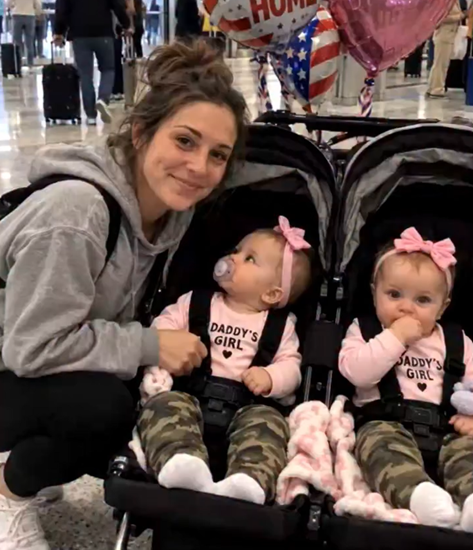
I had prepared the girls’ outfits several days earlier. Jeremy’s mother had sent us two matching outfits with pink glitter letters across the front.
They read:
“DADDY’S HOME.”
I dressed them carefully.
I adjusted their little blankets and tied three balloons to their stroller. One for me and one for each of our daughters.
I wanted everything to be perfect.
Even though I knew the girls were too young to understand what was happening, I wanted their first day with their father to be special.
When we arrived at the airport, I positioned myself near the arrivals doors.
I had the flight-tracking application open on my phone.
His airplane was getting closer.
Every few minutes, I checked the screen.
Then, finally, the word appeared:
“LANDED.”
His flight had arrived.
My heart began beating faster.
People started gathering near the doors. Some held flowers, while others had their phones ready to capture their reunions.
A little boy ran toward his father and jumped into his arms.
A woman dropped the flowers she was holding and embraced her husband.
I smiled.
Then I started checking every face.
Jeremy had to be there.
I had imagined this moment hundreds of times.
He would see the girls first. Then he would approach the stroller and try to decide which daughter to pick up first.
I would laugh and probably cry.
He would kiss me and tell me how much he had missed us.
But the minutes kept passing.
People were leaving.
Some passengers hugged their families and walked away together.
Others collected their luggage and continued toward the exit.
But Jeremy was nowhere to be seen.
I checked my phone again.
The flight had landed.
Nothing had changed.
I began thinking that perhaps he had stopped to collect his luggage. Maybe he was looking for the correct exit. Perhaps his phone battery had died.
Then one of the girls started moving beneath her blanket.
I adjusted it and kissed her forehead.
“Just a little longer, sweetheart,” I whispered.
And that was when someone gently touched my shoulder.
My heart jumped.
I turned around immediately, already smiling.
“Jeremy?”
But it wasn’t him.
A soldier in a formal uniform was standing in front of me.
He wasn’t carrying a suitcase.
He wasn’t smiling.
And the way he looked at me made me feel that something was terribly wrong.
“Are you Jeremy’s wife?” he asked.
“Yes. Where is he?”
The man took a deep breath.
“Ma’am, he’s not coming.”
For several seconds, I thought I had misunderstood him.
“What do you mean?”
“He wasn’t on that flight.”
I stared at him in confusion.
“But I saw him leaving. He sent me a video. The flight just arrived.”
The soldier lowered his eyes.
“You should go home.”
I felt as though the floor was disappearing beneath my feet.
“What are you trying to tell me? Is my husband dead?”
He immediately raised his head.
“No, ma’am.”
I gripped the stroller more tightly.
“Then he’s alive?”
“Yes.”
“Where is he?”
He hesitated.
“Jeremy is receiving medical care.”
At that moment, one of the girls began crying. Her sister woke up and started crying too.
I bent down to comfort them, but my hands were shaking so badly that I dropped the pacifier onto the floor.
“Please,” I said. “Don’t make me guess. I have two children here. I need to know what happened to their father.”
The soldier looked at me and introduced himself.
“My name is Daniel. I served with Jeremy.”
I recognized his name.
Jeremy had mentioned him several times during our calls.
“Daniel? Why hasn’t he called me himself?”
He answered carefully.
“There has been a medical complication.”
“What kind of complication?”
Daniel remained silent for a moment.
“Jeremy was injured six weeks ago.”
I felt my stomach tighten.
“Six weeks?”
“Yes.”
“But I’ve been talking to him throughout that time.”
“I know.”
“How could he not tell me?”
Daniel lowered his voice.
“He suffered injuries to his back and legs. He’s currently using a wheelchair.”
For a moment, I couldn’t speak.
I remembered all our conversations.
Jeremy always sat in front of the camera.
Whenever I asked him to show me where he was, he made a joke.
When I asked whether he was getting enough exercise, he changed the subject.
Now I understood why.
“What happened to his flight?” I asked.
Daniel explained that Jeremy had boarded his first plane, but during the connection at another airport, his condition had worsened. His pain had become severe, and the weakness in his legs had increased.
Medical personnel had taken him to a nearby hospital for examination and treatment.
He hadn’t been able to continue his journey.
“Why didn’t he call me?”
Daniel took a deep breath.
“He was embarrassed.”
“Embarrassed about what?”
“Because he thought he would disappoint you.”
I turned toward the airport doors.
They were still opening.
People continued walking through them.
But I wasn’t waiting for anyone anymore.
“Where is he now?” I asked.
Daniel told me Jeremy was still at the hospital near the connecting airport. His medical team was arranging transportation to a rehabilitation facility closer to our home.
“When will he arrive?”
“According to the information we have, he should be here by this evening.”
“Then I’ll wait.”
“Jeremy asked me to take you home.”
I looked directly into his eyes.
“I just spent several minutes thinking my husband had died. Please don’t ask me to leave now.”
Daniel didn’t argue again.
“I’ll help you see him.”
At the rehabilitation facility, the hours seemed much longer than usual.
I settled into a quiet family room with the girls.
I fed them, changed their clothes, and eventually put them down to sleep.
But my thoughts were somewhere else.
I was thinking about Jeremy.
About the pain he might have experienced.
About the fear he might have felt.
And most of all, about the fact that he had chosen not to tell me.
I called him twice.
He didn’t answer.
Daniel told me the medical team was still arranging the transportation.
I didn’t want to be angry with Jeremy before seeing him.
But I couldn’t understand how he had managed to hide something so important for six weeks.
I remembered the night our daughters were born.
Their first cries.
Their tiny hands.
And the phone I had kept beside my pillow, waiting for Jeremy to see their faces.
He had cried when he saw them.
He had told me he would be the best father he could possibly be.
And I had promised him we would experience every step of their childhood together.
Now he was alive, but he was trying to face something difficult alone when we should have been facing it together.
That evening, Daniel entered the room.
“He’s arrived,” he said.
I immediately stood up.
“Where is he?”
“Room twelve.”
I took the stroller and followed him down the hallway.
As we approached the door, I felt my heart beating rapidly again.
Daniel stopped.
“There’s something I should tell you. Jeremy is frightened.”
“So am I.”
He knocked gently and entered.
Then I heard my husband’s voice.
“I told you not to bring her here.”
I stopped.
“I just needed another week,” he continued.
Another week.
After nine months away from his family.
I pushed the door open and walked inside.
Jeremy was sitting on the edge of the bed.
He looked thinner.
His hair was shorter, and there were dark circles beneath his eyes.
A wheelchair stood beside him.
But he wasn’t looking at me.
His eyes were fixed on the stroller.
One daughter was sleeping with her mouth slightly open.
The other had her little hand resting beside her cheek.
Jeremy covered his mouth.
“They’re real,” he whispered.
Then he repeated:
“They’re really here.”
I slowly approached him.
He reached toward the stroller but then looked down at his legs.
His hand returned to the blanket.
I could see him trying to smile.
Trying to appear strong.
But his eyes were filled with tears.
“Jeremy,” I said.
He lowered his head.
“I’m sorry.”
“How long?”
“Six weeks.”
“Six weeks knowing something was wrong, while I believed you were perfectly fine.”
He didn’t answer.
“I trusted you when you told me everything was okay. I trusted you when you said you couldn’t wait to come home. Meanwhile, you were facing something this serious and wouldn’t let me be there for you.”
“I didn’t want you to worry.”
“Jeremy, today at the airport, I thought I had lost you forever.”
He raised his eyes.
“When that soldier told me you weren’t coming, for a few seconds I thought he was giving me the worst news of my life.”
Jeremy began crying.
“I’m sorry.”
“Please, don’t apologize again without listening to me.”
He became completely still.
“I don’t need you to walk to be my husband. I don’t need you to be perfect. I don’t need you to prove that you can do everything by yourself.”
I sat beside him.
“I need you to be honest with me.”
Jeremy looked at me for a long time.
Then he told me something he had never shared before.
“I’ve been trying to walk,” he said.
“I know.”
“No, you don’t know how hard I’ve been trying.”
He rubbed his eyes.
“My therapists have been helping me with exercises every day. Some days I can stand for a little while. Other days, my legs simply won’t cooperate. But I kept trying.”
“Why didn’t you tell me?”
“Because I wanted to come home walking.”
I looked at him without speaking.
“I wanted to walk through those airport doors, pick up my daughters, and show you that everything was okay.”
“But things aren’t always okay, Jeremy.”
“I know.”
“Then why did you try to carry all of this alone?”
He looked at our daughters again.
“Because I promised myself I would never become like my father.”
I knew Jeremy’s relationship with his father had been difficult.
But he rarely spoke about him.
He had only told me that his father had suffered an accident and eventually needed a wheelchair.
I didn’t know how deeply the experience had affected him.
“When I was seven, my father and I used to build things every Saturday,” he continued.
“I loved wooden airplanes. One day, we started building one together. We didn’t finish it that afternoon.”
He took a deep breath.
“Then the accident happened.”
After the accident, his father changed.
He became quieter and spent much of his time behind the closed door of his bedroom.
Jeremy, still a little boy, continued knocking on that door.
“One Saturday, I took the little airplane and went to his room. I told him we could finish it together.”
He stopped.
“But he told me to go away.”
I held his hand.
“I tried again the following week. And the week after that. Every time, I hoped he would finally tell me to come inside.”
“What happened then?”
“One day, I left the airplane outside his door. I didn’t want to carry it back with me. It felt like admitting that he no longer wanted to spend time with me.”
Jeremy lowered his head.
“Eventually, I stopped knocking.”
I didn’t know what to say.
“I was afraid the same thing would happen with my daughters. That one day they would look at me in a wheelchair and I would close myself inside a room. That I wouldn’t be able to play with them, carry them, or show them all the things I had dreamed about.”
I squeezed his hand.
“You’re not your father, Jeremy.”
“But I was doing the same thing. I was pushing my family away because I was afraid I wasn’t the man I used to be.”
“Your father hurt you by shutting himself away. But you can choose not to repeat that story.”
He began crying again.
I moved closer and wrapped my arms around him.
For the first time in nine months, I felt his arms around me.
It wasn’t the embrace I had imagined.
It was slower.
More careful.
But it was him.
It was my husband.
It was the man I had been waiting for.
For several minutes, neither of us said anything.
Then he kissed my cheek.
“I missed you so much.”
“I missed you too.”
“I love you.”
“We love you too. But you cannot disappear every time you’re frightened.”
He nodded.
“I’ll tell you everything.”
“Even when it’s difficult.”
“Even when it’s difficult.”
A little later, Jeremy looked toward the stroller.
“Can I see them?”
I rolled it closer to the bed.
He reached toward one of the girls but stopped.
“What if I drop her?”
“Then we’ll do it together.”
He told me he had been practicing during therapy with a specially weighted doll to learn how to hold a baby safely.
But the doll didn’t move.
It didn’t cry.
It didn’t have the gentle breathing of a real child.
A nurse helped us position Jeremy safely in his wheelchair.
Then she guided me through the process of placing the baby in his arms.
I slowly approached him.
Our daughter was sleeping peacefully.
I placed her head against his arm and carefully checked that she was supported.
Jeremy didn’t move.
He simply stared at her.
For a long time, he didn’t say a word.
Then he raised one finger and gently touched her cheek.
“I’ve waited so long for you, sweetheart.”
His voice broke.
“I’m here, baby. Daddy’s here.”
Our daughter opened her eyes.
Then she started crying.
Jeremy panicked.
“She’s crying. Maybe she doesn’t know me.”
“Talk to her,” I said.
“What should I say?”
“Sing to her.”
He looked at me.
Then I reminded him of the little song he used to sing during our video calls.
It was the same silly song he had been singing through the phone, even when the connection was terrible.
At first, our daughter cried again.
Then she slowly began to settle.
Jeremy continued singing.
After a moment, she turned her face toward his voice.
He stopped for a second.
“Did she hear me?”
“Yes, Jeremy.”
“Does she recognize my voice?”
“She’s been hearing it for months.”
He began crying again, but this time his tears came with a smile.
“Then she knows me.”
“Of course she knows you.”
A little later, her sister woke up.
Jeremy laughed.
“And that’s my other girl?”
“Yes. The one who was waiting for her turn.”
He looked at both of them.
“I don’t even know where to begin.”
“We’ll learn together, one day at a time,” I told him.
For the first time since I entered that room, I saw him relax.
He wasn’t thinking about his legs anymore.
He wasn’t thinking about the wheelchair.
He was looking at his daughters.
And that was all that mattered in that moment.
That evening, we stayed in the rehabilitation room for a long time.
Jeremy asked me about everything.
Which girl slept more?
Which one woke up most often during the night?
Which one cried when I changed her diaper?
Which one had started smiling?
He wanted to know every little detail.
I told him about the sleepless nights, the bottles, the tiny clothes they had already outgrown, and the moments when the girls wrapped their little fingers around mine.
He listened carefully.
Sometimes he smiled.
Other times, he closed his eyes as though he were trying to imagine everything he had missed.
Before I left, he asked:
“Will you come tomorrow?”
I gently touched his cheek.
“Of course.”
“Will the girls come too?”
“Both of them.”
He smiled.
“Then tomorrow will be a good day.”
The following morning, I decided to call Jeremy’s mother.
There was something I wanted to understand better.
I wanted to know more about his relationship with his father, especially the story of the little wooden airplane.
When I told her about our conversation the previous evening, she remained silent for several seconds.
Then she asked:
“Did Jeremy tell you about the airplane?”
“Yes.”
“Sweetheart, does he still have it?”
“Yes. He kept it in a box with his childhood belongings.”
She began crying.
“Then there’s something you need to know.”
I sat down.
“What is it?”
“His father finished that airplane.”
I couldn’t understand what she meant.
“What did you say?”
“After the accident, he struggled terribly with accepting his condition. But he loved Jeremy. He loved him more than anything.”
She explained that after the Saturday when Jeremy had left the airplane outside his bedroom door, his father had picked it up and finished it himself.
He had worked on it for a long time.
He had repaired the wings, the tail, and the little pieces that had remained unfinished.
Then he had placed it back inside the box containing his son’s childhood belongings.
“But why didn’t he give it to him?” I asked.
She was quiet.
“Because he didn’t know how to reach out. He was struggling emotionally. He believed Jeremy no longer wanted to spend time with him.”
I felt a tightness in my chest.
“So Jeremy thought his father didn’t love him.”
“Yes. They both loved each other, but neither knew how to communicate what they were feeling.”
Jeremy’s mother told me that his father continued asking about him every Saturday.
“How is Jeremy?”
“Did he go out today?”
“Has he mentioned me?”
He continued asking even after Jeremy stopped knocking on his bedroom door.
But neither of them found the courage to make the first move.
“I should have told Jeremy earlier,” she said through tears.
“I should have helped him understand that his father loved him.”
I didn’t know what to say.
Then she added something else.
“There’s one more thing. Something is written underneath the airplane.”
After ending the call, I went to the box where Jeremy kept his childhood belongings.
I found the little airplane wrapped in an old towel.
I remembered that Jeremy never allowed anyone to touch it.
I carefully picked it up and began unwrapping it.
The airplane was more beautiful than I had imagined.
It had two finished wings.
The tail was smooth.
And the wood looked as though someone had worked on it with great patience.
I turned it over.
On the bottom, four words had been carved into the wood.
“FOR JEREMY. ALWAYS DAD.”
I sat down on the floor.
And I began to cry.
It wasn’t just an old toy.
It was a message that had remained hidden for years.
A message Jeremy had never read.
A father who had wanted to reach his son but didn’t know how.
And a son who had spent his life waiting to hear that he was still loved.
I carefully wrapped the airplane again and decided to take it with me.
When I arrived at the rehabilitation facility that afternoon, Jeremy was sitting beside the window.
He smiled when he saw the girls.
But then he noticed the object in my hands.
“What do you have there?”
“Something for you.”
I approached him and placed the airplane on his lap.
He immediately became serious.
“My airplane?”
“Yes.”
“Did you find it in the box?”
“Yes. But there’s something I need to tell you.”
He picked it up carefully.
He touched the wooden surface.
Then he noticed the finished wings.
“It wasn’t like this before,” he said.
“Your father finished it.”
Jeremy raised his head.
“No.”
“Yes. Your mother told me everything.”
He slowly shook his head.
“That’s impossible.”
I explained that his father had continued asking about him every Saturday.
That he had worked on the airplane after Jeremy stopped knocking.
That he had kept it in the box because he hoped his son would find it someday.
Jeremy turned the airplane over.
Then he noticed the words carved underneath.
He read them once.
Then again.
“FOR JEREMY. ALWAYS DAD.”
For several seconds, he didn’t move.
Then he pulled the airplane against his chest.
And began to cry.
“I spent my whole life thinking he didn’t love me.”
His voice was barely audible.
“Meanwhile, he thought I didn’t want to see him.”
I sat beside him.
“He loved you, Jeremy. But that doesn’t change the fact that you were hurt.”
Jeremy nodded.
“He should have opened that door.”
“Yes.”
He looked at our daughters.
“And I should have told you the truth.”
“Yes.”
“I was doing the same thing to my own family.”
I took his hand.
“But you can still change your story.”
He looked at the airplane.
Then at his daughters.
And finally, he said:
“I won’t hide anymore.”
Jeremy’s recovery didn’t happen overnight.
There were medical appointments.
Difficult exercises.
Days when the pain was stronger.
Days when progress seemed painfully slow.
And days when he needed my help with even the simplest things.
But something important had changed.
Jeremy was no longer hiding.
He started talking openly about his fears.
He told me when he was exhausted.
He told me when he was having a difficult day.
And when he couldn’t complete an exercise, he no longer considered it a personal failure.
He began to understand that being a father had nothing to do with the ability to walk.
It was about being present.
About love.
About commitment.
And about being willing to show up even when life didn’t go according to plan.
When the day finally came for him to return home, we took the photograph we had dreamed about for months.
Jeremy was sitting in his wheelchair.
One daughter was resting in his arms.
The other was sitting safely beside him.
I stood behind them with my hands resting on my husband’s shoulders.
On the table next to us was the little wooden airplane.
The girls’ matching outfits were already becoming a little too small.
The pink letters across their chests were still clearly visible.
“DADDY’S HOME.”
When I looked at the photograph, I started crying.
Not because everything had suddenly become easy.
But because, after all those months, our family was finally together.
That night, one of the girls woke up crying.
I was preparing to get out of bed when I heard Jeremy’s voice.
“I’ll go.”
He moved his wheelchair toward her little crib.
He looked at her for a few seconds.
Then he began singing their song.
“I’m here, sweetheart.”
Our daughter continued moving for a moment.
Then she slowly began to settle.
I stood in the doorway and watched them.
I remembered the airport.
The three balloons.
The two babies.
The two little spaces beside the stroller where I had imagined Jeremy standing.
I remembered the soldier who had touched my shoulder.
And the fear I had felt when I thought my husband might never come home.
But now he was here.
He hadn’t entered our house walking.
He hadn’t been able to pick up both girls at the same time.
But he was beside them.
He was singing to them.
He was teaching them to recognize the voice that had comforted them for months.
And that mattered more than anything I had imagined at the airport.
For months, Jeremy had worried that our daughters would recognize his voice before they recognized his face.
Now I could see with my own eyes that his voice had become one of the things that comforted them.
He turned toward me and smiled.
“She’s listening to me,” he whispered.
“Of course she is,” I answered.
Then he continued singing.
And I thought about something I would never forget:
Sometimes the people we love don’t need us to rescue them from every difficulty. They simply need to know that we won’t abandon them when life becomes difficult.
Jeremy had believed he needed to be strong to return to his family.
But that day, he learned something different.
He didn’t need to be perfect to be a good father.
He didn’t need to walk to be present for his daughters.
And he didn’t need to hide his pain to deserve our love.
Because family isn’t a place where nobody has problems.
Family is a place where nobody should have to face those problems alone.
And that night, as our daughter peacefully fell asleep to her father’s voice, I realized that Jeremy had finally found his way through the door that had once remained closed.
This time, he wasn’t walking away.
This time, he was staying.
And our daughters would grow up knowing that their father was there for them, not because he could do everything, but because he chose never to give up on being part of their lives.