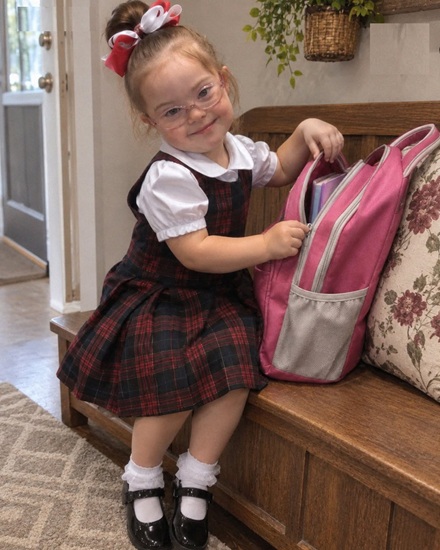
Ten years ago, I came home from work and found my six-year-old daughter sitting on the staircase, crying so hard she could barely speak.
Her little hands were wrapped around her knees. Her backpack lay beside her, still unopened, and her cheeks were wet with tears.
I dropped my keys.
“Sweetheart, what happened?”
She looked up at me, trying to catch her breath.
“Daddy, Mommy said she’s not coming back.”
For a moment, I didn’t understand what she meant. I thought Caroline had gone somewhere for the afternoon. Perhaps she was upset about something. Maybe they had argued, and my daughter had misunderstood.
I knelt beside her and wiped her cheeks.
“What do you mean, she’s not coming back?”
“Mommy said she was leaving. She said she doesn’t want to live here anymore.”
I forced a little smile, hoping it would make her feel better.
“Okay, sweetheart. Let’s go inside. Mommy and Daddy will talk about it.”
But even as I said those words, something inside me was beginning to feel terribly wrong.
The house was unusually quiet.
Our other three daughters were upstairs, and I could hear one of them playing with toys in her bedroom. I walked through the hallway, calling Caroline’s name.
There was no answer.
I checked the kitchen, the living room, and the bathroom. I opened the bedroom door and stopped.
Half of the closet was empty.
Her favorite dresses were gone. Several pairs of shoes were missing. Her jewelry box had been taken, and the small suitcase she usually kept tucked away was nowhere to be found.
Then I noticed something on the dresser.
Her wedding ring.
It was lying beside a folded piece of paper.
I picked it up, hoping it would explain what was happening.
The note contained only a few words.
“Don’t look for me. I want to live on my own.”
I read it once.
Then again.
And again.
I kept waiting for the words to somehow change into something else. A misunderstanding. A joke. An explanation that would make sense.
But they didn’t.
Caroline was gone.
And she had left our four daughters behind.
Caroline and I had been married for ten years.
From the outside, people often told us we had the kind of family they wished they could have. We had four beautiful daughters, a comfortable home, photographs from family vacations, and birthdays filled with decorations and laughter.
We weren’t perfect.
We had disagreements, stressful days, bills to pay, and the occasional argument about things that seemed important at the time. But I had never imagined that our marriage was about to disappear without a conversation.
I couldn’t understand how someone could leave four children without saying goodbye properly.
I couldn’t understand how the woman who had kissed them goodnight the previous evening could walk away the next morning and not look back.
And most of all, I couldn’t understand why.
I immediately tried calling her phone.
It went straight to voicemail.
I called again.
And again.
I sent messages asking where she was, whether she was safe, and whether she would at least tell me what was happening.
Nothing.
I contacted the authorities because I didn’t initially know whether she had left voluntarily or whether something terrible had happened. I checked hospitals and tried to find anyone who might have seen her.
That night, I barely slept.
Every time my phone vibrated, I reached for it.
Every time a car slowed outside the house, I looked through the window.
I kept thinking she might suddenly return, walk through the door, and tell me there had been some terrible misunderstanding.
But the hours passed.
Then the days.
And Caroline still didn’t call.
The hardest part wasn’t the silence between us.
It was trying to explain that silence to four little girls.
Our oldest, Sophie, was old enough to understand that something serious had happened. She watched me constantly, looking for answers in my face.
“Daddy, is Mommy mad at us?”
“No, sweetheart. This has nothing to do with you.”
“Did we do something wrong?”
That question nearly broke me.
I sat beside her on the couch and held her hands.
“Listen to me. None of you did anything wrong. Mommy leaving is not because of anything you said or did. Do you understand?”
She nodded, but I could tell she wasn’t convinced.
The other girls asked different questions.
“Is Mommy coming back tomorrow?”
“Can we call her?”
“Does she know we miss her?”
I didn’t have answers.
I didn’t know whether Caroline would come back in a week, a month, or never.
I was trying to understand what had happened while keeping four children from feeling as though their entire world had been taken away.
And I was terrified that I would fail them.
For weeks, I searched for an explanation.
Eventually, the authorities informed me that Caroline had been located. She was alive and staying with another man in a different state.
I remember sitting inside my truck when I heard the news.
I had parked outside the house, but I couldn’t bring myself to walk inside. My hands were gripping the steering wheel, and I stared through the windshield without really seeing anything.
She hadn’t disappeared because something had happened to her.
She had chosen to leave.
And she had chosen a life somewhere else.
I began crying.
Not the kind of crying that comes from a single painful moment, but the kind that comes after holding everything together for too long.
I cried for my marriage.
I cried for the years I thought we had built together.
I cried for my daughters, who were waiting inside the house for a mother who had stopped answering their calls.
Then I glanced toward the kitchen window.
All four girls were standing there.
They were watching me.
I quickly wiped my face, opened the truck door, and walked toward the house.
I couldn’t let them believe they had lost both parents at once.
Their mother had left.
But I was still there.
And I was going to stay.
The first few months were harder than I ever imagined.
I had never been the only parent responsible for every little thing. Suddenly, I was trying to remember school schedules, grocery lists, appointments, laundry, meals, permission slips, and four different personalities that needed attention at the same time.
Some mornings began with someone crying because her favorite shirt was missing.
Other mornings involved arguments over cereal, shoes, hairbrushes, and who had taken whose toy.
I burned pancakes more times than I care to admit.
I accidentally packed the wrong lunch.
I forgot a school event once and spent the entire afternoon feeling like the worst father in the world.
There were nights when all four girls wanted to talk at the same time.
“Daddy, I need help with my homework.”
“Daddy, she took my blanket.”
“Daddy, my stomach hurts.”
“Daddy, can you come see what I made?”
I would stand in the middle of the hallway and wonder how one person was supposed to be in four places at once.
But somehow, we managed.
I learned to braid hair by watching videos and practicing until my fingers stopped getting tangled.
I learned which daughter needed a hug before she could talk and which one needed a few minutes alone.
I learned that bedtime could take an hour even when everyone was exhausted.
And I learned that sometimes the most important thing I could do was sit beside one of them and listen.
The first Christmas without Caroline was the one I feared most.
I tried to make everything feel normal.
We decorated the tree together, hung lights around the windows, and placed wrapped presents beneath the branches.
The girls were excited, but there was something missing that none of us could ignore.
When we sat down for dinner, I noticed our youngest had placed an extra plate at the table.
I looked at her.
“Sweetheart, who is that plate for?”
She shrugged as if the answer were obvious.
“Mommy.”
My heart tightened.
“Why did you put a plate for Mommy?”
“Maybe she’ll come home. Maybe she’s hungry.”
I couldn’t speak for a moment.
I wanted to tell her that her mother wasn’t coming. I wanted to tell her not to wait anymore.
But how could I crush a hope that was still keeping her little heart together?
I gently moved the plate closer to the center.
“Let’s keep it here for now,” I said.
That Christmas, after the girls had fallen asleep, I sat alone beside the tree.
I looked at the empty chair.
I thought about all the promises Caroline and I had made. The things we had imagined doing as the girls grew older. The family trips we had planned. The birthdays. The ordinary evenings that I would have given anything to experience again.
And I wondered how someone could walk away from all of it.
As the years passed, the questions became less frequent.
The girls slowly stopped asking when their mother was coming home.
They stopped asking whether I had heard from her.
But sometimes, when a school assignment involved family photographs, I noticed them searching through old albums.
Sometimes one of them would ask about Caroline’s favorite food.
Sometimes they wanted to know what she was like when she was young.
I never tried to erase their mother from their lives.
Whatever had happened between Caroline and me, she was still their mother. I didn’t want my anger to become something they had to carry.
So I told them about the good memories.
I told them about the time Caroline laughed so hard she couldn’t finish a sentence.
I told them about the family vacation when we got lost and ended up eating dinner at a little roadside restaurant.
I told them about the way she used to sing while cooking.
The girls deserved to know that their lives had once been filled with happy moments too.
But I never pretended she had stayed.
And I never told them she was coming back.
There were moments when I wondered whether I could keep going.
After the girls were asleep, I sometimes sat at the kitchen table staring at bills, school papers, and a list of things that needed to be done the following morning.
I was exhausted.
There were times I missed having someone to talk to about the smallest things.
Someone to tell me that the youngest had finally learned to tie her shoes.
Someone to laugh with when the girls did something ridiculous.
Someone to sit beside me after a difficult day.
But every morning, four little faces appeared.
And they needed me.
So I got up.
I made breakfast.
I packed lunches.
I drove them to school.
I went to work.
I came home.
I listened.
I did it again.
And again.
The years passed faster than I expected.
The little girls who once needed help reaching the kitchen counter began helping me cook.
The ones who had cried because their mother was gone began making their own decisions.
They became teenagers.
They developed opinions about clothes, music, friends, and everything else.
They argued with me sometimes.
They laughed at me often.
They told me I was embarrassing.
And I loved every bit of it.
Ten years after Caroline left, we finally moved into the house I had spent years saving for.
It wasn’t the biggest house in the neighborhood.
It didn’t have the most expensive furniture.
But every room represented something we had worked for together.
There were photographs on the walls.
There were family decorations.
There were four bedrooms filled with the girls’ belongings.
And there was a kitchen where we had shared hundreds of ordinary meals.
When we first walked through the front door, the girls began screaming.
“We actually did it!”
Sophie hugged me so tightly I nearly lost my balance.
One of the younger girls ran upstairs to claim her room.
Another immediately began talking about how she wanted to decorate the hallway.
I stood in the living room, looking around, unable to believe that the little family I had been so afraid of losing had made it this far.
That evening, they surprised me.
They had made a cake.
The frosting was uneven, and the writing wasn’t perfectly straight. One corner had a little too much decoration, and I could tell they had been trying to fix it before I arrived.
But the words on top were clear.
“You were always enough, Dad.”
I stared at it.
I read it again.
Then I looked at my daughters.
“What is this?”
Sophie smiled.
“It’s for you.”
“Why?”
“Because you always told us we could count on you.”
Another daughter stepped forward.
“And we wanted you to know that we counted on you too.”
I tried to laugh, but my voice broke.
I pulled all four of them into my arms.
For the first time in a long time, I allowed myself to cry in front of them without trying to hide it.
They hugged me.
Then someone started laughing.
I don’t even remember who.
Soon all five of us were laughing and crying at the same time, standing in the middle of our new living room.
I thought that was the moment I would remember forever.
I thought nothing could take that happiness away.
Then someone knocked on the door.
The knock was gentle.
Two taps.
Then a pause.
Sophie wiped her hands on a napkin and headed toward the front door.
“Probably a neighbor,” she said.
I was still smiling when I heard the door open.
Then everything went quiet.
“Sophie?”
No answer.
I looked toward the hallway.
A few seconds later, she returned.
Her face had changed.
Her eyes were red, and she was trying to say something without making the others hear.
“Daddy…”
“What is it?”
She swallowed.
“Someone’s here for you.”
I stood up.
“Who?”
Sophie looked at me as if she couldn’t believe the answer herself.
“Mom.”
The room suddenly felt smaller.
I could hear the girls behind me asking questions.
“Who is it?”
“What’s happening?”
“Why is Sophie crying?”
I walked toward the front door.
And there she was.
Caroline.
Ten years had passed, but I recognized her immediately.
She looked much the same as the woman I remembered. Her hair was different, perhaps a little shorter. Her face showed signs of time, but the expression was familiar.
She stood on our porch with her hands clasped in front of her.
For a moment, neither of us spoke.
I had imagined this moment countless times.
I had imagined her apologizing.
I had imagined yelling at her.
I had imagined asking a hundred questions.
But now that she was standing in front of me, I couldn’t seem to find the words.
Finally, I spoke.
“What are you doing here?”
Caroline looked down.
“I came to explain.”
I almost laughed.
“Explain?”
My voice grew louder than I intended.
“Explain what? Explain where you went? Explain why you left four little girls behind? Explain why you never called?”
She didn’t interrupt.
I kept going.
“Do you know how many nights they waited for you? How many birthdays they looked at the door? How many Christmases they asked if you were coming home?”
Caroline’s eyes filled with tears.
“I know.”
“No. You don’t know.”
I took a breath, trying to calm myself.
“You missed everything. Their first days of school. Their birthdays. The nights they were sick. The moments they needed their mother and I had no idea what to tell them.”
She lowered her head.
“I know I hurt them.”
“Then why are you here?”
She looked past me, toward the living room.
I could see Sophie standing behind the wall.
The other girls were nearby, listening.
Caroline’s lips trembled.
“I wanted to see them.”
I shook my head.
“You don’t get to walk back into their lives as if nothing happened.”
“I know.”
“Do you?”
She looked at me.
“I know I have no right to ask for anything.”
I stepped back slightly.
“Then you should understand that the apology you owe isn’t to me.”
I pointed toward the living room.
“It’s to your daughters.”
Caroline nodded.
“I know.”
I turned to walk away.
For ten years, I had imagined what I would say if I ever saw her again.
I had promised myself I wouldn’t let her hurt me twice.
I had promised myself that I would never give her the power to destroy the life we had rebuilt.
But before I could close the door, she reached out and caught my hand.
“Please.”
I stopped.
“There is something I haven’t told you.”
I looked at her.
“What now?”
She was shaking.
“Something from the night I left.”
My anger returned immediately.
“Ten years, Caroline. You had ten years to tell me whatever it is.”
“I couldn’t.”
“Couldn’t, or didn’t want to?”
She closed her eyes.
“I was afraid.”
I stared at her.
“Afraid of what?”
She looked toward the girls again.
Then back at me.
“Please. Just let me speak.”
I didn’t move.
She tightened her grip on my hand.
“For ten years, I couldn’t tell the truth. I thought if I stayed silent long enough, it would disappear. I thought I could live with what I had done.”
Her voice cracked.
“But it didn’t disappear.”
I felt a chill run through me.
“What truth?”
Caroline looked at the house.
At the four daughters she had left behind.
At the father who had spent ten years trying to make sure they never felt abandoned again.
Then she whispered the words I had never expected to hear.
“You have to know what really happened the night I left.”
I stood there, unable to answer.
Behind me, Sophie stepped into the hallway.
“Dad?”
I looked at my daughter.
Then at Caroline.
For the first time in ten years, I wasn’t the only one waiting for an explanation.
And whatever Caroline had come to reveal, it was no longer a secret that belonged only to the two of us.
The past had finally found our front door.
But I still didn’t know whether opening it would bring us answers—or another heartbreak.