
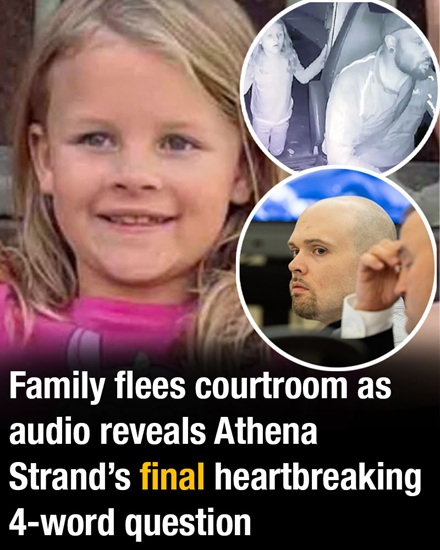
This case involves the tragic disappearance and death of seven-year-old Athena Strand in Texas in 2022, a case that later led to a highly emotional court trial and sentencing process in the United States justice system.
Athena Strand lived with her family in a rural community in Texas, where life was generally quiet and centered around school, family, and daily routines typical for a small-town environment.
In December 2022, an event that initially appeared to be a routine delivery quickly turned into a major criminal investigation after the young girl went missing from her home.
A delivery driver arrived at the property to drop off a package that was reportedly part of holiday preparations, an ordinary task that many families experience during the busy season.

Shortly after the delivery, the child was reported missing, and her family immediately contacted law enforcement authorities to report the situation and request urgent assistance.
Local police responded quickly, launching an intensive search operation that included ground teams, specialized units, and community volunteers who joined efforts to locate the missing child.
As the investigation progressed, authorities began reviewing surveillance information, delivery routes, and nearby activity in order to reconstruct the timeline of events.
Within a short time, investigators identified a suspect connected to the delivery vehicle that had been in the area at the time of the disappearance.
The suspect, Tanner Horner, a 34-year-old delivery driver, was later taken into custody as law enforcement continued gathering evidence related to the case.
The investigation was treated as a capital murder case under Texas law, reflecting the seriousness of the allegations and the circumstances surrounding the incident.

As the legal proceedings moved forward, Horner eventually pleaded guilty to capital murder and aggravated kidnapping shortly before the scheduled start of his trial.
His guilty plea significantly changed the direction of the case, shifting the focus from a full trial to a sentencing hearing where a jury would determine punishment.
Under Texas law, the sentencing options in such cases include life imprisonment without parole or the death penalty, depending on jury deliberation and legal standards.
During the sentencing phase, prosecutors presented evidence to help the jury understand the timeline of events and the seriousness of the charges.
The courtroom proceedings were highly emotional, with family members of the victim present throughout key stages of the hearing.
Before certain sensitive evidence was presented, the judge issued a formal warning to those in the courtroom, giving individuals the option to leave if they felt unable to continue.

This warning reflected standard courtroom procedure in cases involving highly sensitive material, ensuring respect for both legal process and emotional impact.
As the proceedings continued, some family members chose to step out temporarily, while jurors remained in court to continue reviewing the evidence presented.
The emotional weight of the case was evident throughout the hearing, as both legal teams presented arguments and evidence related to sentencing considerations.
Prosecutors emphasized the severity of the crime and its devastating impact on the victim’s family, community, and wider public awareness.
The defense, meanwhile, focused on legal arguments related to sentencing, as is standard in capital punishment cases under Texas law.
Court officials maintained strict order throughout the proceedings to ensure that the trial remained fair, structured, and compliant with judicial requirements.

The jury’s responsibility was to carefully evaluate all presented evidence and determine whether the appropriate punishment should be life imprisonment or capital punishment.
Throughout the hearing, emotional reactions were reported among attendees, particularly during portions of testimony and evidence review.
Family members of Athena Strand attended the court sessions, observing the legal process as it unfolded and seeking justice through the judicial system.
The case drew widespread attention across the United States, with many news outlets reporting on both the investigation and courtroom developments.
Public reaction to the case was marked by grief and shock, largely due to the young age of the victim and the circumstances surrounding her disappearance.
The investigation itself was considered a rapid-response effort, with law enforcement agencies working closely with community members during the initial search phase.

Officials later acknowledged the importance of coordination between multiple agencies, which helped investigators quickly identify key leads in the case.
As the sentencing phase progressed, attention shifted from investigation details to legal outcomes and the jury’s final decision-making process.
The jury was required to carefully consider aggravating and mitigating factors before reaching a unanimous decision under Texas sentencing law.
The courtroom atmosphere remained serious and emotional, reflecting the gravity of the case and its impact on everyone involved.
Throughout the process, the judge ensured that legal procedures were followed correctly and that both prosecution and defense were given equal opportunity to present arguments.
The victim’s family remained present for significant portions of the proceedings, observing the legal process that would determine the final outcome of the case.
Outside the courtroom, the case continued to generate national discussion about child safety, delivery service accountability, and community awareness.
Legal experts noted that capital cases involving child victims often carry heightened emotional weight and require careful judicial handling.
The sentencing phase represented the final stage in determining legal responsibility and punishment under the state’s criminal justice system.
As the jury prepared for deliberation, the court emphasized the importance of impartial decision-making based solely on evidence and legal standards.
The case ultimately became one of the most widely followed criminal proceedings in Texas, due to its emotional impact and the seriousness of the charges.
It also contributed to broader conversations about public safety, law enforcement response times, and preventive measures in residential areas.
In the end, the case of Athena Strand remains a deeply tragic event that affected a family, a community, and the national public conversation around child protection and justice.
The courtroom proceedings served as the final legal step in addressing the charges, while the emotional impact of the case continues to be remembered across the country.
