
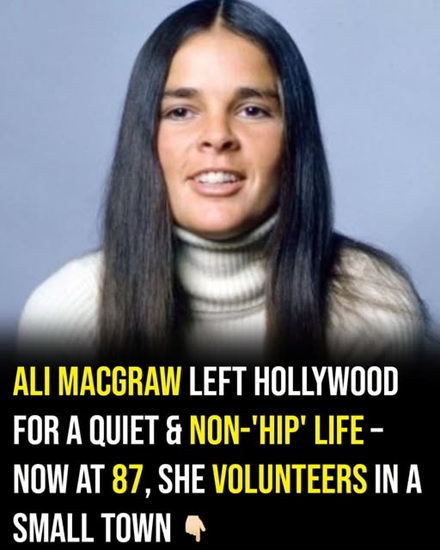
Ali MacGraw is an American actress, model, and author whose career trajectory is often described as one of the most rapid rises and quiet retreats in Hollywood history, shaped by both major success and personal transformation over several decades.
Born Elizabeth Alice MacGraw on April 1, 1939, in Pound Ridge, New York, she was raised in a household influenced by artistic expression, intellectual ambition, and periods of financial instability that affected her early family life.
Her mother, Frances, worked in the arts and education sector, while her father, Richard MacGraw, was an artist whose personal history and emotional struggles played a significant role in shaping the family environment.
MacGraw has occasionally reflected on her upbringing, describing it as both creatively stimulating and emotionally complex, with moments of instability that influenced her resilience and independence.

She attended prestigious educational institutions, including Rosemary Hall and later Wellesley College, where she developed interests in culture, literature, and visual arts before moving toward a professional career.
After completing her education, she relocated to New York City, where she entered the fashion industry and began working at Harper’s Bazaar, initially in an assistant-level position.
Working under influential editor Diana Vreeland, MacGraw gained experience in a highly competitive editorial environment that required discipline, attention to detail, and long working hours.
Her early responsibilities included administrative and creative support tasks, which gave her exposure to the inner workings of fashion publishing during a transformative era in the industry.
Over time, her strong work ethic and visual presence attracted attention from photographers and creative directors, leading to opportunities in styling and fashion production roles.
Photographer Melvin Sokolsky was among those who recognized her potential, helping transition her from behind-the-scenes work into modeling assignments and on-camera opportunities.

MacGraw soon appeared in fashion campaigns, magazine editorials, and commercial projects, gradually building recognition as a rising figure in the New York fashion scene.
Her modeling success eventually opened the door to acting, a transition that marked the beginning of her career in the entertainment industry.
She made her film debut in A Lovely Way to Die (1968), followed by a more prominent performance in Goodbye, Columbus (1969), which brought her critical recognition.
Her role in Goodbye, Columbus earned her a Golden Globe Award for Most Promising Newcomer, establishing her as a new talent in Hollywood.
Shortly afterward, she was cast in the romantic drama Love Story (1970), a film that would become one of the defining works of her career.
In Love Story, she starred alongside actor Ryan O’Neal, portraying a character in a story that resonated strongly with audiences and achieved major commercial success.
The film became a cultural phenomenon, ranking among the highest-grossing films of its time and receiving multiple Academy Award nominations.
MacGraw’s performance earned her an Academy Award nomination for Best Actress and a Golden Globe Award for Best Actress in a Drama, significantly elevating her international profile.

During this period of rising fame, she became one of Hollywood’s most recognizable actresses, frequently featured in magazines, interviews, and public appearances.
Her personal life also became a subject of public interest when she married film producer Robert Evans, a major executive at Paramount Pictures.
The couple welcomed a son, Josh Evans, who would later pursue a career in acting and filmmaking, continuing the family’s connection to the entertainment industry.
Despite her professional success, MacGraw’s personal relationships became increasingly complex under the pressures of fame, media attention, and demanding industry schedules.
While working in Hollywood, she met actor Steve McQueen, and their relationship developed during the filming of The Getaway.
Their connection became highly publicized, and MacGraw eventually separated from Evans and entered a relationship with McQueen, relocating to live with him in California.
MacGraw has later described this period as emotionally intense, noting both admiration and challenges within the relationship due to differences in lifestyle and expectations.
She has stated in interviews that McQueen’s personality was shaped by a difficult upbringing, which influenced how he approached relationships and personal trust.
Over time, the relationship experienced significant strain, including conflicts related to independence, career choices, and personal boundaries.

MacGraw eventually ended the relationship in 1978, marking a major turning point in her personal and professional life.
Following this period, she experienced a shift in her Hollywood career, as roles for leading actresses began to change and opportunities became more limited.
Some of her later films, including Players and Just Tell Me What You Want, did not achieve the same level of success as her earlier work.
MacGraw has spoken about the challenges faced by women in Hollywood, particularly regarding aging, typecasting, and media scrutiny of female actors.
By the early 1980s, she began reducing her involvement in film and explored other creative interests, including interior design and writing.
She appeared in television projects such as The Winds of War (1983) and China Rose (1985), but gradually stepped away from full-time acting.
During this time, she also faced personal difficulties, including emotional stress and struggles with alcohol, which led her to seek professional treatment and rehabilitation support.
MacGraw entered the Betty Ford Center, where she participated in recovery programs that focused on addiction, emotional health, and long-term stability.
She has since described this period as a critical stage in her personal recovery and self-awareness, emphasizing the importance of seeking help when needed.
In 1993, a wildfire destroyed her home in California, an event that contributed to her decision to leave Los Angeles and relocate.

She later moved to Santa Fe, New Mexico, eventually settling in the nearby village of Tesuque, where she adopted a quieter and more private lifestyle.
In New Mexico, MacGraw became involved in community activities, including volunteer work supporting cultural events and local arts initiatives.
She also developed a strong interest in yoga and wellness, eventually producing instructional yoga videos that reflected her commitment to health and mindfulness.
Her later public appearances have been limited, focusing primarily on occasional interviews, community engagement, and creative wellness projects.
In 2006, she briefly returned to stage work, reuniting with Ryan O’Neal in a theatrical adaptation project, marking a rare return to performance.
Her life in recent decades has been defined by privacy, personal reflection, and selective creative involvement rather than continuous public exposure.
Her son, Josh Evans, has built a career in the entertainment industry as both an actor and director, working on independent films and television projects.
He began his career with small acting roles before transitioning into directing, where he developed his own creative identity within Hollywood.
MacGraw has often expressed pride in her son’s work and maintains a close family relationship, including time spent with her grandchildren.
Today, Ali MacGraw is widely recognized not only for her iconic Hollywood career but also for her decision to step away from fame in favor of a quieter and more grounded life.
Her legacy is often described as a combination of early cinematic success, personal reinvention, and a long-term commitment to wellness, family, and private living.
