
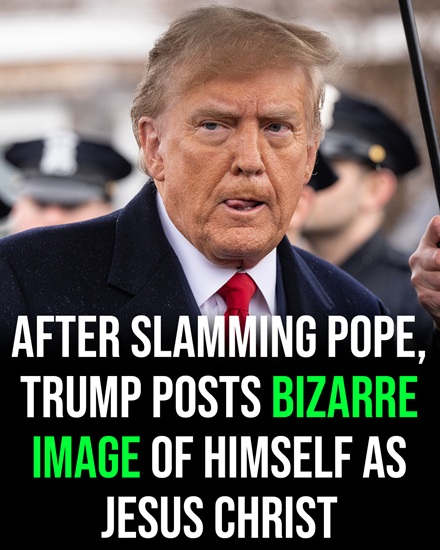
Recent online discussions have intensified after widespread claims circulated across social media platforms suggesting that Donald Trump shared a controversial AI-generated image on his Truth Social account, sparking global debate and public reaction.
According to user reports and online descriptions, the alleged image depicts Trump in a highly symbolic and religiously themed composition, which quickly attracted attention due to its visual style and perceived meaning.
The circulating narrative suggests that the image portrays Trump wearing flowing robes in white and red tones, positioned in a dramatic scene involving a healing gesture directed toward an individual lying in a hospital bed.
Many online descriptions compare the visual composition to traditional religious artwork, particularly imagery associated with spiritual healing, symbolism, and depictions of authority figures in moments of intervention or transformation.

The scene, as described in social media discussions, reportedly includes strong visual effects such as glowing light, emotional expressions from surrounding figures, and carefully staged dramatic positioning.
Some users also claim that the background contains symbolic references such as national monuments, patriotic elements, and stylized representations of American cultural imagery, although these details remain unverified.
Because the image has not been confirmed through official or independent journalistic sources, its exact content remains based primarily on user-generated descriptions and viral social media interpretations.
The timing of the alleged post has also contributed to the controversy, with claims suggesting it appeared shortly after Trump made critical remarks regarding Pope Leo XIV in separate online commentary.
According to circulating posts, Trump’s comments reportedly included criticism of the Pope’s stance on international political issues, foreign policy decisions, and global conflict-related statements.
These claims have fueled additional discussion online, with users linking the alleged image to broader debates about political messaging, religious symbolism, and digital communication strategies.

At the same time, the figure referred to as Pope Leo XIV in these discussions has been described in online narratives as a religious leader who has spoken about peace, humanitarian concerns, and international conflict.
Some circulating summaries attribute statements to him emphasizing diplomacy, reduction of violence, and protection of civilians affected by ongoing global tensions, although official confirmation of these statements is limited.
Online discourse suggests that responses to these alleged interactions were divided, with some users interpreting the situation as symbolic expression, while others viewed it as controversial political messaging.
Supporters in certain online communities described the alleged imagery as artistic or metaphorical, arguing that political figures often use symbolic visuals to communicate broader ideas or themes.
Critics, however, raised concerns about the use of religious symbolism in political contexts, suggesting that such imagery can lead to misinterpretation or emotional polarization among audiences.
This divide reflects a broader trend in digital communication, where political content is often rapidly interpreted differently depending on personal beliefs, cultural background, and media perspective.
The role of artificial intelligence in generating or enhancing political imagery has also become a major topic of discussion in recent years, particularly regarding authenticity and public perception.

Experts in digital media analysis frequently emphasize that AI-generated visuals can be highly realistic, making it difficult for audiences to distinguish between authentic photographs and digitally created content.
In this case, the lack of official confirmation regarding the image has contributed to uncertainty, allowing interpretations and assumptions to spread widely across online platforms.
The narrative surrounding Trump’s alleged post also fits into a broader pattern of viral political content that often circulates rapidly without verification before reaching large global audiences.
Historically, Trump’s social media activity has attracted significant attention, with posts frequently generating strong reactions due to their direct tone, visual elements, or controversial framing.
Observers of digital communication trends note that political figures often use imagery and messaging strategies designed to engage audiences quickly in highly competitive online environments.
As a result, even unverified claims involving such figures can gain widespread visibility, particularly when they involve emotionally charged or visually striking content.
Social media platforms contribute to this phenomenon by amplifying trending posts through engagement-based algorithms, which prioritize content that generates high interaction rates.

This system can sometimes lead to the rapid spread of narratives that are not fully verified, especially when they involve high-profile individuals or controversial themes.
Media analysts emphasize the importance of distinguishing between confirmed reporting, user-generated content, and speculative interpretations when evaluating such viral stories.
In the absence of verified sources, circulating narratives should be understood as part of broader digital discourse rather than established factual reporting.
The reactions to the alleged image also highlight how political and religious symbolism can intersect in modern communication, often leading to polarized interpretations.
Some users interpret such imagery as expressive political storytelling, while others view it as potentially inappropriate depending on context and perceived intent.
This ongoing debate reflects broader questions about the boundaries of political expression in the digital age, especially when AI-generated media is involved.
In addition, the rapid circulation of such content demonstrates how online narratives can evolve independently of traditional journalistic verification processes.
Once a story gains traction online, it is often reshared, reinterpreted, and expanded upon by users, sometimes introducing additional details that are not part of the original claim.
This process contributes to the formation of complex viral narratives that may blend factual elements, speculation, and creative interpretation.
Ultimately, the discussion surrounding the alleged Trump AI-generated image highlights the growing influence of digital media in shaping political perception and public discourse.
It also underscores the importance of media literacy in helping audiences critically evaluate the authenticity and origin of viral content.
In conclusion, while the circulating narrative about Donald Trump and the alleged symbolic AI-generated image has gained widespread attention online, it remains unverified and should be interpreted as part of ongoing social media discourse rather than confirmed reporting.
As digital communication continues to evolve, distinguishing between factual information and viral interpretation becomes increasingly important for accurate understanding of global events.
