
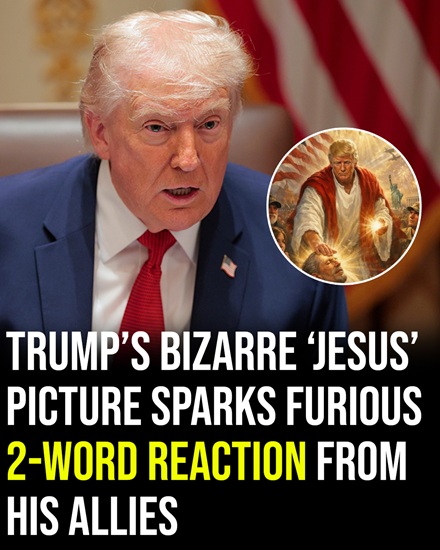
Donald Trump has recently become the focus of widespread online discussion following the circulation of an AI-generated image he shared on his social media platform Truth Social, drawing strong reactions across political and religious communities.
The image, which quickly spread across various platforms, sparked debate due to its religious symbolism and highly stylized presentation. Many observers interpreted it differently depending on political and cultural perspectives.
The post appeared shortly after Trump shared a separate message criticizing Pope Leo XIV. In that message, he used strong language regarding the pope’s public statements on foreign policy and crime-related issues.
Following this, Trump posted an AI-generated illustration without any caption or explanation. The lack of context contributed to increased speculation about its intended meaning and purpose among viewers and commentators.

The image depicted Trump in a stylized, symbolic scene where he appears wearing flowing robes and placing his hand on an elderly man lying in a hospital bed in a gesture resembling healing.
Many viewers noted similarities between this imagery and traditional religious depictions of Jesus Christ healing the sick, which intensified discussion about symbolism and perceived intent behind the post.
Around the central figures, additional characters were visible in the image, including individuals resembling medical staff, soldiers, and civilians observing the scene in a reverent or emotional manner.
The background also contained various symbolic elements associated with American identity, such as imagery resembling national monuments, flags, and other patriotic references often used in political visuals.
Some interpretations of the image also included references to military aircraft, eagles, and dramatic lighting effects, contributing to its highly stylized and emotionally charged appearance.
Because the image was AI-generated, public interpretations varied widely. Some viewed it as symbolic political messaging, while others considered it provocative or potentially inappropriate due to religious undertones.
A portion of online commentary focused on speculation about specific details in the image. However, many of these interpretations remain unverified and are based on individual perception rather than confirmed information.

As the image circulated, reactions quickly divided across social media platforms. Some users expressed strong criticism, while others defended it as artistic expression or symbolic communication.
Critics argued that the use of religious imagery in a political context can be sensitive, especially when it involves figures or themes associated with deeply held spiritual beliefs.
Some observers expressed concern that the depiction may blur the line between political messaging and religious symbolism, leading to misunderstandings or unintended offense among viewers.
Other commentators described the image as inappropriate, stating that public figures should be cautious when using imagery that may be interpreted as sacred or spiritually significant.
At the same time, supporters of Trump interpreted the post differently, suggesting it may represent symbolic communication rather than literal representation or religious claim.
Within conservative and religious communities, reactions were not uniform. While some strongly criticized the post, others defended it as expressive or metaphorical in nature.

Several commentators in media and political analysis circles noted that Trump has previously used AI-generated or stylized imagery in his online communication strategy.
This pattern of visual communication has been a recurring topic of discussion, particularly when such imagery includes symbolic or exaggerated representations of political themes.
In this case, the inclusion of religious-style imagery made the reaction more intense compared to previous posts that focused primarily on political or cultural symbolism.
Religious commentators emphasized that imagery connected to faith traditions often carries deep emotional and cultural significance, which can lead to heightened sensitivity in public discourse.
Because of this, some analysts suggested that public figures should exercise caution when engaging with religious symbolism, especially in politically polarized environments.
Others argued that AI-generated content is increasingly common in digital communication and that interpretation often depends on viewer perspective and context.

The absence of an official explanation from Trump regarding the image contributed to ongoing speculation and discussion across media outlets and online communities.
White House officials, speaking anonymously in some reports, suggested that similar controversies in the past have often diminished over time as new political events emerge.
However, they also acknowledged that religious symbolism in political imagery tends to generate stronger reactions compared to standard political communication or commentary.
The incident has also been widely discussed in relation to the growing use of artificial intelligence in creating political imagery and digital content.
Experts in media studies note that AI-generated visuals introduce new challenges in communication, particularly when symbolism can be interpreted in multiple and conflicting ways.
In this case, the lack of clear explanation means the public interpretation remains open, shaped largely by personal beliefs, political alignment, and cultural background.
As a result, discussions around the image have become highly polarized, reflecting broader divisions in how political messages are interpreted in the digital age.
Some analysts suggest that such controversies highlight the increasing difficulty of separating artistic expression, political messaging, and religious symbolism in modern media environments.
Supporters often view such imagery as symbolic or expressive, while critics may interpret the same content as inappropriate or misleading depending on context.
The controversy also reflects a broader trend in which AI-generated content is becoming a central part of political communication strategies worldwide.
As artificial intelligence tools become more accessible, political figures and public personalities are increasingly using them to create visual narratives.
This development raises ongoing questions about responsibility, interpretation, and the potential impact of digitally generated political imagery on public discourse.
In this situation, reactions were amplified by the timing of the post and the sensitive nature of the religious themes involved in the imagery.
Observers note that symbolic communication in politics often carries different meanings depending on audience interpretation and cultural background.
The same image can therefore be seen as inspirational by some viewers and controversial by others, depending on individual perspectives.
This divide illustrates how digital communication in modern politics often leads to rapid and highly contrasting interpretations.
The discussion also highlights the role of social media platforms in amplifying political content and accelerating public response cycles.
As the image continued circulating, commentary expanded beyond political circles into religious, cultural, and media analysis discussions.
Many experts emphasize that in the current digital environment, visual content often spreads faster and generates stronger reactions than written statements.
This makes AI-generated imagery particularly influential in shaping public perception and political narratives.
While interpretations remain divided, the incident demonstrates how quickly symbolic content can become a focal point of national and international debate.
It also reflects the broader challenges of communication in an era where artificial intelligence can generate highly realistic and emotionally charged visual content.
As discussions continue, analysts suggest that similar situations are likely to occur more frequently as AI tools become more integrated into political communication.
In conclusion, the controversy surrounding the AI-generated image illustrates the complex relationship between politics, religion, symbolism, and modern digital media.
It also shows how a single post can generate widespread debate, influenced by interpretation, context, and individual perspective across diverse audiences.
