
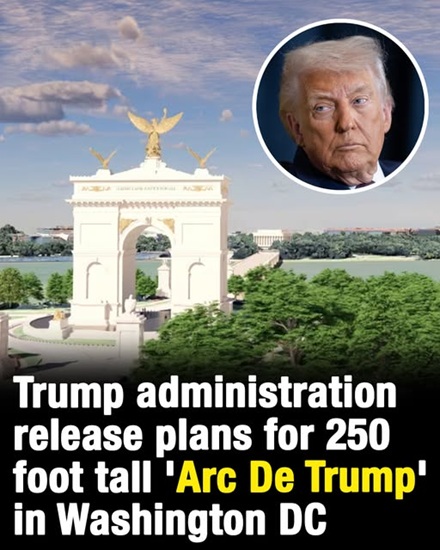
Recent discussions in political and media circles have brought renewed attention to a proposed monumental structure associated with former U.S. President Donald Trump, sparking widespread curiosity, debate, and analysis.
The concept, often referred to informally as the “Arc de Trump,” has been described as a large triumphal arch inspired by historic European landmarks, particularly the iconic Arc de Triomphe in France.
The Arc de Triomphe itself stands as a globally recognized symbol of national pride, originally commissioned by Napoleon Bonaparte to honor military victories and commemorate French history.
In the American context, the proposed monument concept aims to reflect themes of patriotism, national identity, and historical continuity, aligning itself with the broader tradition of monumental architecture found throughout Washington, D.C.

According to publicly shared descriptions and earlier presentations, the concept envisions a large-scale structure that would stand prominently within the capital, contributing to the already symbolic and historically rich environment of the city.
Washington, D.C. is widely known for its carefully planned layout, featuring monuments dedicated to key historical figures such as George Washington and Thomas Jefferson.
The city also includes the renowned Lincoln Memorial, which honors Abraham Lincoln and serves as one of the most visited and meaningful landmarks in the United States.
Within this context, any proposal for a new large monument naturally raises questions about scale, placement, and the criteria used to determine which figures or ideas are commemorated.
Descriptions of the “Arc de Trump” suggest a structure that could reach approximately 250 feet in height, making it one of the tallest architectural elements within the central monumental area.
If constructed at that scale, such a structure would significantly influence the visual landscape of the capital, potentially altering sightlines and the balance between existing monuments and open public spaces.

Some conceptual designs reportedly include a central archway framed by classical architectural elements such as columns, sculpted reliefs, and decorative features intended to evoke historical grandeur and permanence.
In several widely discussed mockups, a statue resembling Lady Liberty appears as a central or crowning element, reinforcing symbolic connections to freedom and democratic ideals associated with the Statue of Liberty.
The inclusion of Lady Liberty imagery reflects a broader tradition in American symbolism, where figures representing liberty and justice are used to communicate foundational national values and aspirations.
Additional elements described in conceptual versions include inscriptions such as “One Nation Under God,” a phrase commonly associated with American civic identity and widely recognized in public discourse.
Some versions of the design also feature sculptural lions positioned at the base, a traditional architectural motif often used to represent strength, vigilance, and authority in monumental design.
While these details have generated significant discussion online, it is important to emphasize that no officially approved project of this nature has been confirmed through standard federal planning and review processes.
In Washington, D.C., the development of new monuments requires careful evaluation by multiple institutions, including the National Capital Planning Commission, which oversees urban planning decisions.
Another key body involved in such decisions is the U.S. Commission of Fine Arts, responsible for reviewing architectural proposals to ensure they align with the city’s historical and aesthetic standards.

These review processes are designed to preserve the integrity of Washington’s monumental core while allowing for thoughtful and historically appropriate additions when deemed suitable.
Because of these requirements, any proposal of this scale would likely undergo years of evaluation, including public input, environmental impact studies, and legislative consideration before construction could begin.
Despite the lack of official confirmation, the idea has generated a wide range of reactions, reflecting the diverse perspectives that often accompany discussions about national symbols and public monuments.
Supporters of the concept argue that new monuments can serve as powerful expressions of modern history, reflecting recent political developments and acknowledging contemporary leadership within the broader narrative of the nation.
Some proponents also view large-scale architectural projects as opportunities to create visually impactful landmarks that attract tourism and contribute to the cultural and economic vitality of the capital.
On the other hand, critics emphasize the importance of historical distance when commemorating individuals, suggesting that monuments should represent widely recognized and enduring contributions over time.
Others have raised concerns about the potential impact of a large new structure on the carefully designed layout of Washington, D.C., which was originally planned with a balance of open space and symbolic architecture.
Urban planners often highlight the significance of maintaining sightlines between major landmarks, noting that these visual connections contribute to the city’s unique identity and historical coherence.

The introduction of a new monument with significant height and scale could potentially disrupt these design elements, leading to ongoing discussions about preservation versus modernization.
Another important aspect of the conversation involves the role of digital imagery and conceptual design in shaping public perception of proposed projects.
Advances in visualization technology have made it possible to create highly detailed mockups that appear realistic, even when the underlying projects remain conceptual or unapproved.
These visual representations can quickly spread across social media platforms, influencing public opinion and generating discussion long before any formal decisions are made.
As a result, distinguishing between conceptual ideas and confirmed projects has become increasingly important in modern media environments, where information spreads rapidly and widely.
The discussion surrounding the “Arc de Trump” also reflects broader questions about how societies choose to commemorate individuals and events through physical structures.
Throughout history, monuments have served as enduring symbols of cultural values, often reflecting the priorities and perspectives of the time in which they were created.
From ancient arches to modern memorials, such structures carry both artistic and political meaning, shaping how future generations understand historical narratives.
In the United States, the process of creating monuments has traditionally involved extensive deliberation, ensuring that commemorative structures reflect a broad consensus and lasting significance.
This approach helps ensure that monuments remain meaningful over time, rather than becoming sources of ongoing controversy or division.
As conversations about new monuments continue, the “Arc de Trump” concept serves as an example of how ideas can generate significant attention even without formal approval.
It highlights the intersection of politics, architecture, and public perception in shaping discussions about national identity and historical legacy.
Ultimately, whether viewed as a visionary proposal, a controversial concept, or simply an architectural idea, the discussion reflects the evolving nature of how societies engage with history.
For now, the proposed monument remains part of a broader public conversation rather than a confirmed development, illustrating how powerful ideas can influence debate without becoming physical reality.
As with many topics related to public memory and national symbolism, opinions are likely to remain divided, ensuring that discussions about monuments and legacy continue well into the future.
