
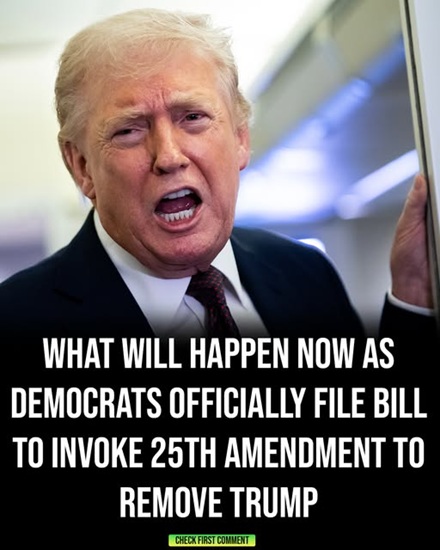
House Democrats in the United States Congress have introduced new legislation that seeks to establish a structured and formalized process for evaluating the fitness of a sitting president to carry out the duties of the office.
The proposal is connected to the 25th Amendment of the U.S. Constitution, which outlines procedures for dealing with presidential incapacity and succession in extraordinary circumstances.
The bill has attracted attention in Washington due to its focus on presidential capacity and the creation of a formal mechanism for assessment.
It is not designed to remove any specific president automatically, but rather to create a system that could be used in cases where serious concerns about physical or mental ability arise during a presidency.
Supporters of the proposal argue that the United States lacks a clear, independent, and standardized process for evaluating presidential fitness when questions emerge about a president’s ability to perform constitutional responsibilities. They believe this gap could be addressed through a bipartisan commission.

The legislation has been associated with Representative Jamie Raskin and other Democratic lawmakers who have expressed concerns about presidential accountability and institutional stability. According to public statements, the proposal aims to strengthen constitutional safeguards rather than target any individual president.
The bill reportedly has around 50 Democratic co-sponsors in the House of Representatives, showing a level of support within the Democratic caucus. However, it does not currently have broad bipartisan backing, which limits its chances of moving forward in the current political environment.
Under the proposed structure, the legislation would establish a 17-member bipartisan commission made up of former senior officials from both political parties.
These individuals would be appointed by congressional leaders and would not be active members of the executive branch.
The purpose of this commission would be to evaluate whether a sitting president is mentally or physically capable of carrying out the duties of the office as defined under the U.S. Constitution. The commission would operate as an advisory and evaluative body.
If concerns were formally raised, the commission could review relevant information and, in certain circumstances, recommend further medical or cognitive evaluation. This could include requests for examinations conducted by qualified medical professionals.

The intention behind this structure is to create a more consistent and transparent method of evaluating presidential capacity in rare and serious cases, while reducing the influence of partisan political conflict.
Representative Jamie Raskin, one of the leading figures associated with the proposal, has argued that public confidence in presidential fitness is an important constitutional issue. He has stated that Congress has a responsibility to ensure mechanisms exist to address potential incapacity at the highest level of government.
In his remarks, Raskin referenced concerns about political rhetoric, foreign policy statements, and public behavior that he believes have contributed to wider debates about presidential stability and decision-making.
He also pointed to recent controversies involving statements on international conflicts, including tensions related to Iran and broader Middle Eastern geopolitical issues. These comments have been cited by supporters of the bill as part of the context for introducing the legislation.
Additionally, attention has been drawn to a social media post shared by President Donald Trump that included an AI-generated image portraying him in a religious context. This post received criticism from some political and public observers and became part of the wider public discussion referenced by lawmakers.
Raskin has argued that Congress must ensure preparedness for situations in which questions about presidential capacity become a matter of national importance. He has emphasized that the issue should be treated as one of constitutional responsibility rather than partisan politics.

The proposal connects directly to the 25th Amendment, which was ratified in 1967. This amendment outlines procedures for transferring presidential power in cases where a president is unable to discharge official duties.
Under the amendment, the vice president and a majority of the cabinet must agree in order to declare a president unable to perform their duties. This process is considered politically and legally complex, and has rarely been invoked in modern U.S. history.
Even if the proposed commission were established, it would not have the authority to remove a president directly. Instead, its findings would serve as recommendations that could inform constitutional procedures under the 25th Amendment.
Final authority under the amendment would still rest with the vice president and a majority of cabinet officials, making removal a highly structured and politically sensitive process.
Because of these requirements, constitutional experts generally view the removal of a sitting president under the 25th Amendment as a difficult and unlikely outcome unless there is broad executive agreement.
Republican lawmakers are expected to oppose the legislation, particularly given the current balance of power in Congress. Without bipartisan support, the bill faces significant procedural challenges in advancing through committees and reaching a full vote.
Critics of the proposal argue that establishing such a commission could lead to the politicization of medical or psychological assessments of presidents. They caution that it could be used as a political tool during periods of partisan disagreement.

The White House has strongly rejected the claims underlying the proposal. Administration representatives have defended President Trump’s ability to serve and dismissed concerns about cognitive or physical incapacity.
A spokesperson for the White House criticized the arguments made by Representative Raskin, describing them as politically motivated and disputing the characterization of the president’s condition.
The administration also referenced comparisons with previous political leadership, arguing that claims about mental or physical decline have been inconsistently applied across different administrations and political contexts.
Supporters of President Trump have similarly rejected the proposal, arguing that questions of fitness for office should be decided by voters through elections rather than by congressional commissions.
They maintain that the president remains active in domestic and international affairs and continues to perform the responsibilities of the office.
At the same time, supporters of the legislation argue that the proposal is not intended to remove any specific president but to ensure that the United States has a clear and structured process in place for rare constitutional situations.
They emphasize that the goal is institutional preparedness and safeguarding democratic stability rather than engaging in partisan conflict.
The debate surrounding the proposal has intensified broader political divisions in Washington, where disagreements over presidential authority, foreign policy, and executive power remain highly contentious.
Some lawmakers and political observers believe the discussion reflects deeper concerns about transparency, governance, and the limits of executive authority in modern American politics.
Others view it as part of ongoing partisan disputes that have characterized recent legislative sessions, particularly in relation to presidential conduct and national security issues.
Legal analysts note that the 25th Amendment was designed for extraordinary circumstances, such as sudden illness or incapacity, rather than routine political disagreements or policy disputes.
Historically, the amendment has been used sparingly, and its most common application has involved temporary transfer of power during medical procedures rather than permanent removal of a president.
As a result, the proposed legislation is expected to face significant debate before any potential advancement through the legislative process.
Even within the Democratic Party, there may be varying opinions on how far the proposal should go and how such a commission should operate in practice.
Given the current composition of Congress and expected opposition from Republicans, the bill is widely viewed as having limited chances of becoming law in its present form.
Nevertheless, the introduction of the legislation has added to ongoing national discussions about presidential accountability and the mechanisms available under the U.S. Constitution.
The broader issue continues to be part of a larger political conversation in the United States about leadership, governance, and institutional safeguards.
At this stage, the proposal remains in its early legislative phase, and its future will depend on committee review, political negotiations, and the overall direction of congressional priorities.
For now, it stands as a significant but controversial effort to formalize how questions of presidential fitness might be evaluated within the framework of constitutional law.
