
A high-profile state visit between the United Kingdom and the United States drew significant global attention, not only for its diplomatic importance but also for the strong visual presence of its participants. When senior political figures and members of the royal family appear together in formal settings, every detail—from speeches to clothing—often becomes part of a broader public conversation. In this case, fashion choices, protocol expectations, and media interpretation all contributed to a widely discussed cultural moment.
The White House state dinner held during the visit served as one of the most important events of the trip. Taking place in a formal diplomatic setting, the evening brought together King Charles III, Queen Camilla, President Donald Trump, and First Lady Melania Trump. The dinner followed earlier engagements, including official ceremonies and speeches that emphasized the long-standing historical relationship between the two nations. The atmosphere was structured, ceremonial, and carefully coordinated according to traditional diplomatic protocol.
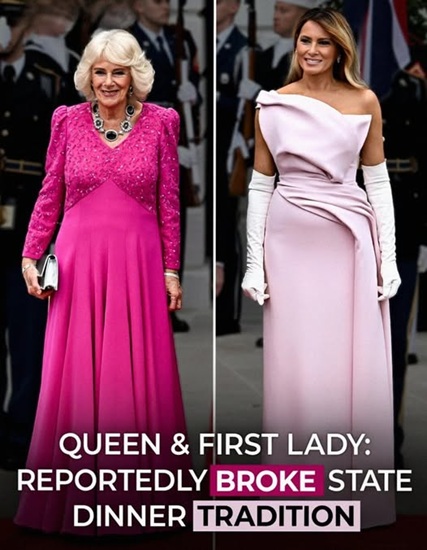
Melania Trump’s appearance at the state dinner quickly became a focal point of public discussion. She wore a pale pink silk gown designed with a structured silhouette, complemented by long gloves and minimal accessories. The overall look reflected a modern interpretation of formal elegance, combining simplicity with high-fashion tailoring. Fashion observers often analyze such choices in terms of color balance, silhouette, and symbolism, especially during internationally significant events.

Queen Camilla’s outfit also attracted attention for its distinct stylistic approach. She wore a brighter pink ensemble with a traditional royal silhouette, paired with a diamond necklace that reflected long-standing royal jewelry traditions. Her look emphasized continuity with established ceremonial fashion norms within the British royal family. Together, the two appearances created a visual contrast between modern diplomatic fashion and traditional royal styling.
Color choices during state visits are often analyzed by commentators who follow diplomatic fashion closely. While no official confirmation is typically given regarding symbolic intent, soft color palettes such as pink, white, and pastel tones are frequently associated with formality, respect, and ceremonial balance. In this context, both Melania Trump and Queen Camilla appeared in variations of pink, which became a notable visual theme of the evening.

Earlier moments during the visit also contributed to ongoing fashion discussions. Melania Trump was seen in a tailored butter-yellow suit during one engagement, while Queen Camilla appeared in a white ensemble during another official appearance. These outfits were widely interpreted as reflecting a blend of personal style and national design identity, as both women wore pieces from designers associated with their respective countries. Such choices are often viewed as subtle expressions of cultural representation during diplomatic events.
Public reaction to the state dinner and associated appearances spread rapidly across social media platforms. Discussions ranged from admiration of elegance and presentation to personal interpretations of style choices. As is common with high-visibility events involving political and royal figures, opinions were divided and highly subjective. Some viewers focused on aesthetics and refinement, while others analyzed perceived symbolism or compared outfits to historical fashion references.

Fashion commentary in diplomatic settings often extends beyond clothing itself and enters broader cultural analysis. Analysts frequently discuss how modern state visits reflect evolving expectations of public image, where tradition and contemporary style intersect. Over time, royal fashion and political wardrobe choices have become part of a larger media narrative that extends well beyond the event itself.
Alongside fashion discussions, broader media attention surrounding public figures during the same period contributed to increased online engagement. Political commentary, entertainment media, and public discourse often overlap during high-profile international visits, creating a complex media environment where multiple narratives develop simultaneously. In such contexts, fashion becomes one of several focal points of public interest.

State dinners, in particular, are designed to represent diplomacy, respect, and continuity between nations. Every element, from seating arrangements to dress codes, follows established protocols intended to reflect mutual recognition and formality. Within this framework, clothing choices are not only personal expressions but also part of the visual language of diplomacy, contributing to the tone of the event.
The combination of royal presence and U.S. leadership at the same event naturally intensified public interest. King Charles III’s address to Congress earlier in the visit added historical context to the trip, reinforcing the long-standing relationship between the two countries. Against this backdrop, the state dinner served as a symbolic conclusion to a series of formal diplomatic engagements.
Fashion experts often note that state visits provide rare moments where high-level diplomacy intersects with global media visibility. As a result, even subtle stylistic decisions can generate widespread discussion. However, interpretations vary widely, and most commentary remains subjective rather than definitive. This is especially true in the age of social media, where visual impressions are quickly shared and analyzed by global audiences.

Ultimately, the state visit demonstrated how modern diplomacy operates on multiple levels simultaneously. Formal political discussions, ceremonial traditions, and public perception all interact to shape how such events are remembered. Fashion, while only one aspect of the visit, played a visible role in how audiences engaged with the occasion and interpreted its atmosphere.
In the end, the state dinner and surrounding events reflected both continuity and evolution in diplomatic tradition. While the core structure of formal state visits remains consistent, public interpretation continues to expand, influenced by media coverage, cultural trends, and online discussion. The result is a modern diplomatic experience where symbolism, presentation, and public engagement all contribute to the overall narrative.
