Monday, November 23, 2026Independent ideas for everyday life.

Author: admin

  • My Mother-in-Law Refused to Accept My Newborn as Her Grandchild – Until a DNA Test Revealed an Unexpected Truth

    My Mother-in-Law Refused to Accept My Newborn as Her Grandchild – Until a DNA Test Revealed an Unexpected Truth

    The first time my mother-in-law saw my newborn daughter, she didn’t smile. She didn’t ask how the delivery had gone, whether I was recovering well, or whether the baby had been sleeping. She didn’t even reach out to touch the tiny hand resting beside the blanket.

    Instead, she leaned over the bassinet and stared at my daughter’s hair. It was bright copper red. Stella was only nine days old, and already that little patch of hair seemed to have become the most interesting thing in the room.

    My husband, Bryson, and I both had dark brown hair. We also had brown eyes. Stella, however, had inherited a completely different appearance. Her hair was reddish, her skin was fair, and her eyes were still a striking shade of blue.

    I was sitting on the couch with a cushion behind my back and an ice pack resting against my side. My body was still recovering from childbirth, and I was exhausted in a way I had never experienced before.

    Yet the moment I noticed Gianna’s expression, I knew something was wrong.

    “That’s certainly… noticeable,” she finally said.

    I looked at her.

    “What is?”

    She didn’t answer immediately. Instead, she continued examining Stella as though she were trying to find an explanation hidden somewhere in the baby’s face.

    “Her hair,” she eventually replied.

    I glanced down at my daughter.

    “She’s beautiful,” I said quietly.

    Gianna straightened, but her expression didn’t change.

    Bryson walked into the room carrying two cups of coffee. He noticed his mother’s serious expression and gave a small laugh.

    “What’s going on here?”

    “Your daughter has quite an interesting appearance,” Gianna replied.

    Bryson looked into the bassinet.

    “She’s nine days old, Mom. Babies change.”

    He smiled and gently touched Stella’s blanket.

    “Besides, she’s perfect.”

    Gianna didn’t smile back.

    “Hair can darken,” she said. “Eyes can change, too.”

    Then she looked directly at me.

    “But not everything changes.”

    I felt my stomach tighten.

    I wanted to believe I had misunderstood her. I wanted to believe she was simply making an awkward comment about genetics.

    But something in her voice suggested otherwise.

    And unfortunately, this wasn’t the first time she had made me feel unwelcome.


    Gianna had never been particularly warm toward me.

    From the beginning of my relationship with Bryson, she seemed determined to find something wrong with every decision I made.

    When we bought our first house together, she walked through the living room, looked around, and asked whether her son really had to come home to a place like that every day.

    When I changed jobs, she remarked that not everyone was ambitious enough to build a successful career.

    When I prepared dinner for the family, she occasionally made comments about how Bryson had always preferred his mother’s cooking.

    None of these remarks seemed particularly serious when considered individually.

    That was what made them difficult to confront.

    Whenever I mentioned them to Bryson, he would sigh and say the same thing.

    “That’s just Mom, Macy.”

    For years, I accepted that explanation.

    I told myself that perhaps Gianna needed time to adjust to having another woman in her son’s life. I tried not to take every comment personally.


    Pages: 1 2 3 4 5 6 7 8 9 10

  • I Took My Young Son to His Dream Football Match to Make One Special Wish Come True – A Day We’ll Never Forget

    I Took My Young Son to His Dream Football Match to Make One Special Wish Come True – A Day We’ll Never Forget

    I thought I knew what the most memorable part of that day would be. I expected my son Ethan to spend the afternoon watching his favorite football player, Jake Thompson, compete on the field. I imagined him cheering whenever Jake touched the ball, celebrating every successful play, and talking about the game all the way home.

    That was the reason we had brought him to the stadium. Ethan had been looking forward to the match for a long time. He knew Jake’s playing style, recognized his number, and could talk about his favorite moments with the kind of enthusiasm only a devoted young fan could have.

    But there was another reason the day meant so much to our family.

    Ethan had been dealing with an illness, and we wanted to give him something positive to look forward to. We wanted him to enjoy an experience that would take his mind away from appointments, difficult conversations, and the uncertainty that had become part of our everyday lives.

    We did not need the day to be perfect.

    We simply wanted to see him smile.

    My husband and I had no idea that the afternoon would become something none of us would ever forget.

    Because before the game was over, Ethan’s favorite player would leave the field-side area, walk toward our row, and bring our son a gift that had been signed by the entire team.

    And that was only the beginning.

    A Day Ethan Had Been Waiting For

    From the moment we arrived at the stadium, Ethan seemed different.

    He was excited, alert, and eager to take in every detail. The sounds of the crowd, the movement around the entrances, and the sight of the field seemed to make the entire experience feel special.

    He kept looking around.

    Every few moments, he would turn toward us and point out something he had noticed.

    “Mom, look at the field!”

    Then he would turn toward his father.

    “Do you think Jake will start today?”

    My husband smiled and told him we would soon find out.

    Ethan had already talked about the match countless times at home. He had imagined what it would be like to see his favorite player in person rather than through a screen.

    He knew that watching a professional match from the stands would be different.

    Pages: 1 2 3 4 5 6 7 8 9 10

  • A Childhood Filled With Judgment: The Truth That Finally Divided My Family

    A Childhood Filled With Judgment: The Truth That Finally Divided My Family

    For ten years, the people in our town believed Nora was responsible for my daughter Emily’s disappearance.

    They called her heartless. They whispered that she had been jealous, that she had manipulated a younger girl, and that she knew far more about that rainy night than she had ever admitted.

    Some people never bothered to hide their opinions.

    Whenever Nora walked down the street, conversations became quieter. Neighbors looked away, shopkeepers exchanged uncomfortable glances, and strangers seemed to recognize her before she had even introduced herself.

    She was a child when Emily disappeared.

    Yet the town treated her as though she had been an adult capable of planning something terrible.

    And I was treated almost as badly for refusing to turn my back on her.

    People called me foolish. Some said grief had destroyed my judgment. Others believed I had taken Nora into my home because I could not accept that Emily was gone.

    But I knew what Emily had thought of Nora.

    She had loved that girl.

    And when Nora was left without anyone capable of caring for her, I could not bring myself to abandon her too.

    For ten years, I raised her as my daughter while keeping Emily’s bedroom almost exactly as it had been on the night she vanished.

    I never imagined that one evening, after all those years of silence, Nora would walk through my front door and tell me something that would change everything I thought I knew.

    It was raining again.

    And this time, the truth was finally coming home.

    The Night Everything Changed

    The rain had started before sunset.

    It tapped against the kitchen window, ran down the glass in uneven streams, and turned the streetlights outside into blurry circles of yellow.

    I sat alone at the kitchen table.

    In front of me lay an old pink scarf.

    It had belonged to Emily, and I had kept it for ten years. The fabric had become softer with age, and one corner was slightly frayed from the way she used to twist it around her fingers.

    I could still picture her wearing it.

    She had always been particular about little things. She liked her hair a certain way, preferred one particular mug for hot chocolate, and complained whenever I forgot to buy her favorite cereal.

    Those ordinary memories had become precious.

    After a person disappears, the smallest details can begin to feel enormous.

    I remembered the sound of her footsteps in the hallway. I remembered her laughter coming from upstairs. I remembered how she used to call my name from another room instead of simply walking over to speak to me.

    And I remembered our final argument.

    That memory was the hardest to carry.

    For ten years, I had replayed it in my mind, wondering whether one different sentence could have changed everything.

    But there was no way to return to that evening.

    There was only the empty chair across from me, the pink scarf, and the daughter I had never stopped waiting for.

    Then I heard the front door open.

    At first, I thought Nora had returned from one of her evening walks.

    But something about the sound was different.

    The door did not close immediately. There was a pause, followed by the sound of someone standing motionless in the entrance.

    I looked toward the hallway.

    “Dad?”

    Her voice was barely audible.

    I stood up.

    Nora was soaked. Her hair clung to her face, and her hands were trembling. Her expression was so pale that I immediately wondered whether she had been hurt.

    “What happened?” I asked, moving toward her.

    Pages: 1 2 3 4 5 6 7 8 9 10

  • Grandma’s Simple Trick for Cleaning a Dryer Vent

    Grandma’s Simple Trick for Cleaning a Dryer Vent

    For years, I thought cleaning the dryer meant doing one simple thing: opening the door, removing the lint from the screen, and getting on with the next load of laundry. It was such a familiar part of the routine that I rarely gave it a second thought.

    Whenever the clothes came out slightly damp, I assumed I had overloaded the machine or chosen the wrong drying setting. Sometimes I simply started another cycle and moved on with my day.

    Then my grandmother showed me something I had been overlooking.

    She explained that the lint screen was only one part of the dryer’s ventilation system. Farther behind the appliance, inside a duct that most people rarely inspect, lint could gradually collect and interfere with the movement of air.

    I remember expecting her to show me some complicated repair involving special equipment. Instead, she brought out a vacuum cleaner, a flexible dryer vent brush, and a few basic supplies.

    What surprised me most was not the equipment. It was how carefully she approached an area of the house I had almost forgotten existed.

    She wanted me to understand that a dryer does more than heat clothes. It also needs to move warm, moist air safely out of the appliance and through the exhaust duct.

    And when that pathway becomes restricted, the consequences can be more important than an inconvenient laundry day.

    The Part of the Dryer Most People Rarely See

    The lint screen is easy to remember because it is directly in front of us. Most people can see the collected fibers after every load, and removing them quickly becomes a habit.

    The exhaust duct is different.

    It is usually positioned behind the dryer, sometimes connected to a longer ventilation route that passes through a wall, floor, or ceiling before reaching the outside of the home.

    Because much of this system is hidden, it can be easy to forget that it needs attention too.

    My grandmother explained that lint does not necessarily stop collecting just because the visible screen has been cleaned. Small amounts of lint can move beyond the screen and accumulate in parts of the exhaust system.

    Over time, that material may contribute to restricted airflow.

    At first, the change might be difficult to recognize. The dryer may continue working, the drum may turn normally, and the clothes may still become warm.

    Pages: 1 2 3 4 5 6 7 8 9 10

  • A Husband Mocked His Wife’s New Perm – He Had No Idea Her Best Friend Was His Barber

    A Husband Mocked His Wife’s New Perm – He Had No Idea Her Best Friend Was His Barber

    At eighty years old, I had learned that retirement did not necessarily mean having less work to do. Sometimes, it simply meant having more time to supervise one extremely stubborn husband.

    My name is Birdie, and I had been married to Walter for fifty-eight years. If someone had asked me what kept our marriage going for so long, I probably would have mentioned patience, understanding, and the ability to forgive.

    But if I were being completely honest, I would have added one more thing.

    A very healthy sense of humor.

    Walter was eighty-two, and he still behaved like a mischievous teenager whenever he thought he could get away with something.

    He loved teasing me, making ridiculous comments, and pretending that he had forgotten things he knew perfectly well.

    I had learned not to take every little remark seriously.

    After all, when you have shared nearly six decades with someone, you eventually discover that arguing over every silly comment is simply exhausting.

    Still, there were moments when even my patience had limits.

    And one Thursday morning, Walter managed to find one of them.

    It began with a pair of reading glasses.

    “Birdie, have you seen my glasses?” he called from the living room.

    I was standing in the kitchen, preparing breakfast, when I heard him moving cushions and opening drawers.

    “Have you checked your head?” I asked.

    “My head?”

    “Yes. That’s usually where you leave them.”

    He dismissed the suggestion immediately.

    “They aren’t there.”

    I put down the spoon and looked toward him.

    “Then perhaps you’ve grown a second pair of eyebrows.”

    Walter touched his forehead.

    A few seconds passed before he realized what I meant.

    “Why didn’t you tell me?”

    “Because I wanted to see how long you’d survive without adult supervision.”

    He laughed and shook his head.

    “You should have been a comedian.”

    “I taught elementary school for thirty-five years, Walter. I survived children who ate glue, swallowed pennies, and blamed imaginary classmates for their mistakes.”

    “That sounds exhausting.”

    “It was nothing compared to raising an eighty-two-year-old husband.”

    Walter finally found his glasses and put them on.

    He looked at me with the expression of a man who had already prepared his next joke.

    I knew that expression very well.

    It usually meant trouble.

    And that morning, he was about to discover that I could be just as troublesome as he was.

    The Hair Appointment That Started Everything

    I had an appointment at the salon that afternoon.

    It was something I had been looking forward to for several days.

    Pages: 1 2 3 4 5 6 7 8 9 10

  • My Son and I Planned a Surprise Visit on My Pilot Husband’s Flight – His Reaction Left Us Speechless

    My Son and I Planned a Surprise Visit on My Pilot Husband’s Flight – His Reaction Left Us Speechless

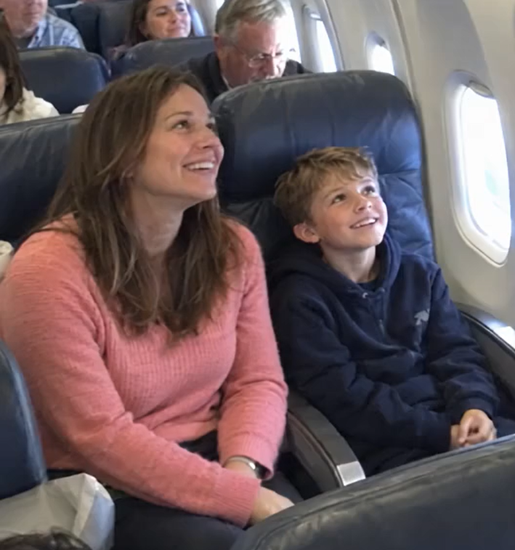
    I was halfway out of my seat when my husband’s voice came through the aircraft speakers again. For a moment, I thought I had misunderstood what he was saying. I looked toward the front of the plane, then down at my son, Mason, who was holding my hand so tightly that I could feel his excitement in every little movement.

    We had boarded that morning with one simple plan: surprise Tyler, my husband and Mason’s father, while he was working as the pilot on a flight to Chicago.

    We had imagined his reaction a dozen different ways. Maybe he would notice us while greeting passengers. Maybe he would recognize Mason’s voice. Or perhaps he would only discover our presence after the aircraft had landed.

    But nothing had prepared us for what happened next.

    Tyler was speaking to the passengers, and his words sounded different from his usual announcements. His voice was calm, warm, and unusually personal.

    “This person has been with me through thick and thin,” he said. “I couldn’t have asked for a better co-pilot in life.”

    Mason immediately turned toward me.

    “Mom, he’s talking about us!”

    I smiled, although I wasn’t entirely sure. There was something in Tyler’s voice that made me wonder whether he had already discovered our little surprise.

    I gently squeezed Mason’s hand and encouraged him to keep listening.

    After all, we had spent so much time planning this moment. We wanted to hear what his father would say.

    And then Tyler continued.

    “But this isn’t just any special person. This is someone who has been my friend, my partner, and my inspiration. She’s my rock.”

    Mason’s eyes widened.

    “Mom… is he talking about you?”

    Before I could answer, Tyler chuckled softly through the speakers.

    “And she’s been there through every takeoff and landing. My beautiful wife, Emily.”

    For a second, I couldn’t move.

    Pages: 1 2 3 4 5 6 7 8 9 10

  • Can You Spot the Key, Crescent Moon, and Fish? This Tricky Puzzle Challenges Your Attention to Detail!

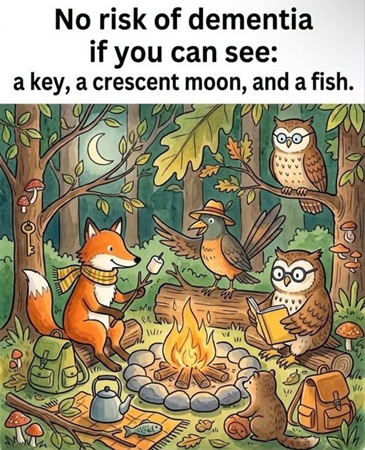
    Can You Spot the Key, Crescent Moon, and Fish? This Tricky Puzzle Challenges Your Attention to Detail!

    A Woodland Illustration That Hides Three Unexpected Objects

    At first glance, this colorful woodland illustration looks like a peaceful scene taken straight from a children’s storybook. Several animals have gathered around a glowing campfire, surrounded by the familiar sights of a forest at night. The warm colors, playful characters, and small decorative details make the picture appear easy to understand.

    But there is more to the illustration than meets the eye.

    Somewhere within the scene, three objects have been cleverly hidden. A key, a crescent moon, and a fish are waiting to be discovered, and finding them requires viewers to look beyond the most obvious parts of the artwork.

    The challenge seems simple when explained. After all, everyone knows what a key looks like. A crescent moon has a familiar curved shape, and a fish is usually easy to recognize. Yet when those objects are placed among animals, branches, shadows, and decorative elements, identifying them can become surprisingly difficult.

    That is where the puzzle begins.

    The woodland scene invites viewers to slow down and examine the illustration more carefully. Instead of focusing only on the characters, the search encourages attention to the smaller shapes scattered throughout the composition.

    A detail that initially looks like part of an animal, a tree, or a decorative feature may deserve another look.

    Pages: 1 2 3 4 5 6 7 8 9 10

  • I Arrived at the Hospital to Bring Home My Wife and Newborn Twins – But Only the Babies Were Waiting

    I Arrived at the Hospital to Bring Home My Wife and Newborn Twins – But Only the Babies Were Waiting

    I had imagined bringing my wife and our newborn twin daughters home from the hospital dozens of times. During the final weeks of Suzie’s pregnancy, those little daydreams had become something I held onto whenever the nights were long or she was uncomfortable.

    I pictured the four of us standing in our living room, the babies finally sleeping in their own beds, and Suzie looking at me with that exhausted smile that meant we had made it through another difficult day.

    I had balloons waiting in the car. They were nothing extravagant, just a few pink and white ones tied together, but I thought she would appreciate them. I had prepared the nursery, checked the bassinets more times than necessary, and made dinner so she wouldn’t have to worry about cooking when we got home.

    I wanted the day to be perfect.

    After everything she had endured during the pregnancy, I thought I was doing the right things. I had made sure the house was clean, the baby clothes were washed, the bottles were ready, and the refrigerator was stocked. I believed I had taken care of all the little details that could make the first evening easier for her.

    What I didn’t realize was that there was something much more important I had failed to notice.

    When I arrived at the hospital that afternoon, I was carrying the balloons in one hand and the bags for the babies in the other. I walked through the corridor with a smile I couldn’t hide. Every time someone passed me, I felt like announcing that I was finally going to bring my daughters home.

    I had spent so much time imagining that moment that I barely noticed how unusually quiet the hallway seemed.

    When I reached Suzie’s room, I opened the door carefully, expecting to see her sitting in bed, perhaps asking whether I had remembered the car seats or joking about how long it had taken me to arrive.

    Instead, I found the twins sleeping in their bassinets.

    I stopped just inside the doorway.

    For a moment, I simply looked at them. One had her tiny hands tucked close to her face. The other was resting with her mouth slightly open, breathing softly. They were so small that I couldn’t understand how the world expected me to carry them home and somehow know what I was doing.

    I stepped closer and smiled.

    Then I looked toward the bed.

    Suzie wasn’t there.

    Pages: 1 2 3 4 5 6 7 8 9 10

  • Every Birthday and Anniversary, He Wrote to His Wife Who Had Passed Away – One Night, Something Unexpected Happened

    Every Birthday and Anniversary, He Wrote to His Wife Who Had Passed Away – One Night, Something Unexpected Happened

    For ten years, my grandfather had been sending messages to someone who could never answer him. Every birthday, every anniversary, and sometimes on ordinary evenings when the house felt especially quiet, he opened Facebook and wrote to my grandmother.

    He never expected a reply. He simply wanted somewhere to put the words he still carried.

    Then, on his eighty-ninth birthday, a message arrived from her account. And when he read the first few lines, his hands began trembling. I had never seen my grandfather look so frightened.

    Less than two hours earlier, we had been celebrating his birthday at his house. I had organized a small surprise party, invited family members, prepared his favorite food, and tried to make the evening feel special.

    For the first time in months, he had laughed until tears rolled down his cheeks.

    He kept telling everyone he didn’t need a party, but every time someone arrived, his face lit up. He hugged relatives he hadn’t seen in a while and insisted that everyone eat something before leaving.

    At one point, he stood beside the dining table, wearing his favorite blue sweater, and made a joke about being eighty-nine but still refusing to let anyone tell him what time to go to bed.

    Everyone laughed.

    I remember thinking that the evening had turned out better than I could have hoped.

    Then I went home.

    I had barely settled down when my phone rang.

    It was Grandpa.

    His voice sounded different, almost unrecognizable.

    “Sweetheart, can you come back?”

    I sat upright.

    “What’s wrong? Are you feeling sick?”

    “No. No, I’m fine. But you need to see something.”

    He paused.

    “I think your grandmother remembered.”

    I didn’t understand what he meant.

    “Remembered what?”

    He didn’t answer immediately.

    Instead, I heard the sound of paper moving, followed by a long silence.

    Then he said, “She sent me a message.”

    I grabbed my keys and rushed outside, still wearing my pajamas.

    The drive to Grandpa’s house seemed longer than it had earlier that evening. I kept calling him, but he didn’t answer. I imagined all kinds of possibilities, none of which made sense.

    When I arrived, the lights were on in the kitchen.

    Grandpa was sitting at the table, his laptop open in front of him. His blue sweater was still the same one he had worn during the party.

    He hadn’t even changed.

    His eyes were red, and one hand rested beside the laptop as though he were afraid to touch it again.

    “Grandpa?”

    He looked up.

    “She remembered, sweetheart.”

    I pulled out a chair and sat beside him.

    “Who remembered?”

    He turned the laptop toward me.

    The message was from Grandma’s Facebook account. The account had been silent for ten years.

    I stared at the screen.

    The first sentence read:

    “Don’t be afraid of tomorrow, my love. If I can’t remember your face, I’ll still remember how safe you made me feel.”

    I read it once.

    Then again.

    The words seemed strangely familiar, but I couldn’t understand why Grandpa was reacting as though he had heard something impossible.

    He pointed toward the next sentence.

    “And if I ever forget how to live without you, promise you’ll find a way to remind me.”

    Grandpa covered his mouth.

    “Sweetheart, those were my exact words.”

    I looked at him.

    “What words?”

    “The ones I whispered into your grandma’s ear the night she died. Nobody else was there.”

    He shook his head slowly.

    “Nobody was supposed to know.”

    I didn’t know what to say.

    Pages: 1 2 3 4 5 6 7 8 9 10

  • My Husband Made a Cruel Joke About My Weight on Our Anniversary, Gave Me a Scale – He Didn’t See My Next Move Coming

    My Husband Made a Cruel Joke About My Weight on Our Anniversary, Gave Me a Scale – He Didn’t See My Next Move Coming

    For twenty years, I convinced myself that the hardest part of my marriage was learning to live with the little things that hurt. I thought every couple had disagreements, every husband occasionally made an insensitive joke, and every wife sometimes had to swallow her feelings to keep the peace. I never imagined that one evening, surrounded by friends and family, I would finally understand how much damage those little things had done to me.

    It happened during our twentieth wedding anniversary celebration. A night Greg had spent weeks planning, a night meant to remind everyone how successful, happy, and devoted we supposedly were. But before the evening was over, his carefully arranged celebration would reveal something neither of us could hide anymore.

    And the moment everything changed began with a gift box.

    Greg and I met when we were twenty-six. Back then, he was the kind of man people noticed the moment he walked into a room. He was confident, loud, charming, and always surrounded by friends. He knew how to make people laugh, how to tell a story, and how to turn an ordinary evening into something memorable.

    When he introduced me to his friends, they immediately teased him.

    “You won the lottery,” one of them said, slapping his shoulder.

    Greg laughed proudly, pulling me closer to him. I remember feeling flattered. I believed I had found someone who genuinely admired me, someone who was happy to have me beside him.

    But there was one habit I noticed early on that I never quite understood.

    Greg paid unusual attention to what I ate.

    At our first dinner with several of his friends, I reached for another piece of bread. Greg looked at my plate, then at me, and smiled.

    “A woman should always eat less than her man,” he said jokingly.

    Everyone laughed.

    I laughed too, mostly because I didn’t want to make the moment uncomfortable. I told myself it was just one of those jokes men made when they were trying to be funny. I didn’t want to appear overly sensitive or turn a pleasant evening into an argument.

    Then I reached for another roll.

    Greg raised his eyebrow.

    “Saving room for dessert too?”

    His friends laughed again, and I put the bread back.

    Pages: 1 2 3 4 5 6 7 8 9 10