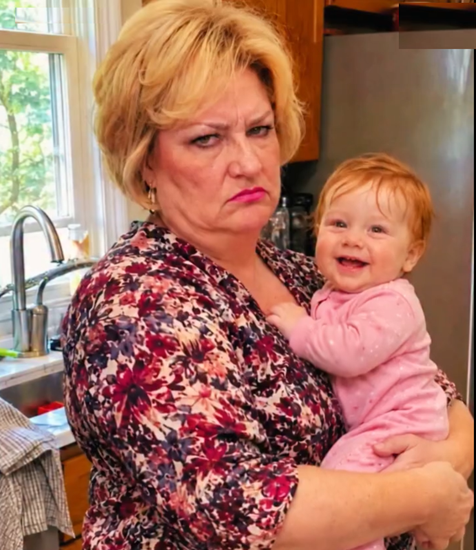
The first time my mother-in-law saw my newborn daughter, she didn’t smile. She didn’t ask how the delivery had gone, whether I was recovering well, or whether the baby had been sleeping. She didn’t even reach out to touch the tiny hand resting beside the blanket.
Instead, she leaned over the bassinet and stared at my daughter’s hair. It was bright copper red. Stella was only nine days old, and already that little patch of hair seemed to have become the most interesting thing in the room.
My husband, Bryson, and I both had dark brown hair. We also had brown eyes. Stella, however, had inherited a completely different appearance. Her hair was reddish, her skin was fair, and her eyes were still a striking shade of blue.
I was sitting on the couch with a cushion behind my back and an ice pack resting against my side. My body was still recovering from childbirth, and I was exhausted in a way I had never experienced before.
Yet the moment I noticed Gianna’s expression, I knew something was wrong.
“That’s certainly… noticeable,” she finally said.
I looked at her.
“What is?”
She didn’t answer immediately. Instead, she continued examining Stella as though she were trying to find an explanation hidden somewhere in the baby’s face.
“Her hair,” she eventually replied.
I glanced down at my daughter.
“She’s beautiful,” I said quietly.
Gianna straightened, but her expression didn’t change.
Bryson walked into the room carrying two cups of coffee. He noticed his mother’s serious expression and gave a small laugh.
“What’s going on here?”
“Your daughter has quite an interesting appearance,” Gianna replied.
Bryson looked into the bassinet.
“She’s nine days old, Mom. Babies change.”
He smiled and gently touched Stella’s blanket.
“Besides, she’s perfect.”
Gianna didn’t smile back.
“Hair can darken,” she said. “Eyes can change, too.”
Then she looked directly at me.
“But not everything changes.”
I felt my stomach tighten.
I wanted to believe I had misunderstood her. I wanted to believe she was simply making an awkward comment about genetics.
But something in her voice suggested otherwise.
And unfortunately, this wasn’t the first time she had made me feel unwelcome.
Gianna had never been particularly warm toward me.
From the beginning of my relationship with Bryson, she seemed determined to find something wrong with every decision I made.
When we bought our first house together, she walked through the living room, looked around, and asked whether her son really had to come home to a place like that every day.
When I changed jobs, she remarked that not everyone was ambitious enough to build a successful career.
When I prepared dinner for the family, she occasionally made comments about how Bryson had always preferred his mother’s cooking.
None of these remarks seemed particularly serious when considered individually.
That was what made them difficult to confront.
Whenever I mentioned them to Bryson, he would sigh and say the same thing.
“That’s just Mom, Macy.”
For years, I accepted that explanation.
I told myself that perhaps Gianna needed time to adjust to having another woman in her son’s life. I tried not to take every comment personally.
Sometimes I even defended her when other people noticed her behavior.
But after Stella was born, her remarks became harder to ignore.
The little girl who should have brought the family together somehow became the center of a suspicion nobody had openly admitted yet.
At two weeks old, Stella still had her reddish hair.
It was becoming a little thicker, and the copper color looked even more noticeable in natural light.
One afternoon, Gianna visited again.
She sat beside the bassinet and watched Stella move her tiny hands beneath the blanket.
After a few moments, she leaned closer.
“She doesn’t have Bryson’s eyes,” she said.
I was folding a small blanket nearby.
“She’s still a newborn. Her eyes may change as she grows.”
Gianna looked at me.
“Bryson’s eyes were brown immediately.”
“Every baby is different.”
She didn’t respond.
Instead, she gently returned Stella to her blanket and changed the subject.
But I noticed something else.
She had started avoiding the word granddaughter.
Instead of saying, “How is my granddaughter?” she would ask, “How is the baby?”
Instead of saying, “Our little girl,” she would simply use Stella’s name.
At first, I thought I was being overly sensitive.
New motherhood had left me emotional, tired, and constantly worried about whether I was doing everything correctly.
Still, I couldn’t shake the feeling that something had changed.
And then came the Sunday afternoon when Gianna finally said what she had apparently been thinking all along.
Stella was six weeks old when Gianna arrived at our house that Sunday.
I had just finished feeding her, and she was sleeping peacefully against my chest.
Bryson was sitting across from me, folding tiny onesies and arranging them into a neat pile.
The room was quiet.
For several minutes, Gianna simply watched us.
Then she placed her handbag beside the chair and folded her hands.
“I think we need to stop pretending,” she said.
Bryson looked up.
“Pretending about what?”
Gianna nodded toward Stella.
“About what everyone can see.”
I shifted slightly.
“What exactly can everyone see?”
She looked directly at me.
“That this baby doesn’t look anything like my son.”
Bryson stopped folding the clothes.
“Mom, what are you talking about?”
Gianna pointed toward Stella’s head.
“Look at her hair. Look at her eyes. Red hair and blue eyes. Where did those come from?”
I felt anger rising inside me.
“Genetics don’t ask for permission, Gianna.”
Her mouth tightened.
She looked at Bryson, apparently expecting him to support her.
Then she delivered the accusation I had never imagined hearing from someone in my own family.
“I won’t let you pass another man’s baby off as my son’s.”
For a moment, I couldn’t speak.
I looked at her, then at Bryson.
He had gone completely still.
“Mom,” he whispered. “Stop.”
But his voice didn’t sound nearly as angry as I needed it to.
It sounded embarrassed.
Almost uncertain.
And that uncertainty hurt more than the accusation itself.
Gianna leaned forward.
“If I’m wrong, prove it.”
Bryson rubbed his forehead.
“Mom, this is not the time.”
“Then when?” she demanded. “A DNA test. That’s all I’m asking.”
I stared at her.
“You’re not asking for a test. You’re accusing me of cheating on your son.”
She didn’t deny it.
Instead, she repeated that if I had nothing to hide, I should have no reason to refuse.
I turned toward my husband.
“Bryson?”
He looked down at the floor.
That small movement frightened me more than anything Gianna had said.
I needed him to look at me and tell his mother she had crossed a line.
I needed him to defend the woman he had married and the child he had welcomed into the world.
Instead, he hesitated.
“Macy, I know how this sounds.”
I adjusted Stella against my shoulder.
“No. I don’t think you do.”
He stood up and moved closer.
“I love you.”
“That isn’t an answer.”
His eyes moved toward our daughter.
Then he looked back at me.
“Maybe we should just do the test. Then this can finally be over.”
I stared at him for several seconds.
“For who?”
“For everyone.”
I felt tears gathering in my eyes, but I refused to let them fall in front of Gianna.
“I already know who her father is, Bryson.”
“I know.”
“Do you?”
He didn’t answer quickly enough.
That silence made the decision for me.
“Fine,” I said. “We’ll do the test.”
Bryson looked surprised.
“Macy, I don’t want you thinking that I—”
“You wanted proof. You’ll get it.”
Then I turned toward Gianna.
“But when the results arrive, neither of you gets to pretend this was harmless.”
She looked away.
For the first time that afternoon, she had nothing to say.
Gianna left shortly afterward.
Bryson followed her to the door, but I stayed on the couch with Stella in my arms.
I could hear their voices in the hallway.
His mother spoke quietly. He responded even more quietly.
I couldn’t understand the words.
When he returned, he stood near the living room entrance.
“Macy, can we talk?”
I continued looking at Stella.
“Not right now.”
He came closer.
“I didn’t mean for it to happen like that.”
I finally looked up.
“But it did happen like that.”
He lowered his head.
“I’ll arrange the test.”
I nodded.
Then I carried Stella upstairs.
That night, Bryson tried several times to start a conversation.
He asked whether I wanted tea. He offered to prepare something to eat. He even suggested taking the next feeding shift.
I appreciated that he was trying to help.
But none of those gestures answered the question that had been sitting in my mind since his mother left.
Why had he needed a laboratory to tell him whether he could trust his own wife?
The appointment was arranged two days later.
The procedure itself was simple.
We arrived at a small testing facility, completed the necessary paperwork, and followed the technician’s instructions.
There were cheek swabs, identification details, and signatures.
The technician explained the process in a calm, professional manner.
She treated the appointment like any other routine testing procedure.
For her, perhaps it was.
For me, it felt like walking into a room where my marriage had already been placed on trial.
Bryson sat beside me while Stella rested in her car seat.
He tried to make a joke.
“At least she slept through the whole thing.”
I fastened the straps around Stella.
“Good for Stella.”
He looked at me.
“Macy.”
I closed the car door.
“What?”
“I didn’t accuse you.”
I stopped moving.
“You asked me to prove I wasn’t lying.”
“That’s not exactly the same thing.”
I turned toward him.
“From where I’m standing, it is.”
He rubbed both hands over his face.
“I was scared.”
“So was I.”
“Of what?”
I looked at him for a long moment.
“Of discovering that my husband could be persuaded to doubt me by one person who has disliked me since the day we met.”
He opened his mouth.
Then he closed it again.
There was nothing he could say that would make that moment disappear.
The following days were strange.
Bryson became unusually attentive.
He washed the bottles before I asked. He prepared dinner and made sure there were clean blankets in the nursery.
When Stella woke at four in the morning, he got out of bed and carried her around the room until she settled.
He even started checking whether I had eaten enough during the day.
I knew he was trying.
But every kind gesture reminded me of the same painful fact.
He was waiting for a laboratory to tell him whether his wife had been faithful.
Sometimes I caught him looking at me when he thought I wasn’t paying attention.
Perhaps he wanted to apologize again.
Perhaps he was trying to understand why I had become so quiet.
I didn’t know.
I was taking care of our daughter, recovering from childbirth, and trying to process something I had never expected to experience in my marriage.
I didn’t want another argument.
I wanted time.
When the envelope finally arrived, I left it unopened on the kitchen counter.
I had been in the living room feeding Stella when Bryson came home.
He walked into the kitchen, placed his keys on the counter, and immediately noticed the envelope.
“Macy?”
“Living room.”
He appeared in the doorway a moment later.
“You haven’t opened it?”
“No.”
“Why not?”
I looked down at Stella.
“Because I don’t need it.”
He stared at me.
For a few seconds, neither of us moved.
Then he returned to the kitchen.
I heard the envelope being opened.
Paper shifted.
There was a long silence.
I continued feeding Stella, trying to concentrate on her tiny fingers resting against my hand.
Then I heard Bryson whisper something.
“I can’t believe this.”
I looked toward the kitchen.
He was standing beside the counter, holding the report.
His eyes moved across the page.
Then he looked back at the beginning and read it again.
The refrigerator hummed.
A vehicle passed outside.
Stella swallowed quietly.
Finally, Bryson turned the paper toward me.
The report stated that the probability of paternity was greater than 99.99 percent.
He was Stella’s biological father.
Exactly as I had known he was.
I looked at the number.
Then I looked at my husband.
“Congratulations.”
His face changed.
“Macy…”
“Now you know.”
His eyes became wet.
“I’m so sorry.”
I adjusted Stella’s blanket.
“Don’t.”
He stepped closer.
“I shouldn’t have listened to Mom.”
I looked up sharply.
“Don’t rewrite what happened, Bryson.”
He stopped.
“If you truly knew, we wouldn’t have needed this paper.”
He lowered his eyes.
The report remained between us.
For a moment, I thought the worst part of the afternoon was finally over.
Then his phone rang.
Gianna’s name appeared on the screen.
Bryson looked at me.
I said nothing.
He answered.
“Mom.”
I couldn’t hear everything she said, but her voice was loud enough for me to recognize that she was asking about the results.
“Yes,” Bryson replied.
A pause followed.
Then he spoke clearly.
“Stella is mine.”
There was another silence.
Bryson’s expression hardened.
“Do you hear me? She is my daughter.”
Gianna continued speaking.
He closed his eyes briefly.
“No. You don’t get to say that now.”
I sat still, holding Stella.
Then Gianna said something that made Bryson stop moving.
His expression changed.
It was no longer anger.
It was confusion.
“What did you say?”
Silence.
“Mom?”
Her voice came through again.
This time, I heard a few words.
“Then it came back.”
Bryson frowned.
“What came back?”
Gianna didn’t immediately respond.
He looked toward Stella.
Then at the report.
Then back at the phone.
“Mom, what are you talking about?”
The call ended.
Bryson lowered his phone slowly.
I watched him.
“What happened?”
He didn’t answer immediately.
He was staring at the reddish hair on Stella’s head.
Finally, he said, “My mother just told me something I don’t understand.”
“What?”
He swallowed.
“She said, ‘Then it came back.'”
I frowned.
“What came back?”
Bryson looked toward the kitchen counter.
Then he reached for his keys.
“I have no idea.”
He glanced at me.
“But I’m going to find out.”
We drove to Gianna’s house that evening.
Bryson was unusually quiet during the journey.
I sat in the back beside Stella, who was sleeping in her car seat.
I kept thinking about the phone call.
What could possibly have returned?
And why had Gianna reacted that way after learning that the DNA results confirmed Bryson was the father?
When we arrived, she opened the door before Bryson had finished knocking.
He didn’t bother with a greeting.
“What came back, Mom?”
Gianna glanced at me.
Then she looked at Stella.
“I don’t know what you’re talking about.”
Bryson held up the DNA report.
“You know exactly what I’m talking about.”
She looked at the paper.
He continued.
“You said something about it coming back. Then you mentioned red hair.”
Gianna pressed her lips together.
“Bryson, this is complicated.”
“Then explain it.”
He stepped inside.
His eyes moved around the living room until they stopped at the family photographs covering one wall.
There were pictures of him as a child.
Photographs of birthdays, holidays, school events, and family gatherings.
And several pictures of his father.
Bryson walked toward them.
“Where are the old albums?”
Gianna followed him.
“Why?”
“Because I want to see something.”
“Please don’t do this.”
He turned.
“Where are they, Mom?”
For several seconds, she didn’t move.
Then she pointed toward the stairs.
“Upstairs.”
The old photo albums were stored in a bedroom closet.
Some were carefully arranged on a shelf. Others were inside cardboard boxes covered with dust.
Gianna took one down and placed it on the bed.
Bryson opened it.
He moved through the photographs slowly.
There were pictures of his parents when they were young.
His father standing beside a car.
His mother holding a bouquet.
The two of them sitting at a family gathering.
Bryson turned another page.
Then his hand stopped.
A photograph showed a teenage boy standing outside what appeared to be a school building.
He had freckles across his face.
His hair was unmistakably copper red.
Bryson leaned closer.
The boy was his father.
He stared at the photograph for a long time.
Then he looked at Gianna.
“Dad?”
She sat down slowly.
“Yes.”
Bryson turned the photograph toward her.
“Was his hair really that red?”
Gianna nodded.
“It was.”
He looked back at the picture.
“Why didn’t you ever tell me?”
“Your father’s hair darkened as he grew older.”
Bryson looked at her.
“That’s not what I asked.”
She lowered her eyes.
He turned another page.
There were more photographs.
His father at different ages.
The same freckles.
The same distinctive hair, sometimes brighter in the sunlight and sometimes appearing darker in the faded photographs.
Bryson slowly looked from the album to Stella’s car seat.
Then he understood why his mother had become so uncomfortable when she first saw his daughter.
But he still didn’t understand why she had accused me of cheating.
“You knew this was possible,” he said.
Gianna didn’t answer.
“Didn’t you?”
She folded her hands.
“I remembered your father’s hair.”
Bryson’s voice became quieter.
“Then why did you accuse Macy?”
Gianna looked at the photograph.
And for the first time, she seemed unable to find an excuse.
After a long silence, Gianna began explaining.
When she was a teenager, she had known Bryson’s father.
He had been a quiet boy with freckles and red hair.
Unfortunately, some of the other students had treated him badly because of his appearance.
They made jokes about his hair.
They teased him about his freckles.
Sometimes they deliberately excluded him.
Gianna admitted that she had been among those who participated in the teasing.
At first, she claimed she had only laughed along with the others.
But Bryson kept asking questions.
“Did you ever defend him?”
Gianna looked away.
“Not always.”
“What does that mean?”
She took a slow breath.
“Sometimes I joined in.”
Bryson remained silent.
Then she added something even more difficult.
“Sometimes I started the jokes myself.”
The room became very quiet.
I looked at her.
This was not the explanation I had expected.
I had thought perhaps there was some forgotten family secret, some unusual medical detail, or some other reason for her reaction.
Instead, the explanation appeared to be connected to something she had done many years earlier.
Bryson closed the album.
“You treated Dad badly?”
Gianna nodded.
“I was young.”
“That doesn’t answer the question.”
“No,” she admitted. “It doesn’t.”
She explained that she had wanted to be accepted by certain people at school.
She had cared too much about their opinions.
Instead of standing up for the boy who was being teased, she had sometimes joined the people making fun of him.
Years later, she had encountered him again at a neighborhood diner.
He remembered her.
He also remembered how she had treated him.
Gianna said she apologized.
But forgiveness did not happen immediately.
They spoke occasionally.
They slowly rebuilt a friendship.
Eventually, that friendship developed into something deeper.
And they married.
“I loved your father,” she said quietly. “But I never liked remembering the person I had been when we were young.”
Bryson looked at her.
“Did Dad forgive you?”
“Eventually.”
“Did you ever talk about what happened?”
Gianna nodded.
“More than once.”
Bryson looked back at the photograph.
“Then you knew exactly why Stella had red hair.”
Gianna looked toward the sleeping baby.
“I knew it was possible.”
For a moment, nobody spoke.
Bryson picked up the photograph again.
His father’s younger face looked remarkably similar to Stella in certain ways.
The copper hair.
The pale complexion.
The small features.
Even the freckles, although Stella was still too young for anyone to know how her appearance would develop.
Bryson looked at his mother.
“You accused my wife of cheating when you knew my father had red hair?”
Gianna shook her head.
“I didn’t think about it properly.”
“How could you not?”
She lowered her eyes.
“When I saw Stella, I remembered your father as a young boy. I remembered the things people said about him. I remembered what I had done.”
Bryson frowned.
“And?”
Gianna struggled to continue.
“I didn’t want to think about it.”
I finally spoke.
“So instead, you decided the problem must be me.”
She looked at me.
I continued.
“You knew red hair existed in your own family. You knew your husband had it. Yet you looked at my newborn daughter and decided I had betrayed your son.”
Gianna’s eyes filled.
“I know.”
“No,” I said. “I don’t think you understood what you were doing.”
She remained silent.
For weeks, she had questioned whether Stella belonged to our family.
She had avoided calling her a granddaughter.
She had placed doubt between a husband and wife during one of the most vulnerable moments of their lives.
And now she was saying that the sight of a familiar hair color had brought back memories she didn’t want to face.
I looked down at Stella.
She was sleeping peacefully.
She had done nothing except arrive in the world looking like someone from her father’s family.
Yet she had somehow become the target of an old insecurity.
Bryson looked at his mother.
“Did Dad know you still felt this way about his hair?”
Gianna appeared shocked.
“I never hated his hair.”
“Then why did you react like that when you saw it on Stella?”
She looked toward the baby.
“Because it reminded me of him.”
Bryson waited.
Gianna continued in a quieter voice.
“It reminded me of the boy I had been unkind to. I remembered the teasing, the things I had said, and the person I used to be.”
She paused.
“I suppose I didn’t want to face those memories again.”
I looked at her.
“So you made my daughter the problem.”
Gianna’s eyes dropped.
She didn’t deny it.
We left the house without resolving everything.
Gianna followed us to the front door.
“Macy, please.”
I stopped.
“I am sorry.”
I looked at her.
“Don’t apologize to me first.”
She blinked.
I adjusted Stella’s blanket.
“You spent weeks refusing to call her your granddaughter. You questioned whether she belonged in this family. If you want to make things right, start with the person you decided didn’t belong.”
Gianna looked at Stella.
Then she nodded.
“I understand.”
I wasn’t sure whether she truly did.
I got into the car.
Bryson followed and closed the door.
For several minutes, neither of us spoke.
Halfway home, he reached toward my hand.
I moved it onto my lap.
He withdrew his hand without arguing.
“I was scared,” he finally said.
I looked out the window.
“So was I.”
He waited.
I continued.
“I had just become a mother. I was recovering from childbirth, trying to understand this new life, and taking care of our little girl. The person who was supposed to make me feel safe decided that his mother’s suspicion deserved more trust than his wife’s word.”
Bryson stared through the windshield.
“I know.”
“Do you?”
He didn’t answer.
I looked at him.
“You know the test result. But that doesn’t automatically repair what happened between us.”
He nodded slowly.
“I understand.”
For once, he didn’t try to convince me that everything should be fine simply because the truth had been confirmed.
That evening, the doorbell rang.
Bryson looked toward the entrance.
I already knew who it was.
Gianna stood outside.
She wasn’t carrying anything.
She didn’t try to walk into the house as she usually did.
Instead, she waited.
“May I come in?” she asked.
I stepped aside.
Stella was awake in her bassinet.
Gianna approached slowly.
She looked at the baby for several seconds before turning toward me.
“May I hold my granddaughter?”
The word sounded different this time.
Granddaughter.
It was the first time in weeks that I had heard her say it without hesitation.
I picked Stella up and placed her carefully in Gianna’s arms.
She held the baby gently, supporting her head and adjusting the blanket.
Then she looked at the little patch of copper hair.
A small expression of recognition crossed her face.
“Oh,” she whispered.
Bryson looked over.
“What?”
Gianna smiled faintly.
“Your father’s hair did that.”
She gently pointed toward Stella’s head.
“Whenever he woke up, it would stand in every direction. He used to flatten it before leaving the house, but by lunchtime, it would be sticking up again.”
For the first time since Stella’s birth, Gianna seemed to be looking at her without suspicion.
She was remembering someone.
Not an accusation.
Not a possible betrayal.
Her husband.
After a few minutes, Gianna asked us to follow her.
She wanted to show us something.
At her house, she walked to an old cedar chest that had belonged to her husband’s family.
She opened it carefully.
Inside were several small belongings, neatly folded and protected.
There were photographs, handwritten notes, and a few pieces of clothing that had been kept for years.
Then she removed a small knitted cap.
“His mother made this when the teasing became difficult for him.”
Bryson touched the fabric.
“He wore it to hide his hair?”
Gianna nodded.
“Sometimes.”
She looked down at the cap.
“He didn’t always want people looking at him. His mother thought it might make him feel more comfortable.”
Bryson examined the small knitted item.
Then Gianna looked toward Stella.
Without thinking, she lifted the cap slightly toward the baby’s head.
But her hands stopped.
She looked at the little girl.
Then she slowly lowered the cap.
For several seconds, she simply held it.
Finally, she folded it carefully and placed it back inside the chest.
“No,” she said softly.
Bryson looked at her.
Gianna closed the lid.
“Nobody is hiding her.”
It was a small sentence.
But it was the first thing she had said that sounded like a genuine acceptance of the child she had spent weeks questioning.
Later that night, we returned home.
Stella fell asleep against my chest while Bryson sat at the other end of the couch.
The house was quiet.
He looked at me several times, but he seemed unsure how to begin.
Finally, he spoke.
“Macy?”
I looked over.
“What do you need from me?”
I wasn’t expecting the question.
For days, he had been trying to explain his actions.
Now, for the first time, he seemed to be asking what I needed rather than what would make the situation easier for him.
“Time,” I answered.
He nodded.
“Okay.”
He didn’t ask how much time.
He didn’t tell me I should forgive him because the test had confirmed the truth.
He simply accepted my answer.
Stella moved slightly in her sleep.
The little copper tuft on her head stood upright again.
Bryson noticed it.
A sad smile appeared on his face.
“Dad’s hair.”
I looked down at our daughter.
“Yes,” I whispered.
He watched her for a moment.
Then he said, “I wish I had recognized it sooner.”
I didn’t answer.
There was still a lot we needed to work through.
The test had answered one question.
The old photograph had explained something about Gianna’s reaction.
But neither had erased the hurt caused by the accusations.
Over the following days, Gianna began making small changes.
She called to ask how Stella was doing.
She stopped making comments about her appearance.
When she visited, she asked whether I was comfortable with her holding the baby instead of simply reaching into the bassinet.
It wasn’t a complete repair.
Trust does not return simply because someone finally understands why they were wrong.
But at least she had begun to recognize that her granddaughter deserved to be accepted without conditions.
Bryson also changed the way he approached the situation.
He no longer expected me to move on immediately.
He listened when I explained how deeply his hesitation had hurt me.
He began to understand that the DNA report had not created the problem.
It had only exposed the lack of trust that had already been allowed into our home.
One evening, while we were sitting together, he looked at Stella and gently brushed a strand of hair away from her forehead.
“She’s going to have a lot of questions about her hair someday,” he said.
I smiled faintly.
“Then we’ll tell her where it came from.”
He nodded.
“And we’ll tell her she never needed to prove she belonged.”
I looked at him.
That was the first thing he had said in days that made me feel he understood what had truly mattered.
A week later, Gianna visited again.
She brought a small photograph of her husband as a teenager.
It was the same photograph we had found in the old album.
She placed it on the table beside a picture of Stella.
The resemblance was impossible to ignore.
Gianna stood quietly, looking at both images.
Then she said something I hadn’t expected.
“I wish I had seen it differently the first time.”
I looked at her.
“What do you mean?”
She touched the edge of the old photograph.
“I saw his hair and remembered the things I regretted. I let those memories control my reaction.”
She paused.
“I should have looked at Stella and seen my granddaughter.”
I didn’t rush to reassure her.
I didn’t tell her everything was forgiven.
Instead, I nodded toward the baby.
“Then start doing that now.”
Gianna looked down.
“I will try.”
It wasn’t a perfect ending.
But it was an honest beginning.
That night, after everyone had gone home, I carried Stella into the nursery.
She was almost asleep.
Her little face was relaxed, and her reddish hair stood up in its familiar stubborn way.
I lowered her gently into the crib.
For a moment, I watched her breathing.
A few weeks earlier, that same hair had been treated like evidence of something terrible.
It had become the reason for accusations, arguments, and a DNA test nobody should have needed to demand from a new mother.
But it had never been evidence of betrayal.
It was simply a part of her.
A small inheritance from a family history that nobody had bothered to remember until it appeared in front of them.
Bryson came into the nursery and stood beside me.
He looked down at our daughter.
Then he quietly said, “She really does look like him.”
I nodded.
“She does.”
He reached for my hand.
This time, I let him hold it.
We stood together in the quiet room, watching Stella sleep.
There were still things we needed to repair.
There were conversations we hadn’t finished.
And there was trust that would take more than a laboratory report to rebuild.
But one thing was no longer in question.
Stella belonged.
Not because a document said so.
Not because someone finally recognized the color of her hair.
And certainly not because she had passed a test.
She had belonged from the moment she was born.
The little red-haired girl had never been the mystery.
The mystery had been why the people who should have welcomed her had needed so long to see her for who she was.