My Husband Couldn’t Tell Our Identical Twins Apart, So He Shaved Their Initials Into Their Hair. But What Our Boys Revealed That Night Changed Everything
The thing that made me run upstairs that night wasn’t the sound of the boys laughing.
It was the sound of electric hair clippers.
I was halfway through getting ready for bed when I heard something unusual coming from my children’s bedroom. At first, I thought Henry was simply checking on the twins. But then I heard the clippers again.
I immediately hurried upstairs.
“Henry!”
I reached the boys’ room and pushed the door open.
My husband was standing between their beds, holding a pair of electric clippers. Both of our four-year-old sons were wide awake, and neither seemed particularly worried about what was happening.
In fact, they were grinning.
Leo was sitting in Max’s bed, while Max had somehow ended up in Leo’s.
Something about the scene felt strange.
“What are you doing?” I asked.
Henry jumped slightly. The clippers nearly slipped from his hand.
“Jeez, Emma. You scared me.”
“Why are you holding those?”
The boys started laughing.
Henry looked at them, then at me.
“They switched.”
“I can see that.”
“No, I mean the letters.”
I looked more closely at their heads.
The enormous initials that Henry had shaved into their hairstyles earlier that day were almost completely gone.
Max no longer had a recognizable M.
Leo’s L had disappeared too.
Instead, both boys had uneven patches of short blond hair.
I stared at my husband.
“Did you shave them again?”
Henry shook his head.
“No.”
Then Leo proudly announced something that made my stomach drop.
“We did!”
I looked at the boys.
“You did what?”
Max pointed toward Leo.
“He did mine.”
Leo pointed back.
“Then he did mine.”
For a moment, I couldn’t speak.
They were four years old. They had somehow managed to get hold of their father’s electric clippers and had apparently taken turns removing the very markings that were supposed to help Henry tell them apart.
I looked at the clippers in Henry’s hand.
“You let them use those?”
“No. I found them on the floor when I came in. I was about to take them away.”
He explained that the boys had apparently discovered the clippers earlier while the adults were downstairs. They had already started removing the letters before he noticed what was happening.
I wasn’t sure whether to laugh or become even angrier.
“Why were they somewhere they could reach them?”
“They were on the bathroom counter.”
“They’re four, Henry.”
“I know.”
I took a breath.
“Nobody is touching another hair on either child’s head tonight.”
Max frowned.
“But Mama…”
“No. We’re finished with the clippers.”
Henry tried not to smile.
I turned toward him.
“Don’t.”
“I’m not saying anything.”
“You already caused enough trouble today.”
But then Leo said something that made the entire argument disappear from my mind.
“We had to.”
I looked at him.
“What do you mean?”
He glanced at Max.
Max pulled his blanket up toward his chin.
I sat down on the edge of the nearest bed.
“Why did you shave the letters off?”
Neither boy answered immediately.
Then Leo looked at his father and said quietly:
“Because Daddy was sad.”
Henry’s expression changed.
I turned toward him.
“What?”
He looked uncomfortable.
“Nothing.”
But Max sat up.
“We heard you.”
And suddenly, the clippers didn’t seem like the biggest problem in the room anymore.
My name is Emma. Henry and I had been married for seven years, and our identical twin boys, Max and Leo, were four.
They were so similar that strangers often struggled to tell them apart.
Both had blond curls, blue eyes, matching dimples, and almost exactly the same height.
Even their voices sounded remarkably alike.
But to me, they were two completely different little people.
Max was quieter. He usually watched what was happening before deciding whether to join in. He loved dinosaurs and slept with a green stuffed dinosaur named Pickle.
Leo was the opposite.
He talked constantly, asked endless questions, and seemed to have enough energy for three children. He slept on his back with both arms above his head.
Max hated strawberries.
Leo would happily eat an entire carton if we allowed him.
Max wrinkled his nose whenever he felt nervous.
Leo often rubbed his left ear.
I could usually recognize them from across a playground.
Henry, however, sometimes struggled.
At first, we treated it as a harmless family joke.
I would hold one of the boys and ask Henry which child he was looking at.
He would study the little face.
“Max?”
“Wrong.”
“Leo?”
Sometimes he got it right. Other times he didn’t.
The boys quickly discovered that their father’s confusion could become a game.
They would exchange shirts, switch seats, and occasionally answer to each other’s names.
They thought it was hilarious.
I laughed too.
But I had gradually noticed that Henry didn’t always find it funny.
Whenever he called Max by Leo’s name, he would look embarrassed. At birthday parties, he sometimes hesitated before handing one of the boys a plate.
At preschool pickup, he occasionally waited until one of them spoke before greeting him.
Once, a teacher jokingly asked whether Henry still couldn’t tell his own children apart.
We both laughed.
Looking back, I wish I had paid more attention to his reaction.
Because the afternoon before the clippers incident, Henry had done something I had never expected.
I had gone grocery shopping and left him at home with the twins.
When I returned, the boys came running toward me.
I nearly dropped the shopping bags.
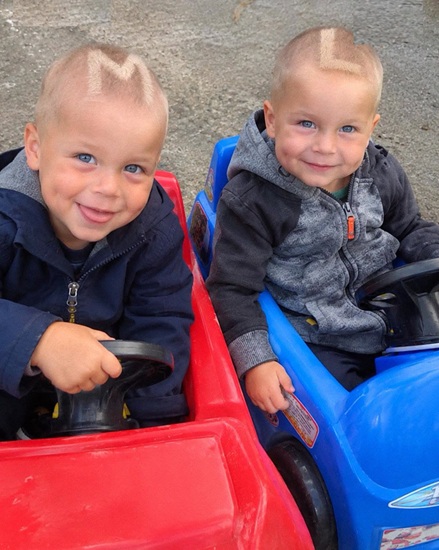
Their beautiful blond curls were gone.
Not trimmed.
Not shortened.
Almost completely shaved.
Henry had left sections of hair on top of their heads to create two enormous letters.
One had an M.
The other had an L.
I stared at them.
“Henry!”
He appeared from the kitchen with a proud smile.
“Problem solved.”
“Problem?”
“Now nobody can mix them up.”
I put the shopping bags down.
“You shaved initials into our children?”
“They’re just haircuts, Emma.”
“They had beautiful curls!”
“Hair grows back.”
I was furious, partly because he had made such a big decision without discussing it with me.
The boys, however, loved their new hairstyles.
“I’m M!” Max shouted.
“I’m L!” Leo announced.
They jumped around the living room, proudly showing off their letters.
Henry looked pleased with himself.
“See? Happy customers.”
I didn’t want to argue in front of the children, so I told him we would discuss it later.
The boys spent much of the evening admiring their new hairstyles.
During bath time, they repeatedly touched the letters and laughed.
I put them to bed at around 8:30 p.m.
Max slept beside the window, while Leo’s bed was closer to the door. That was their usual arrangement.
A few hours later, I checked the baby monitor.
Both appeared to be sleeping.
Then Leo climbed out of bed.
He quietly approached Max and shook him awake.
The boys whispered to each other.
Max picked up Pickle and his blanket.
Then they switched beds.
I assumed they were playing another version of their identity game.
But something else was happening.
Leo looked directly toward the monitor and whispered:
“Shhh.”
I watched them for a moment.
Then the bedroom door opened.
Henry walked inside.
And that was when I saw the clippers in his hand.
Now, sitting beside the boys’ beds, I wanted to understand what they had heard.
I looked at Henry.
“What did they hear?”
He leaned against the wall and looked down.
“After you went shopping, I called my brother.”
“Tom?”
He nodded.
“Why?”
Henry hesitated.
“Because I knew you were going to be angry about the haircuts. I wanted someone to tell me whether I’d made a terrible decision.”
I raised my eyebrows.
“And what did Tom say?”
Henry gave a small, embarrassed smile.
“He laughed for about two minutes.”
I almost smiled too.
“That sounds about right.”
But Henry wasn’t finished.
He explained that after Tom stopped laughing, they had started talking about why he had decided to shave the letters into the boys’ hair.
Henry admitted something he had never really said out loud before.
He told his brother that he hated not being able to distinguish the twins consistently.
He knew they were his children.
He knew their personalities, their favorite toys, their habits, and the little things that made them different.
But sometimes, when they stood together without speaking, he genuinely struggled to recognize which face belonged to which child.
He told Tom that he sometimes felt embarrassed.
He worried that other people would think he didn’t know his own sons.
And he admitted that he sometimes felt like he was failing at something a father should naturally be able to do.
I stopped smiling.
Henry looked toward the boys.
“I know it sounds ridiculous.”
“It doesn’t.”
He shook his head.
“I should know which one is which.”
“They’re identical twins, Henry.”
“I know. But I’m their father.”
That was the real problem.
He wasn’t simply frustrated because he occasionally used the wrong name.
He was worried about what those mistakes meant.
He had turned something ordinary into a personal test of whether he was a good father.
And every time he got the boys mixed up, he felt as though he had failed.
Then Max spoke.
“Bad daddy.”
Henry immediately crouched beside his bed.
“No, buddy. That’s not what I meant.”
Max looked worried.
“But you said it.”
Henry gently touched his cheek.
“I said something stupid because I was upset. I didn’t mean that I’m a bad daddy.”
Leo leaned forward.
“Then you made the letters.”
Henry nodded.
“Yes, I did.”
Max looked down at his own hair.
“We didn’t like them.”
I stared at him.
“But you both seemed so happy earlier.”
Leo shrugged.
“We liked them first.”
Max continued.
“Then we heard Daddy.”
That was when I understood why they had taken the clippers.
They had heard their father saying he was bad at being their dad.
They had misunderstood the situation in the way young children sometimes do. They believed that the letters were connected to his sadness, and they had decided to remove them.
In their minds, they were fixing something.
I felt tears building.
I looked at Henry.
He looked equally emotional.
Max climbed out of bed and stood in front of his father.
“Who am I?”
Henry looked at him.
For a moment, he didn’t answer.
Max was wearing Leo’s pajamas, and the boys had switched beds. His hair was almost completely shaved, and there was no longer an M to help identify him.
Henry studied his son.
Then he smiled.
“Max.”
Max’s face lit up.
“How?”
Henry pointed toward the green stuffed dinosaur.
“Because you’re holding Pickle.”
Max immediately threw the dinosaur onto Leo’s bed.
“Again!”
Leo jumped up.
The boys switched places, laughing.
Henry turned away while they moved.
When he looked back, he hesitated.
“Leo?”
The answer was correct.
Leo cheered.
“How did you know?”
Henry smiled.
“You rub your left ear when you’re excited.”
Leo immediately lowered his hand.
They switched again.
This time Henry guessed incorrectly.
The boys burst into laughter.
But something had changed.
Henry laughed with them instead of looking embarrassed.
“Okay, you got me.”
Max shouted that he was Leo.
Henry shook his head.
“No, you’re Max. You’re just trying to trick me.”
Max collapsed onto the bed, laughing.
I watched my husband carefully.
For the first time that evening, he wasn’t treating the situation like a test.
He was simply enjoying his children.
I realized that we had made a mistake too.
We had turned recognizing the boys into a game that Henry was expected to win.
Every wrong answer became another joke.
Every hesitation became another opportunity for us to tease him.
I hadn’t understood how much that bothered him.
So I apologized.
“I’m sorry.”
Henry looked at me.
“For what?”
“For making jokes about it. I didn’t realize it was hurting you.”
He shook his head.
“You didn’t know.”
“Maybe I should have asked.”
He nodded.
Then I pointed toward the boys’ uneven hairstyles.
“But you still shouldn’t have shaved initials into their heads without discussing it with me.”
Henry gave a small smile.
“Fair.”
“And definitely not without considering what happens when four-year-olds get hold of the clippers.”
“Also fair.”
We finally managed to get the boys back into their own beds.
Max returned to the bed beside the window, with Pickle and his green blanket.
Leo returned to the bed beside the door.
Before we left, Max called out.
“Daddy?”
Henry turned around.
“What is it?”
“If you get us wrong, it’s okay.”
Henry stood still.
Leo added something that made me laugh.
“We get us wrong too.”
That was true.
Sometimes we showed the boys old photographs, and even they struggled to identify themselves.
Henry smiled.
“Good night, boys.”
“Good night!”
We closed the bedroom door and walked downstairs.
I thought the conversation was finished.
But when I entered the kitchen, Henry was sitting at the table.
He looked as though something else was on his mind.
“There’s something I haven’t told you,” he said.
I stopped.
“What is it?”
He rubbed the back of his neck.
“I had an appointment last month.”
“What kind of appointment?”
“An eye appointment.”
I frowned.
“Why didn’t you tell me?”
He said he had been wondering whether something was wrong with his eyesight.
He had noticed that recognizing faces could sometimes be difficult for him, not only when looking at the twins.
He wanted to understand whether there was a physical reason.
The eye examination did not reveal a problem with his eyesight.
His vision was fine.
But after explaining his experiences, he had been advised that the difficulty might involve face recognition rather than the ability to see clearly.
He hadn’t received a confirmed diagnosis at that appointment.
The doctor had suggested speaking with a specialist if the problem continued to affect his daily life.
I listened carefully.
“Is that why you worry so much about the boys?”
Henry nodded.
“Partly. They’re especially difficult because they look so much alike.”
He told me that he had arranged another appointment to understand the issue more clearly.
I asked whether he wanted me to go with him.
He said he would appreciate that.
Later, according to Henry, a specialist explained that his experiences were consistent with developmental prosopagnosia, commonly known as face blindness.
It was an explanation that helped him understand why recognizing some faces could be difficult even when his eyesight was normal.
It did not mean he couldn’t recognize everyone.
He could recognize me and many members of our family.
But he often relied more heavily on voices, movements, clothing, and familiar habits than on facial features alone.
That explanation helped us understand something that had confused us for years.
Henry hadn’t been ignoring the differences between our children.
He had been noticing other details that I sometimes took for granted.
He knew which boy walked into a room quietly.
He knew which one rushed ahead.
He knew who asked for the green cup and who preferred the blue one.
He knew which child hated strawberries and which one would happily eat them every day.
He knew their personalities.
He simply didn’t always recognize their faces as easily as I did.
And that distinction mattered.
After that, we stopped testing him.
We stopped asking him to identify the boys just to see whether he could get the answer right.
Instead, we encouraged him to use the details that helped him recognize them naturally.
Max had a habit of walking into rooms carefully, watching everything before joining in.
Leo usually arrived with enough energy to fill the entire room.
Max often laughed quietly.
Leo sometimes snorted when something made him laugh.
Max loved his dinosaur, Pickle.
Leo preferred his blue blanket.
There were hundreds of little differences.
They had always been there.
We just needed to remember that recognizing a child was about much more than recognizing a face.
Eventually, the boys’ hair grew back.
The uneven patches disappeared, and their blond curls returned.
The next time they needed haircuts, we chose ordinary styles.
No initials.
No numbers.
No attempts to turn their heads into identification labels.
When they eventually started kindergarten, their teacher asked whether there was an easy way to tell them apart.
Henry smiled.
“Max likes green. Leo likes blue.”
The teacher nodded.
“That’s helpful.”
Then Henry added:
“But don’t rely on their clothes. They’ll probably switch them.”
The boys grinned at each other.
The teacher looked slightly concerned.
I couldn’t blame her.
They still enjoyed confusing people.
Last Halloween, they decided to dress like each other.
Max wore Leo’s favorite blue sweatshirt and announced that he was Leo.
Leo claimed to be Max.
Henry looked at them for a moment.
Then he smiled.
“Nice try.”
Max looked surprised.
“How did you know?”
Henry pointed toward him.
“You’re standing behind your brother because you’re waiting to see whether this gets you into trouble.”
Max looked offended.
Then he turned toward me.
“Did Daddy cheat?”
I laughed.
“No.”
Henry looked extremely pleased with himself.
Of course, he still gets them mixed up sometimes.
And so do I.
One afternoon, I spent several minutes telling Leo to pick up the wet towels from the bathroom floor.
He finally looked at me and said:
“Mom, that’s Max.”
I stopped speaking.
Max was sitting nearby, trying not to laugh.
Leo enjoyed the entire situation.
I apologized, and Henry made sure to remind me of the mistake for the rest of the week.
Apparently, even mothers aren’t immune to getting identical twins confused.
But I don’t make the old jokes anymore.
That night taught me something I hadn’t understood before.
I had thought Henry shaved the boys’ heads because he wanted an easy solution.
I thought he simply didn’t want to make the effort to learn their differences.
But the truth, as he explained it, was almost the opposite.
He cared so much about being a good father that he had convinced himself every mistake meant he was failing.
He had been embarrassed to admit that recognizing faces could be difficult for him.
Instead of talking about it, he tried to solve the problem with a pair of clippers and two enormous letters.
It was a terrible idea.
But the boys had understood something important before either of us did.
They didn’t need their father to identify them correctly every single time.
They needed him to know them.
Those things were not the same.
A letter could help Henry remember which child was Max.
Another letter could help him remember which child was Leo.
But a letter could never tell him who needed the green cup, who hated strawberries, who rubbed his ear when he was nervous, or who slept with Pickle.
Henry already knew all those things.
He had known them long before he shaved the initials into their hair.
And perhaps that was what our sons were trying to show him when they picked up those clippers.
They didn’t need matching labels to know who they were.
They only needed their father to keep seeing them as the two wonderful, different little boys they had always been.
The letters eventually disappeared.
The hair grew back.
And Henry stopped treating every mistaken guess as proof that he wasn’t good enough.
Because being a good father was never about passing a test.
It was about being there, paying attention, learning, and loving your children exactly as they are.