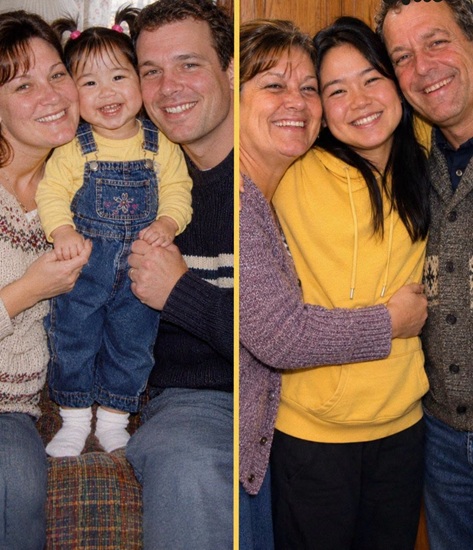
For almost twenty years, I believed the day I found my daughter at a bus stop was the most extraordinary coincidence of my life. I remembered the cold morning, the sound of a baby crying, and the tiny basket beneath the bench. I remembered taking off my coat and wrapping it around a child I had never seen before.
I remembered crying all the way home. What I never remembered questioning was whether we had truly been there by accident. Then, one ordinary Tuesday afternoon, a package arrived from China.
Inside it was a letter from a woman I had never met. Its first sentence made my hands tremble.
“Thank you for raising my daughter.”
I read those words several times, trying to understand what they meant.
Then my husband walked into the kitchen, saw the letter, and turned completely pale.
“Richard?” I asked quietly. “Who sent this?”
He didn’t answer immediately.
His eyes moved from the letter to the photographs scattered across the table. Then he looked at me as though he had been waiting for this moment for years.
“Jules, I can explain.”
I had heard those words before in other circumstances, but never from the man I thought I knew better than anyone.
And something in his expression told me that whatever he was about to explain would change the way I remembered the beginning of our family.
Until that afternoon, I had believed I knew our story.
Richard and I had spent years trying to become parents. We had visited doctors, waited for test results, and allowed ourselves to hope more times than I could count.
For a long time, every month brought another possibility.
Eventually, the possibilities became disappointments.
We stopped discussing baby names. I packed away the few things I had bought during the years when I still believed a pregnancy announcement might be just around the corner.
We were both in our early forties, and although we loved each other, the subject had become painful.
Sometimes, when friends announced that they were expecting children, I smiled and congratulated them. Later, I would sit quietly in the car and wonder why something that seemed so natural for other people had become so difficult for us.
Richard always tried to comfort me.
“We still have each other,” he would say.
I knew he meant it.
But there was a part of me that continued to imagine what our home might sound like if a child lived there.
Then came the morning that changed everything.
At the time, Richard was working in China on a temporary company contract. We were living there while he completed his assignment, and I was still trying to adjust to the unfamiliar streets, different routines, and language I understood only in small pieces.
One chilly morning, Richard suggested that we visit a local market.
He said we could walk around, buy a few things, and enjoy a day away from our usual routine.
I agreed.
We took a bus and got off near the market. The street was busy, with people carrying shopping bags and vendors preparing their stalls.
As we stepped away from the bus, I heard something.
It was a thin, uneven cry.
At first, I thought it might be a kitten.
I stopped and looked around.
“Did you hear that?” I asked Richard.
He turned toward me.
“Hear what?”
The sound came again.
This time, I knew it wasn’t an animal.
I followed it toward a nearby bench. Several people were waiting for transportation, but nobody appeared to be paying attention.
I looked underneath the bench.
That was when I saw the basket.
Inside was a newborn baby girl, wrapped in a blanket that looked far too thin for the weather.
For a moment, I couldn’t move.
Then I dropped to my knees.
“Oh my God. Richard, it’s a baby!”
Her tiny hands felt terribly cold. I immediately removed my coat and carefully wrapped it around her while Richard called for emergency assistance.
I remember looking at her little face and wondering how long she had been there.
I remember feeling frightened that we might have arrived too late.
When help arrived, the baby was taken into professional care. Officials began asking questions, and we explained exactly where we had found her.
I answered what I could, but my thoughts remained with the child.
That night, I barely slept.
I kept imagining the basket beneath the bench and the little hands reaching out from the blanket.
Richard told me that the authorities would investigate and that the baby would be looked after.
He was right.
But knowing that she was receiving care did not make it easy to stop thinking about her.
A few days later, Richard and I began asking about adoption.
We understood that finding a child did not give us any special right to become her parents. There would have to be an official investigation, legal procedures, and a proper assessment of whether adoption was possible.
We agreed to follow whatever process the authorities required.
There were interviews, documents, questions about our circumstances, and long periods when we had no definite answers.
Sometimes, I wondered whether we were allowing ourselves to hope too much.
But eventually, after the required procedures and decisions had been completed, we were approved to adopt the little girl.
We named her Maya.
When I first held her as her mother, I felt a mixture of happiness and disbelief.
I had imagined becoming a parent for years, but nothing had prepared me for the responsibility of knowing that this little person would depend on us.
We returned to the United States with Maya, and our home changed in ways I could never have predicted.
There were sleepless nights, bottles, laundry, and the constant worry that we might do something wrong.
There were also first smiles, tiny fingers holding mine, and the day she took her first steps toward Richard.
I still remember how he laughed when she reached him.
“She’s coming to me!” he shouted.
Maya fell against his legs, and he lifted her into his arms.
I stood nearby, crying and laughing at the same time.
As she grew older, she became curious, stubborn, funny, and wonderfully independent.
On her first day of preschool, she cried when I tried to leave.
I promised to wait outside the classroom until she felt comfortable.
A few years later, she would run home from school and tell me everything that had happened during the day.
When friendships became difficult, she came to me.
When she was nervous about an exam, she called Richard.
And whenever she had something important to say, she usually insisted that we both sit down and listen.
By the time she turned nineteen, she was away at college.
She called while walking between classes, sent photographs of ordinary things, and occasionally complained about assignments as though they were the greatest injustice in the world.
To me, she was still the little girl who had once reached for my hand in a crowded shop.
I never questioned the love that had grown between us.
And I never questioned the story of how we had found her.
Until the package arrived.
The delivery came on a Tuesday afternoon.
Richard was at work, and Maya was on campus. The box was addressed to me and had been sent from China.
I couldn’t remember ordering anything.
The package was not especially large, but it was heavier than I expected.
I placed it on the kitchen table and carefully opened it.
Inside were several photographs, copies of documents, a tiny knitted sweater, and a folded letter.
The letter was on top.
I opened it.
“Thank you for raising my daughter. I know you may not believe me, but I have to tell you the truth about the day you found Maya. I can’t keep this to myself any longer.”
I stopped reading.
The next sentence was even more unsettling.
“Ask your husband if you really ended up there by accident.”
I read it again.
Then I heard the front door open.
Richard walked into the kitchen, loosened his tie, and started to ask about my day.
He stopped when he saw the package.
I held up the letter.
“Someone is trying to tell me that the day we found Maya wasn’t an accident.”
His face changed.
He didn’t ask who had sent it.
He didn’t ask what the letter said.
Instead, he stared at the handwriting.
“Her name is Lin,” he finally said.
I felt my stomach tighten.
“Who is Lin?”
“I knew her in China.”
I looked at the photographs again.
“Do you know Maya’s birth mother?”
Richard sat down slowly.
“Not when we found Maya. Not for certain.”
I gripped the back of the chair.
“What does that mean?”
He rubbed his hands together, searching for words.
Then he began telling me about a woman who had worked as a translator for the company that employed him.
Her name was Lin.
She was young, pregnant, and struggling to manage her circumstances after the baby’s father disappeared from her life.
According to Richard, she had little support from her family and was worried about keeping her job.
He had helped her with some paperwork and transportation on a few occasions.
I tried to remember whether he had ever mentioned her.
He had spoken about colleagues, company meetings, and people he had met through work.
But he had never told me about Lin.
“Why didn’t you tell me about her?” I asked.
Richard looked down.
“Because I didn’t know how to explain everything.”
“Everything about what?”
He hesitated.
Then he said something that made my chest tighten.
“She knew about us. She knew how much we wanted a child.”
I stared at him.
“How would she know that?”
“I had mentioned our situation when we spoke.”
I remembered all the times I had shared my sadness with Richard. I had never imagined that he might have discussed our private struggles with someone I had never met.
“What happened between you and her?”
“Nothing romantic, Jules. I was trying to help.”
I wanted to believe him, but I needed more than a reassurance.
“What does she have to do with the bus stop?”
Richard closed his eyes briefly.
“She asked me to meet her there.”
The kitchen suddenly felt smaller.
“You knew we were going to find a baby?”
“I thought we were going to meet Lin. I thought she wanted to talk about her situation.”
“But you told me we were going shopping.”
“I didn’t know how to bring it up.”
I pulled out the chair opposite him.
“Then start from the beginning. And this time, don’t leave anything out.”
Richard explained that Lin had contacted him after giving birth.
She was struggling to find a way to care for her daughter while continuing to work. She needed help arranging childcare and finding a more secure living situation.
Richard said he had offered to discuss adoption as one possible solution.
He believed Lin was considering it.
But he had never told me that she had also asked for help keeping her baby.
I looked at him.
“Did she actually ask you to find someone to adopt her?”
“She said she didn’t know what she could do.”
“That’s not the same thing.”
He nodded.
“You’re right.”
Then he explained the morning of the bus stop.
He had agreed to meet Lin before work. Instead of telling me the real reason for the trip, he suggested that we visit the market.
He said he wanted me to meet her before we discussed anything serious.
Our bus was delayed.
During the journey, Richard received a message from Lin.
According to him, she said she could not wait any longer and had left the baby for him.
He claimed he misunderstood what she meant.
He thought she might have gone into a nearby shop or that they would meet somewhere else.
But when we arrived and I heard the crying, he began to suspect what had happened.
I stared at him.
“You knew before I did?”
He nodded.
“Did you recognize that it might be her baby while I was holding her?”
His eyes filled with tears.
“I suspected it was Lin’s child.”
I pushed my chair back.
“She was a newborn, Richard. She was outside in the cold.”
“I know.”
“She could have been seriously hurt.”
“I know.”
“And you let me believe that we had simply stumbled across her?”
He didn’t answer.
I walked toward the package.
There were still photographs and documents I had not examined.
“I want to read everything before you explain anything else.”
Among the photographs was one of a young woman holding a newborn.
The woman looked tired, but she was smiling down at the baby.
The child’s cheeks and tiny nose reminded me of Maya’s photographs from her first months.
I turned the photograph over.
Someone had written a short message in careful English.
“My daughter, before everything changed.”
Beneath the photographs was the pale yellow knitted sweater.
It was impossibly small.
I touched the soft material and imagined someone making it while waiting for a baby to arrive.
Then I found another document.
It was a copy of a letter written before Maya’s birth.
Richard leaned closer.
“Jules…”
“Please don’t interrupt me.”
I unfolded the paper.
Lin’s words were simple.
She thanked Richard for listening to her problems and asked whether he could help her find affordable childcare.
She needed to continue working.
She wanted a safe place to live with her baby.
Then I reached the sentence that changed everything.
“I am frightened, but I want to keep my daughter. Please help me find a way.”
I read it again.
Then I looked at Richard.
“You told me she wanted us to adopt Maya.”
“I told you she was struggling and that adoption might be an option.”
“You made it sound as if she had asked you to arrange it.”
He rubbed his forehead.
“I thought she was reaching the point where she couldn’t manage.”
“But she wrote that she wanted to keep her daughter.”
“That was before things became worse.”
“Did she ever tell you that she had changed her mind?”
Richard looked at the table.
He did not answer.
And that silence told me more than I wanted to know.
I thought about all the years we had spent hoping to become parents.
I remembered the appointments, the disappointments, and the quiet evenings when I had wondered whether we would ever have a child.
I knew what desperation felt like.
But I also knew that another person’s difficult circumstances should never be treated as an opportunity.
“Did you listen to what Lin actually wanted?” I asked.
Richard remained silent.
I continued reading.
The longer letter was addressed directly to me.
Lin explained that after giving birth, she had become frightened about losing her job and the room she rented.
She believed Richard might help her arrange temporary care while she worked out what to do.
She had expected to discuss the details when he arrived.
But that morning, she had already been late for work more than once.
She waited at the bus stop.
When Richard did not arrive, she panicked.
She placed the basket beneath the bench, sent him a message, and left.
Her explanation did not excuse what she had done.
In fact, she acknowledged that herself.
“I told myself he was only moments away,” she wrote. “That was a terrible thing to believe was enough. I endangered my daughter, and I have regretted it every day.”
I put the letter down.
“She didn’t know I was coming,” I whispered.
Richard shook his head.
“No. I wanted you to meet her first.”
“You wanted me to see the baby.”
“Yes.”
For nearly twenty years, I had described that morning as an extraordinary coincidence.
Now I understood that Richard had deliberately brought me to the place where he expected to meet Lin.
He had allowed me to believe I was simply going shopping.
But there was still something I needed to understand.
“What happened after the authorities took Maya?”
Richard explained that Lin eventually learned her daughter was safe and receiving care.
She later came forward and was involved in the official process concerning the child’s future.
According to the documents, she considered her options and tried to find a way to provide a stable home.
Over time, she made the decision to relinquish her parental rights through the required legal process.
The adoption did not happen simply because we had found Maya.
There were investigations, official decisions, and a formal adoption procedure.
Richard and I had applied and had been approved.
I looked at him.
“So the authorities handled everything properly?”
“Yes. We followed the official process.”
“Then why did you hide your involvement?”
He lowered his head.
“I was afraid you would think I had influenced her decision.”
“Had you?”
“I offered adoption more than once. I thought it could give Maya a stable home. But I should have listened more carefully when Lin asked me to help her keep her daughter.”
I felt a deep sadness settle over me.
“Did you know that she had written those words before Maya was born?”
He nodded.
“And you never told me?”
“No.”
“Not during the adoption process?”
“No.”
“Not when Maya was growing up?”
He shook his head.
“Why?”
Richard covered his face.
“At first, I thought I was protecting you. Then I was afraid that telling you would destroy everything. Every year, it became harder to explain why I hadn’t told you sooner.”
I looked at the man I had shared nearly two decades of marriage with.
“You weren’t protecting me, Richard. You were deciding what I was allowed to know.”
He didn’t argue.
I picked up the final letter.
Lin explained that she had eventually managed to build a more stable life.
She had not known which family had adopted her daughter.
For years, she had no reliable way to contact us.
Then an old colleague showed her a public photograph of Richard with his family.
She recognized him.
After making further inquiries, she understood that the young woman in the photograph was the child she had given birth to in China.
She waited before sending the package.
She was uncertain whether she had the right to contact the family that had raised her daughter.
But as Maya approached her twentieth birthday, Lin decided she could no longer keep her story to herself.
The final paragraph was short.
“I am not asking her to call me Mother. I only hope she knows I loved her before I made decisions I cannot undo.”
I put the letter down.
For a long time, neither Richard nor I spoke.
Then I asked the question that had been sitting in my mind.
“Why didn’t you try to find Lin afterward?”
“I knew the authorities were handling the adoption. I was afraid that contacting her privately could complicate things.”
“And telling me?”
He looked at me.
“I was afraid you’d think I had pushed her into giving Maya up.”
“Did you?”
He took a long breath.
“I don’t know how much my suggestions affected her. I know I wanted adoption to happen. I wanted us to have a child. And I should have been honest about that.”
It was the first answer that sounded completely honest.
It was also the one that hurt the most.
We spent the rest of the evening sitting apart.
Richard offered to call Maya immediately.
I told him that she deserved to hear the truth from both of us, but I needed time to understand what we could honestly tell her.
We had to separate what we knew from what we assumed.
We could tell her what the documents said.
We could tell her what Richard had admitted.
But we could not pretend to know every thought Lin had experienced on that morning.
The following day, I called Maya.
“Mom? Is everything okay?”
“I’m safe, sweetheart. But there’s something about your adoption that we need to discuss in person.”
She became quiet.
“Is Dad okay?”
“He’s here.”
“Then I’ll come home tomorrow.”
I spent the rest of the day thinking about how to begin.
How could I tell a nineteen-year-old that the story she had grown up hearing was incomplete?
How could I explain that her father had known more than he had ever admitted?
And how could I make sure she understood that none of this changed her worth or the love she had received?
Maya arrived on Friday afternoon.
She walked through the front door carrying her backpack and wearing the same worried expression she used to have as a child whenever she knew something serious was happening.
Richard stood up.
“Thank you for coming home.”
Maya looked between us.
“What’s going on?”
I asked her to sit down.
Richard began with an apology.
Then he explained Lin’s identity, the planned meeting, and the message he had received before we reached the bus stop.
Maya listened without interrupting.
When he finished, she looked directly at him.
“You knew who she was?”
“Yes.”
“And you let me grow up believing nobody knew why I was there?”
Richard swallowed.
“Yes. I should have told you.”
“Why didn’t you?”
He tried to explain that he had been afraid of upsetting her and that he had believed the truth would make her childhood more difficult.
Maya shook her head.
“That’s not an answer.”
Richard looked at the floor.
“You’re right. I was afraid of facing what I had done.”
For once, I didn’t step in to make the conversation easier.
Maya turned toward the box.
“Did she send all of this?”
I handed her Lin’s letter.
She read it slowly.
At first, her expression was difficult to understand.
Then she stopped halfway through and covered her mouth.
I wanted to reach for her, but I waited.
When she finished, she placed the paper on the table.
“Can I have a few minutes alone?”
“Of course,” I said.
She went upstairs.
Richard sat down heavily.
“Do you think she’ll hate me?”
I looked at him.
“I don’t know. But right now, this isn’t about making you feel better.”
An hour passed before Maya returned.
She was holding the tiny yellow sweater.
“She made this?” she asked.
“That’s what the letter says.”
Maya turned it over in her hands.
“I spent years thinking she left me because she didn’t want me.”
I moved closer.
“Her decision that morning put you in danger. She acknowledges that. But her letter also says she loved you and wanted to find a way to care for you.”
“Then why did she leave me there?”
“I don’t know every part of what she was thinking. We can ask her if you want to.”
Maya sat beside me.
For a moment, she looked like the little girl who used to come to me after a difficult day at school.
Then she leaned against my shoulder.
“I want to talk to her.”
“That’s your decision,” I told her. “You don’t have to decide everything today.”
She looked at Richard.
“I love you, Dad. But you should have told me.”
Richard’s eyes filled.
“I know.”
“Please don’t decide what I can handle anymore.”
He nodded.
“I won’t.”
That weekend, Maya began writing a letter to Lin.
She asked about her birth, the early days, and what Lin remembered about that time.
She also told her about college, her friends, her favorite subjects, and her plans for the future.
She did not promise an immediate relationship.
She did not pretend that everything was suddenly resolved.
She simply wanted to know more.
Before sending the letter, Maya asked me to bring down the box where I had kept her baby belongings.
Inside were photographs, hospital documents, a few tiny clothes, and the old blanket she had been wrapped in when she first came into our lives.
The blanket had become faded over the years.
One corner was frayed, and the fabric had softened from being folded and unfolded so many times.
Maya spread it across the kitchen table.
Then she looked at the photograph Lin had sent.
The pattern matched.
“She wrapped me in this,” Maya whispered.
“Yes.”
Maya studied the photograph for a long time.
“Can we send her a picture of it?”
I nodded.
A few weeks later, Lin replied.
Her letter answered Maya’s questions as honestly as she could.
She did not claim that her choices had been right.
She did not ask Maya to forget the past.
She explained what she remembered and acknowledged that some questions might never have simple answers.
Eventually, Maya agreed to a video call.
I stayed nearby because she asked me to, but I let her lead the conversation.
At first, both women were nervous.
Lin spoke carefully.
Maya asked about the photograph, the sweater, and the blanket.
They talked about the past, but they also talked about ordinary things.
Maya told her about college.
Lin asked what she liked studying.
There were pauses, tears, and moments when neither seemed to know what to say.
It wasn’t a perfect reunion.
It wasn’t the end of every difficult question.
It was simply a beginning.
Richard and I were still dealing with what his secret had done to our marriage.
I loved him, but love did not automatically restore trust.
I told him that apologies were important, but honesty had to become part of our everyday life.
He agreed to give me the time I needed.
And Maya made her own decisions about how much contact she wanted with Lin.
One evening, after Maya had returned to college, I found the photograph of the old blanket beside Lin’s first letter.
“Thank you for raising my daughter.”
I read the sentence again.
For years, I had believed that finding Maya at the bus stop was the moment that made me her mother.
Now I understood that the story was more complicated than I had ever imagined.
There had been a young woman struggling to find a way forward.
There had been a decision made in fear that placed a newborn in danger.
There had been an official process that eventually brought Maya into our family.
And there had been a husband who had hidden part of the truth because he was afraid of what it would mean.
None of those facts erased the life Maya and I had built together.
I remembered her first steps, her first day of school, the nights she was frightened, and the countless ordinary moments that made a family.
I remembered her calling me after a difficult exam simply because she wanted to hear my voice.
Those memories were real to us.
They did not belong to Richard’s secret, and they did not disappear because we had learned something new.
Lin had given Maya life.
I had helped raise her.
And Maya, as she grew older, would decide what both relationships meant to her.
I no longer described that morning as a perfect coincidence.
It was a complicated event involving people who had made difficult choices, some of them deeply painful.
But one thing had not changed.
Maya was not responsible for the decisions the adults had made before she was old enough to understand them.
She deserved the truth.
She deserved to ask questions.
And she deserved to decide what happened next.
The greatest lesson I learned was that love cannot be measured by who gets to tell the story.
Sometimes, loving someone means allowing them to hear the truth, even when that truth makes the past harder to understand.
And sometimes, the most important part of a family’s story is not how it began, but how honestly its members choose to move forward.