
Teachers are often remembered for much more than the lessons they deliver or the grades their students achieve. Their influence frequently extends into the small, everyday interactions that take place in classrooms, hallways, and playgrounds. These moments are rarely planned or documented, yet they can have a lasting emotional impact on children. In education, it is often these subtle acts of care and attention that shape how students feel about learning and about themselves.
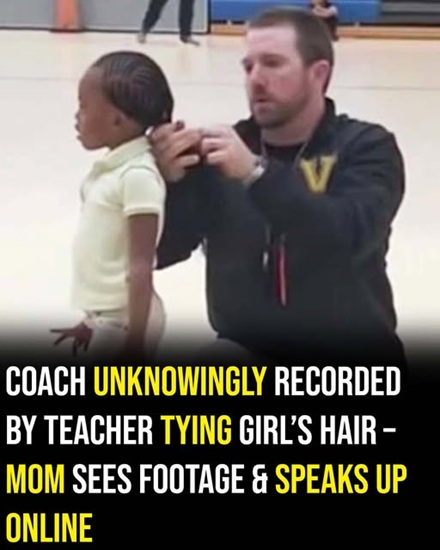
One widely shared example of this came from WG Nunn Elementary School, where a brief interaction between a teacher and a student was captured on video and later spread widely online. The moment involved Jonathan Oliver, a physical education teacher and youth basketball coach, and a young kindergarten student named Kristen Paulk. During a gym class activity, Kristen approached him with a simple but practical request. Her hair kept falling into her face while she was trying to participate in the activity, making it difficult for her to continue comfortably.
Instead of dismissing the request or directing her elsewhere, Oliver responded immediately and without hesitation. He paused what he was doing, knelt down to her level, and carefully gathered her hair into a ponytail so she could continue playing. The gesture was simple and took only a few moments, but it reflected a level of patience and attentiveness that is often associated with effective early childhood educators. The interaction took place naturally within the flow of a regular school activity.
At the time, Oliver was not aware that the moment was being recorded. A school observer, Kandice Anderson, captured the interaction on video and later shared it on social media. The video was posted with a brief caption highlighting the idea that teaching often goes beyond formal instruction. Once shared online, the clip quickly gained attention, spreading across various platforms and reaching a wide audience. Within a short period, it had been viewed and shared by thousands, and eventually millions, of users.
As the video gained traction, it attracted attention from national media outlets, including television programs and online news platforms. The widespread interest was largely driven by the simplicity of the act and the emotional response it generated among viewers. Many people saw the moment as an example of how educators support students not only academically but also emotionally and practically throughout the school day. The story resonated with audiences because it reflected a familiar but often unseen aspect of teaching.
In interviews following the viral attention, Jonathan Oliver expressed surprise at the reaction the video received. He explained that, from his perspective, the interaction was not unusual or extraordinary. Instead, he described it as part of his regular approach to working with young students. In elementary school settings, teachers and staff frequently respond to small personal needs as part of maintaining a supportive learning environment. Oliver emphasized that his focus was always on ensuring that students feel comfortable and included.
He also explained that his role as a physical education teacher involves more than organizing sports activities. It includes creating an environment where children feel safe, encouraged, and able to participate fully. In early childhood education, especially in active settings like gym class, teachers often address minor issues on the spot so that students can remain engaged. These responsibilities are part of the broader duty of care that educators assume when working with young children.
The simplicity of Oliver’s explanation highlighted an important reality about education. Many actions that appear remarkable to the public are actually routine within schools. Teachers regularly help students with small personal challenges, whether related to comfort, participation, or confidence. These actions are rarely highlighted outside the classroom, but they are an essential part of supporting children’s development during their formative years.
Oliver also spoke in a lighthearted way about the situation, acknowledging that while he was comfortable helping with a basic hairstyle, he did not consider himself particularly skilled in that area. His comment reflected the informal and natural nature of the interaction. There was no preparation or expectation that the moment would be recorded or shared publicly. It was simply a response to a child’s immediate need during a normal school activity.
For Kristen’s mother, Miyah Cleckley, the video provided reassurance about her daughter’s school environment. She expressed appreciation for the care shown to Kristen during the school day and noted that it reflected positively on the school staff. Her response highlighted the trust that parents place in educators to support not only academic learning but also the daily well-being of their children while they are at school.
Cleckley also discussed how responsibilities are shared within families, especially in households with multiple children. In many families, daily routines such as preparing children for school require cooperation between caregivers. Seeing a teacher step into a supportive role during the school day reinforced the connection between home and school environments. It demonstrated how children benefit when the adults in their lives work together to support their needs.
The broader significance of this moment lies in its reflection of the role of teachers in early education. Educators in elementary schools often serve multiple roles throughout the day, including instructor, caregiver, mediator, and supporter. Their responsibilities extend beyond academic instruction to include emotional guidance and practical assistance. These combined roles contribute to a stable and supportive environment where children can focus on learning and development.
Education experts often emphasize that early childhood experiences in school play a critical role in shaping long-term attitudes toward learning. Positive interactions with teachers can help build confidence, social skills, and emotional resilience. While major achievements are often highlighted in academic settings, it is usually the small, consistent acts of care that have the most lasting influence on a child’s school experience.
The widespread reaction to the WG Nunn Elementary School video reflects a broader appreciation for these everyday moments in education. In a time when many aspects of schooling are discussed in terms of performance and outcomes, this interaction reminded viewers of the human side of teaching. It showed that education is not only about structured lessons but also about relationships, empathy, and attention to individual needs.
In conclusion, the interaction between Jonathan Oliver and Kristen Paulk represents a simple yet meaningful example of how teachers support students beyond academic instruction. The moment itself was brief and unplanned, but it highlighted the importance of kindness and responsiveness in educational settings. It also demonstrated how small gestures can resonate widely when they reflect universal values such as care and respect.
Ultimately, the story serves as a reminder that some of the most important lessons in education are not written in textbooks or measured in tests. They are experienced in everyday interactions between teachers and students. Long after specific lessons are forgotten, these moments of support and understanding often remain with children, shaping how they view school, learning, and themselves.
