
In the age of social media, everyday family moments can quickly transform into global discussions, especially when they involve parenting, discipline, and teenage behavior. One such case that gained widespread attention involved a mother named Heidi Johnson, whose approach to teaching her teenage son about responsibility became a viral topic shared across Facebook and other platforms in 2015. The story continues to be referenced today in discussions about parenting styles and real-world education. The situation began with a common household challenge faced by many families: the transition of a child into early adolescence.
At around 13 years old, teenagers often begin to explore independence while still lacking the emotional maturity and financial understanding required for adult life. In this case, the disagreement centered around school responsibilities, household expectations, and a growing sense of independence from the teenager’s perspective. According to Heidi Johnson’s account shared publicly at the time, her son Aaron had begun expressing frustration about following household rules, particularly related to completing homework and respecting parental instructions.
Like many teenagers, he was testing boundaries, a natural part of developmental psychology during early adolescence. However, tensions escalated when he began to link his behavior to the small amount of money he was earning online. At the time, Aaron was reportedly earning a modest income through online content creation on YouTube.

Although the earnings were not significant in a real financial sense, they gave him a feeling of independence and control over his own decisions. This perception led to conflict at home, as he began to challenge the authority of his mother based on his belief that he was becoming financially self-sufficient.
The situation reached a breaking point when Aaron reportedly refused to complete his homework and argued that because he was earning money, he should not be required to follow the same household expectations as before. This statement reflected a common misunderstanding among young teenagers about the difference between earning small personal income and achieving true financial independence.
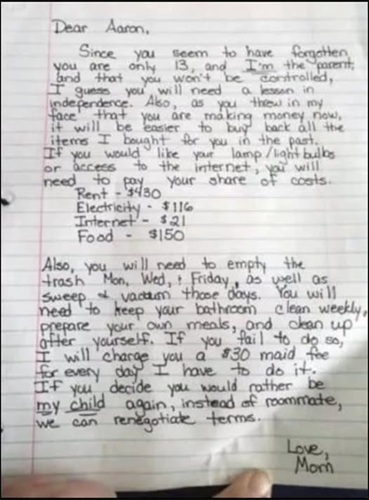
In response, Heidi Johnson decided to approach the situation in a structured and educational way rather than simply imposing traditional punishment. Her goal, as she later explained, was to create a realistic comparison between her son’s perception of adulthood and the actual responsibilities that come with independent living. Instead of grounding or taking privileges away in a traditional sense, she used a written “contract-style” note.
The note she wrote was designed to simulate what life would look like if her son truly operated as an independent adult living under real financial conditions. In the message, she outlined basic adult responsibilities such as paying rent, contributing to household utilities, covering internet expenses, and managing food costs. These are standard elements of independent living that teenagers often do not fully understand.
The tone of the message was firm but structured, focusing on responsibility rather than punishment. At the end of the note, she signed it simply as “Mom,” reinforcing that the exercise was coming from a place of parenting rather than rejection. The purpose was to help her son understand the financial reality behind everyday life, not to actually remove parental support.
When Aaron first read the note, his reaction was emotional and defensive. According to Heidi Johnson’s later explanation, he crumpled the note and left the room in frustration. This type of reaction is not unusual in teenagers, especially when they are confronted with consequences that challenge their developing sense of independence.
However, the situation did not end in long-term conflict. After some time to reflect, Aaron reportedly began to understand the message behind the exercise. He eventually returned to his mother and asked how he could regain certain privileges and improve his behavior. This moment marked an important shift in the learning process, moving from emotional reaction toward reflection and accountability.
Heidi Johnson later clarified that her intention was never to force her son to actually pay rent or become financially independent at such a young age. Instead, the exercise was designed as a teaching tool to demonstrate the hidden costs of adulthood. She wanted him to understand that things like electricity, food, housing, and internet access require consistent financial effort and responsibility.
She emphasized that many teenagers do not naturally see the structure behind everyday life. When children grow up, many essential services appear seamless, but they are supported by work, budgeting, and sacrifice. Her goal was to make these invisible systems more visible to her son in a way he could understand at his developmental stage.
In 2015, Johnson shared the story on Facebook, where it quickly gained widespread attention. The post was widely circulated, sparking thousands of comments, shares, and debates about whether her approach was appropriate. The viral nature of the post turned a private parenting moment into a global discussion about discipline and education.
Many people supported her approach, praising it as a creative and practical way to teach real-world responsibility. Supporters argued that teenagers often struggle with understanding financial reality, and methods like this can help bridge the gap between childhood dependence and adult independence. They viewed it as a lesson in accountability rather than punishment.
Others, however, criticized the method, arguing that publicly sharing the story could be interpreted as shaming the child. Some also questioned whether the approach might be too strict or emotionally challenging for a young teenager still developing emotional regulation skills. This divide highlighted broader disagreements about modern parenting strategies.
In response to the criticism, Heidi Johnson explained that she was not attempting to embarrass her son. Instead, she stated that she was trying to prepare him for the real world, where responsibilities and consequences are unavoidable. She emphasized that adolescence is a transitional stage where children must gradually learn independence while still under parental guidance.
She also highlighted an important parenting principle: that real-world success requires structure, discipline, and understanding of consequences. In her view, shielding children completely from responsibility can make it more difficult for them to adjust later in life when they face academic, professional, and financial expectations.
The story continued to circulate online for years, often resurfacing in discussions about parenting methods, financial education, and teenage development. It became an example frequently cited in debates about whether structured responsibility exercises are effective tools for teaching life skills.
Psychologically, the situation reflects a common stage in adolescent development, where teenagers begin to form their identity and test autonomy. However, without real-world experience, their understanding of independence is often incomplete, focusing more on freedom than on responsibility. Parenting strategies like Johnson’s aim to bridge that gap through experiential learning.
Over time, the story has remained relevant because it reflects a universal parenting challenge: how to prepare children for adulthood without removing necessary support too early. While opinions about the method vary, the underlying message about responsibility, consequences, and financial awareness continues to resonate with many families.
Ultimately, the viral moment involving Heidi Johnson and her son became more than just a social media post. It evolved into a broader conversation about growing up, understanding value, and recognizing the effort required to maintain everyday life. The discussion continues to serve as a reference point in parenting debates around the world.
