
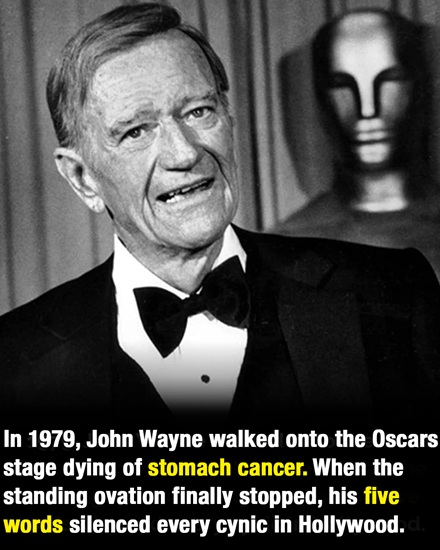
On April 9, 1979, the Dorothy Chandler Pavilion became the center of global attention as it hosted the 51st Academy Awards. The ceremony was expected to celebrate the year’s strongest films, but it also became a night remembered for one of the most emotional appearances in Hollywood history. Beneath the formal elegance of the event, there was an unspoken awareness that something deeply significant was about to unfold. Hollywood in the late 1970s was in a period of transition, moving from the classic studio era into a more modern and socially complex cinematic landscape.
Yet one figure who remained strongly connected to the golden age of American film was John Wayne. For decades, Wayne had symbolized rugged individualism and traditional heroism through Westerns and war films, becoming one of the most influential actors in American cinema history. By 1979, Wayne’s health had become a serious concern. He had already endured major medical challenges, including a lung cancer diagnosis in the 1960s. In 1964, he underwent a significant surgical procedure that resulted in the removal of one lung and several ribs.
Despite this, he continued working in films and remained active in public life, demonstrating remarkable resilience over many years. In early 1979, Wayne underwent what was initially expected to be routine gallbladder surgery. However, during the operation, doctors discovered cancer in his stomach. As a result, he underwent a total gastrectomy, a complex and life-altering procedure in which his entire stomach was removed. The surgery marked one of the most difficult periods of his later life.

Given his condition, there was widespread uncertainty about whether he would attend the Academy Awards ceremony. His presence was not guaranteed, and many in Hollywood understood that his health might prevent him from appearing publicly. However, the idea of his attendance carried strong emotional significance for both fans and the film industry.
One of Wayne’s longtime friends, Bob Hope, who frequently hosted Oscar ceremonies, reportedly encouraged him personally to attend. Hope understood how meaningful Wayne’s presence would be to the audience and to Hollywood history. Ultimately, Wayne made the decision to appear, despite his fragile condition.
When the night of the ceremony arrived, anticipation inside the auditorium was unusually intense. As Wayne entered the hall, the audience immediately rose to their feet. The standing ovation lasted several minutes, reflecting not only admiration for his career but also deep respect for his personal struggle and determination to be present.
Observers at the event noted that Wayne appeared physically weakened compared to earlier years. He was thinner and moved more slowly, yet he still carried the unmistakable presence that had defined his screen persona for decades. Even in poor health, his composure and dignity remained intact, reinforcing the image that audiences had associated with him throughout his career.
When the applause finally settled, Wayne stepped forward to speak. His voice was calm and steady, though softer than in his earlier public appearances. He expressed gratitude to the audience for their reception, acknowledging the emotional weight of the moment. His words were brief but carried significant emotional impact.

One of the most remembered aspects of his speech was his simple acknowledgment of appreciation toward the audience, which resonated deeply with those present. The sincerity of his delivery created an atmosphere of reflection and emotion, as many realized they were witnessing a rare and possibly final public appearance from a major figure in film history.
The audience responded again with prolonged applause. Many attendees were visibly emotional, aware that Wayne’s presence represented not only his personal strength but also the closing chapter of an entire era in Hollywood. His appearance symbolized continuity between the classic film age and the modern industry evolving around it.
Despite his condition, Wayne maintained his characteristic sense of humor during the ceremony. He made light remarks about his long career and even joked about his shared longevity with the Academy Awards themselves. These comments briefly lifted the emotional tone of the evening and reminded the audience of his enduring charm.
During the ceremony, Wayne also served as the presenter for the Best Picture award. The nominees included several critically acclaimed films that reflected the social and political themes of the 1970s. Among them were The Deer Hunter, Coming Home, Midnight Express, An Unmarried Woman, and Heaven Can Wait.
When the envelope was opened, Wayne announced The Deer Hunter as the winner. The announcement was delivered clearly and formally, and the moment itself became part of Oscar history, as the film went on to be regarded as one of the most significant works of its time.
After completing his duties on stage, Wayne stepped away from the spotlight. Unknown to most in attendance, this would become his final public appearance. The evening did not feel like a farewell at the time, but in hindsight, it marked the end of his visible presence in Hollywood events.
In the weeks following the ceremony, Wayne’s health continued to decline. He was admitted to UCLA Medical Center due to complications related to his condition. Although he was later released, his recovery remained fragile, and his medical situation required ongoing attention.
On May 26, 1979, Wayne received the Congressional Gold Medal, one of the highest civilian honors in the United States. The award recognized his extraordinary contribution to American cinema and culture. Despite his physical condition, he remained engaged in public life as much as possible.
Just over two weeks later, on June 11, 1979, John Wayne passed away at UCLA Medical Center at the age of 72. His death marked the conclusion of a remarkable career that had spanned more than five decades and over 170 film appearances, making him one of the most prolific actors in Hollywood history.
In his final months, Wayne had also expressed interest in participating in experimental medical research, hoping his involvement might contribute to future advancements in cancer treatment. This reflected his willingness to support causes beyond his personal circumstances, even during serious illness.
After his passing, Wayne’s legacy continued through his family’s efforts to support medical research. The establishment of the John Wayne Cancer Institute helped advance studies in oncology and ensured that his name remained associated with medical progress and public benefit beyond his film career.
Wayne was buried at Pacific View Memorial Park. His resting place, located on a peaceful hillside overlooking the Pacific Ocean, was chosen for privacy and serenity. For many years, the exact location of his grave was not publicly disclosed, in accordance with the family’s wishes.
Over time, Wayne’s final Oscar appearance has come to be remembered not only as a moment in entertainment history, but also as a symbol of dignity, endurance, and respect. It represents the final public chapter of a man whose influence on Hollywood and American culture remains deeply significant.
