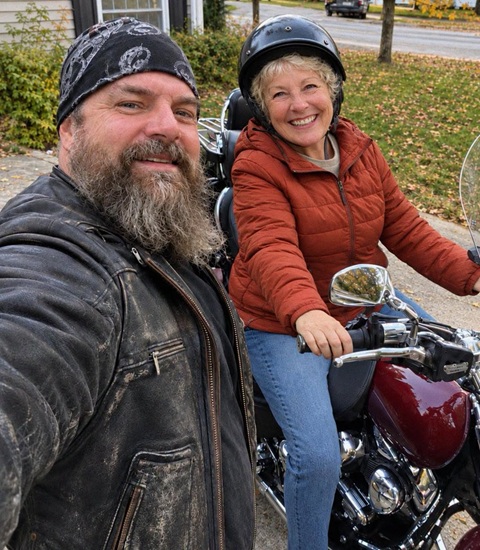
For months, I watched my mother climb onto a stranger’s motorcycle every Saturday morning. She would put on her jacket, collect her handbag, and walk toward the driveway with a smile I hadn’t seen in years.
The man waiting for her was enormous. He had a gray-streaked beard, heavy boots, and a leather jacket that made him look rather intimidating. Yet whenever he greeted my mother, his voice became gentle.
His name was Connor. At first, I thought those motorcycle rides were helping her survive the loneliness that followed my father’s death.
She always returned several hours later looking happier, sometimes carrying a small paper bag or talking about something that had made her laugh.
I never imagined there was something else behind those Saturdays.
Something connected to a part of her life she had carefully hidden from me.
I learned the truth only after her funeral.
Connor approached me while the other guests were saying their goodbyes.
Without his motorcycle jacket, he looked strangely different. He wore a dark suit, and his carefully trimmed beard couldn’t hide how tired he was.
“Your mother was an extraordinary woman,” he said.
“She thought a lot of you too.”
He glanced toward the relatives gathered across the room.
“There’s something I need to tell you, Mia.”
I was exhausted. I had spent the entire day greeting people, accepting condolences, and trying to understand how the house would feel without my mother.
“What is it?”
Connor took a breath.
“Those Saturday rides weren’t exactly what you thought they were.”
My stomach tightened.
“Where were you taking her?”
He looked directly at me.
“To see my mother.”
I stared at him.
“Your mother?”
“Her name is Diane.”
The name meant nothing to me.
Then he mentioned someone else.
“She also knew your Uncle Mike.”
Suddenly, I wasn’t thinking about the motorcycle anymore.
I was thinking about a relative whose name I hadn’t heard in years.
And I realized my mother had been keeping a secret much longer than I had imagined.
Six months earlier, I hadn’t even known Connor existed.
My father, Richard, had died less than a year before I first saw him in our driveway.
Dad had been the louder personality in our family. He sang while washing dishes, told the same jokes repeatedly, and could turn a simple trip to the grocery store into a conversation with three strangers.
My mother, Frances, was different.
She preferred quiet mornings, gardening, crossword puzzles, and long conversations over a cup of tea.
She remembered birthdays, saved old photographs, and could tell you exactly which family member had brought a particular dish to a holiday dinner ten years earlier.
After Dad died, the house seemed to lose its sound.
I began visiting every weekend.
I brought groceries, checked the heating, repaired small things, and tried to make sure she wasn’t spending every day alone.
One Saturday morning, I found her kneeling beside the living-room wall with a dust cloth.
“Mom, give me that. I’ll do it.”
She looked up.
“Mia, I’m grieving, not helpless.”
“I’m only trying to help.”
“You’ve been trying to help since eight this morning.”
I smiled, but she wasn’t joking.
She wanted to do things herself.
I understood that losing Dad had already taken away enough of her independence. Still, I worried about her.
Then a loud motorcycle engine interrupted us.
The sound came from the driveway.
I walked toward the front window and looked outside.
A large motorcycle stood beside a tall man wearing black boots and a leather jacket.
I turned toward my mother.
“Mom, do you know there’s a biker in your yard?”
She looked up from her cleaning cloth.
Then she smiled.
“That’s Connor.”
I frowned.
“Who is Connor?”
She was already reaching for her jacket.
“My ride.”
I laughed because I thought she was joking.
She wasn’t.
A few minutes later, I followed her outside.
Connor removed his helmet.
“Afternoon, Frances.”
“Hello, Connor.”
His voice was deep, but his manner was polite.
Mom pointed toward me.
“This is my daughter, Mia.”
“Nice to meet you,” he said.
I nodded, still trying to understand what was happening.
“Where are you taking her?”
“For a drive,” he answered.
Mom accepted the helmet.
I stepped closer.
“You’re getting on a motorcycle with someone I’ve never met?”
She gave me a look.
“Mia, you’re forty-seven years old. I think we’ve passed the point where I need your permission to make friends.”
“That’s not what I mean.”
Her expression softened.
“I know you’re worried.”
I lowered my voice.
“Dad hasn’t even been gone a year. I don’t want anything happening to you.”
She touched my arm.
“I can’t spend the rest of my life avoiding every road because your father isn’t here to take it with me.”
I had no answer.
She kissed my cheek, climbed onto the motorcycle, and waved before Connor started the engine.
I stood in the driveway watching them disappear.
I told myself I was being overly protective.
But something about the situation still bothered me.
Three hours later, the motorcycle returned.
Mom climbed off carefully, removed her helmet, and shook out her flattened hair.
Her cheeks were pink from the wind.
More importantly, she was smiling.
Not the polite smile she used when relatives asked whether she was doing well.
It was a genuine smile.
Connor handed her a small paper bag.
“You forgot this.”
She took it quickly.
“Thank you.”
I looked at the bag.
“What’s in there?”
“Nothing you need.”
She walked past me into the house.
I watched Connor leave.
Then I looked at my mother.
“Are you going to tell me where you went?”
“We drove around.”
“For three hours?”
“Time passes quickly when you’re enjoying yourself.”
She disappeared into the kitchen.
I didn’t push.
At the time, I thought the bag contained something she had bought during their trip.
I didn’t realize it was the first clue that those Saturdays meant much more to her than a simple motorcycle ride.
Connor began visiting almost every Saturday.
Sometimes he arrived on the motorcycle.
Other times, particularly when the weather was poor, he came in a truck.
Mom always seemed to know when he was coming.
She started getting up earlier on Saturday mornings.
She baked again.
One weekend, I found her carefully placing a lemon cake inside a box.
“Is that for Connor?”
She didn’t look up.
“No.”
“Then who is it for?”
“Someone with excellent taste.”
She closed the box and placed it beside her handbag.
I smiled.
“You’re being mysterious.”
“You’re being nosy.”
I laughed.
But the small secrets continued.
One morning, she put on lipstick before Connor arrived.
I watched her through the kitchen doorway.
“Should I be worried?”
She capped the lipstick and examined herself in the mirror.
“Something should have happened a long time ago.”
I straightened.
“What does that mean?”
She looked at me.
“Have you ever waited so long to apologize that the apology starts feeling selfish?”
My smile disappeared.
“Who did you hurt?”
For a moment, she seemed ready to answer.
Then the motorcycle sounded outside.
She picked up her purse.
“I’ll see you later, sweetheart.”
“Mom, wait.”
She kissed my cheek and walked out.
I watched her leave, wondering who she had been talking about.
I had spent my entire life believing I knew almost everything about her.
Apparently, I didn’t.
As the months passed, I noticed that my mother seemed lighter.
She laughed more often.
She began spending time in the garden again and sometimes played music while preparing dinner.
I was relieved.
After Dad’s death, I had worried that grief would slowly take away the parts of her personality that made her who she was.
Connor seemed to be helping her rediscover some of them.
I never asked whether their friendship was romantic.
I didn’t think it was.
There was something respectful and familiar about the way they treated each other.
Besides, Connor never behaved as though he wanted to replace my father.
He simply arrived, greeted Mom, and took her somewhere.
Then one afternoon, everything changed.
Mom stopped halfway across the living room and pressed a hand against her chest.
I immediately moved toward her.
“Mom?”
She waved me away, but I could see that something was wrong.
We arranged medical appointments, and after further examinations, the doctors explained that her heart was failing.
Suddenly, the Saturday rides became another source of anxiety.
I worried about her getting on the motorcycle.
I worried about the distance.
I worried about what might happen if she became unwell while they were away.
One Saturday, Connor arrived in his truck.
I met Mom at the front door before she could leave.
“You’re staying home today.”
She frowned.
“Move, Mia.”
“You get short of breath walking to the mailbox. You’re not going anywhere.”
Connor remained beside the truck, watching quietly.
Mom looked at me.
“Connor knows what’s happening. I need this.”
“I already lost Dad,” I said. “I can’t lose you because you’re determined to prove you can still do everything you did before.”
Her expression changed.
For a moment, neither of us spoke.
Then she answered softly.
“I’m not trying to prove anything.”
“Then tell me what these Saturdays are about.”
She glanced toward Connor.
Something crossed her face that I hadn’t seen before.
Fear.
Not fear of the motorcycle.
Not fear of her illness.
It looked like the fear of someone who had been carrying an unfinished conversation for too long.
“I’m trying not to leave something unfinished,” she whispered.
My stomach tightened.
“What?”
She shook her head.
“I’m not ready to tell you.”
“Why not?”
“Because it isn’t only my story.”
I stood there, trying to understand.
Whose story was it?
She picked up her purse and walked toward the truck.
I let her go.
But her words stayed with me.
Two months later, my mother was gone.
Her illness had progressed, and despite the care she received, she died.
The house became quiet again.
Only this time, I knew the silence wasn’t temporary.
I spent the days after her funeral sorting through arrangements, answering messages, and trying to adjust to the fact that I would never hear her voice on the telephone again.
Then Connor approached me.
I remembered his words.
“Those Saturday rides weren’t exactly what you thought they were.”
I looked at him.
“Tell me where you were taking her.”
He repeated the name.
“My mother. Diane.”
“Why?”
“They knew each other before we were born.”
I stared at him.
“How?”
“That’s something I think Diane should explain.”
I felt frustration rising.
“I just buried my mother. I’m tired of half-answers.”
Connor nodded.
“I understand.”
“Then bring her here.”
He hesitated.
“Are you sure?”
“Yes.”
He looked toward the other guests.
“Give me a little time.”
An hour later, he returned with a silver-haired woman.
She walked slowly into my mother’s living room.
Her eyes moved across the family photographs.
She stopped in front of one picture and whispered a name.
“Mike.”
My uncle.
I felt the room become smaller.
Diane sat down carefully.
For a moment, she seemed unsure where to begin.
Then she looked at me.
“Frances and I were best friends when we were teenagers.”
I stared at her.
“My mother never mentioned you.”
“I know.”
“How long did you know each other?”
“Since we were young girls.”
She glanced at the photographs.
“We did almost everything together. School, dances, weekend trips, and all the ordinary things teenagers do when they believe their friendships will last forever.”
I listened without interrupting.
Then she mentioned a boy named Sam.
“Frances loved him,” Diane explained. “But he chose me.”
I looked at Connor.
“Was Sam your father?”
Connor nodded.
I turned back to Diane.
“My mother loved Dad.”
“She did,” Diane answered. “But that doesn’t mean she had completely let go of everything that happened before.”
I was confused.
Then Diane continued.
“Years later, your Uncle Mike and I fell in love.”
I stared at her.
“Uncle Mike?”
She nodded.
Mike had been part of my childhood.
He was the uncle who brought presents during holidays, made jokes at the dinner table, and once spent an entire afternoon teaching me how to ride a bicycle.
He eventually moved away.
He married, built a life, and died in a car accident years before my father.
I had never imagined there was another story behind his life.
Diane looked down at her hands.
“Mike and I were serious about each other.”
“What happened?”
She took a slow breath.
“Frances told him she couldn’t accept our relationship.”
I shook my head.
“Why?”
“Because of what happened with Sam.”
The connection began forming in my mind.
Diane explained that Frances had never fully resolved the hurt she felt when Sam chose her.
Years later, seeing Diane happy with Mike brought those old feelings back.
Instead of accepting that the past was over, Frances became involved in a relationship that wasn’t hers to control.
According to Diane, my mother pressured Mike to choose between the relationship and his place in the family.
I stood up.
“No. That doesn’t sound like my mother.”
Diane didn’t argue.
“People can love someone and still hurt them.”
I looked at Connor.
“Did Mike ever tell you this?”
Connor shook his head.
“I was nine when everything happened. I remember him being around, and then I remember him being gone. My mother explained more when I was older.”
I sat down again.
“So you’re telling me my mother interfered with your relationship because she was still hurt about a boy from her teenage years?”
Diane nodded.
“That’s what happened from my side.”
I felt angry, confused, and embarrassed.
I wanted to defend my mother.
But I also wanted to understand why Diane had come to our house after all these years.
“Why are you telling me this now?”
Connor answered.
“Because your mother asked me to bring her to Diane.”
“After forty years?”
“Yes.”
“Why didn’t she tell me?”
Diane looked at the family photographs.
“She was ashamed. She believed that if you knew what she had done, you would never look at her the same way.”
I shook my head.
“You don’t know my mother.”
Diane’s voice remained calm.
“I knew a version of her you didn’t.”
That sentence hurt more than I expected.
I stood and walked toward the door.
“Please leave.”
Connor started to speak.
I raised my hand.
“Both of you.”
They left without arguing.
But after the door closed, I realized I wasn’t satisfied.
I didn’t believe everything Diane had told me.
And I wasn’t ready to accept that the woman I had admired my entire life could have made such a decision.
There was only one place I could think to look.
My mother’s belongings.
I went upstairs and opened the closet.
At the back, beneath a stack of folded blankets, was an old wooden box.
I brought it downstairs and placed it on the floor.
Inside were photographs, birthday cards, letters, and small objects she had kept for decades.
I began going through them.
There were pictures of Dad and Mom.
There were photographs of me as a little girl.
There were pictures from family holidays and school events.
Then I found one of two teenage girls standing together.
One was my mother.
The other was Diane.
They were laughing, their arms wrapped around each other.
I turned the photograph over.
There was no date.
But I knew immediately that it had been taken long before I was born.
I found another photograph.
This time, my mother stood beside a young man.
Her expression was affectionate.
The man was Sam.
But he wasn’t looking at her.
He was looking toward Diane.
I sat quietly, studying their faces.
Then I found a third photograph.
Uncle Mike stood beside Diane with one arm around her shoulders.
A little boy stood in front of them holding a baseball glove.
Connor.
He looked about nine years old.
My mother had kept that photograph all those years.
I couldn’t understand why.
If she had truly wanted nothing to do with Diane, why had she saved a picture of her and Mike?
I placed it carefully beside the others.
For the first time, I wondered whether my mother’s Saturdays had been about something more complicated than apologizing.
Perhaps she had spent decades trying to understand a decision she could never undo.
But the answer was still hidden somewhere.
The following morning, I found it.
I was in the kitchen looking through my mother’s old recipe box.
I wanted to make something familiar.
Something that reminded me of the ordinary weekends we used to share.
As I opened the box, a folded envelope slipped out and landed on the counter.
My name was written across the front.
“My Mia.”
I recognized her handwriting immediately.
My hands began to tremble.
I sat down and carefully opened it.
The letter was several pages long.
My mother had written about her teenage years, her friendship with Diane, and her feelings for Sam.
She didn’t try to make herself look innocent.
She admitted that she had been hurt when Sam chose Diane.
She also admitted that she had carried that hurt for years, even after marrying my father and building a happy family.
Then she wrote about Mike.
She explained that when Diane and Mike fell in love, old feelings returned.
She had convinced herself that she was protecting her brother.
But the letter made it clear that she had allowed jealousy and resentment to influence her decisions.
Then I reached a sentence that made me stop reading.
“Maybe Mike and Diane would have lasted six months. Maybe they would have spent forty years together. I took it upon myself to make sure they never got the chance to find out.”
I covered my mouth.
She had understood what she had done.
She had known that she had interfered in a decision that belonged to two other people.
The letter continued.
My father had eventually confronted her about the situation.
According to her account, he had told her that loving Mike did not give her the right to choose his future.
She wrote that she had been furious with Dad.
But she had also known he was right.
I read those words twice.
My father, who I had always thought of as the easygoing member of the family, had apparently understood something my mother had spent years avoiding.
Then I reached the final paragraph.
It was short.
But it changed the way I looked at everything.
“Please don’t make me better than I was just because you miss me.”
I lowered the letter.
For several minutes, I sat without moving.
My mother had not written the letter to excuse herself.
She had written it because she wanted me to know the truth.
And suddenly, I understood why she had spent those final months visiting Diane.
She wasn’t trying to rewrite the past.
She was trying to face it.
I grabbed my keys and drove to Connor’s house.
He looked surprised when he opened the door.
“Mia?”
Diane appeared behind him.
I walked inside without saying much.
Then I placed my mother’s letter on the table.
“Did she tell you everything?”
Diane looked at the handwriting.
“Yes.”
“Then why did you let her keep coming back?”
Diane sat down.
“Because she didn’t ask me to erase what happened.”
I looked at her.
“Did she apologize?”
“Not properly the first time.”
“What happened?”
Diane gave a small, sad smile.
“We argued.”
That sounded like my mother.
Diane explained that Frances had initially struggled to accept how much pain she had caused.
She wanted to apologize, but part of her still wanted Diane to understand why she had acted that way.
Diane wasn’t ready to give her that comfort.
She had lost years with Mike.
No apology could return those years.
“Your mother came back,” Diane continued. “The next time, she didn’t spend the whole conversation explaining herself. She admitted that what she had done was wrong.”
I looked at the letter.
“Did you forgive her?”
Diane considered the question.
“Eventually.”
“Why?”
She held my gaze.
“Because she finally stopped defending herself. I couldn’t change what happened, but I didn’t want to spend the rest of my life carrying the same anger.”
I lowered my eyes.
I had spent the entire previous evening trying to defend my mother.
I wanted to believe she had never done anything wrong.
But the letter was in front of me.
She had admitted it herself.
Diane spoke again.
“Forgiving Frances didn’t give Mike back his choices. It didn’t return the years we lost. It simply meant I wasn’t going to let anger decide the rest of my life.”
For the first time, I stopped trying to make my mother innocent.
I began trying to understand her.
A week later, I invited several relatives to help sort through my mother’s belongings.
I knew the gathering might be uncomfortable.
But I didn’t want the truth to remain hidden simply because everyone preferred remembering the family as it had always appeared.
Connor and Diane came too.
We spent the morning organizing photographs, documents, and household items.
Some relatives talked about my mother’s garden.
Others remembered her cooking and the way she always insisted that nobody leave without taking leftovers.
Then someone mentioned Uncle Mike.
One relative shook her head.
“Frances always protected him. She was very particular about the people he spent time with.”
Diane’s hand stopped around her coffee cup.
I felt the old instinct rise inside me.
Protect Mom.
Keep everyone comfortable.
Avoid an argument.
But then I remembered the final sentence in her letter.
“Please don’t make me better than I was just because you miss me.”
I took a breath.
“There’s something about Mike that we need to understand.”
The room became quiet.
My relative looked at me.
“What do you mean?”
I placed the letter on the table.
“Mom wasn’t simply protecting him. She admitted that she interfered in his relationship with Diane because she hadn’t let go of something that happened years earlier.”
Someone shook their head.
“Mia, your mother isn’t here to explain herself.”
I nodded.
“I know. That’s why I’m reading what she wrote herself.”
I didn’t share every private detail.
But I explained enough for everyone to understand that my mother had made a decision that hurt two people.
She had eventually recognized it.
And she had spent her final months trying to make amends.
A relative quietly suggested that some things should stay buried.
I looked around the table.
“Mom kept this buried for decades. But she spent her final months trying to face it. I don’t think we should turn her honesty into another secret.”
Diane stood beside me.
“Frances hurt me,” she said. “That will always be true.”
She paused.
“But she came back knowing I might never forgive her. She listened. She admitted what she had done. That matters too.”
Nobody immediately responded.
For once, there was no easy way to divide everyone into good people and bad people.
There were only people who had made choices, people who had been hurt, and people trying to understand what remained.
After everyone left, Connor helped me carry a few boxes into the garage.
He noticed the old motorcycle helmet sitting on a shelf.
“Your mother used that one sometimes,” he said.
I picked it up.
The helmet felt heavier than I expected.
“I still can’t believe she got on that motorcycle.”
Connor smiled.
“She hated it at first.”
I laughed.
“Really?”
“For about ten minutes.”
I looked at him.
“Where did you take her on the last Saturday?”
“To my mother’s house.”
“And after that?”
Connor glanced toward Diane.
“Frances asked me to take the long way home.”
My throat tightened.
“Did she say why?”
He nodded.
“She told me she’d spent too much of her life rushing past things she was afraid to face.”
I looked down at the helmet.
Then Diane approached with an old photograph.
It showed her and my mother as teenagers, standing together and laughing.
I held it carefully.
“Is this how you remember her?”
Diane shook her head.
“Not instead of everything else.”
She touched the photograph.
“Along with everything else.”
I understood what she meant.
My mother had been the woman who taught me to read.
She had been the person who stayed awake when I was sick and remembered every important day of my life.
She had loved my father.
She had also been a person who had made a painful decision and allowed it to affect other lives.
Both things were true.
I didn’t have to erase one to remember the other.
For months, I had wondered whether the woman I knew as Mom had been real.
She had been.
So had the young woman who once felt rejected.
So had the friend who allowed jealousy to damage a relationship.
So had the wife who built a life with my father.
And so had the older woman who climbed onto a motorcycle every Saturday because she wanted to face something she had avoided for decades.
I used to think those rides were about escaping loneliness.
Now I understood they had been about returning to a place she had left behind.
Not to become the person she once was.
Not to undo the past.
But to acknowledge it.
I still think about my father when I remember her final months.
I wonder what he would have said if he had known she was finally making peace with Diane.
Perhaps he would have reminded her, as he apparently once had, that an apology doesn’t change what happened.
It only gives someone the chance to acknowledge it honestly.
And perhaps that was what my mother had been searching for.
She hadn’t spent those Saturdays running away from the end of her life.
She had spent them facing something she didn’t want to leave unfinished.
The motorcycle rides had carried her toward a difficult truth.
And when I finally understood why, I realized that the biggest surprise wasn’t what my mother had hidden from me.
It was what she had taught me without ever intending to.
We can love someone deeply and still recognize their mistakes.
We can remember the good without denying the harm.
And sometimes, the most meaningful thing a person can do near the end of their life is stop making excuses and finally tell the truth.
My mother had taken the long way home.
And now, at last, I understood why.