“You’ve had her long enough. It’s time to give her back.” The words came from a stranger standing on my front porch. For a moment, I thought I had misunderstood him.
I had opened the door expecting an ordinary visitor. Instead, I was looking at a man who seemed to know something about my family that I had never been prepared to hear. He wasn’t smiling.
He wasn’t asking whether he had the right address.
He was looking past my shoulder, toward the hallway inside my home.
I tightened my grip on the door.
“Excuse me? What did you just say?”
He repeated himself.
“The little girl you found twelve years ago. I’ve come to talk about her.”
My stomach tightened.
I hadn’t spoken publicly about the circumstances surrounding Hope’s arrival. Only a small number of people knew the details, and I certainly hadn’t expected a stranger to appear at my door and speak as if he had some kind of claim over my daughter.
“Who are you?”
“My name is Peter. I’m her grandfather.”
Before I could respond, I heard a chair scrape across the kitchen floor.
Then came a familiar voice.
“Mom? Who’s that?”
I turned.
Hope was standing in the hallway, wearing her favorite sweatshirt. Her hair was slightly messy, and she was holding a book she had been reading.
She looked from me to the stranger.
Peter stared at her.
For several seconds, neither of them spoke.
Then he said her name.
“Hope.”
My daughter looked confused.
“How do you know my name?”
I stepped slightly in front of her.
“Hope, sweetheart, go back inside for a moment.”
She didn’t move.
“Mom, who is he?”
I looked at Peter again.
“You’re going to explain exactly why you’re here.”
He folded his arms.
“My daughter wants her child back.”
I felt a sudden wave of anger.
“Your daughter?”
“Anna. She’s Hope’s biological mother.”
I couldn’t believe what I was hearing.
Then he added something that made the situation even more difficult to understand.
“I know you adopted her. But my daughter has changed her mind.”
I reached for my phone.
“Before we discuss anything, I want you to explain who you are, why you’ve come here, and whether Anna actually knows you’re standing on my porch.”
Peter hesitated.
“She knows.”
“Then why isn’t she here?”
He looked away.
That was the first moment I realized his story might not be as simple as he wanted me to believe.
And it was only the beginning.
Twelve years earlier, I had been living a very different life.
My name is Cameron, and for as long as I can remember, I had wanted to become a mother.
It wasn’t something I had decided suddenly.
I had imagined it since I was young. I pictured a house filled with children’s laughter, small shoes near the front door, drawings on the refrigerator, and someone calling me Mom from another room.
When I married Trey, I believed we would eventually build that life together.
We tried for years.
There were medical appointments, difficult conversations, and months filled with waiting.
Every time we received disappointing news, we told ourselves that perhaps the next attempt would be different.
Then came the pregnancies.
And the losses.
The first miscarriage left me emotionally exhausted.
I remember sitting in the doctor’s office, listening to words I barely understood. I nodded when someone spoke, but my mind was somewhere else.
I had already imagined holding that baby.
I had already imagined telling our families.
I had even started thinking about names.
Then everything changed.
Trey tried to comfort me.
He told me we would get through it together.
For a while, I believed him.
When I became pregnant again, I was careful not to let myself become too excited.
I tried to protect my heart.
But hope has a way of growing even when you try to keep it small.
I began imagining the nursery again.
I looked at baby clothes.
I caught myself smiling whenever I passed a family with a stroller.
And then I lost that pregnancy too.
This time, something inside our marriage changed.
Trey became quieter.
He stopped talking about future plans and avoided conversations about having children.
I wanted to try again.
He didn’t.
One evening, after another difficult conversation, he sat beside me on the couch.
“I can’t keep doing this, Cameron.”
I looked at him.
“We don’t have to give up.”
“I’m exhausted.”
“So am I.”
He rubbed his forehead.
“I can’t keep hoping for a baby and then watching you go through this.”
I felt hurt by the way he said it.
“I go through it too, Trey. I’m not asking you to pretend it’s easy.”
He didn’t answer.
I reached for his hand.
“We can take a break. We can talk to someone. We can consider other options.”
He shook his head.
“I don’t know if I can.”
Three months later, he left.
There was no dramatic argument.
No final explanation that made everything easier to understand.
Just a suitcase, a quiet goodbye, and a marriage that had slowly fallen apart under the weight of something neither of us had known how to handle.
The nursery remained untouched.
The little crib we had once discussed buying was never purchased.
The spare room became a place where I stored boxes and things I didn’t know what to do with.
For months, I avoided walking past it.
I had lost the future I imagined with Trey.
And I was beginning to believe motherhood might never become part of my life.
Then one ordinary Saturday changed everything.
It was a quiet morning.
I had finished some household chores and was preparing a cup of tea when I heard something outside.
At first, I thought it was a cat.
Then I heard it again.
A baby crying.
I stopped.
The sound seemed to be coming from near the patio.
I walked toward the back door and looked outside.
A stroller stood beside the patio.
I stared at it, confused.
I hadn’t seen anyone enter the yard.
I opened the door carefully and stepped outside.
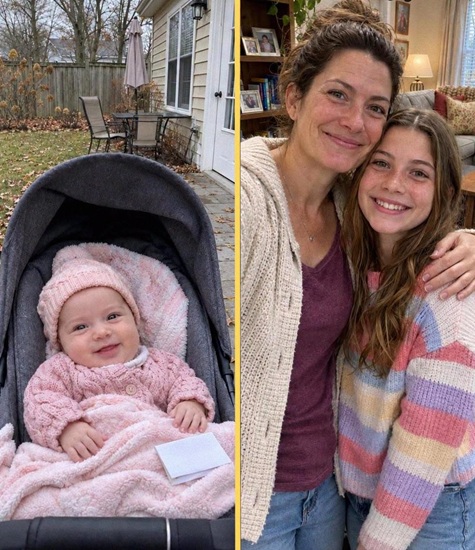
Inside the stroller was a little girl.
She looked around seven months old.
She was wrapped in a pink blanket, and her tiny hands moved beneath the fabric.
A folded piece of paper rested beside her.
For several seconds, I simply stood there.
I looked toward the garden gate.
Then toward the street.
Nobody was there.
I approached the stroller and gently checked the baby.
She was awake and crying.
I picked up the note.
It contained only a few words.
“Please keep her safe.”
My heart began racing.
I immediately called emergency services.
I explained that I had found an infant outside my home and didn’t know who had left her there.
I didn’t want to make assumptions.
I didn’t know whether the baby had been abandoned, whether someone was in danger, or whether there was another explanation.
All I knew was that a child needed help.
While waiting for assistance, I stayed close to the stroller.
I spoke softly to the little girl.
“It’s okay, sweetheart. Someone is coming to help you.”
She continued crying, occasionally pausing when she heard my voice.
When the authorities arrived, I explained everything.
They examined the situation and arranged for the baby to receive appropriate care.
The child was taken into protective care while the authorities worked to identify her family.
I answered every question I could.
I provided the note.
I described where I had found the stroller.
I explained that I had not seen anyone leave it.
And then I went back inside.
The house felt different.
I kept thinking about the little girl.
Was she frightened?
Did she have someone looking for her?
Would she be reunited with her family?
I knew I couldn’t simply assume that she had been abandoned permanently.
There were procedures that needed to be followed, and the authorities had to determine what had happened.
But I couldn’t stop thinking about her.
The first few days were difficult.
I called the appropriate office to ask whether there had been any developments.
I was told that the child was safe and that efforts were being made to locate relatives.
I tried to continue my normal routine.
I went to work.
I prepared meals.
I cleaned the house.
But every time I walked past the patio, I remembered the stroller.
I began wondering whether the baby had been sleeping well.
Whether she had a favorite toy.
Whether she was frightened around strangers.
And whether someone would eventually come forward.
Weeks passed.
Then more time went by.
The authorities continued their work, but no family member had been identified through the information available to them.
I contacted the social worker assigned to the case.
Her name was Laura.
I asked whether the baby was doing well.
“She’s safe, Cameron,” she assured me.
I felt relieved.
Then I asked a question I had been thinking about for days.
“If no family is found and the situation allows it, could I become her foster parent?”
Laura didn’t answer immediately.
Instead, she asked whether I had considered what that would involve.
I told her I understood that it would require assessments, home visits, background checks, and time.
I also understood that fostering was not the same as adopting.
The child’s needs had to come first.
But I wanted to be considered.
“Are you sure this is something you want?” Laura asked.
I looked toward the empty room at the end of the hallway.
For years, I had imagined becoming a mother.
Now there was a little girl whose future was uncertain.
“More than anything,” I said.
Laura explained that the process would take time.
There were legal requirements and decisions that could not be rushed.
I agreed to follow the process.
I wasn’t asking anyone to skip steps.
I simply wanted the opportunity to provide a safe and loving home if that became possible.
The months that followed were filled with appointments and paperwork.
People visited my home.
They asked about my work, my finances, my support system, and my understanding of the responsibilities involved.
I answered honestly.
Some questions were difficult.
Others made me realize how much I still needed to learn.
I wasn’t trying to replace anyone.
I wasn’t trying to claim a child before the proper process had taken place.
I simply hoped that one day I might be able to give her the stability she deserved.
Then Laura called.
There had been progress in the case.
After the necessary legal steps and assessments, I was informed that I could move forward with caring for the little girl.
When I saw her again, I could hardly speak.
She was sitting in a small room, holding a toy.
I approached slowly.
She looked up.
Then her tiny fingers reached toward mine.
I offered my hand.
She wrapped her fingers around one of mine.
I remember that moment more clearly than almost anything else.
Laura smiled.
“Have you thought about a name?”
I looked at the little girl.
I had spent so many years feeling that hope was something I had lost.
Now it was sitting in front of me.
“Hope,” I whispered.
And that was the name I chose.
The following years were filled with ordinary moments that became extraordinary to me.
Hope learned to crawl.
Then she learned to walk.
Her first steps happened in the living room, with one hand reaching toward the couch and the other stretched toward me.
I remember cheering so loudly that she stopped and looked at me.
Then she laughed.
When she said her first clear words, I cried.
When she started calling me Mama, I had to turn away for a moment.
It was a small word.
But to me, it carried years of waiting, disappointment, and a kind of happiness I had almost stopped believing I would experience.
As Hope grew older, she became curious about everything.
She asked why the sky changed colors.
Why birds could fly.
Why some people had different accents.
Why the moon sometimes appeared during the day.
She also loved asking questions about her own story.
I never wanted her to grow up believing that her adoption was something shameful or something that had to be hidden.
So we spoke about it in an age-appropriate way.
When she was five, she asked why I had chosen the name Hope.
We were sitting together, looking through a small photo album.
She pointed at a picture of herself as a baby.
“Was I always Hope?”
I smiled.
“That was the name I chose for you when you came into my life.”
“Why?”
I brushed a strand of hair away from her face.
“Because you brought so much hope into my life.”
She thought about that.
Then she asked something that made me smile.
“So I found you too?”
I laughed softly.
“Yes, sweetheart. You found me too.”
She seemed pleased with that answer.
Then she returned to looking at the pictures.
There were birthday celebrations, school photographs, holidays, and ordinary afternoons at home.
I kept almost everything.
The first drawing she gave me.
The little card she made for Mother’s Day.
A photograph from her first day of school.
A tiny pair of shoes that she had outgrown years earlier.
Each item reminded me of how quickly time was passing.
And how grateful I was to be part of her life.
By the time Hope turned twelve, she had become a thoughtful, funny, and increasingly independent young girl.
She still liked spending time with me, but she also wanted privacy.
She had favorite songs, favorite books, and strong opinions about what she wanted to wear.
Sometimes she would tell me about something that happened at school while we prepared dinner.
Other times, she would sit quietly in her room and draw.
I tried to give her space while making sure she knew she could always come to me.
On her twelfth birthday, we celebrated at home.
There was a cake, a few decorations, and a small gathering with people close to us.
Hope laughed when I brought out an old photograph from her first birthday.
“Mom, my hair was so short!”
“You were adorable.”
“I looked like a tiny potato.”
I laughed.
“An extremely cute potato.”
Later that evening, she hugged me.
“Thank you for everything.”
I held her tightly.
“Happy birthday, sweetheart.”
Then she said something that stayed with me.
“You know I’m never leaving you, right?”
I smiled.
“I’m not planning on going anywhere either.”
“Good,” she said. “Because I’m keeping you forever.”
I laughed.
I thought we had reached a peaceful chapter of our lives.
I thought the hardest parts of our story were behind us.
But the following evening, someone knocked on the door.
And the stranger standing outside knew Hope’s biological family.
Peter was still waiting for an explanation when I finally asked him to sit down.
I didn’t invite him inside immediately.
I wanted to understand why he had come before allowing him to become part of Hope’s world.
He repeated that his daughter was Anna.
He claimed Anna had been struggling when Hope was born.
According to him, she had been unable to provide the kind of stability a baby needed.
I asked why Anna had not come herself.
Peter said she wasn’t ready.
That answer made me even more suspicious.
“Then why are you here?”
“Because someone has to do something.”
“Something like what?”
“Give Hope another chance with her family.”
I stared at him.
“She already has a family.”
He looked toward the hallway.
“She’s biologically Anna’s daughter.”
“Biology doesn’t erase twelve years of raising a child.”
Peter shifted uncomfortably.
“I know you adopted her.”
That surprised me.
“Then you know the adoption was completed through the proper process.”
He nodded.
“But I’m talking about what’s right.”
I took a breath.
“Then let’s start with something simple. Does Anna actually want Hope to leave this home?”
He didn’t answer.
Instead, he said that Anna had changed.
She had a more stable life now.
She wanted to reconnect with her daughter.
I asked whether she had requested that Peter come to my home.
He hesitated.
“She knows I wanted to speak with you.”
“That’s not what I asked.”
He looked down.
I realized that he was avoiding the question.
I asked for Anna’s contact information.
He gave me his phone number instead.
“Let me speak with her first,” he said.
“Then give me her number.”
“She’s not ready for that.”
I looked at him.
“So you’re ready to demand my daughter, but Anna isn’t ready to speak to me?”
Peter didn’t respond.
Before leaving, he asked whether Hope knew she was adopted.
I told him she had always known in an age-appropriate way.
“Does she know about Anna?”
“She knows that she has a biological mother. But she doesn’t know her name or the circumstances surrounding her birth.”
Peter looked uncomfortable.
I told him that I would not discuss any major decision without understanding the situation.
Then I closed the door.
For several seconds, I remained standing in the hallway.
I could hear Hope moving around in the kitchen.
And I knew I couldn’t pretend nothing had happened.
Hope was waiting at the kitchen table.
She had apparently heard more than I had wanted her to hear.
“Was that man serious?”
I pulled out the chair opposite her.
“He’s serious about what he believes.”
“Is he really my grandfather?”
“He says he’s your biological mother’s father.”
Hope looked down.
“Does he know my birth mother?”
“Yes.”
“Is she alive?”
I nodded.
“Yes, sweetheart.”
She was quiet.
Then she asked the question I had expected but still wasn’t prepared to hear.
“Can I meet her?”
I reached across the table.
“I want to understand everything first.”
“Why?”
“Because I don’t want anyone making promises or giving you information that isn’t accurate.”
Hope looked toward the front door.
“Did she send him?”
“I don’t know.”
“Does she want me?”
I felt my throat tighten.
“Peter says she wants to reconnect, but I need to hear that from Anna herself.”
Hope looked at her hands.
“Can he take me away?”
I leaned forward.
“No. You’re my legally adopted daughter. Nobody gets to arrive at our door and decide your future.”
She nodded slowly.
But I could see that she was still frightened.
Then she asked something that made me realize how deeply the stranger’s words had affected her.
“Why did he say I had to be given back?”
I didn’t have a simple answer.
So I told her the truth.
“Sometimes adults say things before they understand how much those words can hurt. But you’re not an object, Hope. You’re a person, and your feelings matter.”
She looked at me.
“Then you’re going to find out what happened?”
“Yes.”
“Promise?”
“I promise I’ll do everything I can to get honest answers.”
She reached for her dinner.
“Good. Because I have questions too.”
The next morning, I contacted Peter.
I told him I wanted to meet somewhere neutral and speak without Hope present.
He agreed.
That afternoon, I found him sitting at a small diner.
There were several photographs spread across the table.
He stood when he saw me.
“Thank you for coming.”
I sat down.
“Let’s get straight to it.”
Peter pushed one photograph toward me.
It showed a young woman standing beside him.
“That’s Anna.”
I looked carefully.
Something about her face seemed familiar.
But I couldn’t immediately place it.
He showed me another photograph.
Anna was younger in that one.
She appeared to be pregnant.
“She loved that baby,” Peter said.
I looked at him.
“Then what happened?”
He explained that Anna had struggled financially around the time Hope was born.
She had been working, but her situation was unstable.
There had been disagreements between them about her future and her ability to raise a child.
I asked where he had been during that time.
Peter shifted in his chair.
“We argued a lot.”
“About what?”
“Her job. Her decisions. The fact that she had become pregnant.”
I waited.
He continued.
“She wanted to keep the baby, but I didn’t think she was ready.”
“Did she ask you for help?”
“Yes.”
“And what did you say?”
He looked away.
“I offered financial assistance under certain conditions.”
“What conditions?”
He hesitated.
“That she consider another family raising the child.”
I stared at him.
“So she asked her father for support, and you made the help conditional on her giving up her baby?”
“I thought I was protecting her.”
“Did she ask you to come to my house and demand Hope?”
“No.”
The answer came quickly.
I leaned back.
“Then why are you doing this?”
Peter rubbed his forehead.
“Because I want my family back.”
I looked at the photographs.
Then I looked at him.
“Did Anna tell you she wanted Hope taken away from me?”
He didn’t answer.
Instead, he said that Anna had told him where I lived.
I felt a chill.
“She gave you my address?”
“Yes.”
“Did she tell you to come here?”
He paused.
“She said she wanted to know how Hope was doing.”
“That’s not the same thing.”
Peter nodded.
I pushed the photographs back toward him.
“Tell Anna she can contact me directly. If she wants to meet her daughter, we can discuss that carefully. But nobody is going to make decisions for Hope.”
Peter looked disappointed.
“You’re making this difficult.”
“No. I’m asking you to stop making decisions that aren’t yours to make.”
I stood.
Before I left, I turned back.
“One more thing. Don’t visit our home again without arranging it first.”
He nodded.
I walked out.
But the photographs had left me with an uncomfortable feeling.
I recognized something about Anna.
And I couldn’t stop thinking about where I might have seen her before.
That evening, I opened the cabinet where I kept Hope’s adoption records.
I hadn’t needed to look through the documents in years.
Everything had been organized carefully.
There were official records, old reports, and copies of the paperwork connected to the process.
I found the original report describing where Hope had been discovered.
It confirmed the information I remembered.
A stroller had been found outside my home.
A baby had been taken into protective care.
A note had been recovered.
I opened the envelope containing a copy of the note.
“Please keep her safe.”
I read it several times.
For twelve years, those words had been part of the story I told myself about the day Hope entered my life.
I had always wondered who had written them.
Now I was beginning to understand that there might have been a person behind that decision.
I thought about Peter’s photographs.
I thought about his mention of fertility treatments.
Then an old memory returned.
Years earlier, during one of my own medical appointments with Trey, I had met a young woman in a waiting area.
Her name had been Anna.
We had started talking because both of us were dealing with difficult fertility-related experiences.
I remembered how kind she had been.
We had spoken several times after that.
She had visited my home once for tea.
I remembered her laughing because I added far too much sugar to my cup.
She had seemed nervous that day.
I hadn’t understood why.
Later, she told me she was pregnant.
I remembered congratulating her.
She had smiled, but there was sadness behind it.
Then we lost contact.
I looked again at Peter’s photograph.
The young woman standing beside him had the same eyes.
I felt my hands grow cold.
Could it really be her?
I picked up my phone.
I called Peter.
He answered after several rings.
“I need to ask you something.”
“What is it?”
“Did Anna receive fertility treatment twelve years ago?”
There was a pause.
“Yes.”
I closed my eyes.
“Did she ever tell you she knew me?”
Another pause.
Then he said something that confirmed what I had begun to suspect.
“She mentioned meeting you.”
I sat down.
“Did she tell you where?”
“She said you had spoken at one of your appointments.”
I looked toward the hallway.
For the first time in twelve years, I was beginning to understand that Hope’s arrival might not have been entirely random.
But I still didn’t know the full truth.
And I wasn’t going to make assumptions about something so important.
Two days later, my phone rang.
The number was unfamiliar.
I answered cautiously.
“Hello?”
A woman’s voice came through.
“Cameron?”
I recognized it immediately.
It was softer than I remembered, but there was no mistaking it.
“Anna?”
She exhaled.
“Yes.”
For a moment, neither of us spoke.
Then she said she was sorry about her father.
“I never asked him to come to your house and tell you to give Hope back.”
I closed my eyes.
“Then why did he come?”
“He thought he was helping.”
“By frightening a twelve-year-old?”
She became quiet.
“I know. I’m sorry.”
I asked what she wanted.
Anna said she would like to meet.
Just the two of us.
I agreed, but I made one thing clear.
“Nobody is making decisions about Hope without listening to her. And nobody is going to treat her like something that can be transferred between adults.”
Anna agreed.
We arranged to meet at a quiet café.
Before ending the call, she said something that brought back another memory.
“Do you still make that terrible tea?”
I almost laughed.
“Every day.”
It was such an ordinary question.
And somehow, that made the situation feel even more complicated.
When I arrived at the café, Anna was already there.
She stood when she saw me.
For a moment, I didn’t know whether to hug her or simply shake her hand.
So we exchanged a quiet greeting.
She looked older than the woman I remembered.
There were tired lines around her eyes.
But she still had the same nervous expression whenever she was unsure what to say.
We sat down.
Anna clasped her hands together.
“I know you probably have a thousand questions.”
“More than a thousand.”
She nodded.
“I deserve that.”
I looked at her.
“Was Hope the baby I remember you expecting?”
Anna’s eyes filled.
“Yes.”
The answer landed heavily.
I had suspected it.
But hearing her confirm it made everything feel different.
I looked out the window for a moment.
Then I turned back.
“How did she end up outside my house?”
Anna lowered her eyes.
“I remembered where you lived.”
I waited.
“You had been kind to me. You listened when I talked about what I was going through. I remembered how much you wanted a child.”
I felt my chest tighten.
“Did you deliberately leave her there?”
Anna nodded.
“Yes.”
I couldn’t speak immediately.
For twelve years, I had believed the stroller had appeared outside my home through circumstances I couldn’t explain.
Now the woman sitting across from me was telling me that she had chosen my house.
I finally asked the question that mattered most.
“Why didn’t you knock?”
Anna’s face crumpled.
“I was afraid you’d refuse.”
I stared at her.
“You should have given me the chance to decide.”
“I know.”
“You could have called. You could have asked for help. You could have contacted the authorities and explained your situation.”
“I know.”
“But you left a baby outside.”
Anna began crying.
“I convinced myself that if I left her somewhere safe, she might have a better life.”
I shook my head.
“You couldn’t know what would happen. You couldn’t know whether someone would find her immediately or whether she would be frightened. You took a decision that should never have been yours to make alone.”
Anna nodded.
“I was scared.”
“I understand that you were scared. But being scared doesn’t make what happened harmless.”
She wiped her cheek.
“I know.”
I took a breath.
“Why are you telling me now?”
Anna explained that she had eventually built a more stable life.
She had found work.
She had moved into a better home.
She had tried to put the past behind her, but the memories never completely disappeared.
She said she had thought about Hope every year.
I asked whether she had ever tried to contact the authorities or obtain information through the proper channels.
She admitted that she had considered it more than once.
But she had been afraid of facing questions about the way she had left her baby.
I looked at her.
“So you chose not to know.”
She nodded.
“Yes.”
That answer hurt more than I expected.
I asked whether she wanted Hope to leave my home.
Anna immediately shook her head.
“No. I don’t want to take her away.”
“Then what do you want?”
“I want to know her. If she wants to know me.”
I watched her carefully.
“That is something we can discuss. But Hope will decide what kind of relationship she wants, at a pace that feels comfortable for her.”
Anna nodded.
Then she said something else.
“My father thinks he can fix what happened by bringing her back.”
I leaned forward.
“He cannot.”
“I know.”
“And he needs to understand that.”
Anna looked down.
“He has always believed he knows what is best for everyone.”
I remembered Peter’s words.
“Then it’s time he listened to you.”
Anna nodded.
For the first time during our conversation, she looked directly at me.
“I want to speak to him with you there.”
I agreed.
But I also told her that the conversation needed to be about what had happened, not about making demands for Hope.
This time, Anna would have to speak for herself.
The following afternoon, I met Anna at Peter’s home.
I wasn’t comfortable going there alone, so I told a trusted person where I would be and arranged to keep the meeting focused and calm.
Anna was already waiting outside.
When Peter opened the door, he seemed pleased to see us together.
“I’m glad we’re finally making progress,” he said.
I didn’t respond.
We sat in the living room.
Peter immediately began explaining his position.
“Anna wasn’t ready to raise a baby twelve years ago.”
Anna looked at him.
“That isn’t what we’re discussing.”
He continued.
“She was struggling financially. She didn’t have a stable job. I was worried.”
Anna’s voice became firmer.
“I was twenty-three, Dad. I had lost my job, and I asked if I could stay with you.”
Peter shifted.
“I offered money.”
“You offered money if I agreed to let someone else raise my baby.”
“I thought that was the safest option.”
“I wasn’t asking you to raise Hope. I was asking you to help me get back on my feet.”
Peter looked away.
I turned toward him.
“So you refused to let your daughter stay unless she considered giving up her child?”
He hesitated.
“Yes.”
Anna wiped her eyes.
“I managed for months after Hope was born. I tried to find work. I tried to keep everything together. Eventually, I fell behind on rent, and I called Dad again.”
I asked what happened.
“He repeated the same offer.”
Peter crossed his arms.
“I thought the baby would have a better life.”
Anna shook her head.
“You didn’t ask what I wanted. You decided I couldn’t be a mother.”
Peter looked toward me.
“I was trying to help.”
I answered carefully.
“Then why did you tell me your daughter wanted Hope back?”
He became quiet.
Finally, he said, “Because I want my family together again.”
I looked at Anna.
“Is that what you want?”
She shook her head.
“I want to know my daughter. I want to have the chance to build a relationship if she wants one. I never asked my father to demand that she be returned.”
Peter looked surprised.
“I thought you wanted her back.”
Anna turned toward him.
“You didn’t ask me.”
He opened his mouth.
She continued.
“You didn’t ask me twelve years ago either. You decided what was best for me, and now you’ve done it again.”
Peter looked down.
For the first time, he seemed to understand that his actions had created another problem instead of solving an old one.
I turned toward him.
“Hope is not a way to repair your relationship with Anna. She is a child with her own feelings, memories, and family.”
Peter looked uncomfortable.
“I just want to be her grandfather.”
“Then start by respecting her mother.”
Anna reached for my hand.
I was surprised by the gesture.
She didn’t ask me to forgive her.
She didn’t ask me to pretend that the past had been simple.
She simply sat beside me and allowed the conversation to continue.
After a while, Peter apologized for the way he had approached me.
It wasn’t a perfect apology.
But it was a beginning.
I told him that any future contact would have to happen through Anna and with Hope’s comfort in mind.
He agreed.
Outside, Anna walked beside me.
For a while, neither of us spoke.
Then I asked the question I had been holding back.
“Why didn’t you come back sooner?”
Anna stopped.
“At first, I thought I would come back after I found a stable place to live. Then I was ashamed.”
“Of what?”
“Of leaving her. Of what I had done. I was afraid you would hate me.”
I looked at her.
“Did you ever wonder whether Hope was okay?”
“Every birthday.”
“Did you try to find out?”
“Twice, I thought about contacting someone. But I stopped.”
“Why?”
She looked away.
“I didn’t know how to explain what I’d done.”
I nodded slowly.
“So you let the fear decide for you.”
“Yes.”
I didn’t tell her that I understood.
Not completely.
I couldn’t imagine leaving an infant outside someone’s home and walking away.
But I could see that Anna was finally acknowledging the choices she had made.
I asked what she wanted now.
“To meet Hope. To answer her questions. And to let her decide whether she wants me in her life.”
I studied her face.
“Then that’s what we’ll try to arrange.”
She nodded.
Before we separated, I told her something important.
“Hope already has a mother. I’m not saying that to hurt you. I’m saying it because you need to understand the place you are asking to enter.”
Anna wiped her cheek.
“I know.”
I hoped she did.
That evening, Hope was waiting at the kitchen table.
She had been thinking about the conversation all day.
“Did you meet her?”
I sat beside her.
“Yes.”
“What was she like?”
I considered how to answer.
“She seemed nervous. She was sorry about what happened, and she said she would like to meet you if you want that.”
Hope looked down at her plate.
“Why did she leave me?”
I explained that Anna had been young and struggling.
I told her that Anna had remembered me from years earlier and had made a decision that she believed would give Hope a stable home.
“But she didn’t ask me,” Hope said.
“No.”
“She didn’t ask you either?”
“No.”
Hope thought about that.
“Was she scared?”
“Yes. But she also made a decision that wasn’t safe or fair to you.”
Hope looked at me.
“Do you hate her?”
I shook my head.
“No. But I don’t agree with what she did.”
“Do you think she loves me?”
I took her hand.
“I think she has thought about you for a long time. But love also means taking responsibility for your choices. She has some things to explain.”
Hope was quiet.
Then she asked whether she could meet Anna.
I told her that we could arrange it carefully.
I also explained that she didn’t have to decide anything about the future during that first meeting.
She could ask questions.
She could leave whenever she wanted.
She could decide she needed more time.
And she could change her mind.
Hope nodded.
Then she said something that made me smile despite everything.
“I want to know if she likes the same things I do.”
I asked what she meant.
“Books. Music. Chocolate. Stuff like that.”
I laughed softly.
“Those are important questions.”
She smiled.
Then she grew serious again.
“Mom?”
“Yes?”
“Will you be there?”
“Every step of the way.”
Before arranging the meeting, I contacted the agency and reviewed the appropriate steps for making contact with Hope’s biological family.
I wanted everything to be handled carefully.
There were legal records, questions about identity, and details that needed to be confirmed.
A photograph and someone’s personal account weren’t enough.
The relevant information was reviewed, and the appropriate process was followed.
The records supported the circumstances surrounding Hope’s adoption, and the necessary identity checks helped confirm Anna’s relationship to her.
I also made sure that any meeting would take place only with Hope’s knowledge and agreement.
Peter called after hearing that we were considering a meeting.
“I’ll come too,” he said.
I told him that Hope had not agreed to meet him.
“But I’m her grandfather.”
“That doesn’t mean you get to decide.”
He became frustrated.
“Anna wants this.”
“Then Anna can speak for herself.”
He sighed.
I could hear the disappointment in his voice.
But this time, I wasn’t going to let another adult’s expectations determine what Hope experienced.
Eventually, Anna and I agreed on a short meeting at a quiet café.
We chose a place where Hope could feel comfortable.
I would stay with her.
There would be no pressure to hug, talk, or make promises.
The goal was simply to give her an opportunity to ask questions.
The night before the meeting, Hope knocked on my bedroom door.
I was reading when she entered.
“Can we talk about tomorrow?”
I closed the book.
“Of course.”
She sat beside me.
“What if I don’t like her?”
“Then you don’t have to meet her again.”
“What if she doesn’t like me?”
I looked at her.
“That isn’t something you need to worry about. You don’t have to become someone else to earn another person’s affection.”
She nodded.
Then she asked another question.
“What if I do like her?”
I smiled.
“Then we can work out what happens next.”
Hope looked at her hands.
“Peter said I belonged with them.”
I felt my chest tighten.
“He shouldn’t have said that.”
“Why?”
“Because you aren’t something that belongs to one family or another. You’re a person. You have feelings, and you have a life.”
She looked at me.
“Did he make Anna leave me?”
I took a moment before answering.
“From what Anna told me, her father made things harder for her when she asked for help. But the decision to leave you was Anna’s.”
Hope nodded.
“Was it wrong?”
“Leaving a baby outside without making sure the child was safe was wrong. Being afraid doesn’t make that decision okay.”
She seemed to appreciate the honesty.
Then she asked something I hadn’t expected.
“Do you think she’ll be upset if I call you Mom?”
I held her hand.
“I hope she understands that I’m your mother in the life we’ve built together.”
“Would you be upset if I called her Anna?”
“No.”
“Would you be upset if I wanted to see her again?”
I wanted to say that I would never be upset.
But I knew the situation was more complicated than that.
So I answered honestly.
“I might have feelings about it, because I’m human. But I would never want you to feel guilty for asking questions about your past.”
Hope leaned against me.
“Okay.”
Then she stood up.
At the doorway, she turned around.
“Mom?”
“Yes?”
“Don’t answer my questions for me tomorrow.”
I smiled.
“I’ll try not to.”
“I mean it.”
“I know.”
She nodded.
Then she went to bed.
I stayed awake for a while.
I knew the next day might bring happiness, confusion, difficult questions, and emotions none of us could predict.
But one thing was certain.
Hope deserved to be heard.
On Saturday, Anna was waiting when we arrived.
Hope stopped beside me.
“That’s her?”
I nodded.
Anna stood slowly.
“Hello, Hope.”
“Hi.”
For a few seconds, they simply looked at each other.
I could see that Anna was trying not to overwhelm her.
She didn’t rush forward.
She didn’t try to hug her.
She simply waited.
Hope pulled out a chair.
Anna sat opposite her.
I remained beside my daughter.
Anna began by saying that she was grateful Hope had agreed to meet.
Hope looked at her.
“Mom told me you knew each other.”
Anna nodded.
“Yes. We met years ago.”
“Before I was born?”
“Yes.”
“Where?”
Anna explained that they had met while attending appointments related to fertility treatment.
Hope looked at me.
“She was trying to have a baby too?”
I nodded.
Anna smiled sadly.
“We were both hoping for children.”
Hope considered that.
“Then I came to live with Mom.”
“Yes,” Anna said.
Hope leaned forward.
“Do you remember what I was like?”
Anna’s eyes filled.
“I remember that you liked holding my fingers. You were very small, and you would wrap your hand around my pinky.”
Hope looked down at her own hand.
“Really?”
Anna nodded.
“You also had a little blanket that you seemed to like.”
Hope glanced at me.
“Did I have a blanket?”
I told her that the original records mentioned the pink blanket she had been wrapped in when she was found.
Anna confirmed that it was familiar to her.
Then Hope asked the question she had been thinking about for days.
“Did you think about me on my birthdays?”
Anna swallowed.
“Every year.”
“Then why didn’t you send me a card?”
Anna looked down.
“I was afraid.”
Hope frowned.
“Afraid of what?”
“That you wouldn’t want to hear from me. That Cameron would be angry. That you would ask me why I left.”
Hope looked at her.
“I would’ve liked a card.”
Anna nodded.
“I understand.”
The conversation continued slowly.
Hope asked what Anna liked to eat.
Anna told her about her favorite books.
They discovered that they both liked chocolate cake.
Hope laughed when Anna admitted that she wasn’t very good at baking.
Then Anna asked whether Hope enjoyed school.
Hope told her about her favorite subject and the friends she spent time with.
For a while, the conversation felt almost ordinary.
But eventually, Hope asked the question that had been waiting beneath everything else.
“Did you not want me?”
Anna’s face changed.
She leaned forward.
“I wanted you. I was frightened, and I didn’t know how to take care of you. I made a terrible decision, and I should have asked for help instead of leaving you the way I did.”
Hope listened.
“Why didn’t you come back?”
Anna’s voice trembled.
“Because I was ashamed. And because I kept thinking I would find the right time. But the longer I waited, the harder it became.”
Hope looked toward me.
I didn’t interrupt.
She turned back to Anna.
“Are you sorry?”
“Yes.”
“Really sorry?”
“Every day.”
Hope sat quietly.
Then she asked whether Anna had any photographs from when she was a baby.
Anna said she had a few.
Hope wanted to see them.
Anna took out her phone and showed her some old pictures.
One showed Anna holding a tiny baby.
Another showed a small blanket.
Hope studied the photographs carefully.
“That’s me?”
Anna nodded.
“Yes.”
Hope smiled faintly.
Then she looked at me.
“Mom, can we keep these?”
I felt my eyes fill.
“Of course, sweetheart.”
Anna looked relieved.
The meeting continued for a little while longer.
When Hope finally stood, Anna didn’t ask her to promise another visit.
She simply thanked her for coming.
Hope said goodbye.
And then we left.
On the drive home, Hope looked out the window.
I didn’t ask her how she felt immediately.
I wanted to give her time.
After a few minutes, she spoke.
“Can we see Anna again?”
I looked at her.
“If that’s what you want.”
She nodded.
“Yes.”
Then she asked whether I would come.
“Of course.”
She smiled.
“But maybe someday I want to talk to her alone.”
I nodded.
“When you’re ready, and when we have made sure everything is comfortable and appropriate, we can discuss that.”
Hope seemed satisfied.
Then she leaned back.
“I still have questions.”
I laughed.
“I expected that.”
When we got home, she dropped her schoolbag beside the couch and sat next to me.
“Can I choose the movie tonight?”
“You chose yesterday.”
She grinned.
“You said I get a say.”
I handed her the remote.
“Don’t get carried away.”
She leaned against my shoulder.
“Too late, Mom.”
I laughed and wrapped my arm around her.
For the first time since Peter had appeared at our door, the house felt peaceful again.
But I knew there were still conversations ahead.
Anna would need to rebuild trust.
Peter would need to understand that he couldn’t make decisions for other people.
And Hope would need time to understand her story without feeling that she had to choose between the people connected to it.
I couldn’t control every part of that process.
What I could do was continue being the person Hope had always been able to turn to.
Over the following weeks, Anna and Hope exchanged a few messages through the arrangement we had agreed upon.
They talked about ordinary things.
A book Hope was reading.
A dessert Anna had tried making.
A photograph from the past.
Sometimes Hope asked questions about her birth.
Other times, she simply wanted to tell Anna about something funny that had happened at school.
I didn’t force the relationship to move faster.
There were days when Hope was curious.
There were other days when she didn’t want to discuss Anna at all.
Both were perfectly understandable.
One afternoon, she came into the kitchen holding a photograph.
It was one Anna had shared from the time Hope was a baby.
“Mom, do you think I look like her?”
I looked at the picture.
“Your eyes are similar.”
Hope studied it.
“What about my smile?”
“That might be yours.”
She laughed.
Then she put the photograph beside one of her school pictures.
For a moment, I wondered what she was thinking.
But I didn’t ask.
She eventually spoke.
“It’s strange seeing someone who knew me before I remember anything.”
I nodded.
“It can feel strange.”
“Do you ever wish you didn’t know her?”
I took a breath.
“No. I wish the way everything happened had been different. But knowing more about your story isn’t something I want to prevent.”
Hope nodded.
Then she placed the photographs back on the table.
“Good.”
She walked toward the living room.
A few minutes later, I heard her laughing at something on television.
And I realized that she was beginning to understand something important.
Learning about where she came from didn’t erase where she belonged.
Peter eventually contacted me again.
This time, he apologized for appearing at our home and speaking as if Hope could simply be handed over.
He admitted that he had acted out of guilt.
He said he had spent years believing he could have prevented what happened if he had supported Anna differently.
Now he wanted to repair the relationship with his daughter.
I told him that was something he needed to work out with Anna.
He asked whether he could meet Hope.
I said that it was not my decision alone.
Hope would need to know who he was, understand what had happened, and decide whether she felt comfortable.
Peter accepted that.
A few weeks later, Hope said she might be willing to meet him someday.
But not yet.
I respected that.
There was no reason to rush.
Sometimes, when I look back at the day I found the stroller outside my home, I wonder how many different decisions could have changed everything.
I wonder what Anna was thinking when she left that note.
I wonder how frightened she must have been.
I also wonder what might have happened if she had knocked on my door and asked for help instead.
Perhaps I would have helped her find support.
Perhaps the authorities would have arranged a different path.
Perhaps everything would have unfolded differently.
I’ll never know.
What I do know is that a child should never have to carry the responsibility for the decisions adults make.
Hope didn’t choose the circumstances of her birth.
She didn’t choose to be left outside my home.
She didn’t choose the years of silence.
And she certainly didn’t choose Peter’s decision to arrive at our door and tell her she needed to be returned.
She deserved honesty.
She deserved safety.
She deserved time to understand her past.
Most importantly, she deserved to make her own feelings known.
I used to believe that becoming a mother meant finally getting the family I had spent so many years hoping for.
Now I understand that motherhood is also about making room for difficult questions.
It means listening when your child wants to know where she came from.
It means being honest even when the truth is uncomfortable.
It means protecting your child without making her feel guilty for being curious.
And it means understanding that love cannot be measured by biology alone.
Anna gave birth to Hope.
I raised her.
Both facts are part of her story.
But Hope is not a possession that either of us can claim.
She is a young girl who deserves to grow up knowing that her life belongs to her.
The stranger who appeared at my door believed he was there to take something back.
Instead, he forced all of us to confront a past that had never truly been resolved.
And although I cannot change the way Hope entered my life, I can make sure she never has to wonder whether she is wanted in the home we built together.
Because every night, when she walks past my bedroom and calls out, “Goodnight, Mom,” I still hear the little girl who once wrapped her tiny fingers around mine.
And I know that whatever questions the future brings, she will never have to face them alone.
What do you think matters most in Hope’s story: the love and stability Cameron gave her, Anna’s decision to finally face her past, or Hope’s right to decide what kind of relationship she wants with her biological family?