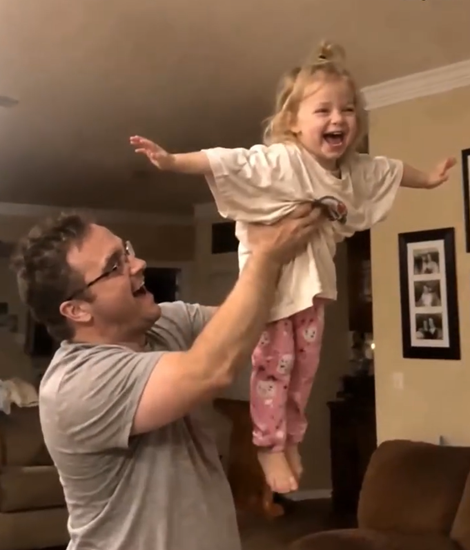
“Daddy, put me down! Now!” Just seconds earlier, my three-year-old daughter, Ellie, had been laughing so hard that she could barely catch her breath.
Her little arms were stretched out like airplane wings, and she had been making engine noises while I carried her through the living room. Then everything changed.
Her smile disappeared. Her body became tense, and she grabbed my shirt with both hands.
I lowered her immediately.
“Sweetheart, what’s wrong?”
Ellie didn’t answer at first. Instead, she moved behind my legs and held on tightly to my jeans.
Then she raised one trembling finger toward the ceiling.
“There’s a girl up there.”
I followed her gaze.
At first, I saw nothing unusual. Just the familiar living room, the sofa, a floor lamp, and the enormous wooden cabinet standing against the wall.
But Ellie kept pointing.
“She’s looking at me, Daddy.”
I crouched beside her.
“Where is she, honey?”
“On top of the big cupboard. She’s watching me.”
I looked again, but the cabinet was too tall for me to see what was resting on its upper surface.
And then Ellie said something that made me stop smiling.
“She has my face.”
I didn’t know what to make of that.
I only knew that my little girl was frightened, and I needed to find out why.
My name is David, and Ellie is my only child.
My wife, Anna, and I have been married for eight years. We have built a quiet family life together, filled with ordinary routines, small celebrations, and the kind of moments that seem unimportant until you realize how quickly childhood passes.
One of our favorite traditions was our evening airplane game.
Every night, after Ellie’s bath and before bedtime, she would ask me to carry her around the house as if she were flying.
I would stretch out my arms, lift her carefully, and pretend to be the pilot of an imaginary aircraft.
She always chose our destination.
Sometimes we flew to the moon. Sometimes we visited a castle in the clouds. On particularly adventurous evenings, we traveled across the ocean to find a secret island.
Anna usually watched from the doorway, laughing at our ridiculous sound effects.
“David, you’re going to need a new back if you keep doing that,” she would tell me.
“Then I’d better enjoy these flights while I can,” I’d reply.
Ellie always giggled.
I never imagined that one of those ordinary evenings would uncover something my wife had kept hidden for decades.
Last Tuesday, Anna had to work late.
Ellie had already finished her bath and was wearing her favorite pajamas, decorated with tiny yellow stars.
Her hair was still slightly damp, and she had a stuffed rabbit tucked under one arm.
I was preparing to take her upstairs when she suddenly raised both hands.
“One more flight, Daddy!”
I pretended to check an imaginary instrument panel.
“Where are we going tonight, Captain?”
She thought carefully.
“To the moon!”
I lifted her gently.
“Flight number one is preparing for departure.”
She laughed.
We moved through the hallway, passed the bathroom, and made a wide turn around the kitchen island.
Ellie stretched out her arms and made a loud airplane noise.
Then we entered the living room.
Everything was perfectly ordinary until we passed the tall cabinet.
Her laughter stopped so suddenly that I initially thought she had become tired.
Then she grabbed my shoulder.
“Daddy! Put me down!”
I lowered her at once.
She stepped away from me and stared toward the cabinet.
“What’s wrong, sweetheart?”
“That girl!”
“What girl?”
“She’s up there!”
I looked toward the cabinet.
It was an old piece of furniture that had belonged to Anna’s mother, Margaret. After Margaret passed away several years earlier, Anna had asked me to help move it into our house.
The cabinet was made of dark wood and stood almost as high as the ceiling.
We used it to store blankets, board games, seasonal decorations, and several boxes of things we rarely needed.
I had never paid much attention to what might be sitting on top.
“Ellie, I don’t see anybody.”
“She’s looking at me!”
I tried to reassure her.
“Maybe you saw something in the shadows.”
She shook her head.
“No, Daddy. She looks like me.”
That was when I decided to investigate.
I asked Ellie to sit on the sofa while I went to the kitchen to get something sturdy enough to help me see above the cabinet.
I brought back a stable step ladder rather than trying to balance on a chair.
“Stay right there, okay?”
She nodded, although she kept watching me.
I carefully climbed high enough to look over the cabinet.
At first, I noticed a layer of dust and several old storage boxes.
Then I saw something that made my heart jump.
A pair of eyes was staring directly at me.
I instinctively pulled back.
For a split second, I thought someone had hidden up there.
Then I looked again.
The eyes belonged to a framed photograph.
It was leaning against the wall, partly covered by a faded white cloth.
I moved the cloth aside.
The photograph showed a little girl wearing a yellow dress. She had soft brown curls, round cheeks, and unusually familiar eyes.
I stared at the picture.
Something about her face seemed impossible to ignore.
She looked remarkably similar to Ellie.
Not simply because they were both little girls with brown hair.
There was something more specific.
The shape of her cheeks, the expression around her eyes, and even a small crescent-shaped birthmark near her left eyebrow reminded me of my daughter.
I carefully brought the photograph down.
But the photograph wasn’t the only thing hidden above the cabinet.
Behind it was a small bundle wrapped in an old piece of fabric.
Inside, I discovered a faded yellow dress, a stuffed rabbit with one repaired ear, and an envelope.
The envelope had a name written across the front.
Anna.
I recognized the handwriting immediately.
It belonged to her mother.
I turned the photograph over.
There was a short handwritten message on the back.
“Our beautiful Lucy.”
Beneath it was a date from 1994.
I looked at the photograph again.
Who was Lucy?
And why had my wife never told me about her?
“Daddy?”
Ellie’s small voice came from beside the sofa.
I climbed down carefully, holding the photograph.
She approached slowly, still looking uncertain.
“Is the girl gone?”
“She’s not really here, sweetheart. She’s in a photograph.”
I turned the frame toward her.
Ellie stared at the little girl.
Then she reached out and touched the glass.
“That’s me.”
I smiled gently.
“No, honey. That’s another little girl.”
She moved her finger toward the birthmark near the girl’s eyebrow.
“But she has my mark.”
I didn’t have an answer.
Children notice details adults sometimes overlook. And Ellie had noticed something that I had only just begun to understand.
“Maybe she’s someone from Mommy’s family,” I said.
Ellie considered that possibility.
“Can we put her somewhere else?”
“Of course.”
I placed the photograph safely on a shelf, away from the cabinet.
Then I carried Ellie upstairs.
She asked me twice whether the girl was going to come into her bedroom.
Both times, I reassured her that the photograph was simply a picture of someone who had lived a long time ago.
Eventually, she relaxed enough to fall asleep.
But I couldn’t stop thinking about what I had discovered.
I returned downstairs and examined the little bundle again.
The yellow dress was carefully folded. The stuffed rabbit had clearly been loved by a child. Its fabric was worn, and someone had repaired one of its ears with pink thread.
These weren’t random objects.
Someone had kept them for a reason.
And the sealed envelope addressed to Anna suggested that the photograph was connected to something much more personal.
I decided not to open it.
Whatever was written inside belonged to my wife.
I would wait until she came home.
Anna arrived shortly after ten that evening.
She placed her bag near the entrance and took off her coat.
“How was Ellie?”
“She’s asleep.”
Anna smiled.
“Did she enjoy her airplane flight?”
I hesitated.
“Something happened during the game.”
Her expression immediately changed.
“Is she okay?”
“She’s fine. But she saw something above your mother’s cabinet.”
Anna looked toward the living room.
“What do you mean?”
I picked up the framed photograph.
The moment she saw it, her expression changed completely.
Her smile disappeared.
The color seemed to drain from her face.
“Where did you get that?”
“It was on top of the cabinet.”
She didn’t move.
“Anna, who is this little girl?”
For several seconds, she said nothing.
Then she whispered one word.
“Lucy.”
I waited.
She looked at the photograph again.
“That’s my sister.”
I stared at her.
“Your sister?”
Anna nodded slowly.
“I had a little sister.”
I sat down beside her.
We had been married for eight years, and I knew quite a lot about her childhood. I knew that she had grown up with her mother after her father left. I knew that her family life had been difficult at times.
But I had never heard about Lucy.
Anna had always described herself as an only child.
“Why didn’t you ever tell me?”
She lowered her eyes.
“Because Lucy died when we were little.”
I reached for her hand.
“I’m sorry. I had no idea.”
Anna nodded, but she didn’t seem to hear me.
She was looking at the photograph as if it had brought her back to a place she had spent years trying to avoid.
I asked her what had happened.
She closed her eyes.
“We were at home. Mom was making dinner, and she asked me to keep Lucy occupied.”
Her voice became quieter.
“I was nine years old. Lucy was four.”
I waited for her to continue.
But instead of explaining, Anna stood up.
“I can’t talk about this tonight.”
“That’s okay.”
“Please don’t ask me anything else right now.”
I nodded.
She walked toward the stairs, then stopped.
Without turning around, she said something I would remember for a long time.
“Lucy died because I wasn’t watching her.”
Then she went upstairs.
That night, I barely slept.
I kept thinking about Anna’s reaction.
I’d seen her worried before. I’d seen her upset, exhausted, and overwhelmed.
But the way she had looked at that photograph was different.
It was as though the little girl in the frame had brought back an entire lifetime of memories in a single moment.
Suddenly, several things about Anna’s behavior made more sense.
She was always extremely cautious whenever Ellie climbed furniture.
She checked the bathtub carefully before allowing our daughter to get inside.
If Ellie wandered out of sight in a crowded place, Anna became visibly anxious.
Once, at a department store, Ellie had disappeared behind a display for less than a minute. We found her standing beside a shelf of toys.
Anna had been so frightened that she needed several minutes to calm down.
At the time, I had assumed she was simply a protective mother.
Now I wondered whether her fear had deeper roots.
The following morning, Ellie came into the kitchen while Anna was preparing breakfast.
She noticed the photograph on the counter.
“Mommy, that’s the girl I saw!”
Anna turned around.
For a moment, she looked uncertain about what to say.
Then she knelt beside Ellie.
“Her name was Lucy.”
Ellie studied the picture.
“Was she your friend?”
Anna smiled sadly.
“She was my little sister.”
“Where is she now?”
Anna took a breath.
“She died a long time ago, sweetheart.”
Ellie looked at her mother’s face.
“Are you sad?”
Anna’s eyes filled with tears.
“Sometimes, yes.”
Ellie put her little arms around her mother’s neck.
Anna hugged her tightly.
I watched them from the kitchen doorway.
And I realized that our daughter had unknowingly brought something back into our home that Anna had spent years trying to forget.
After Ellie left for preschool, Anna and I sat at the kitchen table.
The small bundle from the cabinet was between us.
She touched the faded yellow dress.
“I haven’t seen these things in years.”
“Did you put them up there?”
“No. Mom must have stored them.”
Anna explained that her mother had used the cabinet for years. She often kept old photographs, seasonal decorations, and family belongings on its upper shelves.
When Margaret passed away, we had arranged for the cabinet to be moved into our house.
Anna had never examined everything that was stored above it.
I looked at the envelope.
“It’s addressed to you.”
She recognized the handwriting immediately.
“That’s Mom’s.”
“Did she ever mention leaving you a letter?”
Anna shook her head.
“No.”
She picked it up, turned it over, and studied the seal.
For a moment, I thought she would open it.
Instead, she placed it back on the table.
“I don’t know if I’m ready.”
I didn’t push her.
We had time.
And before reading the letter, Anna wanted to tell me about the little girl in the photograph.
“Lucy was always following me,” Anna began.
“Wherever I went, she wanted to come too.”
She smiled faintly.
“If I went into the garden, she followed. If I sat down to draw, she wanted paper. If I played with my dolls, she wanted to choose one.”
I smiled.
“Sounds familiar.”
Anna nodded.
“She was exactly like Ellie.”
Lucy loved drawing animals, especially rabbits and cats. She was fascinated by airplanes and would spend hours pretending to fly around the house.
The stuffed rabbit from the bundle had been her favorite toy.
She carried it everywhere.
“She used to call me Annie,” Anna said.
“Nobody else called me that.”
Anna told me that Lucy had a habit of climbing into her bed whenever she became frightened.
Sometimes, she would fall asleep holding Anna’s little finger.
“She was so small,” Anna whispered.
I could hear how much she missed her.
Then her expression changed.
“That afternoon, Mom was preparing dinner. She asked me to keep Lucy upstairs while she finished something.”
Anna had been building a blanket fort in her bedroom.
Lucy wanted to help.
But Anna remembered that she had left her coloring book downstairs.
“I told her to wait for me.”
“Did she?”
Anna shook her head.
“I don’t know exactly what happened. I only remember coming back and realizing she wasn’t there.”
Anna searched the hallway.
Then she called her sister’s name.
No answer.
She checked the living room and the kitchen.
Finally, she heard her mother screaming.
Lucy had fallen down the basement stairs.
Her mother immediately called for help.
Lucy was taken for medical attention, but she died later that day.
Anna stopped speaking.
I reached across the table and gently held her hand.
She looked down at our joined fingers.
“I was supposed to watch her.”
“You were nine years old, Anna.”
“I know what people say.”
“Then why do you still blame yourself?”
She pulled her hand away.
“Because I told her to wait. If I’d stayed with her, maybe she wouldn’t have gone downstairs.”
I wanted to comfort her, but I also knew that a simple sentence wouldn’t undo decades of guilt.
So I asked something else.
“Did your mother ever tell you that it was your fault?”
Anna looked toward the window.
“Not directly.”
“What do you mean?”
“At the hospital, after the accident, I heard her say something.”
She swallowed.
“She said, ‘I told Anna to watch her.'”
Anna’s voice broke.
“I was standing nearby. I heard every word.”
I understood why those words had stayed with her.
A frightened child had heard her grieving mother say something that sounded like blame.
And nobody had ever sat her down afterward to explain what had really happened.
For years, Anna had believed that her mother blamed her.
Whenever she tried to talk about Lucy, Margaret became quiet or changed the subject.
Eventually, Anna stopped asking questions.
She learned to keep the memories to herself.
She went to school, grew older, moved forward, and eventually built a family of her own.
But the guilt never completely disappeared.
Then Ellie was born.
Anna told me that when she first held our daughter, she noticed the resemblance immediately.
The same brown eyes.
The same little cheeks.
The same expression Lucy used to make whenever she was trying to stay awake.
At first, the resemblance brought her comfort.
But as Ellie grew older, Anna sometimes found herself remembering the accident.
She became frightened whenever Ellie climbed too high or wandered too far away.
She knew that her fears were sometimes stronger than the situation required, but she struggled to control them.
“I didn’t want to tell you,” she admitted.
“Why?”
“Because I thought you’d think I was being unreasonable.”
I shook my head.
“I wouldn’t think that.”
Anna looked at the letter.
“Maybe Mom wrote this because she knew.”
I moved it closer to her.
“Perhaps it’s time to find out.”
She stared at the envelope for another minute.
Then, slowly, she opened it.
The paper inside was old and slightly yellow.
At the top was a date from several years earlier, shortly before Margaret died.
Anna began reading.
“My dearest Anna,
There is something I should have told you many years ago.
I have thought about writing these words countless times, but I never found the courage to give them to you.”
Anna paused.
Her fingers were trembling.
She continued.
“I know you have carried the memory of Lucy for most of your life. I also know that you have blamed yourself for what happened that afternoon.”
Anna looked up at me.
“What does she mean?”
I gently nodded toward the letter.
“Keep reading.”
She took a breath.
“You were only nine years old. I asked you to watch your little sister because I was busy preparing dinner.”
“That was my responsibility, not yours.”
Anna stopped.
Her eyes filled with tears.
For the first time, she was reading words from her mother that directly addressed the guilt she had carried since childhood.
But there was more.
Anna continued.
“After the accident, I was frightened and overwhelmed. I couldn’t understand how something so terrible had happened in our home.”
“I remember saying that I had told you to watch Lucy.”
“I said those words while I was in shock, but I never considered how deeply they might hurt you.”
Anna pressed her hand against her mouth.
The letter continued.
“There is something else you never knew.”
Anna stopped reading.
She looked at me.
Then she returned to the page.
“The basement door had been giving me trouble for weeks. The latch was loose, and sometimes the door appeared closed even when it had not caught properly.”
“I knew it needed to be repaired.”
“I kept telling myself I would take care of it the following day.”
Anna stared at the page.
She had never known about the faulty latch.
Her mother continued.
“That afternoon, I believed the door was secure. I was wrong.”
“I should have made sure that the basement was inaccessible to a little child.”
“I should never have placed the responsibility for Lucy’s safety on a nine-year-old.”
Anna began crying.
The letter went on.
“You were a child, Anna. You were her sister, not her parent.”
“I failed to recognize how much responsibility I had placed on your shoulders.”
“And after losing Lucy, I failed you again by allowing you to believe that you had caused her death.”
Anna lowered the letter for a moment.
She was crying too hard to continue.
I moved closer and put my arm around her.
She leaned against me.
After a few minutes, she picked up the paper again.
There was one final section.
“Please understand that I never blamed you for what happened.”
“I was grieving, and I was overwhelmed by the thought of losing my little girl.”
“I should have spoken to you. I should have explained everything. I should have reassured you that you were not responsible.”
“But instead, I stayed silent.”
“I watched you grow up while carrying a burden that belonged to me.”
“I am sorry, Anna.”
“I cannot change what happened to Lucy, and I cannot give you back the years you spent blaming yourself.”
“But I hope that one day you will remember your sister without feeling that you caused her death.”
“Remember her laughter. Remember her drawings. Remember the way she followed you around the house.”
“She loved you more than anything.”
“And you deserved to grow up without believing that you had failed her.”
“Please forgive yourself for something that was never yours to carry.”
“With all my love,
Mom.”
Anna lowered the letter.
For a long time, she didn’t speak.
Then she whispered something that broke my heart.
“She knew I was still blaming myself.”
I nodded.
“She knew.”
“Why didn’t she tell me when I was younger?”
I didn’t have a perfect answer.
Perhaps Margaret had been afraid to revisit the accident. Perhaps she had struggled with her own grief and regret.
Whatever the reason, the truth had remained hidden for far too long.
Anna looked at the photograph again.
“All these years, I thought she couldn’t talk about Lucy because she blamed me.”
I held her hand.
“Maybe she couldn’t talk about it because she blamed herself.”
Anna pressed the letter against her chest.
The letter couldn’t bring Lucy back.
It couldn’t erase the accident or return the years Anna had spent believing she was responsible.
But it gave her something she had never had before.
A different understanding of what happened.
And perhaps, for the first time, permission to stop punishing herself for being a child.
Over the next several days, Anna began sharing more memories of Lucy.
She brought out old family photographs that had been stored in a box.
Some showed the two sisters wearing matching pajamas.
Others showed them playing in the garden or sitting together on the living room floor.
In one photograph, Lucy was sitting inside a cardboard box while Anna pretended to push her around.
I laughed.
“She looks like she was having the time of her life.”
Anna smiled.
“She thought it was the greatest game ever invented.”
Another photograph showed Lucy holding the stuffed rabbit we had found above the cabinet.
Anna carefully placed it beside the picture.
“I thought I’d lost this years ago.”
She ran her fingers over the repaired ear.
“Mom must have kept it.”
I asked whether she wanted to put the photograph somewhere in the house.
Anna thought for a moment.
Then she chose a small shelf in the living room.
We placed the picture there, along with the stuffed rabbit.
It wasn’t a memorial we had planned.
It was simply a place where Lucy could be remembered as part of the family.
Anna also decided to speak with a counselor.
She wanted help understanding why the accident had affected her so deeply and why she had carried so much guilt for so many years.
I supported her decision.
There were memories that love alone couldn’t resolve, and I didn’t want her to feel that she had to work through everything by herself.
Some evenings, she talked about Lucy.
Other evenings, she preferred to sit quietly.
I learned not to force conversations.
The important thing was that she no longer felt she had to hide the subject from me.
Then, one afternoon, Ellie noticed the photograph on the shelf.
She pointed toward it.
“Mommy, that’s the girl!”
Anna turned around.
“Yes, sweetheart.”
“What’s her name again?”
“Lucy.”
Ellie smiled.
“Is she Aunt Lucy?”
Anna looked at me briefly.
Then she nodded.
“Yes. You can call her Aunt Lucy.”
Ellie studied the photograph.
“She looks like me.”
“She does.”
“Did she like airplanes?”
Anna laughed softly.
“She loved pretending to fly.”
Ellie’s face brightened.
“Like me?”
“Exactly like you.”
Ellie looked toward me.
“Daddy, can we fly again?”
I glanced at Anna.
She smiled.
“Just be careful with your back.”
I pretended to examine my shoulders.
“Captain, the aircraft is ready for departure.”
Ellie stretched out her arms.
“To the moon!”
I lifted her carefully and carried her around the living room.
When we passed the shelf, she noticed the photograph again.
She waved.
“Bye, Aunt Lucy!”
Anna’s eyes filled with tears.
But this time, she was smiling.
Later that evening, after Ellie had gone to bed, I found Anna sitting alone in the living room.
She was looking at the photograph.
I sat beside her.
“What are you thinking about?”
She smiled faintly.
“How much time I spent trying not to remember her.”
I put my arm around her.
“You don’t have to hide those memories anymore.”
Anna leaned against my shoulder.
“I know.”
She picked up the stuffed rabbit and turned it gently in her hands.
“I used to think remembering Lucy meant remembering the worst day of my life.”
“And now?”
“Now I want to remember the little girl who used to follow me everywhere.”
I smiled.
“That’s a much better way to remember her.”
Anna nodded.
For the first time since I had known her, she spoke about Lucy without immediately returning to the accident.
She told me about her favorite games, her drawings, and the way she used to laugh whenever Anna pretended to be a teacher.
We spent nearly an hour looking through photographs.
And slowly, the little girl in the yellow dress became more than the subject of a painful memory.
She became a sister again.
A daughter.
A child who had been loved.
I still think about the evening Ellie screamed during our airplane game.
At first, I thought I was simply going to find a forgotten object above an old cabinet.
Instead, I discovered a photograph that revealed a part of my wife’s childhood I had never known existed.
I also discovered how deeply a few words spoken during a moment of grief can affect a child.
Anna had spent more than three decades believing she was responsible for something that happened when she was only nine years old.
Her mother’s letter did not change the past.
But it finally gave Anna the explanation and reassurance she had needed for so long.
We cannot know how different her life might have been if those words had been spoken earlier.
What we can do is make sure that Ellie grows up knowing she can talk to us about difficult feelings, frightening memories, and questions she doesn’t understand.
And we can remember Lucy without allowing the circumstances of her death to become the only thing that defines her.
The photograph now has a permanent place on our living room shelf.
The little yellow dress is stored safely in a box.
And the stuffed rabbit sits beside the picture, its repaired ear facing outward.
Sometimes Ellie stops to look at it.
She has started calling it Aunt Lucy’s bunny.
Whenever she does, Anna smiles.
The night my daughter pointed toward the top of that cabinet, I thought I was about to discover something frightening.
I did discover a secret.
But it wasn’t a monster hiding above the ceiling.
It was a story of two sisters, a grieving mother, and a little girl who had carried guilt that was never hers to bear.
And now, instead of hiding from those memories, my wife is slowly learning to hold on to the good ones.
Because Lucy deserves to be remembered for the life she lived, not only for the day her family lost her.
And Anna deserves to remember her sister without blaming herself.