
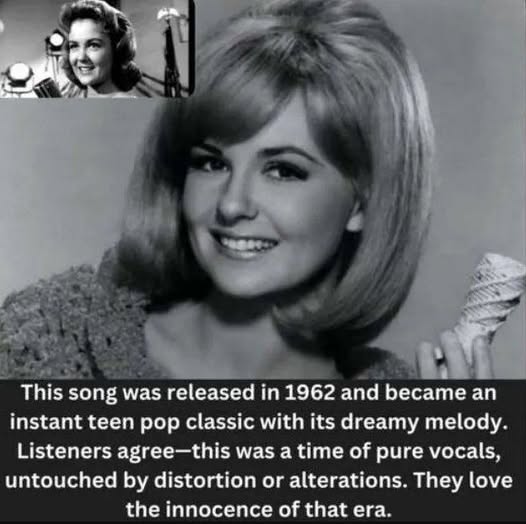
In the early 1960s, American popular culture was undergoing a significant transformation, as music, television, and youth identity began to merge into a unified entertainment landscape that reflected teenage emotions and evolving social values.
During this period, Shelley Fabares emerged as a prominent young performer, already widely recognized for her role in the family television series The Donna Reed Show, which shaped her public image.
Born and raised in Santa Monica, California, she grew up near the center of the entertainment industry, where exposure to acting opportunities and media production influenced her early development as a performer.
Her television success established her as a relatable and wholesome figure, often associated with innocence, warmth, and the idealized representation of American teenage life during that era.

At the time, the entertainment industry frequently encouraged actors to expand into music careers, particularly when they already had strong public recognition and a loyal audience base.
This industry environment led Fabares into the recording studio, not as a long-term musical ambition, but as a natural extension of her growing visibility in television.
In 1962, she recorded and released the song “Johnny Angel,” which would become one of the most recognizable pop singles of the early 1960s.
The song captured the emotional tone of teenage longing, focusing on themes of admiration, innocence, and quiet romantic desire that were central to youth culture at the time.
Its gentle melody and simple lyrical structure allowed listeners to connect easily with the emotional message, especially in an era before digital communication and instant expression.

For many young listeners, the song reflected the private emotional world of adolescence, where feelings of love and attraction were often unspoken and deeply personal.
The production of the track featured experienced studio musicians and background vocal arrangements, creating a soft, polished sound that complemented Fabares’ delicate vocal delivery.
Upon release, “Johnny Angel” quickly gained commercial success, eventually reaching the number one position on the Billboard Hot 100 chart in the United States.
The song’s popularity extended beyond the United States, achieving international recognition in several countries and contributing to the global spread of American pop music.
This success briefly positioned Fabares as a rising star in the music industry, even though her primary professional identity remained rooted in acting and television.
Following this breakthrough, she released “Johnny Loves Me,” a continuation in tone and theme, though it did not reach the same level of commercial or cultural impact.
Despite moderate success, the follow-up highlighted the challenges of sustaining a music career in a rapidly changing industry influenced by shifting audience preferences.

As the 1960s progressed, the musical landscape began to evolve with the emergence of new styles, including rock-driven sounds associated with the British Invasion.
This shift gradually reduced the mainstream popularity of softer teenage ballads, marking the end of an era in which songs like “Johnny Angel” had dominated the charts.
Recognizing these changes, Fabares shifted her focus back toward acting, where she had already established long-term stability and professional recognition.
Her return to television and film demonstrated her adaptability and ability to navigate different areas of the entertainment industry successfully.
She later appeared in several productions alongside Elvis Presley, further expanding her presence in Hollywood films during the 1960s.
These roles showcased her versatility as an actress capable of performing in both musical and dramatic entertainment formats.

Over the following decades, she built a consistent acting career, appearing in well-known television series such as One Day at a Time and later Coach.
Her continued presence on television introduced her to new generations of viewers, reinforcing her long-term relevance in the entertainment industry.
Although her music career was brief, “Johnny Angel” remained a defining cultural milestone that continued to represent the sound and sentiment of early 1960s pop music.
The song is often remembered for its emotional simplicity, which allowed listeners to project their own experiences of youthful love and longing onto its lyrics.
Its enduring popularity reflects the lasting appeal of music that focuses on universal human emotions rather than complex production techniques or trends.
Music historians frequently associate the track with the girl-group and teen-pop era, a period defined by emotional storytelling and accessible melodic structure.

Fabares’ vocal performance is often described as sincere and understated, contributing to the song’s ability to maintain emotional resonance across decades.
Even in modern times, the song continues to appear in nostalgic collections, films, and retrospectives that revisit early American pop culture.
Its presence in media highlights its role as both a commercial success and a cultural artifact representing the emotional landscape of its time.
The success of “Johnny Angel” also illustrates how entertainment industries of the 1960s often shaped young performers into multi-platform personalities.
Fabares’ career trajectory reflects this system, where television fame often translated into temporary opportunities in music and film.
However, her decision to focus primarily on acting ultimately defined her long-term career stability and professional identity.
Her later achievements in television demonstrated her ability to sustain relevance in an industry known for constant change and evolving audience expectations.
Today, her contribution to both television and music is viewed as part of a broader legacy of mid-20th-century American entertainment history.
“Johnny Angel” remains a symbol of youthful innocence, emotional simplicity, and the cultural tone of a transitional period in popular music history.
Ultimately, Shelley Fabares’ career represents a unique balance between brief musical success and enduring television achievement, leaving a lasting mark on entertainment history.
