
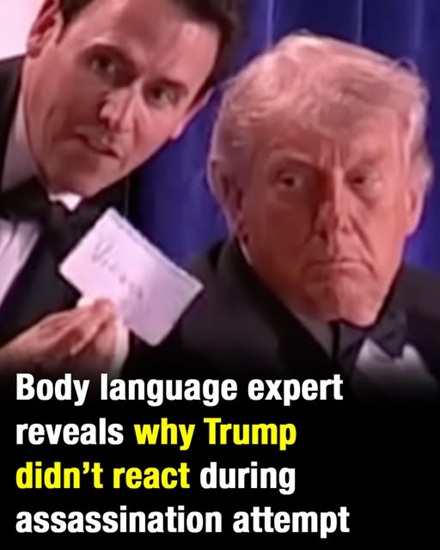
High-profile public events involving political leaders, journalists, and large audiences are always conducted under strict security protocols. These environments are designed to minimize risk and ensure rapid response in case of any unexpected disruption. Despite these precautions, human behavior in such situations remains a key area of study for psychologists, security experts, and body language analysts. The way individuals react under sudden stress provides valuable insight into how the human nervous system operates under pressure.
When an unexpected or potentially dangerous situation occurs, the human body automatically activates survival mechanisms. These mechanisms are not consciously controlled but are instead governed by the autonomic nervous system. The most widely recognized responses include fight, flight, and freeze. Each of these reactions serves a different purpose in helping the individual cope with perceived danger. The freeze response, in particular, is often the first stage, where the body temporarily pauses while the brain processes information and assesses risk levels.
During the freeze response, external behavior may appear unusual to observers. A person may remain still, show minimal facial expression, or appear emotionally detached. However, this does not indicate a lack of awareness. Instead, it reflects a temporary neurological state where cognitive processing is prioritized over physical reaction. Experts emphasize that this phase is extremely brief but critical in determining the next course of action.

Following the freeze response, individuals may transition into either flight or fight responses depending on the situation. The flight response is characterized by movement away from the perceived threat. This can include standing up quickly, stepping back, or seeking protective cover. These actions are instinctive and often occur without conscious planning. Even subtle movements such as leaning backward or turning the body away from the source of danger are part of this survival mechanism.
In contrast, the fight response involves preparing to confront or neutralize the threat. In modern controlled environments such as public events, this response is typically observed in trained security personnel rather than civilians. Security teams are specifically trained to assess, react, and respond to threats within seconds. Their movements are deliberate and coordinated, aiming to protect individuals and restore safety as quickly as possible.
Body language experts often caution against interpreting short moments of footage without full context. Human reactions during emergencies are complex and influenced by multiple factors, including training, awareness, personality, and situational understanding. What may appear as calmness or indifference in a brief clip may actually be a moment of intense cognitive processing. Without full situational awareness, interpretations can easily become misleading.
Another important factor in behavioral analysis is emotional suppression during high-stress events. Individuals may subconsciously reduce visible emotional expression in order to maintain focus. This is especially common among people who are trained or accustomed to operating in high-pressure environments. The brain prioritizes decision-making and situational awareness over outward emotional display, which can result in a neutral facial expression even under significant stress.
Security procedures at major public events are designed to manage both physical safety and crowd behavior. When a potential threat is identified, protocols are immediately activated to guide individuals to safety. These procedures are carefully structured to prevent panic and ensure orderly movement. Trained personnel assist attendees and coordinate with law enforcement agencies to stabilize the situation as quickly as possible.
Crowd behavior during emergencies can vary significantly. Some individuals respond immediately by moving away from the perceived danger, while others remain stationary for a brief period before reacting. This variation is normal and expected in large groups of people. Environmental factors such as noise, visibility, and proximity to the incident also influence how quickly individuals recognize and respond to a threat.
Experts in psychology also highlight the role of cognitive overload during emergencies. When the brain is processing large amounts of information rapidly, emotional and physical responses may become delayed or suppressed. This can create the appearance of calmness, confusion, or delayed reaction. These states are part of the brain’s attempt to prioritize survival and decision-making under pressure.
In conclusion, human reactions during unexpected security incidents are shaped by deeply rooted biological and psychological mechanisms. These reactions are not uniform and vary greatly between individuals. Understanding the science behind body language and emergency response helps provide a more accurate interpretation of behavior in high-stress situations. Rather than drawing conclusions from isolated moments, experts recommend considering full context, environmental conditions, and human neurological responses.
