
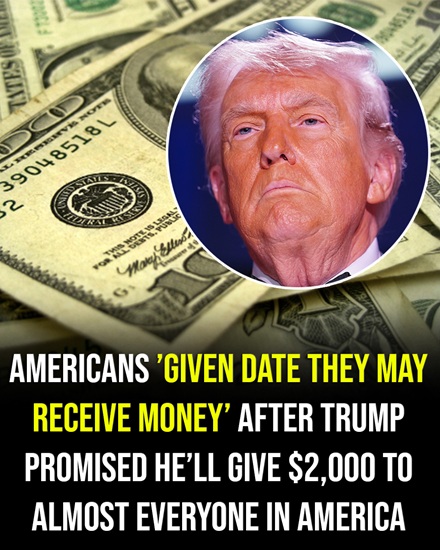
Public discussion in the United States has recently returned to the idea of potential direct payments to citizens, sometimes referred to as “tariff dividend” checks. The concept has been publicly mentioned by President Donald Trump in speeches and social media posts, where he suggested that revenue collected from tariffs on imported goods could be redistributed to eligible Americans. At present, however, there is no approved federal program, no legislative authorization, and no official timeline for such payments.
The proposal exists only as a political idea rather than an operational government policy. Any implementation would require formal approval through Congress, as well as detailed planning through federal agencies such as the Treasury Department and the Internal Revenue Service.
Understanding Tariffs and Government Revenue
Tariffs are taxes imposed by a government on imported goods entering the country. In the United States, tariff revenue is collected by the federal government and contributes to general federal income. These funds are typically used to support a wide range of government spending priorities, including infrastructure, defense, and public services.

The idea behind a “tariff dividend” is that a portion of this revenue could be redistributed directly to citizens in the form of payments. However, such redistribution would require specific legislation defining eligibility, funding allocation, and administrative procedures. Without legal authorization, tariff revenue cannot automatically be distributed as direct cash payments to individuals.
Political Statements and Public Discussion
The proposal for tariff-based payments has been referenced in public statements and online communications by Donald Trump, where he suggested that American citizens could potentially receive direct financial benefits from tariff revenue. In these remarks, he indicated that payments could vary based on income levels, with higher-income individuals potentially excluded.
Despite these statements, officials within the federal government have not confirmed any active development of such a program. Scott Bessent and other economic officials have indicated in public remarks that no formal policy framework has been established, and no administrative process is currently in place.
Legislative Requirements for National Payment Programs
In the United States, large-scale financial distribution programs require approval from Congress. This includes authorization of funding, definition of eligibility criteria, and establishment of implementation systems. Without congressional approval, federal agencies are not permitted to distribute large-scale direct payments.
Historical examples, such as economic stimulus payments, were enacted through formal legislation passed during national emergencies or economic crises. These programs involved detailed planning, legal authorization, and coordination between multiple federal agencies. Any similar future program would need to follow the same legal and procedural framework.
Economic Considerations and Fiscal Impact
Economists and policy analysts have examined the potential cost of distributing $2,000 payments to eligible Americans. Depending on eligibility criteria, such a program could cost hundreds of billions of dollars. Estimates vary widely based on population coverage and income thresholds.
At the same time, tariff revenue is not a fixed or guaranteed funding source. It fluctuates based on trade volume, import levels, and broader economic conditions. Because of this variability, economists note that relying on tariffs as a consistent funding mechanism for direct payments could present significant fiscal challenges.
Administrative and Implementation Challenges
If a tariff dividend program were ever to be implemented, it would require extensive administrative infrastructure. Agencies such as the Internal Revenue Service (IRS) would need to verify eligibility, process payments, and manage distribution systems. This would involve designing secure databases, preventing fraud, and ensuring accurate delivery of funds.
Additionally, clear eligibility rules would need to be established. These could include income limits, residency requirements, and tax status conditions. Without such definitions, large-scale payment programs cannot function effectively or fairly across the population.
Role of the Treasury and Federal Agencies
The U.S. Department of the Treasury plays a central role in managing federal finances, including revenue collection and government spending. Any proposal involving redistribution of tariff revenue would require coordination with Treasury officials and other financial agencies.
However, as of now, there is no confirmed program or directive instructing these agencies to begin planning or implementation. Public statements indicate that discussions remain theoretical rather than operational. This distinction is important in understanding the current status of the proposal.
Media Coverage and Public Interpretation
Media coverage of the tariff dividend idea has varied widely across outlets. Some reports focus on political statements, while others analyze economic feasibility and legislative requirements. In the digital age, public interpretation of such proposals can spread quickly through social media platforms.
Because of this, it is important to distinguish between official policy and public discussion. Many viral posts or commentary pieces may present the idea as more developed than it actually is. In reality, no confirmed government program currently exists for $2,000 tariff-based payments.
Public Debate and Political Perspectives
The idea of direct payments funded by tariffs has generated debate among policymakers and the public. Supporters argue that if tariff revenue increases, it could be used to directly benefit taxpayers. Critics, however, raise concerns about sustainability, economic distortion, and legal authority.
These debates reflect broader disagreements about trade policy, taxation, and government redistribution. While such discussions are common in U.S. politics, they do not necessarily translate into immediate policy action. Most proposals require extensive review before becoming law.
Constitutional and Legal Considerations
Under the U.S. Constitution, federal spending must be authorized through the legislative process. This means that large-scale payment programs cannot be created solely through executive statements or proposals. Congressional approval is required to allocate funds and define program structure.
Legal experts generally emphasize that any attempt to implement such a program without legislative approval would face significant constitutional and procedural challenges. This reinforces the distinction between political proposals and enforceable government policy.
The idea of $2,000 tariff dividend payments remains a political proposal rather than an active government program. While it has been publicly discussed by Donald Trump and referenced in broader economic conversations, it has not been approved by Congress, funded, or scheduled for implementation.
There is currently no official eligibility system, no payment timeline, and no operational infrastructure supporting such a program. As a result, the proposal exists at the discussion stage only, with its future dependent on legislative action, economic feasibility, and political consensus.
Until formal steps are taken, the tariff dividend concept remains an idea within ongoing debates about trade policy and economic distribution in the United States.
