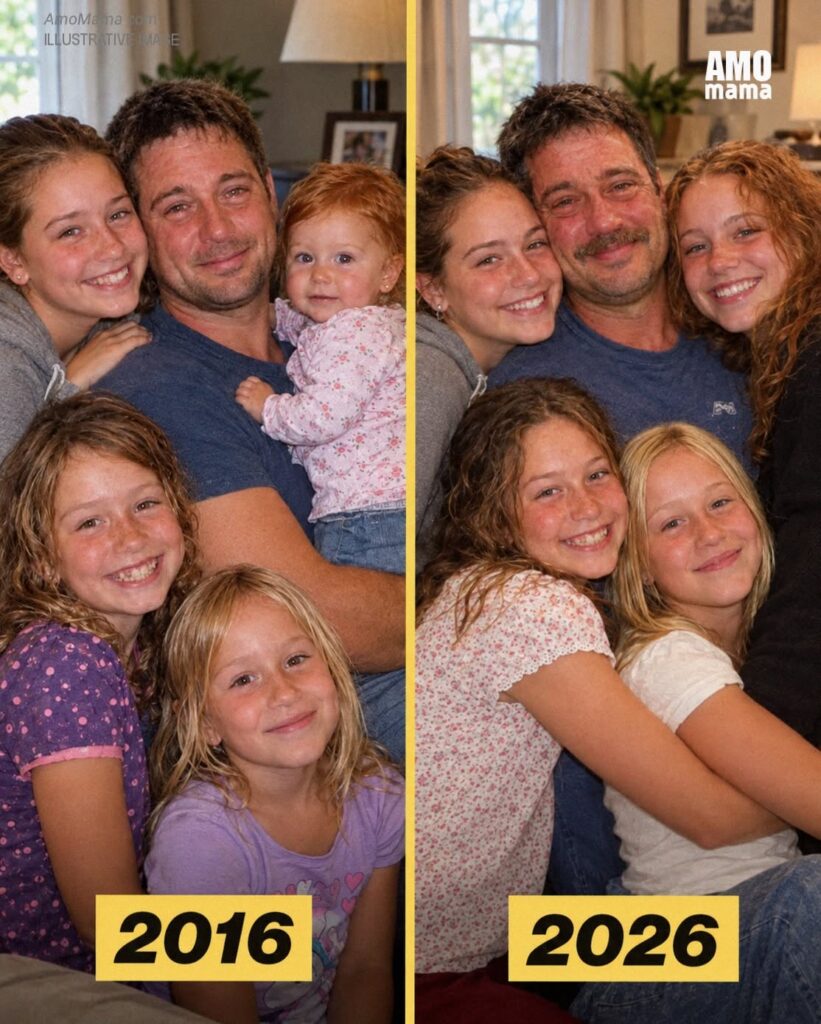
The Mother Who Returned After Ten Years—But Her Daughters Had Already Learned to Live Without Her
Ten years ago, Adam came home from work expecting an ordinary evening. He imagined dinner waiting, his daughters arguing over something small, and Caroline asking him how his day had gone. It was the kind of routine he had lived for years, a routine he never thought could disappear in a single moment.
Instead, he found his six-year-old daughter sitting on the stairs, crying. Her little shoulders trembled. Her hands were pressed against her face, and she kept looking toward the front door as though she expected someone to walk through it.
“Daddy,” she whispered when she saw him. “Mommy said she’s not coming back.”
Adam stopped moving.
For a second, he didn’t understand the words. He thought perhaps Caroline had gone somewhere and their daughter had misunderstood. Maybe her mother had said she was going to visit a friend. Maybe there had been an argument. Maybe she would be home before bedtime.
He gave a nervous laugh and knelt beside his daughter.
“Come on, sweetheart. Mommy’s probably just gone somewhere.”
But the little girl shook her head.
“She said she was leaving.”
Something about her voice made Adam’s smile disappear.
He carried her into the living room, sat beside her, and tried to get her to explain. Every answer was short. Every question seemed to make her cry harder.
Eventually, she told him that Caroline had packed some of her belongings and left.
Adam still refused to believe it.
He walked upstairs, expecting to find his wife waiting in their bedroom, ready to explain that something had gone wrong. But the moment he opened the closet, he knew the situation was much worse than he had imagined.
Half of Caroline’s clothes were gone.
Her drawers were empty.
Her wedding ring was sitting on the dresser.
And beside it was a note.
“Don’t look for me. I want to live on my own.”
Adam read it once.
Then again.
Then a third time, hoping that perhaps he had misunderstood something.
He hadn’t.
His wife had left him, and she had left their four daughters behind.
He immediately called her phone.
It rang.
No answer.
He tried again.
And again.
Each time, the same result.
He sent messages asking where she was, whether she was safe, and whether she intended to come home. He asked her to explain what had happened. He even apologized for things he didn’t understand, simply because he thought there might be something he could do to bring her back.
But Caroline never responded.
That night, Adam barely slept.
He sat on the edge of the bed with his phone in his hand, listening for every sound in the house. He kept checking the screen, hoping her name would appear.
It never did.
By morning, he was convinced something terrible might have happened to her.
He called the police.
He checked hospitals.
He drove through places where he thought she might have gone.
He searched parking lots, familiar streets, and places they had visited together. Every time he saw a woman who resembled Caroline, his heart jumped before sinking again.
He didn’t know whether she had been hurt, whether someone had forced her to leave, or whether she had simply decided that her family no longer belonged in her life.
For weeks, he lived with that uncertainty.
Then the police finally confirmed what Adam had feared and, at the same time, what he had never wanted to hear.
Caroline had left voluntarily.
She was living in another state.
And she was with another man.
Adam sat in his truck outside his house after receiving the news. He stared at the steering wheel, unable to move. The tears came before he could stop them.
Through the kitchen window, he could see his daughters.
They were watching him.
He quickly wiped his face.
He couldn’t let them see him fall apart.
Sophie, the oldest, was only nine years old. The other girls were younger, and the youngest was just three. They didn’t understand marriage, betrayal, or the complicated reasons adults sometimes gave for destroying their own families.
They understood only one thing.
Their mother was gone.
Adam took a deep breath, opened the truck door, and walked inside.
He had no idea how he was going to raise four little girls by himself.
But he knew he had to try.
And he knew he couldn’t leave them waiting for someone who had already walked away.
The first few months were harder than he ever imagined.
He had always been a father, but suddenly he was responsible for everything. Every meal, every school morning, every bath, every doctor’s appointment, every bedtime story, every tear that came when one of the girls asked why their mother wasn’t home.
He learned how to braid hair by watching videos.
He practiced ponytails, only to discover that the girls could somehow make them fall apart before he had finished the second one.
He burned pancakes.
He forgot permission slips.
He once sent Sophie to school wearing two different shoes because neither of them noticed until she came home and showed him.
At first, he was embarrassed by the mistakes.
Then he began laughing about them with his daughters.
They started calling his cooking experiments “Daddy’s surprises.” Some were edible. Others were quietly abandoned after the first bite.
The house was no longer as organized as it had once been.
There were toys everywhere.
Laundry appeared in places he didn’t understand.
Someone was always asking for something at the exact moment he thought he could sit down.
But the girls began adjusting.
And Adam adjusted with them.
He learned that being a good father didn’t mean getting everything right. Sometimes it meant apologizing for forgetting something. Sometimes it meant staying awake beside a child who couldn’t stop crying. Sometimes it meant pretending to be confident when he was terrified that he was failing.
He made mistakes.
Plenty of them.
But he stayed.
As the years passed, the girls grew older. Their problems changed, but the responsibilities never really disappeared.
There were school projects that needed help late at night.
Arguments over clothes.
Teenage friendships that suddenly ended.
First crushes.
Broken hearts.
Moments when one daughter refused to talk, while another wanted to tell him every detail of her day before he had even taken off his shoes.
Adam learned to listen.
He learned that sometimes his daughters didn’t need solutions.
They needed someone who would sit beside them and let them finish.
The hardest moments, however, were the holidays.
Christmas was supposed to be a time of warmth, excitement, and family. But for the first few years, there was always an empty space that nobody knew how to fill.
The youngest girl had a habit of setting an extra plate at the table.
Adam noticed it the first time and gently asked why.
“Maybe Mommy will be hungry when she comes home,” she said.
He looked at the plate.
He looked at his daughter.
And he couldn’t bring himself to tell her that Caroline hadn’t called, that there had been no message, and that he didn’t know whether she would ever return.
So he simply sat down beside her.
The extra plate remained.
The following Christmas, she did it again.
And the Christmas after that.
Adam never told her to stop.
He didn’t want to crush a hope that belonged to a child. He also didn’t know how to explain that waiting for someone could sometimes become its own kind of pain.
Eventually, the little girl stopped setting the extra plate.
She stopped asking whether her mother was coming.
She stopped checking the window when a car pulled into the driveway.
Adam noticed the change, but he didn’t celebrate it.
He understood that sometimes children stopped asking questions not because they had received the answers, but because they had learned that nobody was coming to answer them.
Meanwhile, Caroline remained absent.
Not a phone call.
Not a birthday message.
Not a letter.
Not even a brief explanation.
Their marriage eventually ended formally, but the paperwork did little to change what had already happened inside the house.
Adam continued working.
He saved what he could.
He made sacrifices that his daughters didn’t always notice at the time. He postponed things he wanted. He took extra shifts when he could. He tried to make sure the girls had what they needed, even when he wasn’t sure how he would manage the next month.
He never wanted them to feel that their lives had become smaller because their mother had left.
Years passed.
The little house that had once felt overwhelming began to feel like home again.
The girls grew into young women with different personalities, different dreams, and different ways of making Adam laugh.
And after years of saving, he finally accomplished something he had quietly worked toward for a long time.
He bought a new house.
It wasn’t simply a building to him.
It represented every overtime shift, every postponed purchase, every difficult month, and every moment he had reminded himself that the girls deserved stability.
Last Saturday, they celebrated.
The daughters had baked a cake.
They had decorated the dining room.
They had spent the afternoon laughing, taking pictures, and teasing their father about how emotional he would become when he saw the frosting.
The words written across the cake made him stop.
“You were always enough, Dad.”
He hugged all four of them.
For a moment, he didn’t care how messy the kitchen was or how much work remained to be done.
He was surrounded by his daughters.
They were happy.
And they were together.
Then someone knocked on the door.
Sophie, now nineteen, went to answer it.
A few moments later, she returned.
But she wasn’t smiling anymore.
Her cheeks were wet.
“Daddy,” she said quietly. “Someone’s here for you.”
Adam felt a strange uneasiness before he even stood up.
He walked toward the door.
And when he stepped outside, he nearly collapsed.
Caroline was standing in front of him.
Ten years had passed, but he recognized her immediately.
She looked older, naturally. There were lines around her eyes that hadn’t been there before. Her hair was different. Her expression seemed uncertain, almost frightened.
But it was her.
The woman who had left without saying goodbye.
The woman who hadn’t called their daughters for ten years.
The woman who had missed birthdays, school events, Christmas mornings, growing pains, and every ordinary moment that had quietly become important.
“What are you doing here?” Adam asked.
His voice barely sounded like his own.
Caroline looked down.
“I came to explain.”
Adam let out a short, disbelieving breath.
“Explain?”
He looked toward the house, where the celebration was still happening.
“Do you know how many nights they cried for you? How many birthdays they spent waiting? How many times I had to answer questions I couldn’t answer?”
Caroline didn’t interrupt.
“You owe those girls an apology,” he continued. “Not me.”
He turned away.
But she reached for his hand.
“Please. There’s something I’ve kept from you for ten years.”
Adam pulled his hand free.
“Then why tell me now?”
Her eyes filled with tears.
“I couldn’t tell you the truth for ten years. But now you need to know what really happened the night I left.”
Adam stared at her.
He had spent years trying to understand why she had abandoned them. He had imagined different explanations, different possibilities, and different versions of what might have happened.
None of them had prepared him for this.
“Was the man the police found you living with your boyfriend?”
Caroline nodded.
“Then what haven’t you told me?”
She glanced toward the doorway.
Sophie was standing there.
Watching.
“There’s another girl involved,” Caroline whispered. “And she thinks I’m her mother.”
Adam’s expression changed.
“What girl?”
Caroline looked as though she wanted to turn around and leave.
“Can we talk somewhere private?”
Adam told Sophie that he needed a few minutes. Then he led Caroline toward the far end of the porch, away from the open door and the sounds of the family celebration.
He folded his arms.
“Start talking.”
Caroline clasped her hands together.
“Before I left, I met someone through work. He made me feel different. Like I could be someone besides a wife and mother.”
Adam’s jaw tightened.
“So you abandoned us.”
“I thought I’d found something that would make me happy.”
“And did it?”
Caroline’s eyes filled.
“No.”
For the first time, Adam heard something in her voice that sounded less like an explanation and more like regret.
She told him the man had promised her a new life. At the time, she had believed that leaving everything behind would somehow solve the emptiness she felt.
But the excitement didn’t last.
Within months, the relationship began changing. The promises became arguments. The future she had imagined seemed increasingly distant.
Before their first year together had ended, the man asked her to leave.
Adam listened without speaking.
He had waited ten years for an explanation.
But the more Caroline talked, the less he understood how she could have made the choices she had.
She found a job.
She rented a small apartment.
She lived alone.
“Then why didn’t you come home?” Adam asked.
Caroline looked down at her hands.
“I was ashamed.”
Adam stared at her.
“Shame?”
He shook his head.
“Sophie cried herself to sleep for months. Our youngest asked whether you’d forgotten the way home. You could have called.”
“I know.”
“You had years, Caroline. Years.”
She covered her mouth.
“I kept thinking I’d call the next day. Then another month passed. Eventually, I didn’t know what I could possibly say.”
Adam felt the old anger returning.
“So you said nothing.”
Caroline couldn’t argue.
He remembered the first Christmas after she left. He remembered sitting outside the girls’ bedroom, listening to the youngest cry for her mother.
He remembered holding the phone, wondering whether Caroline was thinking about them.
Now he knew she had been somewhere else.
And the silence had continued.
“There’s more,” Caroline said.
Adam almost laughed.
“Of course there is.”
“Four years after I left, I met someone else.”
He folded his arms tighter.
“Go on.”
Caroline hesitated.
“When I met him, I told him I didn’t have children.”
For a moment, Adam couldn’t understand what he had just heard.
“You told him our daughters didn’t exist?”
“I wanted a fresh start.”
Adam looked away, stunned.
“A fresh start by pretending four people had never been born?”
Caroline’s voice became quieter.
“We got married the following year.”
He didn’t care about her second marriage. He didn’t care about the man she had chosen or the life she had built.
But then she said something that made him look at her again.
“He had a daughter from his previous marriage. She was eight when I met her.”
Caroline’s expression changed.
“She was shy around me at first. But eventually, we became close.”
Adam watched her.
“How close?”
“I helped raise her.”
The words landed harder than he expected.
“You raised another man’s daughter?”
Caroline nodded.
Adam thought about all the mornings he had rushed four girls out of the house. All the evenings he had spent helping with homework after exhausting days at work.
He thought about the little girl who had once waited beside the phone.
“Did you go to her school events?”
“Yes.”
“Her birthdays?”
“Of course.”
“Did you take care of her when she was sick?”
Caroline began crying.
“Adam, please.”
His voice was low.
“If you could be a mother to someone else’s daughter, why couldn’t you be one to ours?”
She pressed her palms against her eyes.
“I don’t have a good answer.”
“Try.”
Caroline took a shaky breath.
“When I met her, she didn’t know what I’d done. She saw someone kind. Someone she could depend on.”
Adam looked toward the house.
“And our girls?”
“They knew I’d left them.”
That was the part he couldn’t forget.
The girl Caroline had raised didn’t have to wonder why her mother had disappeared. She had never been asked to carry the weight of Caroline’s abandonment.
Adam finally understood something that made the betrayal even more painful.
Caroline hadn’t been incapable of loving a child.
She had chosen to love a child whose life didn’t remind her of the family she had walked away from.
“Being with her made me feel like I could be a good person again,” Caroline admitted.
Adam shook his head.
“You could have been a good person by calling your own daughters.”
Caroline lowered her head.
“I know that now.”
But Adam wasn’t sure she truly understood.
Then she reached into her purse.
She removed an old photograph.
Adam recognized it immediately.
It was a picture of Caroline sitting on their old living room couch. All four girls were crowded around her.
Sophie was grinning, missing a front tooth.
The youngest was asleep against Caroline’s shoulder.
Adam had taken the photograph shortly before Caroline disappeared.
He stared at it.
“Why do you still have this?”
“It was the only picture I kept.”
For ten years, Adam had imagined Caroline had thrown away everything connected to them.
But apparently, she had kept that photograph while telling another family that her daughters didn’t exist.
“Why bring it here?”
Caroline swallowed.
“A few months ago, my husband found it while we were putting things into storage. His daughter saw it before I could put it away.”
The girl had asked who the children were.
At first, Caroline told her they were relatives.
But the girl noticed something in the picture.
The resemblance.
The way Caroline held the youngest.
The familiar closeness that couldn’t easily be explained away.
She kept asking questions.
Eventually, Caroline admitted the truth.
“My husband couldn’t believe I’d hidden four daughters from him,” Caroline said. “But his daughter took it hardest.”
Adam looked at the photograph.
“What did she say?”
Caroline stared at the image.
“She asked whether I would have left her too.”
Adam felt a bitter silence settle over him.
Inside the house, his daughters were celebrating the new home they had worked toward together.
For the first time, he wondered whether Caroline understood what she had taken from them.
“She trusted me,” Caroline continued. “I was there for her when she needed someone. She thought I would never leave.”
Adam interrupted.
“That’s exactly what our girls thought.”
Caroline nodded miserably.
“She asked why I never contacted them. I told her I was ashamed. She said being ashamed wasn’t an excuse.”
“She’s right.”
Caroline revealed that her marriage had ended and that the girl barely spoke to her anymore.
Adam finally understood why she had suddenly appeared after ten years.
But understanding the reason didn’t make him feel any better.
“Did she tell you to come here?”
Caroline nodded.
“She said she couldn’t trust me when I’d never even apologized to my own children.”
Adam studied her face.
“And you thought coming here would change her mind?”
“I wanted to make things right.”
“For whom?”
Caroline hesitated.
“For everyone.”
Adam shook his head.
“Why now? Why not when your boyfriend left? Why not when Sophie turned ten? Why not when our youngest started school?”
“I was afraid you’d hate me.”
“We might have. But we still deserved to hear from you.”
Caroline said nothing.
Adam asked the question that had been forming in his mind ever since she mentioned the girl.
“If your new family hadn’t discovered us, would you be standing here today?”
Caroline opened her mouth.
Then closed it.
Finally, she whispered, “I don’t know.”
That answer hurt more than anything else.
At least it was honest.
For years, Adam had imagined Caroline occasionally wondering whether her daughters needed her.
Now he knew she had built another life while convincing herself that the first one could remain buried.
The front door opened.
Sophie stepped onto the porch.
“Dad? Are you okay?”
Adam turned toward her.
“I’m alright, sweetheart.”
She looked at Caroline.
“Is it really you?”
Caroline nodded.
“Hi, Sophie.”
Sophie didn’t move.
She was nineteen now.
Taller.
Older.
And no longer the little girl who waited for her mother beside the phone.
“Why are you here?”
“I wanted to explain why I left.”
Sophie crossed her arms.
“Then explain.”
Caroline glanced at Adam.
He didn’t rescue her.
She told Sophie that she had been unhappy, that she had made a terrible decision, and that she regretted leaving.
Sophie listened without interrupting.
Then she asked the question that had stayed with her for years.
“Why didn’t you ever call?”
Caroline looked down.
“I didn’t know if you’d want to hear from me.”
Sophie let out a bitter laugh.
“I was nine. I waited beside the phone every birthday.”
Caroline’s face crumpled.
“I remember asking Dad if I’d done something wrong,” Sophie continued. “I thought maybe I was too loud. Maybe you were tired of us fighting. Maybe you just didn’t like being our mom anymore.”
“Sophie, no. It wasn’t your fault.”
“Then why didn’t you tell me that when I was nine?”
Caroline had no answer.
Sophie noticed the photograph.
“What’s that?”
Adam explained how Caroline’s new family had discovered the picture. Then he told Sophie about the stepdaughter.
Her expression changed.
“You raised another girl?”
Caroline nodded.
“She needed someone.”
Sophie stared at her.
“We needed someone too.”
“I know.”
“Did she ever have to wonder whether you loved her?”
Caroline began crying again.
Sophie stepped closer to Adam.
“You don’t get to come back because your other family doesn’t want you anymore.”
“I didn’t come only because of that,” Caroline insisted.
Sophie looked directly at her.
“Would you have come otherwise?”
Caroline looked between them.
“I want to believe I would have.”
Sophie shook her head.
“That’s not an answer.”
For a long moment, nobody spoke.
Then Caroline finally said, quietly, “You’re right.”
She took a shaky breath.
“I left because I wanted to. I stayed away because I was afraid to face what I’d done. And I came here because I couldn’t keep pretending it hadn’t happened.”
Sophie wiped her cheeks.
“You didn’t lose us, Mom. You left us.”
Caroline reached toward her, then stopped.
“I’m sorry.”
Sophie moved closer to her father.
“I’m not ready to forgive you.”
“I understand.”
Caroline looked past them through the open doorway.
The dining room table was visible.
Five plates were arranged around it.
She stared at the table for a moment.
“Do the girls ever ask about me?”
Adam thought about all the questions she had missed.
“Our youngest used to set an extra plate for you every Christmas.”
Caroline’s eyes widened.
“She did?”
“She thought you might come home hungry.”
A tear rolled down Caroline’s cheek.
“Does she still do that?”
“No.”
“What happened?”
“She got tired of waiting.”
Adam remembered the Christmas when his youngest had quietly returned the extra plate to the cabinet.
She had told him she wanted to enjoy dinner with the people who were there.
He hadn’t realized until that moment how much she had grown.
Caroline covered her face.
“I missed everything.”
“Yes,” Adam said. “You did.”
For once, he didn’t soften the truth.
Caroline asked whether she could see the younger girls.
Adam told her they knew she was outside. He would let them decide whether they wanted to speak with her.
“Can I at least leave my number?”
“Yes. But don’t expect them to call.”
Caroline nodded.
“I know I don’t deserve anything from them.”
Adam looked at the photograph still in her hand.
“Then don’t ask them to make you feel better about what happened. If they contact you, listen. If they don’t, respect that.”
Caroline wrote her number on a piece of paper.
Before leaving, she looked at Sophie one more time.
“I really am sorry.”
Sophie didn’t answer.
Caroline walked down the driveway without looking back.
Adam watched until she disappeared around the corner.
For ten years, he had wondered whether knowing the truth would make things easier.
It didn’t.
But it finally made something clear.
Caroline hadn’t left because their daughters were difficult to love.
She hadn’t left because Adam wasn’t enough.
She had made a choice.
Then she had spent years avoiding its consequences.
When Sophie touched his arm, he turned toward her.
“Dad, are you okay?”
He looked at his daughter, the same little girl who had once waited beside the phone.
“I think I will be.”
They went inside together.
His other three daughters were waiting near the kitchen. The youngest came straight over and hugged him.
“Is everything okay?”
Adam looked at their faces.
“Not everything,” he admitted. “But we’re okay.”
Sophie picked up the cake knife.
“Can we finally eat this?”
Everyone laughed.
Adam looked at the words written across the frosting.
“You were always enough, Dad.”
For years, he had worried that his daughters were missing something he couldn’t provide.
He had tried to fill every gap.
He had tried to become the kind of parent who could make them forget the person who had left.
But standing there, surrounded by the four people who mattered most, he understood what they had been trying to tell him.
They had never needed him to replace their mother.
They had needed him to stay.
And he had.
They sat down together at their new dining table.
Five chairs.
Five plates.
Nobody reached for another.
Every seat was filled.
And for the first time in a long time, Adam didn’t feel like the family was waiting for someone to return.
They were simply home.