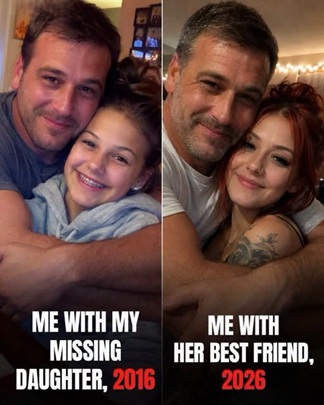
For ten years, the people in our town believed Nora was responsible for my daughter Emily’s disappearance.
They called her heartless. They whispered that she had been jealous, that she had manipulated a younger girl, and that she knew far more about that rainy night than she had ever admitted.
Some people never bothered to hide their opinions.
Whenever Nora walked down the street, conversations became quieter. Neighbors looked away, shopkeepers exchanged uncomfortable glances, and strangers seemed to recognize her before she had even introduced herself.
She was a child when Emily disappeared.
Yet the town treated her as though she had been an adult capable of planning something terrible.
And I was treated almost as badly for refusing to turn my back on her.
People called me foolish. Some said grief had destroyed my judgment. Others believed I had taken Nora into my home because I could not accept that Emily was gone.
But I knew what Emily had thought of Nora.
She had loved that girl.
And when Nora was left without anyone capable of caring for her, I could not bring myself to abandon her too.
For ten years, I raised her as my daughter while keeping Emily’s bedroom almost exactly as it had been on the night she vanished.
I never imagined that one evening, after all those years of silence, Nora would walk through my front door and tell me something that would change everything I thought I knew.
It was raining again.
And this time, the truth was finally coming home.
The Night Everything Changed
The rain had started before sunset.
It tapped against the kitchen window, ran down the glass in uneven streams, and turned the streetlights outside into blurry circles of yellow.
I sat alone at the kitchen table.
In front of me lay an old pink scarf.
It had belonged to Emily, and I had kept it for ten years. The fabric had become softer with age, and one corner was slightly frayed from the way she used to twist it around her fingers.
I could still picture her wearing it.
She had always been particular about little things. She liked her hair a certain way, preferred one particular mug for hot chocolate, and complained whenever I forgot to buy her favorite cereal.
Those ordinary memories had become precious.
After a person disappears, the smallest details can begin to feel enormous.
I remembered the sound of her footsteps in the hallway. I remembered her laughter coming from upstairs. I remembered how she used to call my name from another room instead of simply walking over to speak to me.
And I remembered our final argument.
That memory was the hardest to carry.
For ten years, I had replayed it in my mind, wondering whether one different sentence could have changed everything.
But there was no way to return to that evening.
There was only the empty chair across from me, the pink scarf, and the daughter I had never stopped waiting for.
Then I heard the front door open.
At first, I thought Nora had returned from one of her evening walks.
But something about the sound was different.
The door did not close immediately. There was a pause, followed by the sound of someone standing motionless in the entrance.
I looked toward the hallway.
“Dad?”
Her voice was barely audible.
I stood up.
Nora was soaked. Her hair clung to her face, and her hands were trembling. Her expression was so pale that I immediately wondered whether she had been hurt.
“What happened?” I asked, moving toward her.
She shook her head.
For a moment, she seemed unable to find the words.
Then she looked directly at me.
“I need to tell you the truth about Emily.”
I felt the room become strangely quiet.
For ten years, I had imagined hearing those words.
But I had never imagined that they would come from Nora.
The Girl Emily Refused to Leave Behind
Before everything happened, our family had been through more than its share of loss.
My wife, Abigail, had passed away, leaving Emily and me to build a life without her.
Emily was still young, but she had a remarkable ability to notice when someone was hurting.
She was not perfect. She could be stubborn, impatient, and occasionally impossible to convince that she was wrong.
But she had a generous heart.
That was how Nora became part of our lives.
Nora lived a few houses away with her grandmother. Her parents were not a consistent presence in her life, and her grandmother’s health was gradually declining.
As the older woman’s memory became less reliable, Nora was left facing responsibilities that were far too difficult for a child.
Emily noticed.
At first, she simply invited Nora over for dinner.
Then she began sharing clothes, school supplies, and little things that most children would normally keep for themselves.
Sometimes I would find the two girls sitting together at the kitchen table, laughing over something that had happened at school.
Other times, Nora would arrive looking tired, and Emily would quietly make her a sandwich without asking too many questions.
Their friendship developed naturally.
Before long, they were spending so much time together that it felt as though they had grown up as sisters.
Emily even began referring to Nora as the sister she had never had.
I was happy to see her showing such kindness.
But not everyone viewed the friendship in the same way.
Emily’s maternal grandparents, Carla and Grant, had strong opinions about how she should be raised.
They believed they knew what was best for her, and they frequently questioned my decisions.
They spoke about stability, discipline, and proper influences.
Sometimes their concerns sounded reasonable.
But over time, their comments became increasingly personal.
They questioned why Nora was always at our house. They suggested that Emily was being distracted from school and that I was allowing too much freedom.
They made it clear that they did not approve of the friendship.
I tried to avoid unnecessary arguments.
I wanted Emily to have a relationship with her grandparents, even when I disagreed with their opinions.
I never imagined how important that decision would become.
The Argument I Could Never Forget
The evening Emily disappeared began with something that seemed ordinary.
There was a school dance approaching, and Emily wanted to attend.
I was uncomfortable with some of the arrangements. I worried about transportation, supervision, and the possibility that she might stay out later than we had discussed.
Emily believed I was being unreasonable.
She wanted me to trust her.
I wanted her to understand that being a parent sometimes meant saying no, even when your child did not appreciate the reason.
The disagreement grew louder.
She accused me of treating her like a little girl.
I reminded her that I was responsible for her safety.
Then she mentioned her grandparents.
“They understand me better than you do,” she said.
The words hurt more than I expected.
I was still grieving Abigail, and Emily was the most important person in my life.
Instead of taking a breath and responding calmly, I let my frustration speak for me.
“Then go ask them if they know better.”
The moment the words left my mouth, I regretted them.
Emily looked at me.
For a second, I thought she might answer.
Instead, she turned toward the door.
I called after her, but she was already leaving.
Nora had been nearby.
She saw Emily storm outside and immediately followed her.
“I’ll bring her back,” she called over her shoulder.
Those were the last words I heard from her that evening before everything changed.
I waited.
At first, I expected them to return within a few minutes.
Then I checked the clock.
The rain grew heavier.
I called Emily’s phone, but there was no answer.
I tried Nora.
Nothing.
Eventually, Nora returned alone.
She was crying so hard that she could barely speak.
“Where is Emily?” I asked.
She shook her head.
“I don’t know.”
I asked whether they had argued, whether Emily had gone somewhere, whether she had seen anyone.
Nora kept repeating that she had tried to bring her back.
But Emily was gone.
And nothing I did that night brought her home.
A Town Looking for Someone to Blame
The disappearance quickly became the center of the community’s attention.
People asked questions.
They discussed what might have happened and offered opinions about where Emily could have gone.
Some genuinely wanted to help.
Others seemed more interested in finding someone to blame.
Nora became the focus of suspicion.
She had been the last person known to follow Emily.
She had returned alone.
And she could not provide an explanation that satisfied everyone.
Rumors began spreading.
Some people claimed Nora had been jealous of Emily.
Others suggested she had deliberately led her away.
There were even people who insisted that her behavior after the disappearance proved she was hiding something.
But suspicion was not proof.
Nora was a frightened child who had lost the person closest to her.
She repeatedly insisted that she had not hurt Emily and did not know where she had gone.
I wanted to believe her.
More importantly, I had no reason to treat accusations as established facts.
Still, the atmosphere became unbearable.
Every time Nora appeared in public, she seemed to feel the weight of the town’s judgment.
And I began to understand that the disappearance had taken something from her too.
She had lost her closest friend.
Then she lost the freedom to grieve without being accused.
Why I Took Nora Into My Home
As the months passed, Nora’s situation became increasingly difficult.
Her grandmother was no longer able to provide the care she needed.
There were concerns about what would happen next, and the possibility of her entering the foster care system became a real source of uncertainty.
I thought about Emily.
I remembered the way she had welcomed Nora into our home.
I remembered their laughter and the quiet understanding they shared.
I could not imagine Emily wanting the girl she loved to be left without support.
So I made a decision.
I welcomed Nora into my home.
Some people criticized me immediately.
They asked how I could raise the person they believed was responsible for Emily’s disappearance.
Others suggested that I was trying to replace my missing daughter.
They did not understand.
Nora was not a replacement.
She was another child who needed a safe and stable home.
I eventually adopted her.
It was not a decision I made because I had forgotten Emily.
It was a decision I made because I refused to let another child feel abandoned.
Nora understood that too.
She never tried to erase Emily’s memory.
Emily’s bedroom remained untouched for years.
Her photographs stayed on the shelves, and the pink scarf remained folded in the drawer.
Every year, Nora placed flowers on Emily’s pillow.
Sometimes she would sit quietly in that room for a long time.
I never asked what she was thinking.
I believed she needed that space to remember her friend.
But there was something I did not know.
Nora had been carrying a secret.
And the longer she carried it, the more afraid she became of telling me.
Ten Years of Questions
Life continued, although it never returned to the way it had been.
I learned how to be a father to Nora.
I attended school meetings, helped with homework, prepared meals, and tried to give her the ordinary childhood she deserved.
There were good days.
There were difficult days.
Sometimes she laughed so freely that I almost forgot the sadness that had brought us together.
Other times, a photograph of Emily or a familiar song would make the entire house feel quiet again.
Nora never asked me to stop talking about Emily.
In fact, she sometimes reminded me of things I had forgotten.
“She used to hate rainy mornings,” she once said.
Another time, she laughed while remembering how Emily had tried to teach her to ride a bicycle.
Those moments mattered.
They reminded me that Emily had been more than the person who disappeared.
She had been a daughter, a friend, and a young girl with dreams that deserved to be remembered.
But the unanswered questions never disappeared.
I wondered where she had gone.
I wondered whether she was safe.
I wondered whether she had ever thought about coming home.
And every year, on the anniversary of her disappearance, I found myself returning to the same kitchen table.
The town eventually became less interested in the story.
People moved on to other conversations.
But for Nora and me, the silence remained.
Until one evening, a message appeared on her phone.
The First Message
Nora entered the kitchen holding her phone.
Her hands were shaking.
“Dad, I need you to read something.”
I looked at the screen.
The message was short.
“Did Ross really stop looking for me?”
I read it once.
Then again.
I did not recognize the number.
I did not understand why someone would send such a message to Nora.
But the name Ross was unmistakably mine.
I looked up.
“Who sent this?”
Nora swallowed.
“I don’t know.”
“Have you answered?”
“No.”
I asked her to show me the rest of the conversation.
There were additional messages.
One questioned whether I had truly wanted Emily to return.
Another asked whether Nora believed I had adopted her simply because I could not accept losing my first daughter.
The questions were cruelly personal.
They seemed designed to create doubt between us.
But the next item was different.
It was a photograph.
I stared at it.
The woman in the picture looked older than the girl I remembered.
Her face was thinner. Her hair was different. Time had changed the details.
Yet something about her eyes was familiar.
I moved closer to the screen.
My heart began beating so hard that I could hear it.
“Nora,” I whispered. “Who is that?”
She looked at me.
Then she said the name I had spent ten years hoping to hear.
“Emily.”
A Face From the Past
I could not immediately accept what I was seeing.
For years, I had imagined what Emily might look like as she grew older.
Would she still have the same smile?
Would she wear her hair the same way?
Would she have finished school, found work, made friends, and built a life somewhere?
The photograph seemed to answer some of those questions while creating a hundred more.
I wanted to believe it was real.
But I was afraid of being disappointed.
I had received false hope before.
Every unfamiliar phone call, every possible sighting, and every rumor had once sent me searching for answers.
I could not allow myself to believe without understanding what was happening.
“How do you know this is Emily?” I asked.
Nora looked down.
“I recognize her.”
“Have you spoken to her?”
She hesitated.
That hesitation frightened me more than the photograph.
“Tell me everything,” I said.
Nora took a breath.
“Before I tell you, you need to understand that I tried to tell the truth before.”
I sat down.
She remained standing.
“I tried to explain what happened that night,” she continued. “But nobody believed me. And I was scared.”
“Scared of whom?”
She looked toward the photograph.
Then she told me something I had never expected to hear.
She believed Emily had not simply disappeared after leaving our house.
According to Nora, someone had taken control of what happened next.
And the people involved were not strangers.
They were people we had trusted.
The Secret Behind the Disappearance
Nora explained that after Emily stormed out that rainy evening, she had followed her down the street.
At first, Emily was angry and did not want to talk.
Nora tried to calm her.
She reminded Emily that I was worried and that the argument did not mean I had stopped loving her.
But Emily was upset.
She wanted space.
According to Nora, they eventually reached a place where Carla and Grant appeared.
Nora had not expected to see them there.
She believed they had come because they knew Emily was upset and wanted to take her somewhere safe.
At the time, she did not immediately understand that something was wrong.
The grandparents spoke to Emily.
They told her they could help her.
They suggested that she needed time away from the arguments at home.
Nora said she tried to question their intentions.
But she was young, frightened, and unsure how to challenge adults who appeared confident and certain.
Then, according to her account, Carla and Grant separated the girls.
Emily left with them.
Nora was told to go home.
She said she was promised that Emily would be returned after things had calmed down.
But Emily never came back.
When Nora returned to my house, she was terrified.
She did not know how to explain what had happened without accusing two adults whose influence over the family was considerable.
She also feared that nobody would believe her.
The town already suspected her.
And she believed that speaking openly would only make things worse.
I listened without interrupting.
Every detail seemed to reopen a memory.
The grandparents’ questions.
Their insistence that they knew what was best for Emily.
Their sudden involvement after the disappearance.
I had considered many possibilities over the years.
But I had never imagined that the people who claimed to care so deeply about my daughter could be connected to her disappearance.
Still, Nora’s account was an allegation.
I needed evidence.
And I needed to know where Emily was.
The Question Nora Had Been Afraid to Answer
I looked at the photograph again.
“Does Emily know where she is?” I asked.
Nora nodded slowly.
“She knows now.”
“Does she know about me?”
Her eyes filled with tears.
“That’s why she contacted me.”
I felt my throat tighten.
For ten years, I had wondered whether Emily believed I had abandoned her.
Now I was hearing that she might have been living with a completely different understanding of what had happened.
Nora explained that the messages had started recently.
At first, the person contacting her had asked questions about the past.
The questions became increasingly specific.
They mentioned the night Emily disappeared.
They mentioned my decision to adopt Nora.
And they asked whether I had continued searching.
Nora had not immediately told me because she wanted to be certain.
She feared that the person might be pretending to be Emily.
She also feared that if she made a mistake, she would reopen wounds that had never healed.
Then the photograph arrived.
It changed everything.
“Why didn’t you tell me earlier?” I asked.
Nora began crying.
“Because I was afraid you would think I had lied to you for ten years.”
I reached for her hands.
“Did you know where Emily was all this time?”
She shook her head.
“No. I knew something happened that night, but I didn’t know where they took her or what happened afterward.”
I wanted to ask a hundred questions.
But one mattered more than all the others.
“Can we speak to Emily?”
Nora looked at her phone.
“She wants to come home.”
The Door Opens Again
Hours passed before we received confirmation that Emily was coming.
I could barely sit still.
I walked from the kitchen to the living room, then back toward the hallway.
Every sound outside made me turn toward the door.
I wondered what I should say.
Should I apologize first?
Should I ask where she had been?
Should I tell her that I had never stopped loving her?
The truth was that I did not know how to prepare for a moment I had imagined for ten years.
Nora stood near the window.
She was quiet.
I could tell she was frightened too.
She had spent years believing that she would never be able to explain what happened.
Now she was about to face the person whose disappearance had changed both their lives.
Then headlights appeared outside.
A vehicle stopped near the house.
I heard a door close.
Footsteps approached.
And finally, someone knocked.
I opened the door.
A woman stood on the porch.
Her eyes were filled with tears.
She looked at me as though she was searching for the father she remembered and the stranger she had been told I had become.
I knew her face.
Even after ten years, I knew it.
“Emily?” I whispered.
She covered her mouth.
Then she asked a question that broke my heart.
“Did you really stop looking for me?”
I could barely speak.
“No,” I finally answered. “Never.”
She began crying.
I stepped forward, but I did not immediately know whether she wanted to be hugged.
Then she moved toward me.
I held my daughter.
For the first time in ten years, she was standing in my arms.
And I realized that the reunion was only the beginning.
What Emily Had Been Told
When we finally sat together, Emily explained what she remembered.
She had been told that the argument with me proved our relationship was broken.
She had been encouraged to believe that I was tired of her behavior and that I wanted her to leave.
According to Emily, Carla and Grant presented themselves as the people who could give her stability.
They told her she needed time away from the conflict.
At first, she believed she would return home after a short period.
But the situation changed.
She said she was repeatedly given reasons not to contact me.
Sometimes she was told I was angry.
Other times, she was told I did not want to speak to her.
Eventually, the explanations became more frightening.
She was led to believe that returning would create serious problems for everyone.
She also said that the people around her discouraged questions about her old life.
Over time, she became increasingly isolated from the memories and relationships she had once known.
The details were difficult to hear.
I wanted to interrupt.
I wanted to ask why she had believed those explanations.
But I stopped myself.
She had been young.
She had been separated from the person she trusted most and placed in a situation where the adults around her controlled the information she received.
I could not judge every decision she had made without understanding the circumstances.
Then Emily looked at me.
“Why didn’t you come for me?”
I felt the question like a physical blow.
“I did look for you,” I said. “I never stopped wanting you home.”
She began crying again.
For ten years, she had carried one version of the story.
For ten years, I had carried another.
And now both of us had to face the possibility that the separation had been built on lies.
The Role Nora Had Played
Emily turned toward Nora.
For a moment, neither girl spoke.
They had once been inseparable.
Now they were looking at each other after a decade of distance, uncertainty, and painful memories.
Nora’s voice trembled.
“I’m sorry.”
Emily shook her head.
“You were a child too.”
Nora explained that she had tried to speak about what she witnessed.
But she felt nobody believed her.
The accusations had followed her for years.
She had been treated as though she were responsible for something she had not understood and could not control.
She was also afraid of losing the only stable home she had.
When I adopted her, she wanted to tell me everything.
But she believed that any accusation against Carla and Grant would be dismissed.
She worried that I would see her differently.
And she feared that she might lose the family she had finally found.
Emily reached for her hand.
“You didn’t take me away,” she said.
Nora began crying.
The two girls held each other.
I watched them and remembered the way they used to sit together at the kitchen table.
For years, I had wondered whether their friendship had ended in betrayal.
Now I was beginning to understand that both of them might have been victims of the same painful situation.
But the most difficult questions were still unanswered.
Facing the People Who Had Been Trusted
The following day, I knew that we could not simply pretend everything was over.
There were serious allegations that needed to be examined.
Emily and Nora deserved answers.
If Carla and Grant had deliberately separated Emily from her family, that was not something that could be resolved through a private conversation alone.
I wanted the truth established properly.
I also wanted to avoid turning a painful family matter into another round of rumors.
The community had spent years judging Nora without knowing the full story.
I did not want the same thing to happen to anyone else.
I asked Emily whether she felt ready to speak about what she remembered.
She was uncertain.
She had just returned after ten years.
She needed time.
I understood.
But she also wanted people to know that Nora had not deserved the treatment she received.
Together, we discussed what should happen next.
Any evidence, messages, photographs, and other information connected to Emily’s disappearance needed to be preserved.
The allegations also needed to be brought to the appropriate authorities rather than treated as proven simply because they had been described in an emotional conversation.
There were legal and personal questions that could not be answered overnight.
But one thing was clear.
The truth could no longer be buried beneath gossip.
The Community Hall
The following afternoon, I entered the community hall with both girls.
The room was familiar.
I had attended meetings there over the years, sometimes listening to neighbors discuss ordinary community matters while feeling as though my own life had stopped on the night Emily disappeared.
This time, people noticed us immediately.
Some recognized Emily.
Others looked confused.
A few whispered.
I could see Nora becoming uncomfortable.
She had spent ten years being judged in rooms like that.
I reached for her hand.
Emily stood beside her.
We had not come to ask the town to decide what had happened.
We had come to make it clear that the accusations against Nora had never been established as facts.
I spoke about the years of rumors.
I spoke about the way people had treated a child who had already lost her closest friend.
I explained that Emily had returned and that serious questions had emerged about the circumstances of her disappearance.
I did not claim that every allegation had already been proven.
There were matters that required investigation.
But I refused to let the community continue presenting Nora as guilty without evidence.
Then Emily stepped forward.
She looked around the room.
Her voice was quiet at first.
“Everyone thought Nora did something to me.”
Nobody interrupted.
“She didn’t.”
Nora lowered her eyes.
Emily reached for her hand.
“She was my friend. She was my sister. She tried to help me.”
The room fell silent.
Some people looked uncomfortable.
Others seemed unable to meet Nora’s eyes.
For the first time in ten years, the girl they had blamed was standing beside the person they had believed she had harmed.
And Emily was telling them the opposite of what they had spent a decade repeating.
The Apology That Came Too Late
After the gathering, several people approached Nora.
Some expressed regret.
Others said they had only repeated what they had heard.
A few struggled to admit that they had been wrong.
Nora listened quietly.
I could see that the apologies mattered, but they could not erase the years that had passed.
A child had grown up under suspicion.
She had learned to expect judgment whenever she entered a public place.
She had been forced to defend herself against a story she did not create.
An apology could be a beginning.
It could not return the childhood she had spent carrying that burden.
Emily understood this.
She stayed beside Nora throughout the afternoon.
When someone apologized, Emily did not demand that Nora forgive immediately.
She simply reminded them that both girls needed time.
The community’s reaction was no longer something Nora had to face alone.
But there was still a family conversation waiting to happen.
Carla and Grant had not yet answered the questions surrounding Emily’s disappearance.
And the girls deserved more than rumors and assumptions.
The Truth Would Need to Be Established
In the days that followed, the family faced difficult decisions.
Emily’s account needed to be documented carefully.
The messages and photograph that had brought her back into contact with Nora were important, and they needed to be preserved.
Any information about the years she had spent away also needed to be examined.
I wanted answers about the arrangements that had kept her separated from us.
I wanted to know whether anyone had deliberately prevented contact.
And I wanted to understand why Nora had been made to feel that telling the truth would put her own future at risk.
Those questions required more than an emotional confrontation.
They required evidence, careful investigation, and appropriate professional guidance.
I had learned something painful during the previous decade.
When people are grieving, they can become desperate for explanations.
And when a community wants an easy answer, suspicion can quickly become accepted as truth.
I would not allow that to happen again.
Emily and Nora deserved to be heard without pressure.
They deserved privacy while they recovered.
Most of all, they deserved to be treated as people rather than characters in a story that everyone else believed they understood.
The Bedroom That Had Waited
That evening, Emily walked upstairs.
She stopped outside her old bedroom.
The door was open.
The room had changed very little.
Her photographs were still on the shelves.
A few old books remained stacked near the bed.
The pink scarf was no longer in the drawer, but I had kept it safely in the kitchen.
Emily stood in the doorway for a long time.
“Everything is still here,” she whispered.
“I couldn’t bring myself to change it,” I replied.
She touched the edge of her old desk.
For a moment, she looked like the young girl I remembered.
Then she sat on the bed.
“I thought you had forgotten me,” she said.
I sat beside her.
“Not for one day.”
She looked down.
“I thought you were angry.”
“I was angry that night,” I admitted. “But I was never done loving you.”
We both cried.
There were things I wished I could change.
I wished I had not said those words before she left.
I wished I had understood how much she needed to hear that she was loved, even when we disagreed.
But I could not rewrite the past.
I could only be honest about it.
And I could begin rebuilding the relationship we had lost.
Two Sisters, One Family
Later that night, I heard voices coming from the hallway.
Emily and Nora were sitting on the floor outside their bedrooms.
They were talking about old memories.
They remembered the meals they used to share, the clothes they had borrowed, and the games they had played when they were younger.
Some memories made them laugh.
Others brought tears.
They were not pretending that ten years had passed without consequences.
They were simply allowing themselves to reconnect.
At one point, Emily laughed at something Nora said.
It was a familiar sound.
I stood quietly near the staircase.
For years, I had feared that the two girls would never have the chance to speak to each other again.
Now they were sharing stories as though they were trying to recover the parts of childhood that had been taken from them.
Emily eventually reached for Nora’s hand.
“You were always my sister,” she said.
Nora smiled through her tears.
“And you were always mine.”
I returned to the kitchen.
The pink scarf was still on the table.
But for the first time in ten years, it no longer felt like the only thing connecting me to my missing daughter.
Emily was home.
And Nora had finally been heard.
The Morning After
The following morning, I woke earlier than usual.
For a few seconds, I forgot what had happened.
Then I heard movement upstairs.
A door opened.
Footsteps crossed the hallway.
Someone laughed.
I sat up and listened.
The house sounded different.
Not because the pain had disappeared, or because all the questions had been answered.
It sounded different because there were two daughters under my roof again.
At breakfast, Emily sat across from me.
Nora was beside her.
I made coffee and prepared something simple to eat.
It was an ordinary morning in almost every way.
But ordinary moments had become precious to me.
Emily asked whether I still made the same breakfast I used to make when she was younger.
I smiled.
“Unfortunately, yes.”
She laughed.
Nora joined in.
For a moment, the kitchen felt like the home I remembered.
Then Emily looked at me.
“Can we take things slowly?” she asked.
“Of course,” I answered.
She needed time to adjust.
Nora needed time too.
And I needed to understand that bringing Emily home did not mean everything could immediately return to the way it had been.
We had years of memories to recover and difficult conversations ahead.
But we finally had the opportunity to have them together.
What I Finally Understood
For ten years, I believed my greatest failure had been losing Emily.
I replayed the argument, questioned my decisions, and wondered whether I could have prevented her disappearance.
I also watched Nora carry blame that should never have been placed on a child without proof.
Now I understood that the story was far more complicated than the version the town had repeated.
Two girls had grown up with painful questions.
One had been separated from her family.
The other had been judged for something she said she had tried to prevent.
And a father had spent years trying to keep a family together while living with an absence he could never explain.
The truth still needed to be established through proper investigation.
There were serious allegations, unanswered questions, and consequences that could not be resolved in a single day.
But something important had already changed.
Nora was no longer standing alone.
Emily was no longer wondering whether her father wanted her back.
And I no longer had to look at an empty bedroom while imagining what might have happened.
That night, I stood in the hallway between their rooms.
I could hear them talking softly.
Every so often, one of them laughed.
Then the house became quiet.
I looked toward Emily’s bedroom and then toward Nora’s.
For years, I had believed that keeping Emily’s memory alive was the only way to protect the family we had lost.
Now I understood that love had never been limited to one room, one photograph, or one memory.
It had remained in the way Nora cared for Emily’s things.
It had remained in the way Emily remembered the girl who had once shared her meals and clothes.
And it had remained in the home that had kept a place for both of them.
I did not know exactly what the future would bring.
There would be difficult days, questions that required answers, and wounds that needed time to heal.
But I knew one thing.
Neither daughter had to face the next chapter alone.
For ten years, the town had told Nora who she was.
For ten years, Emily had lived with a story that made her believe she had been forgotten.
And for ten years, I had waited for the chance to tell my daughter that the door had never been closed.
Now both girls were home.
And the most important part of our story was no longer about who had been blamed.
It was about two sisters finding their way back to each other, and a family finally being given the chance to begin again.