A Woodland Illustration That Hides Three Unexpected Objects
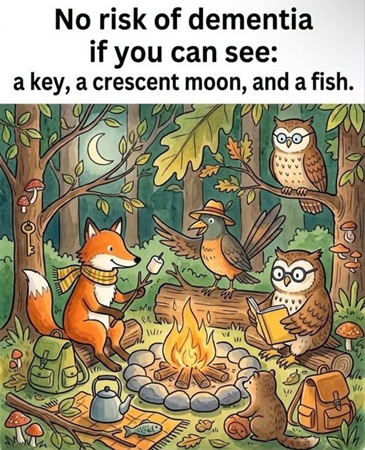
At first glance, this colorful woodland illustration looks like a peaceful scene taken straight from a children’s storybook. Several animals have gathered around a glowing campfire, surrounded by the familiar sights of a forest at night. The warm colors, playful characters, and small decorative details make the picture appear easy to understand.
But there is more to the illustration than meets the eye.
Somewhere within the scene, three objects have been cleverly hidden. A key, a crescent moon, and a fish are waiting to be discovered, and finding them requires viewers to look beyond the most obvious parts of the artwork.
The challenge seems simple when explained. After all, everyone knows what a key looks like. A crescent moon has a familiar curved shape, and a fish is usually easy to recognize. Yet when those objects are placed among animals, branches, shadows, and decorative elements, identifying them can become surprisingly difficult.
That is where the puzzle begins.
The woodland scene invites viewers to slow down and examine the illustration more carefully. Instead of focusing only on the characters, the search encourages attention to the smaller shapes scattered throughout the composition.
A detail that initially looks like part of an animal, a tree, or a decorative feature may deserve another look.
And sometimes, the object people are searching for is hiding in a place they have already examined.
The Animals Make the Search More Complicated
The illustration features several woodland animals gathered around a campfire. A fox, two owls, a bird, and a small squirrel help create the playful atmosphere of the scene.
Each animal has its own visual character.
The fox appears to be one of the most noticeable figures, drawing attention with its distinctive shape and expressive appearance. The owls add another layer of detail, while the bird and squirrel make the surrounding composition feel even more lively.
The campfire serves as a natural focal point.
Its warm appearance draws the eye toward the center of the picture, encouraging viewers to look at the animals and imagine what might be happening in the woodland gathering. It feels like a quiet evening when the forest creatures have come together before settling down for the night.
That first impression can make the hidden-object challenge more difficult.
When people look at an illustration, they often focus on the recognizable characters first. They notice faces, bodies, familiar silhouettes, and the main activity taking place. Smaller shapes can become part of the background without receiving much attention.
The puzzle takes advantage of that tendency.
The key, crescent moon, and fish are not the main characters in the scene. They are details that viewers must actively search for rather than simply notice while looking at the picture.
The longer someone studies the artwork, the more likely they may be to discover something they initially overlooked.
But finding the first object doesn’t necessarily make the remaining two any easier.
The Key May Be Hiding in Plain Sight
The first object viewers are asked to locate is a key.
Keys are familiar objects, but their appearance can vary considerably. Some have long, narrow handles and a recognizable end. Others feature rounded shapes, decorative edges, or unusual proportions.
In a hidden-object illustration, even a familiar key can become difficult to recognize when its shape blends into the surrounding artwork.
The search becomes less about identifying an object immediately and more about recognizing a shape that seems slightly out of place.
Viewers may begin examining different areas of the scene, looking for something that resembles the outline of a key. They may revisit parts of the illustration they had already checked, wondering whether a small detail they dismissed could actually be the object they need.
That process can create a moment of uncertainty.
Is the shape really a key, or is it simply part of the drawing?
Without revealing the answer, the challenge encourages viewers to compare what they see with the familiar structure of the object they are searching for. The handle, the narrow section, and the distinctive end may help guide their attention.
Still, the illustration contains plenty of other shapes.
The animals have outlines, the forest contains branches and natural forms, and the campfire adds its own collection of curves and angles. The key must be distinguished from all those surrounding details.
Some viewers may recognize it quickly.
Others may move past it several times before realizing that they were looking at the right area all along.
And after the key is found, there are still two objects waiting.
The Crescent Moon Requires a Different Kind of Attention
The second hidden object is a crescent moon.
Unlike a key, which has a more structured outline, the crescent moon is defined by its curved shape. It can appear narrow or wide, depending on how much of its circular form is visible.
That makes it an interesting target in an illustration filled with natural shapes.
The woodland scene already contains curved outlines, rounded animal features, and irregular forms. A crescent can easily blend into those details if the viewer is not paying close attention.
The search requires a different approach.
Instead of looking for a familiar object with several distinct parts, viewers need to recognize a curved shape that resembles the moon’s familiar appearance. It may be necessary to examine the spaces between larger elements rather than focusing exclusively on the animals themselves.
The eyes can sometimes become fixed on the obvious subjects.
A person may spend several seconds looking at the fox, then move toward the owls, then examine the bird or squirrel. Meanwhile, the object they are searching for may be concealed somewhere within the visual arrangement they have already passed.
That is one reason hidden-object puzzles can feel more challenging than expected.
The mind is constantly making assumptions about what belongs in the scene. When a shape appears to fit naturally into the illustration, it may not receive the same attention as something unusual or unfamiliar.
The crescent moon can remain unnoticed until the viewer begins questioning those assumptions.
Perhaps the shape that looked like an ordinary detail is not quite what it seemed.
Perhaps a second look is all that is needed.
But the final object may require even more patience.
Why the Fish May Be the Last Object Found
The fish is the third target, and it may be the object that keeps viewers searching after they have already found the key and crescent moon.
There is something interesting about searching for a fish in a woodland scene.
The setting immediately suggests animals that belong in a forest, but a fish has a different shape and is often associated with water. That contrast can make the target feel less obvious, especially when the illustration contains many unrelated visual details.
The fish’s outline is what viewers need to recognize.
A typical fish shape may include a body, a tail, and a recognizable profile, but a hidden illustration can use those familiar features in an unexpected way. The object may be small, positioned among other shapes, or incorporated into the artwork so that it doesn’t immediately look like a separate item.
The challenge is to avoid concentrating too much on the obvious characters.
Once viewers know the fish is somewhere in the picture, they may begin looking at details they previously ignored. They may examine small spaces, unusual outlines, and parts of the composition that seem less important.
That shift in attention can make the search feel different.
The key may have been recognizable because of its distinctive structure. The crescent moon may have stood out because of its curved silhouette. The fish, however, may require viewers to think about the overall shape rather than search for a realistic depiction.
It is easy to understand why someone might find two objects and then struggle with the third.
The feeling of being close to completing the puzzle can make the remaining search even more interesting. Every new detail becomes a possibility, but not every possibility is the correct one.
And that is what keeps the challenge going.
Why the First Look Can Be Misleading
The first time someone sees the illustration, their eyes naturally move toward the largest and most recognizable elements.
The animals are easy to notice. The campfire draws attention. The overall woodland setting is immediately understandable.
The hidden objects are different.
They do not necessarily stand out in the same way as the main subjects. Their purpose is to blend into the composition, creating a challenge that becomes clearer only when viewers deliberately search for them.
This is a familiar feature of visual puzzles.
People often assume that finding a hidden object will be straightforward because they already know what it looks like. But recognizing an object outside a picture and locating it inside a busy illustration are two different tasks.
When the target is surrounded by competing shapes, the viewer must separate it from the rest of the scene.
That can involve looking at the same area several times, changing the direction of the search, or briefly shifting attention away before returning to the image.
A detail that was overlooked during the first few seconds may become much easier to recognize later.
The artwork hasn’t changed.
The viewer’s attention has.
The Satisfaction of Finding One Object
There is often a small moment of satisfaction when the first hidden object becomes visible.
A viewer may have been looking around without much success, then suddenly recognize the key or crescent moon. The discovery can make the rest of the illustration seem different, as though the picture has opened up and revealed more of its details.
That first discovery also changes the search strategy.
Instead of wondering whether the objects are really there, viewers begin concentrating on the remaining targets. They know that the illustration contains concealed shapes, and the first successful find gives them a reason to continue.
However, finding one object doesn’t mean the rest will immediately appear.
The second target may be hidden in a different part of the scene, requiring another careful look. The third may be even more difficult to distinguish from the surrounding artwork.
Some people may complete the challenge quickly.
Others may prefer to take their time, looking at the illustration without rushing. The enjoyment comes from the search itself, not from competing against a clock or proving that someone can find the objects faster than another person.
There is no need to turn the puzzle into a race.
The illustration is simply an opportunity to observe, explore, and enjoy a small visual challenge.
A Puzzle That Encourages Looking Beyond the Obvious
The woodland scene offers more than three objects to search for.
It also provides a reminder of how many details can exist within a single illustration. The animals, campfire, and surrounding shapes all contribute to the composition, and the hidden objects are part of that larger visual arrangement.
Looking carefully can reveal details that were not noticed at first.
That doesn’t mean the puzzle measures intelligence, memory, or a person’s overall ability to think. It is simply a hidden-object activity, and different people may approach it in different ways.
Someone might spot the crescent moon immediately but struggle with the fish. Another person might find the key first, then spend longer looking for the other two.
Those differences are normal for a visual puzzle.
The image can be enjoyable without needing a score, a medical interpretation, or a conclusion about the person viewing it.
The challenge is to find the three objects.
Nothing more needs to be attached to that experience.
Can You Find All Three Before Looking Again?
Now that you know what to search for, take another look at the woodland illustration.
The key is somewhere within the scene.
The crescent moon is waiting to be recognized.
And the fish may be the detail that requires the most patience.
Try not to focus only on the fox, the owls, the bird, or the squirrel. Look beyond the most obvious subjects and pay attention to shapes that seem to blend naturally into the artwork.
You may find that one object appears almost immediately.
Then another becomes visible after you shift your attention.
But the final one may keep you looking a little longer.
That is the entire appeal of a hidden-object puzzle: the answer can be present in the illustration from the very beginning, yet remain unnoticed until you look at it differently.
The woodland gathering may appear simple at first.
The campfire, the animals, and the colorful details create a familiar scene. But somewhere within that same picture are three shapes waiting to be discovered.
Can you find the key, the crescent moon, and the fish?
Take your time, examine the details, and see whether you can identify all three without needing a hint.
The real reward is the moment you finally recognize the last object you had been searching for.