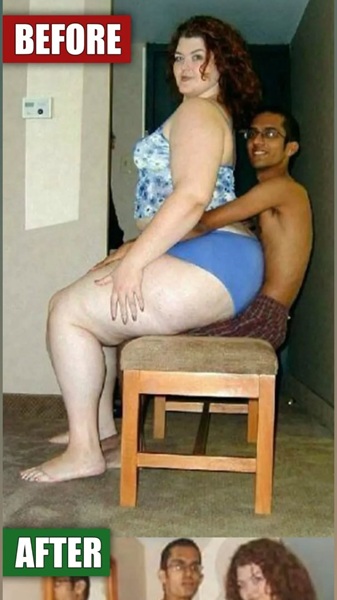
In the digital age, few images travel faster or resonate more immediately than the familiar “before-and-after” photograph.
With a simple side-by-side comparison, these visuals promise a story of change that appears clear, decisive, and complete.
On the left, there is a version of the past framed as a problem; on the right, a version of the present framed as a solution.
This visual shorthand has become a powerful form of cultural currency, widely shared across social media, advertising platforms, wellness blogs, and lifestyle content feeds.
Yet for all their impact, these images are profoundly reductive. They compress complex human lives into a single moment of contrast, offering certainty where reality is anything but simple.

At first glance, the appeal is understandable. Humans are visual beings, and we are naturally drawn to stories of transformation.
Progress, when presented in a binary format, feels comforting. It suggests that change is linear, achievable, and universally recognizable.
However, this static comparison captures only a fraction of the truth. Between those two images exists a vast, invisible landscape—a territory not defined by physical distance, but by time, effort, emotion, and resilience.
This space is where the real story unfolds, yet it remains largely undocumented and rarely acknowledged.
When we pause to look more closely, we begin to see what the camera cannot capture.
Behind every visible shift lies a quiet architecture of transformation: early mornings filled with difficult decisions, long stretches of uncertainty, repeated attempts that didn’t go as planned, and moments of doubt that arrived unannounced in the stillness of the night.
There are medical appointments that required courage, lifestyle changes that demanded patience, and small, private victories that never made it into a caption or headline.
These are not dramatic moments, but they are foundational ones. They are the substance of change, even though they resist visual documentation.

To understand what truly connects a “before” image to an “after” image, we must look beyond appearances and toward the broader context of an integrative health journey.
Change rarely follows a straight line. More often, it unfolds through a series of advances and setbacks, progress and pauses, clarity and confusion.
The individual in the “before” frame is not a failure awaiting correction, nor a project in need of repair. They are a whole person, complete with dignity, agency, and lived experience.
They carry hope, history, and resilience into every future version of themselves, even when that strength is not immediately visible.
When context is stripped away, there is a risk of turning a human life into a consumable spectacle. The image becomes content rather than testimony, something to scroll past rather than reflect upon.
In an era increasingly shaped by personalized medicine, preventive healthcare, and holistic wellness, this oversimplification does a disservice to the reality of health.
Wellbeing is not a single outcome; it is a multifaceted mosaic influenced by physical condition, mental health, emotional stability, environment, and readiness for change.
Nutrition, movement, rest, stress management, and psychological support all play interconnected roles, yet none of these elements can be adequately represented in a photograph.

Behind every visible transformation is a hidden infrastructure of internal work.
Behavioral adjustments, mindset shifts, emotional recalibration, and self-awareness are often the most decisive factors in long-term sustainability. These processes are gradual and deeply personal.
A camera may record a change in shape or posture, but it cannot document the rebuilding of self-trust, the strengthening of emotional resilience, or the quiet expansion of confidence. Mental health growth, in particular, remains largely invisible, despite being central to any lasting sense of wellbeing.
When we encounter before-and-after images in our daily feeds, we are presented with a choice in how we interpret them.
One option is to approach them with simplistic curiosity, asking what “went wrong” before or what “finally worked” after.
While often framed as concern or motivation, this line of questioning can unintentionally reinforce stigma and promote narrow definitions of success.
It suggests that bodies exist in a constant state of evaluation, and that worth is measured by proximity to an idealized outcome.
An alternative approach is one rooted in empathy and understanding. From this perspective, we recognize that health-related journeys—whether related to lifestyle changes, chronic condition management, or personal growth—are deeply private.

No individual owes the public an explanation for how their body has changed, nor do they need to justify how they exist in their own skin.
Physical appearance is influenced by countless factors, many of which are invisible, uncontrollable, or temporary. Respecting this complexity allows us to engage with these images without judgment.
True growth often happens away from public view. It unfolds during moments of relapse, where lessons are learned that perfection never teaches.
It emerges through periods of stagnation, when progress feels slow but internal foundations are quietly strengthening.
It can involve regenerative practices—not only in the biological sense, but in the emotional sense of restoring self-worth and redefining identity.
When we meet these images with shared humanity rather than clinical analysis, they shift in meaning.
They stop functioning as advertisements and begin to serve as invitations—prompts for reflection on our own nonlinear paths and evolving definitions of health.
The cultural obsession with the “after” image also tends to overlook an essential truth: change requires ongoing maintenance. The “after” is not a final destination; it is simply another point along a continuous journey.
Preventive healthcare, sustainable habits, and emotional balance require attention long after a visible milestone has been reached.
Presenting transformation as a finished product can create unrealistic expectations and emotional pressure, encouraging people to perform wellness rather than live it.

When society celebrates the “after” while quietly disparaging the “before,” it reinforces the idea that happiness, acceptance, and value are conditional.
This mindset suggests that fulfillment is a reward granted only after meeting certain aesthetic or biological benchmarks.
In doing so, it ignores a fundamental reality: the person in the first image is the one who began the journey.
They faced uncertainty, navigated the hardest days, and took the initial steps when the outcome was far from guaranteed. That version of the self deserved compassion just as much as the version that followed.
As we navigate an increasingly visual and content-driven world, the demand for innovative healthcare solutions continues to grow.
Technology, data, and personalized approaches all play important roles in shaping modern wellness.
Yet the most innovative and underutilized tool we possess remains empathy. By viewing change through the lens of comprehensive wellness, we begin to see the person behind the pixels.
The body is no longer treated as a static object to be optimized, but as a living record of adaptation, survival, and learning.
Every stage of a personal journey—the struggle, the plateau, the breakthrough—is a valid and necessary part of the narrative. Each phase contributes information, resilience, and perspective.
When we honor all versions of ourselves, we create space for a more sustainable relationship with health.
This approach aligns with the principles of precision health, which recognize that timing, context, and individual needs matter just as much as outcomes.
Ultimately, the most profound transformations often occur in invisible realms.
They take place in the heart and mind, shaping how a person relates to themselves and the world around them.
These shifts may not always produce dramatic visual contrasts, but they lead to greater stability, peace, and self-acceptance.
Whether someone is navigating lifestyle changes, managing a long-term condition, or simply seeking a healthier relationship with their body, they are engaged in a process that is both personal and meaningful.
By deconstructing the myth of the instant transformation, we create room for more honest conversations about what it truly means to be healthy.
We move away from all-or-nothing thinking and toward a more inclusive, realistic understanding of wellbeing.
When we stop viewing the “before” image as a warning or a failure, we begin to recognize the strength that was present from the very beginning.
We realize that the individual in both frames is the same protagonist—continuously adapting, learning, and persevering through circumstances we may never fully see.
As we move forward in a world saturated with visual comparisons, let us treat these digital fragments with greater care. For every pixel of progress displayed, there are countless moments of effort that remain unrecorded.
By choosing empathy over judgment, we not only change how we perceive others, but also how we relate to ourselves.
We foster a culture where growth is measured not by appearance alone, but by resilience, self-awareness, and compassion.
This is the truest story of change—a story that is never finished, always evolving, and far richer than any single photograph could suggest.
When we embrace this perspective, we open the door to a more authentic path toward optimal health—one that honors the journey as deeply as the destination, and recognizes that every version of ourselves has value, purpose, and meaning.
