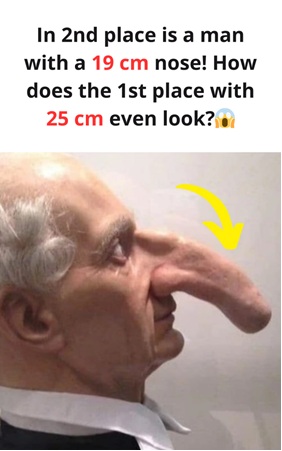
In the rolling hills and pastoral countryside of 18th-century Yorkshire, England, a man lived whose name would endure through history, not for feats of battle, scientific breakthroughs, or political leadership, but for one singular and extraordinary physical feature: his nose.
Thomas Wedders, also historically recorded as Thomas Wadhouse, is recognized as the man who holds the record for the longest nose ever documented in human history.
Measuring an astonishing 7.5 inches (approximately 19 centimeters) from bridge to tip, his nose made him a figure of curiosity, fascination, and, in some instances, satire, securing his place in historical accounts and popular culture for centuries to come.
A Remarkable Feature in an Ordinary Time
Thomas Wedders was born around 1730 in Yorkshire, England, though the exact date and details of his early life remain largely unknown. Like many individuals of his era, he came from a modest background, with little documentation preserved about his family, upbringing, or childhood experiences. The records that do survive focus almost entirely on his distinctive nasal feature.
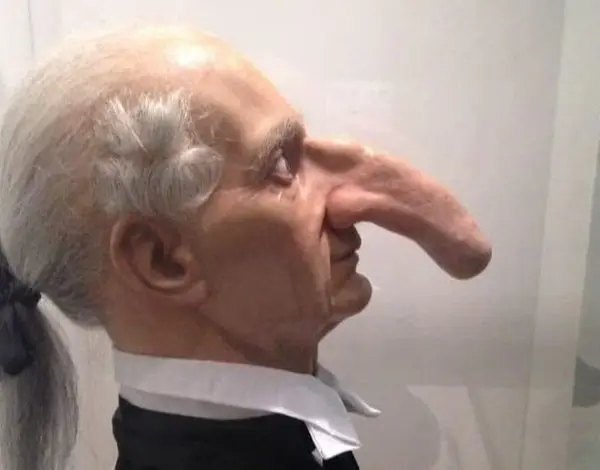
In a period when physical appearance could define social perception, Wedders’ nose was impossible to ignore. Accounts describe it as protruding far beyond what would be considered normal, dominating his facial structure, and making him instantly recognizable among those who met him.
For a society deeply interested in physical anomalies, particularly in an era where conformity was valued, this singular trait became both a marker of identity and a source of public curiosity.
In an age before photography, people relied on written descriptions and illustrations to document unusual phenomena. Wedders’ nose was consistently described in extreme detail, suggesting that while embellishment may have occurred, there was a genuine remarkable physical feature at the center of these accounts.
From Local Curiosity to Public Spectacle
During the 18th century, public exhibitions—what we might now call “freak shows”—were popular forms of entertainment throughout Europe.
Individuals with unique physical characteristics, whether due to congenital anomalies, medical conditions, or simply unusual traits, were displayed for curious audiences. Participation was often voluntary, though some were coerced or performed out of economic necessity.
Historical sources suggest that Thomas Wedders may have appeared in such exhibitions. His enormous nose would have made him an ideal candidate for public display, attracting crowds eager to witness something beyond the ordinary. Newspapers, pamphlets, and word-of-mouth stories circulated about him, sometimes humorously, sometimes mockingly.
A famous mention in The Strand Magazine in 1896, written long after his death, jokingly suggested that if greatness were measured by nose size, Wedders could have “conquered Europe.” Though satirical, such references illustrate both the fascination with his appearance and the societal tendency to reduce extraordinary individuals to a single feature.

While Wedders’ presence as a public figure is documented through secondary accounts, there is no record of his personal perspective. Whether he embraced his notoriety, resented it, or simply endured it for survival, remains a mystery.
No personal letters, diaries, or testimonials from Wedders himself have survived. His inner life—his thoughts, emotions, fears, or aspirations—remains entirely unknown, leaving historians and enthusiasts to piece together his story through the eyes of others.
Medical Mystery: Understanding the Extraordinary Nose
The question of why Thomas Wedders’ nose reached such an extraordinary length remains unresolved. No medical records from his lifetime survive, making any diagnosis speculative. Modern researchers have suggested that Wedders may have had a rare genetic or developmental condition, possibly affecting cartilage, soft tissue, or connective tissue growth.
Some have proposed rhinophyma, a condition causing abnormal enlargement of the nose, as a possible explanation, though this typically does not reach the proportions attributed to Wedders. Other hypotheses include genetic predispositions or anomalies of tissue growth, but no documented evidence confirms these theories.
An additional factor to consider is the role of exaggeration. In the 18th century, storytelling was often sensationalized to attract attention and entertain audiences. It is possible that Wedders’ nose was enlarged in descriptions over time to enhance the story for newspapers, pamphlets, or public curiosity.
However, multiple accounts consistently record its extraordinary length—7.5 inches—indicating that his nose was genuinely remarkable even if some embellishment occurred.
Rumors and speculation occasionally mention familial traits or inherited characteristics, but no records confirm whether relatives shared similar features. Whatever the cause, Wedders’ nose was a defining feature that shaped both his identity and his legacy.
A Life of Curiosity, Humor, and Satire
Despite the intrigue surrounding Wedders’ nose, little else is known about his daily life. He reportedly lived into his early to mid-50s, dying around 1780, though the cause of death is unknown. There is no known grave or memorial marking his passing, and he remains a figure known almost exclusively for a single physical attribute.
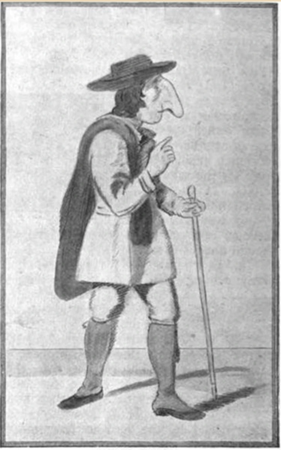
Contemporary humor and satire often surrounded Wedders’ fame. Writers and illustrators exaggerated and joked about the size of his nose, reflecting a society that both admired and mocked human oddities. Yet, the attention also ensured that Wedders’ name endured. Unlike many ordinary individuals whose lives disappeared into history, Wedders’ physical uniqueness allowed him to achieve a peculiar form of immortality.
Legacy Through Wax, Record Books, and Modern Media
Centuries after his death, Thomas Wedders’ story experienced a resurgence through wax museums, historical exhibits, and popular publications like Ripley’s Believe It or Not. These wax representations, based on historical descriptions rather than photographs, allowed modern audiences to visualize his extraordinary feature. While not entirely accurate, they preserved Wedders’ memory, introducing his story to generations far removed from 18th-century England.
In the digital age, Wedders’ fame experienced another revival. Photographs of wax figures and illustrations circulated widely on social media platforms like Reddit, where they garnered viral attention. Online audiences responded with a mix of astonishment, humor, and disbelief.
Some compared Wedders’ nose to fictional characters such as Squidward from SpongeBob SquarePants or even animals like anteaters. These reactions highlight the enduring human fascination with extremes, while also reflecting how modern perspectives blend curiosity, humor, and empathy when discussing unusual physical traits.
Comparisons to Modern Record Holders
According to Guinness World Records, Thomas Wedders remains the historical record holder for the longest nose ever documented. Modern measurements of living individuals have not approached the 7.5-inch length recorded for Wedders.
The current living record holder is Mehmet Özyürek of Turkey, whose nose measures 3.46 inches (8.8 cm) from the bridge to the tip. Özyürek’s nose was officially measured on March 18, 2010, during the Italian television program Lo Show dei Record in Rome. Unlike Wedders, Özyürek has openly discussed his experience, embracing public attention and using it to highlight individuality in a respectful manner.

Özyürek’s story offers a stark contrast to Wedders’ historical experience, reflecting societal shifts in how people with unique physical features are perceived and treated. While Wedders may have been subjected to curiosity, mockery, or involuntary public display, Özyürek enjoys personal agency and modern recognition, underscoring how cultural attitudes toward difference have evolved over time.
Historical Significance and Cultural Impact
Thomas Wedders’ story provides insight into both human biology and societal values. His extraordinary nose reminds us that the human body can produce extreme variations, whether through genetic conditions, environmental factors, or developmental anomalies. At the same time, his story illustrates how societies choose to remember individuals, often reducing them to a single defining characteristic.
Wedders’ life also sheds light on 18th-century attitudes toward physical difference. His notoriety as a “curiosity” reflects a period when public fascination with anomalies was common, and personal dignity was often secondary to entertainment and social interest. In contrast, modern perspectives increasingly recognize the importance of consent, respect, and dignity for those with unique traits, signaling a broader evolution in social values.
Beyond the Nose: Human Fascination with the Extraordinary
Although much about Wedders’ inner life remains unknown, his story continues to captivate imaginations. It reminds us that extraordinary physical traits can simultaneously inspire fascination, humor, and speculation. His life exemplifies humanity’s enduring curiosity about the unusual, a curiosity that spans centuries and continues to manifest in literature, museums, digital media, and popular culture.
The fascination with Thomas Wedders also emphasizes how narrative shapes legacy. In history, some lives are immortalized for accomplishments, influence, or intellect; others, like Wedders’, endure because a single trait captured the collective imagination. His nose became both a source of public attention and a lasting symbol, demonstrating how historical memory can hinge on what is most visible, peculiar, or sensational.
Final Reflections
Thomas Wedders never commanded armies, authored books, or held political office. Yet, through a feature as singular as it is remarkable, he achieved a form of immortality that few can claim. His life bridges centuries, connecting the 18th century to today’s digital age, demonstrating that human fascination with extremes is timeless.
More than two centuries after his death, Wedders remains present in books, museums, online forums, and record books. His story encourages reflection on curiosity, human difference, and the ways societies remember individuals.
Above all, Thomas Wedders reminds us that behind every extraordinary trait is a human being—one whose full life may never be fully known, but whose presence continues to intrigue, educate, and inspire.
From historical pamphlets to modern internet memes, from wax museum displays to Guinness World Records, Thomas Wedders’ nose has made him unforgettable. It is a testament not only to physical uniqueness but also to the enduring human impulse to notice, describe, and share stories that are remarkable, unusual, or extraordinary.
Even today, Wedders’ legacy prompts us to consider the ways we perceive difference, the histories we choose to preserve, and the humor, wonder, and empathy we bring to our understanding of human variation. In the annals of history, Thomas Wedders’ life stands as a singular, enduring reminder that sometimes, a single feature can etch a human story into memory for centuries.
