My husband died four years ago. For a long time, I believed that losing him would be the hardest thing life could ever ask me to survive. I was wrong.
Nothing prepared me for the day a doctor sat across from me, looked at my eleven-year-old son, and began explaining that he had cancer. I remember the room.
I remember the sound of the air conditioner.
I remember the doctor speaking carefully, choosing his words as though each one might break something inside me.
And I remember looking at Noah.
He was sitting beside me, swinging his legs slightly because his feet couldn’t reach the floor.
He didn’t understand everything the doctor was saying.
But he understood enough to know that something serious was happening.
On the drive home, he was unusually quiet.
Normally, Noah could talk for an entire car journey without taking a breath. He had questions about everything, made jokes about things nobody else noticed, and somehow managed to turn even an ordinary trip to the grocery store into an adventure.
That afternoon, he simply looked through the window.
When we reached our house, he finally spoke.
“Mom?”
“Yes, sweetheart?”
“Am I going to get better?”
I held the steering wheel tightly.
“We’re going to listen to the doctors, follow the treatment plan, and take things one day at a time.”
He nodded.
Then he looked at me.
“Because I have plans.”
I tried to smile.
“What kind of plans?”
“Lots.”
He counted on his fingers.
“First, I need to see the ocean. Second, I need to learn how to make pancakes without burning them. Third, I need to find out who keeps stealing my socks.”
I laughed.
And then, when he looked away, I cried.
Noah was eleven when treatment began.
He turned twelve in a hospital room.
I bought cupcakes from the cafeteria because I wanted his birthday to feel like a birthday, even if we couldn’t celebrate at home.
The frosting was bright blue.
The candles were small.
And the little plastic decorations kept falling off.
Noah examined the first cupcake carefully.
“Mom, this frosting tastes like toothpaste.”
I stared at him.
“Then why are you eating it?”
He shrugged.
“Because it’s my birthday.”
Then he took another bite.
He finished one cupcake and asked for a second.
That was Noah.
Even when he was frightened, he could find something ridiculous to say.
He could make me laugh when I thought I had forgotten how.
Later that evening, he looked at me from his hospital bed.
“Mom, I have to get better.”
I moved my chair closer.
“Why’s that?”
He gave me a serious expression.
“Who else will leave dirty socks everywhere?”
I laughed so hard that I nearly spilled my water.
Then I stepped into the hallway and cried.
He never saw that part.
At least, I hoped he didn’t.
The weeks that followed became a routine I never wanted to learn.
There were appointments, tests, conversations with doctors, and long periods of waiting.
Some mornings, Noah woke up hungry and asked for pancakes before I had even opened my eyes.
Other mornings, he barely touched breakfast.
I learned not to take the good mornings for granted.
When he wanted to joke, I joked with him.
When he wanted silence, I sat beside him.
When he was tired, I tried to make the room as comfortable as possible.
I brought his favorite blanket from home.
I placed photographs near his bed.
And I found a small drawing of the ocean that he had made before his diagnosis.
It showed a blue sea, a yellow sun, and a tiny boat.
The waves were much larger than the boat.
Noah had drawn himself standing on the shore.
He had never seen the ocean in person.
Sometimes, he would stare at the picture and ask me questions.
“Mom, are waves really that loud?”
“I think they can be.”
“Can you hear them from far away?”
“Sometimes.”
“What if you’re standing right beside them?”
I smiled.
“Then you probably hear a lot of water.”
He laughed.
He wanted to know whether the sand was warm, whether the water was cold, and whether seagulls really stole people’s food.
I promised him that, when circumstances allowed, we would try to visit the ocean.
He kept the drawing beside his bed.
It became one of the things he looked at whenever the hospital felt too unfamiliar.
Then one afternoon, a volunteer visited his room.
She carried a folder and wore a cheerful expression.
She introduced herself and explained that she worked with an organization that helped children facing serious illnesses experience meaningful wishes.
Noah immediately looked suspicious.
“Does this involve another needle?”
The volunteer laughed.
“Not this time.”
“Good. Because I’m getting tired of those.”
She pulled a chair closer and explained how the program worked.
Children who met the organization’s eligibility requirements could share something they hoped to experience.
The organization would then work with the family and its partners to determine what could safely and realistically be arranged.
Noah listened carefully.
I expected him to ask for the beach.
I expected him to choose a trip, a special day, or something he had talked about for months.
Instead, he asked a question that made the volunteer stop writing.
“Could I buy dinner for people?”
She tilted her head.
“What kind of dinner?”
“For people who don’t have enough food.”
I looked at him.
“Noah?”
He pulled his blanket over his knees.
“Not sandwiches in bags.”
He glanced toward the ocean drawing.
“I mean a proper dinner.”
The volunteer smiled.
“Tell me more.”
“With tables and chairs. Real plates. Food that is warm.”
He paused.
“And dessert.”
I stared at my son.
“Noah, sweetheart, this is your wish.”
“I know, Mom.”
“You could choose something just for yourself.”
He shrugged.
“People do stuff for me every day.”
He looked toward the IV pole beside his bed.
“Doctors help me. Nurses help me. You stay here with me. People bring me things.”
He paused again.
“I want to do something for somebody else.”
The volunteer looked at him for a moment.
Then she gently asked how many people he hoped to feed.
Noah considered the question.
“As many as we can.”
It wasn’t a number.
It wasn’t a detailed plan.
But it was the beginning of something.
The following days brought conversations with the organization and a local community outreach program.
The adults discussed practical details.
They needed a suitable location, a kitchen, enough volunteers, and a way to prepare and serve the food safely.
Noah was involved in the decisions that he could reasonably help with.
He wanted macaroni and cheese.
He wanted roasted chicken.
He wanted warm bread.
And he absolutely insisted on chocolate cake.
The coordinator explained that the community center had a dining hall large enough to host a substantial gathering.
With the available kitchen facilities and enough volunteers, they believed they could organize several servings and work toward a target of 300 guests.
When Noah heard the number, his eyes widened.
“Three hundred?”
The coordinator nodded.
“That’s the number we’re planning around.”
Noah smiled.
“Then we need really good food.”
He immediately started suggesting additions to the menu.
He also wanted yellow napkins.
When I asked why yellow, he answered without hesitation.
“White looks like hospital paper.”
I understood.
For once, our conversations were not about appointments or treatment schedules.
They were about dinner.
They were about how many tables the hall could hold.
They were about whether chocolate cake should be served before or after the coffee.
And they were about a little boy who wanted to make sure strangers felt welcome.
But during the planning process, I began noticing something unusual.
Noah kept checking his backpack.
He carried a small keepsake box inside it.
Whenever I came close, he would close the zipper.
At first, I thought he was keeping a drawing or a birthday surprise.
One afternoon, I asked him directly.
“What are you hiding?”
“Nothing.”
“Then why are you guarding that backpack like it’s full of treasure?”
He grinned.
“Maybe I’m planning your birthday.”
“My birthday is six months away.”
“Exactly. I’m organized.”
I laughed.
But he still didn’t open the bag.
Noah was able to return home between appointments.
Those days were precious.
He slept in his own bed.
He sat on the couch with his favorite blanket.
He complained about the television remote and asked for food that didn’t come on a hospital tray.
The planning for the dinner continued over several weeks.
The adults handled the kitchen arrangements, food preparation, allergy information, and serving schedule.
Noah focused on the details he loved.
He chose the napkin color.
He asked whether there would be enough chairs.
He wanted a place where people could sit comfortably and talk rather than simply collect a meal and leave.
During one planning visit, the kitchen manager asked me to review some forms.
She needed information about food restrictions and the arrangements for serving guests.
I followed her toward the counter.
Noah stayed near the coordinator.
His backpack rested between his shoes.
While the manager explained the final details, I glanced back across the room.
Noah was showing the coordinator something from his little box.
She listened carefully.
Then she opened a folder and wrote something down.
I couldn’t hear their conversation.
When I returned, Noah quickly closed his backpack.
“What did I miss?”
He adjusted the strap.
“Napkin business.”
The coordinator smiled.
“Very confidential napkin business.”
I looked between them.
“Should I be concerned?”
“Absolutely,” Noah said, trying not to laugh.
I assumed they were planning another small surprise.
But later, on the drive home, Noah was unusually quiet.
He held the backpack close to his body.
I asked whether he was tired.
“A little.”
I reached over and touched his shoulder.
“Are you sure you’re still comfortable with the dinner? We can change the plans if you need to.”
He shook his head immediately.
“Don’t cancel it, Mom.”
“I wasn’t going to.”
“Promise?”
“I promise.”
He relaxed slightly.
But he still didn’t explain what he had shown the coordinator.
At his next appointment, we discussed the planned event with his medical team.
The doctors and nurses considered his current condition and the arrangements being proposed.
The plan included precautions.
Noah would avoid crowded serving areas.
He wouldn’t handle hot food or heavy trays.
He would have a place to rest.
And we would leave if he became too tired or uncomfortable.
Noah listened to the discussion.
Then he raised his hand.
“Can I still distribute napkins?”
The nurse smiled.
“With the precautions we’ve discussed, we can plan a safe way for you to help.”
Noah looked at me.
“Official napkin manager.”
I laughed.
“That’s a very important position.”
“I know. It requires serious training.”
He then pulled a folded piece of paper from his blanket.
I noticed that it looked old.
One corner had a faint brown stain.
When he saw me looking, he quickly tucked it away.
“What’s that?”
“Just something I kept.”
“From where?”
He hesitated.
“A long time ago.”
Before I could ask another question, his phone rang.
He looked at the screen.
Then he answered.
“Hi, Daniel.”
I stopped moving.
I had never heard that name before.
Noah lowered his voice.
I stepped into the kitchen area to give him some privacy.
Still, I heard one sentence.
“Please don’t tell my mom yet.”
My hand stopped against the counter.
I waited.
Then he spoke again.
“I want to do it myself.”
He laughed nervously.
“Yeah, I know.”
When he finished, I returned to the room.
“Who’s Daniel?”
Noah rubbed his forehead.
“A guy from the outreach program.”
“Why haven’t I met him?”
“You might.”
“Is everything okay?”
He nodded.
“Yes.”
“Then why does he need to keep secrets from me?”
Noah looked down.
“I just want to explain something myself.”
I sat beside him.
“Sweetheart, you don’t have to handle anything alone.”
He reached for my hand.
“I know.”
Then he added:
“Please don’t cancel the dinner.”
I squeezed his fingers.
“I won’t cancel it just because you have a surprise.”
He smiled.
But the little box stayed hidden.
The morning of the dinner arrived.
Noah woke earlier than usual.
He had barely slept.
I hadn’t slept much either.
He chose his favorite blue sweatshirt and checked his backpack three times.
“Do you have everything?” I asked.
“Probably.”
“Water bottle?”
“Yes.”
“Your comfortable shoes?”
“Yes.”
“Anything else?”
He thought for a moment.
“My extremely important napkin manager badge.”
I raised an eyebrow.
“Do you actually have one?”
He grinned.
“Not yet.”
I kissed his forehead.
He tolerated it for approximately two seconds before pretending to be annoyed.
Then we drove to the community center.
When we arrived, volunteers were already working.
Some were arranging tables.
Others were checking the kitchen supplies and preparing the serving area.
The smell of warm bread filled the entrance.
Large trays were being organized behind the counter.
Noah stopped just inside the doorway.
He looked around.
There were rows of tables.
There were yellow napkins.
There was a dessert station.
And there were people working together to make his wish possible.
“All this?” he asked.
The coordinator approached us.
“All this.”
Noah looked at the tables again.
“That’s a lot of people.”
“It is.”
He smiled.
Then he checked his phone.
I noticed.
He looked toward the entrance.
Then he put the phone away.
I didn’t ask.
Not yet.
The first guests arrived shortly afterward.
Some came alone.
Others arrived with family members or friends.
A few were older adults who greeted the volunteers by name.
Some guests looked tired after long days.
Others seemed pleased simply to have a warm meal and a place to sit.
Noah watched as the room slowly filled.
He wasn’t responsible for serving hot food or carrying trays.
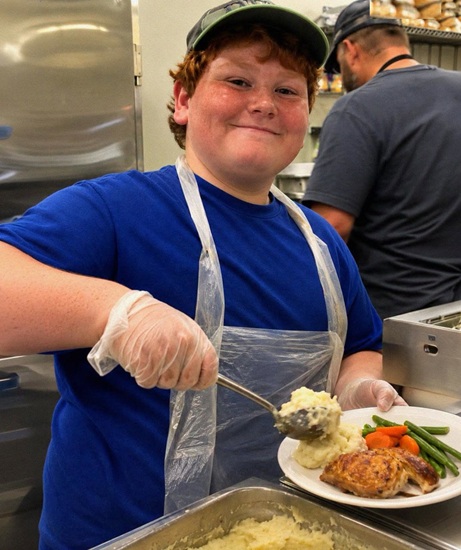
Instead, he helped at a separate station where the volunteers had placed the napkins.
He arranged them carefully.
Then he rearranged them.
I watched him straighten a stack for the third time.
“Are they not straight enough?” I asked.
“They need to look welcoming.”
“They’re napkins, sweetheart.”
He gave me a serious look.
“Exactly. Important napkins.”
An older guest approached the station.
She smiled at him.
“Are you in charge of these?”
Noah nodded proudly.
“Officially.”
She picked up two.
“Then I need to thank you.”
He smiled.
“You’re welcome.”
She looked at the dining hall.
“This is a lovely thing you’re doing.”
Noah shrugged.
“Everyone should get dinner.”
The woman nodded.
“That’s a good thought.”
Then she continued toward her table.
Noah watched her sit down.
For a moment, he looked satisfied.
Then he went back to arranging the napkins.
The volunteers continued serving the food.
The kitchen team worked steadily, and the coordinator kept checking that everything was running smoothly.
Whenever the room became crowded, Noah stepped away to rest.
He complained occasionally.
He wanted to do more.
But I reminded him that the event was already happening because he had brought everyone together.
He didn’t have to exhaust himself to prove anything.
Eventually, he accepted a small piece of chocolate cake.
“Quality control,” he explained.
I shook my head.
“Of course.”
He took another bite.
“Excellent quality.”
I laughed.
But even while he was eating, he kept glancing toward the entrance.
It happened several times.
He would look toward the doors, then return his attention to the guests.
Finally, I asked.
“Are you expecting somebody?”
He shrugged.
“Maybe.”
“Someone from the program?”
“Something like that.”
I decided not to push him.
As the afternoon continued, more guests arrived.
The volunteers kept the serving process organized.
People found seats.
The kitchen team prepared the next trays.
The dining hall became filled with conversation.
Noah watched the guests.
He seemed particularly happy whenever someone returned to the dessert table.
At one point, a little girl approached him.
She was holding a plate with a piece of cake.
“Did you choose this?”
Noah nodded.
“Yes.”
She smiled.
“It’s my favorite.”
He looked delighted.
“Mine too.”
She thanked him and walked back toward her family.
Noah watched her for a moment.
Then he turned toward me.
“That was good, right?”
“Very good.”
He smiled.
After another break, he returned to the napkin station.
He was getting tired.
I could see it in the way he moved and how often he leaned against the table.
But he still wanted to know how many guests had been served.
The coordinator checked the count.
“Two hundred and eighty-five so far.”
Noah looked at the remaining tables.
“Almost there.”
“We’re getting close.”
He nodded.
Then he took a sip of water.
The final guests arrived.
The volunteers served the remaining meals.
The kitchen team checked the last trays.
And eventually, the coordinator approached Noah with a smile.
“We’ve reached our target.”
Noah looked up.
“Three hundred?”
“Three hundred guests served.”
His face changed.
He smiled so widely that I felt tears gather in my eyes.
“Exactly three hundred?”
“Exactly.”
Noah leaned against my shoulder.
“Did we do good, Mom?”
I kissed the top of his head.
“We did wonderful, sweetheart.”
He yawned.
“Can I have more cake?”
“After some water.”
He groaned.
“You’re impossible.”
I handed him his bottle.
He drank.
Then his fingers returned to the zipper of his backpack.
I watched him for a moment.
Something was still waiting inside that little box.
And I had a feeling it was connected to the person he kept expecting.
The volunteers began cleaning the tables.
Some guests stayed to talk.
Others thanked the kitchen staff before leaving.
The coordinator approached us with a clipboard.
She congratulated Noah and told him how much the volunteers appreciated his idea.
He smiled politely.
Then he looked toward the entrance again.
This time, he stopped moving.
A man had just walked into the community center.
He wore a dark suit and a long black coat.
He stood near the doorway, looking across the dining hall.
He appeared to be searching for someone.
Then his eyes settled on Noah.
He began walking toward us.
I noticed my son’s expression change.
The color seemed to drain from his face.
His fingers tightened around the backpack strap.
“Mom?” he whispered.
I turned toward him.
“What’s wrong?”
He didn’t answer.
The man stopped beside our table.
“Clarice?”
I stood.
“Yes?”
“My name is Daniel.”
Noah gripped his backpack more tightly.
I looked at him.
Then I looked back at the stranger.
“Is everything okay?”
Daniel raised both hands slightly.
“Yes. Noah isn’t in trouble. I promise.”
That didn’t make me feel any less confused.
He glanced at my son.
Then he looked at me.
“He hasn’t told you the whole story, has he?”
I pulled out the chair beside Noah.
“What story?”
Daniel looked toward the little backpack.
Then he asked whether he could sit down.
I nodded.
He took the chair across from us.
For a few seconds, nobody spoke.
Then he said something I hadn’t expected.
“Do you remember a man who shared his sandwich with you in a park?”
I felt my fingers tighten around the edge of the table.
A memory returned.
A cold afternoon.
A wooden bench.
A hungry little boy.
And a stranger wearing a worn brown jacket.
I looked at Daniel.
“Michael?”
Daniel nodded.
“He was my older brother.”
Four years earlier, our lives had been very different.
My husband had recently died.
I was trying to manage the household, care for Noah, and work enough hours to keep us financially stable.
There were days when I felt as though I was doing everything at once.
And there were days when I simply didn’t know how we would manage the following week.
One afternoon, I took Noah to a park.
It was cold.
He had been hungry for hours, and I had packed him the last sandwich I had been able to prepare.
I told him I had already eaten.
He was eight years old.
He looked at the sandwich.
Then he looked at me.
“Are you sure?”
I smiled.
“Absolutely.”
He started eating.
I watched him carefully, trying not to let him notice that I was hungry too.
Then a stranger approached the bench.
He wore a brown jacket that looked old and worn.
He carried a small bag and appeared to have been walking for some time.
He stopped nearby.
“Hello,” he said.
I nodded politely.
He looked at Noah.
Then he looked at the sandwich.
Without making a big deal of it, he asked whether we would like to share some food.
I immediately refused.
“That’s very kind, but we’re fine.”
He didn’t argue.
He simply sat at the other end of the bench and took out a sandwich of his own.
“My name’s Michael,” he said.
He mentioned that he volunteered at a community outreach center.
Then he broke his sandwich in half.
He placed one portion between us.
“There’s enough.”
I tried to refuse again.
But he didn’t make me feel embarrassed.
He didn’t ask why I needed help.
He didn’t ask about my circumstances.
He simply offered food.
Eventually, I accepted.
Noah ate his portion.
And I ate mine.
Michael talked to Noah about school.
He asked whether he liked drawing.
Noah told him about a picture he had made of the ocean.
Michael listened as though it were the most interesting story he had heard all day.
Before leaving, he told us that the outreach center served meals to people who needed them.
He said we were welcome to visit.
Then he walked away.
I never forgot him.
But I never saw him again.
The following day, I packed an extra lunch.
I returned to the park, hoping to find him.
He wasn’t there.
I came back another afternoon.
Again, the bench was empty.
I didn’t know his full name.
I didn’t have his phone number.
And I didn’t know how to contact the outreach center.
But I remembered his kindness.
At the community center, Noah slowly opened his backpack.
He took out the small keepsake box.
He placed it on the table.
Then he looked at me.
“Mom, there’s something I never told you.”
My heart began beating faster.
He opened the lid.
Inside was a folded paper napkin.
It had been kept inside a clear plastic sleeve.
The edges were yellowed.
One corner had a faint brown stain.
I stared at it.
Noah touched the plastic gently.
“Remember the park, Mom?”
I nodded slowly.
“Of course.”
He looked down.
“Michael gave us this.”
I looked at the napkin.
Then I looked at Daniel.
“Where did you get it?”
Noah answered.
“I kept it.”
I turned toward him.
“You kept that all these years?”
He nodded.
“I put it in my box after we came home.”
I felt tears gather in my eyes.
“Why didn’t you tell me?”
He shrugged.
“You looked sad enough already.”
I reached across the table and held his hand.
He continued.
“I remembered that day. I remembered you saying you weren’t hungry.”
I tried to speak.
He gently squeezed my fingers.
“I knew you were hungry, Mom.”
I pulled him closer.
For a moment, I couldn’t say anything.
Then he whispered:
“That’s why I picked the dinner.”
I closed my eyes.
He had remembered that afternoon for four years.
And I had never known how deeply it had stayed with him.
Daniel waited quietly.
When Noah finally sat back, Daniel began explaining.
“Michael was my older brother. He spent several years volunteering with community organizations.”
He looked around the dining hall.
“He believed that people should be able to sit down and eat without feeling embarrassed about needing help.”
Daniel explained that Michael had experienced financial difficulties himself.
At one point, he had lost his apartment and needed temporary housing.
He knew what it felt like to be uncertain about where the next meal would come from.
He also knew how difficult it could be to accept help.
But he never wanted people to feel ashamed.
After eventually finding more stable housing, he continued volunteering.
He returned to the outreach center whenever he could.
He helped organize meals.
He carried supplies.
He spoke with guests.
And he often remembered the people he had met.
Daniel glanced at the napkin.
“I never knew he had kept this particular memory.”
I looked at him.
“Michael gave it to Noah?”
Daniel nodded.
“That’s what Noah told the coordinator.”
Then he explained how they had met.
During one of the planning visits, Noah had mentioned the man who once shared his sandwich with us.
The coordinator recognized the name of the outreach center.
She contacted Daniel through the program’s community network.
After that, she arranged a conversation between him and Noah.
Daniel said he had been surprised when he heard the story.
He had known that Michael volunteered in the park and at the community center.
But he hadn’t known about the sandwich.
And he certainly hadn’t known that a child had kept a napkin from that afternoon for four years.
I looked at Noah.
“Why didn’t you tell me about the phone call?”
He lowered his eyes.
“I wanted to surprise you.”
Daniel smiled gently.
“He asked me not to say anything until he was ready.”
I looked at the man in the black coat.
“Why did you come today?”
Daniel glanced toward the tables.
“Because I wanted to see the dinner Noah had planned. And because I wanted to tell him something about Michael.”
He paused.
Then his expression became more serious.
“Michael died last year.”
My eyes lowered.
“I’m sorry.”
Daniel nodded.
“Thank you.”
He looked toward the napkin again.
“He was very important to me.”
I imagined the man in the brown jacket sitting on that park bench.
I imagined him sharing a sandwich with a mother and her young son.
I imagined him walking away without knowing how much that small act would mean years later.
Then Daniel said something that made me look up.
“I never knew about that sandwich. But I think Michael would have been deeply moved by what Noah did today.”
Noah looked at him.
“Really?”
Daniel nodded.
“He spent a lot of time helping people. I think he would have been proud to see someone remember that kindness and pass it along.”
Noah looked down at his backpack.
Then he asked:
“Can I ask you something?”
“Of course.”
“Did Michael like chocolate cake?”
Daniel laughed softly.
“He absolutely did.”
Noah smiled.
“Good. Then he would’ve liked the dinner.”
I thought the story had reached its end.
But Daniel still had something in his coat pocket.
He reached inside and carefully removed a small handwritten recipe card.
The paper was slightly worn.
There were pencil marks along the edges.
“Michael used this when he volunteered,” Daniel explained.
He handed it to Noah.
My son studied the writing.
“What is it?”
“A simple sandwich recipe.”
Daniel pointed to the ingredients.
“Michael liked making sandwiches for people. He used to say that food didn’t need to be complicated to make someone feel welcome.”
Noah read the card carefully.
“Does it have mustard?”
Daniel laughed.
“No. Michael hated mustard.”
Noah nodded seriously.
“He had excellent taste.”
For the first time since Daniel arrived, I laughed.
The three of us sat quietly for a moment.
Then Daniel looked around the dining hall.
He thanked the volunteers.
He thanked the coordinator.
And he thanked Noah for allowing him to be part of the day.
Before leaving, he asked whether he could take a photograph with Noah.
Noah agreed.
They stood beside the yellow napkin station.
I took the picture.
My son held the old recipe card.
Daniel stood beside him, smiling.
When the photograph was finished, Noah asked one final question.
“Will you come back?”
Daniel nodded.
“If the program organizes another event, I’d be happy to visit.”
Noah smiled.
“Maybe we can make sandwiches next time.”
Daniel looked at the recipe card.
“I think Michael would approve.”
Then he shook Noah’s hand.
And he left.
A few weeks later, Noah had another hospital appointment.
The day was tiring.
There were conversations with the medical team and the usual waiting.
When we finally returned home, he asked for a sandwich.
I looked at him.
“Just a sandwich?”
“Yes.”
“After everything you’ve been through today?”
He nodded.
“But it has to be a good one.”
I smiled.
“Of course.”
We took out the recipe card Daniel had given him.
Noah examined the ingredients.
He immediately noticed something.
“Too much mustard.”
I laughed.
“Michael didn’t even like mustard.”
“Then why would anyone put it in?”
We made a simple sandwich together.
I prepared the ingredients while Noah helped with the parts he could comfortably manage.
When we finished, he took a bite.
He thought about it.
Then he nodded.
“Not bad.”
“High praise.”
He smiled.
I packed another sandwich separately.
Noah watched me close the container.
“Who’s that for?”
I placed it in the refrigerator.
“For the outreach program, if they can accept it.”
He nodded.
“We should ask what they need before making more.”
I looked at him.
“That’s a good idea.”
He stared at the recipe card for a moment.
Then he said:
“Michael only gave us half.”
I sat beside him.
“Yes, sweetheart.”
“It was enough that day.”
I put my arm around his shoulders.
“It was.”
He looked at the old napkin inside its plastic sleeve.
Then he looked at me.
“Do you think he knew we remembered?”
I swallowed.
“I don’t know.”
Noah nodded.
“I hope he did.”
The following week, we contacted the outreach program to ask whether they were accepting prepared food donations.
The coordinator explained the rules and suggested ways families could support future meal events.
We agreed that any food contributions would follow the program’s requirements.
Noah wanted to help again, but we discussed doing so in a way that respected his energy and medical needs.
He understood.
He didn’t need to be the person carrying every tray.
He didn’t need to stand for hours.
And he didn’t need to prove how much he cared by making himself exhausted.
He had already done something meaningful.
One evening, I found him sitting at the kitchen table.
The recipe card was in front of him.
The old napkin was beside it.
He was writing something on a small piece of paper.
“What are you working on?”
He covered it with his hand.
“Nothing.”
I smiled.
“Still keeping secrets?”
“Maybe.”
He finished writing and folded the paper.
Then he placed it inside his keepsake box.
I didn’t ask him to show me.
Some things belonged to him.
But before closing the box, he looked up.
“Mom?”
“Yes?”
“Can we keep making dinners?”
I moved my chair closer.
“We can talk to the outreach team and see what they need.”
He nodded.
“Not because I have to.”
“I know.”
“Just because I want to.”
I kissed his forehead.
“That’s a wonderful reason.”
He closed the box.
And for the first time, I understood why he had chosen that wish instead of the ocean.
He hadn’t forgotten his own dreams.
He still wanted to see the waves.
He still wanted to stand on the beach and find out whether they were as loud as he imagined.
He still wanted to make pancakes without burning them.
And he still wanted to discover who kept stealing his socks.
But somewhere along the way, he had learned something from a stranger on a park bench.
A person didn’t need to change someone’s entire life to make a difference.
Sometimes, a simple meal was enough to make a difficult afternoon feel less lonely.
Sometimes, a person who had very little could still offer something meaningful.
And sometimes, the smallest act of kindness stayed with someone for years.
Noah had used his special wish to feed 300 people.
But the story behind that wish had begun with one sandwich, one park bench, and a man who had shared what he had.
I still don’t know whether Michael ever realized how much that afternoon meant to us.
I wish I could tell him.
I wish I could thank him for seeing a hungry little boy and a tired mother without making either of us feel ashamed.
But I can tell his brother.
And I can help Noah keep passing that kindness forward.
The old napkin remains in its plastic sleeve.
The recipe card sits beside it.
And the ocean drawing is still near Noah’s bed.
One day, when circumstances allow, I hope we will stand beside the sea together.
I imagine Noah listening to the waves.
He will probably complain that they are too loud.
Then he’ll ask for something to eat.
And I know what I’ll do.
I’ll pack an extra sandwich.
Because four years ago, a stranger shared half of his.
And my son never forgot.