For two years, my daughter asked me the same question. “Mommy, why doesn’t Daddy call me anymore?” And for two years, I struggled to find an answer that wouldn’t break her heart.
Sometimes I told her that her father was going through a difficult time. Sometimes I said he needed to get better before he could visit. On the hardest days, I simply held her and hoped she would stop asking.
But children don’t forget the people they love.
And Maisie never forgot her father.
Two years earlier, my husband, Russell, had stood in our kitchen and told me he needed a break.
It was an ordinary evening. The dishes from dinner were still on the counter, Maisie’s schoolbag was lying beside the refrigerator, and a small drawing she had made that afternoon was held to the fridge by a colorful magnet.
Russell stood near the kitchen table, staring at a cup of coffee that had already gone cold.
He looked exhausted.
Not angry. Not particularly upset.
Just distant.
“I need some space to figure things out,” he finally said.
I remember putting down the dish towel in my hands.
“What do you mean, space?”
He rubbed his forehead.
“I don’t know how to explain it.”
“Is there someone else?”
“No.”
“Did I do something?”
He shook his head.
“No, honey. This isn’t about something you did.”
I waited for him to say more.
He didn’t.
I asked whether he wanted us to go somewhere together, talk to someone, or take a few days away from our normal routine.
He kept saying the same thing.
“I just can’t do this right now.”
Before I could ask another question, little footsteps came running down the hallway.
Maisie appeared in the doorway holding her stuffed bunny.
She was six years old, wearing her favorite pajamas, and one of the bunny’s ears had started coming loose.
“Daddy! Can you fix Bunny?”
Russell immediately changed his expression.
He crouched down, took the toy from her, and examined the stitching.
“I think Bunny needs a little repair.”
Maisie giggled.
“He’s been broken for a long time.”
“I’ll take care of him.”
Russell kissed her forehead and handed the toy back.
Then he told her something that neither of us understood the importance of at the time.
“I’ll see you soon, sweetheart.”
He picked up his jacket.
And he walked out.
I watched him disappear down the driveway, expecting him to turn around.
He didn’t.
At first, I believed he would come back after a few days.
I thought he needed time to clear his head, and I tried not to make the situation worse by calling constantly.
For the first few weeks, he answered.
He told me he was staying with a friend and wasn’t ready to discuss everything.
When I asked whether Maisie could visit him, he always had a reason why it wasn’t possible.
Sometimes he said he was busy.
Other times he said he wasn’t feeling well.
He promised he would arrange something soon.
But soon never came.
His messages gradually became shorter.
Then the calls became less frequent.
Eventually, my phone would ring until the call went straight to voicemail.
I began leaving messages.
I asked him to call me back.
I told him Maisie missed him.
I explained that she was beginning to notice his absence and that I didn’t know what to tell her.
Most of the time, I received no response.
Then one night, something happened that I still remember more clearly than almost anything else from those first months.
Maisie climbed into my bed after I had turned off the lights.
She carried Bunny under one arm and rubbed her eyes with the other hand.
“Mommy?”
“Yes, sweetheart?”
“Does Daddy not love me anymore?”
I felt my chest tighten.
I moved closer and wrapped my arms around her.
“Of course Daddy loves you.”
She looked at me.
“Then why doesn’t he call?”
I opened my mouth.
Nothing came out.
I wanted to tell her that everything would be fine. I wanted to promise that he would call the following morning and that she would soon see him again.
But I had already made too many promises I couldn’t control.
So I kissed her forehead and held her until she fell asleep.
The following morning, I began making calls.
I contacted Russell’s friends.
I called people he had worked with.
I even contacted his brother, Paul, hoping someone could explain what was happening.
Most people gave me vague answers.
Paul was the only one who seemed to know more.
“Russell is safe,” he told me during one conversation. “He’s dealing with something, and he needs time.”
“Time for what?” I asked.
Paul paused.
“I can’t explain everything.”
“He’s my husband, Paul. And he’s Maisie’s father. I think I deserve to know whether he’s all right.”
“I understand.”
“Then tell me where he is.”
“I can’t.”
I was furious.
I asked him to at least pass along a message.
“Tell Russell that Maisie is asking for him. Tell him she wants her father.”
Paul promised he would.
But nothing changed.
Months passed.
I continued working, paying the bills, preparing school lunches, attending parent meetings, and trying to make our home feel normal.
I learned how to answer difficult questions without letting my own fear show.
I learned how to smile when Maisie asked whether Daddy might come to her birthday.
And I learned how painful it could be to watch a child slowly stop expecting something she once believed was guaranteed.
Her seventh birthday arrived.
She had a small celebration with a few friends.
There were balloons, a cake, and colorful decorations around the living room.
She received presents from relatives and classmates.
But there was no card from Russell.
For the first time, Maisie didn’t ask me several times whether her father had sent something.
She simply looked at the front door once or twice.
Then she went back to playing.
That quiet acceptance hurt more than her questions ever had.
I thought the hardest part might finally be behind us.
I was wrong.
Last week, Maisie came home from school holding a pink flyer.
She was smiling before she even reached the kitchen.
“Mommy! Look!”
I dried my hands and took the paper.
Her school was organizing a special father-daughter ballet performance.
The children would learn a short routine and perform it with their fathers or another trusted adult.
There were pictures of little girls wearing pink tutus and adults holding their hands.
Maisie pointed at one of the pictures.
“That’s what we’re going to do!”
I smiled.
“It looks beautiful.”
She looked at me for a moment.
Then she asked the question I had been dreading.
“Can Daddy come? Just this once?”
I looked down at the flyer.
I knew how much this mattered to her.
I also knew how many times Russell had failed to appear.
But I couldn’t bring myself to tell her that he probably wouldn’t come.
“I’ll try to reach him,” I said.
She hugged the flyer against her chest.
“Maybe he can dance with me.”
“I’ll do my best, sweetheart.”
That evening, I called Russell.
No answer.
I tried again the following morning.
Still nothing.
Over the next several days, I called seventeen times.
I left messages explaining the date, the time, and the importance of the performance.
I told him Maisie had been practicing.
I told him she wanted him there.
I even sent a photograph of the flyer.
Nothing.
I began wondering whether I should tell Maisie to choose another adult.
Her teacher had already offered that option.
She explained that some children might prefer to dance with a teacher, relative, or another trusted person if their father couldn’t attend.
I appreciated her kindness.
But Maisie was determined.
“I want Daddy,” she told me.
“He used to dance with me in the living room.”
I remembered those evenings.
Russell would put on music, pick her up, and spin her carefully while she laughed.
Sometimes he would pretend to forget the steps just to make her giggle.
She remembered those moments.
And she wanted another one.
The night before the performance, Maisie placed Bunny beside her bed.
She had tied a small pink ribbon around his neck.
I asked why.
She smiled.
“Because he’s coming with me.”
I sat on the edge of her bed.
“Are you excited?”
She nodded.
Then she said something that made me turn away for a moment.
“Maybe Daddy will recognize me if I wear his favorite color.”
She had chosen pink because Russell used to tell her that she looked beautiful in it.
I kissed her forehead and promised to help her get ready in the morning.
But after I left her room, I sat alone at the kitchen table for a long time.
I wondered whether I should call Paul again.
I wondered whether Russell would even remember the performance.
And I wondered how I would explain another disappointment to a little girl who had already waited two years.
The morning arrived.
Maisie woke up earlier than usual.
She was excited.
She put on her pink tutu, carefully arranged her hair, and asked me to help tie a ribbon around Bunny’s neck again.
She checked her reflection several times.
“Does it look okay?”
“It looks wonderful.”
“Do you think Daddy will like it?”
I swallowed.
“I think you’ll look beautiful.”
We arrived at the school with enough time to find our seats.
The hallway was crowded with parents and children.
Some fathers were carrying costume bags.
Others were helping their daughters adjust their skirts or straighten their hair ribbons.
There were cameras everywhere.
People were laughing, taking pictures, and looking for familiar faces.
Maisie held my hand.
Her eyes kept moving toward the entrance.
Every time the doors opened, she looked up.
Every time someone walked in, she searched their face.
I tried to distract her by showing her the decorations.
But she kept looking.
“Is he here?”
“Not yet, sweetheart.”
She nodded.
A few minutes later, the teacher announced that the children were getting ready.
Maisie held Bunny tightly against her chest.
Then she walked toward the stage.
Her teacher had already arranged for another adult to stand beside her if she wanted.
But Maisie had asked for an empty space.
She still believed her father might arrive.
I sat in the audience with my hands folded together.
The music was ready.
The children were in position.
And Maisie stood near the center of the stage, looking toward the back of the room.
The music began.
She didn’t move.
Her teacher gave her a gentle smile.
Maisie looked at the entrance again.
Then, just as the first notes filled the hall, a voice suddenly came from the back.
“Wait! Please!”
Everyone turned.
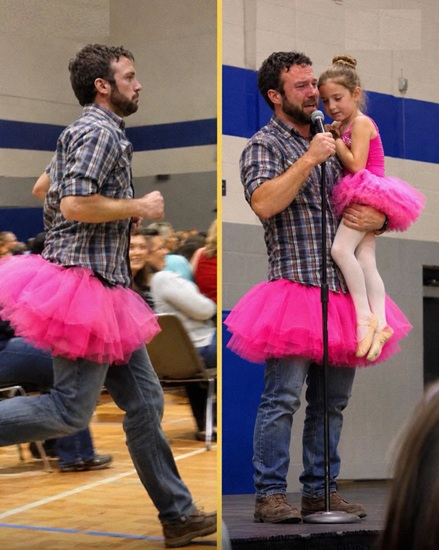
A man was hurrying down the aisle.
He was slightly out of breath.
His hair was shorter than I remembered.
His clothes looked ordinary, except for one ridiculous detail.
He was wearing a bright pink tutu over his jeans.
For a moment, I couldn’t understand what I was seeing.
Then I recognized him.
Russell.
Maisie turned.
Her eyes widened.
“DADDY!”
She rushed toward the steps at the side of the stage.
Her teacher moved to help her, and Russell dropped to one knee just in time to catch her.
Maisie wrapped both arms around his neck.
He held her carefully.
“I came, sweetheart.”
She buried her face against his shoulder.
“You came!”
“I did.”
He hugged her for several seconds.
Then he lifted her just enough to turn around once.
The room began applauding.
Some parents smiled.
A few people laughed when they noticed the tutu.
But I wasn’t laughing.
I was crying.
I had spent two years wondering whether I would ever see that moment again.
And now it was happening in front of me.
Russell gently placed Maisie on the floor.
He looked toward the teacher and asked whether he could say something.
She handed him the microphone.
He turned toward the audience.
“Excuse me, everyone. I need to say something important.”
My smile slowly disappeared.
His hands were shaking.
He reached inside his shirt and pulled out a small metal disc attached to a ribbon.
He held it up.
“I know this isn’t the right time to make a long announcement, and I don’t want to take attention away from the children. But there is something I should have explained a long time ago.”
The room became quiet.
Russell looked at me.
Then he looked at Maisie.
“Two years ago, I left my family because I was struggling with an addiction to pain medication.”
I felt my knees weaken.
He continued.
“I was taking more medication than I had been prescribed. I kept telling myself I could stop whenever I wanted. Eventually, I couldn’t control it anymore.”
He held up the small disc.
“This is a sobriety medal. I’ve been working toward recovery, and I should have told my wife and daughter the truth instead of disappearing.”
His voice broke.
“I’m sorry.”
The room remained silent.
Nobody seemed to know what to say.
I looked at the medal in his hand.
Then I looked at the man wearing the pink tutu.
And suddenly, I realized that the story I had been trying to understand for two years was much more complicated than I had imagined.
The teacher stepped forward gently.
“Thank you, Russell. Let’s give the children some space to continue their performance.”
She took the microphone and reminded everyone that the event was about the children.
I was grateful.
Maisie was still holding her father’s hand.
She looked up at him.
“You’re supposed to dance with me.”
Russell glanced at the teacher.
The teacher smiled and nodded.
“There’s still time.”
He took Maisie’s hand.
They walked back toward the stage.
Russell admitted quietly that he couldn’t remember the steps.
Maisie laughed.
“I’ll show you!”
She guided him to the correct position.
The music restarted.
At first, Russell moved awkwardly.
He watched Maisie’s feet and tried to follow her movements.
He missed a turn.
Then he stepped in the wrong direction.
Maisie laughed and corrected him.
He laughed too.
And for a few minutes, the entire room watched a father and daughter trying to find the rhythm together.
Maisie smiled throughout the performance.
I watched from my chair.
Part of me wanted to stand up and embrace them.
Another part of me remembered every unanswered call.
I remembered the birthdays.
The questions.
The nights when Maisie had fallen asleep holding Bunny because she missed her father.
I felt joy and anger at the same time.
And I understood that one beautiful moment couldn’t erase two painful years.
When the music ended, the children bowed.
The parents applauded.
Maisie ran toward Russell again.
She asked him to pose for photographs with Bunny.
He agreed.
He held the stuffed animal carefully and smiled for the camera.
For a moment, it looked like an ordinary family photograph.
Then Maisie asked the question I had been afraid of hearing.
“Are you coming home?”
Russell’s smile disappeared.
He looked at her.
Then he looked toward me.
“We need to talk about that, sweetheart.”
Maisie’s shoulders dropped.
I immediately stepped closer.
“Daddy and I have some grown-up things to discuss. That doesn’t mean you did anything wrong.”
She hugged Bunny tightly.
My friend Nina, whose daughter had also performed, noticed the tension.
She quietly offered to take Maisie for ice cream while Russell and I spoke.
Maisie agreed, but only after Russell promised he would say goodbye before leaving.
He promised.
Then Nina took her hand and led her toward the exit.
Russell and I walked into an empty classroom.
I closed the door.
For several seconds, neither of us spoke.
Then I turned toward him.
“Two years, Russell.”
He nodded.
“Two years.”
“And you decided to tell me what happened in front of an entire school?”
“I didn’t plan to say everything.”
“But you did.”
He looked down at the medal.
“I was scared.”
“Scared of what?”
“That you would tell me to leave before I had a chance to explain.”
I stared at him.
“You could have called me. You could have written a letter. You could have answered one of the seventeen calls I made this week.”
He swallowed.
“I saw them.”
Those three words hurt more than I expected.
“You saw them?”
“Yes.”
“And you still didn’t answer?”
He nodded.
I felt my hands begin to shake.
“Do you understand what that was like for us?”
“I do.”
“No, you don’t. Maisie asked me whether you stopped loving her. She asked whether she had done something wrong. She waited for you at her birthday. She kept looking at the door.”
Russell closed his eyes.
“I know I hurt her.”
“You didn’t just hurt me. You left a little girl trying to understand why her father disappeared.”
He didn’t interrupt.
I continued.
“How did this happen? What happened to you?”
Russell sat down.
He explained that several months before leaving, he had injured his back while moving equipment at work.
The injury had caused persistent pain.
A doctor had prescribed pain medication for a limited period.
At first, Russell followed the prescription.
He attended appointments and tried to manage the discomfort.
But as the weeks passed, he began taking more than directed.
He told himself he needed it to get through work.
Then he told himself he needed it to sleep.
Eventually, he started obtaining pills from other people when his prescription was no longer available.
He hid how much he was taking.
He lied about feeling better.
He made excuses when I noticed that something was wrong.
I remembered those months.
He had been tired more often.
Sometimes he became irritated over small things.
He stopped wanting to take Maisie to the park.
He spent long periods alone.
I had assumed his back still hurt.
I hadn’t understood how far things had gone.
“Why didn’t you tell me?” I asked.
Russell stared at the floor.
“Because I was ashamed.”
“Of what?”
“Of needing help. Of losing control. Of becoming someone I didn’t recognize.”
I sat opposite him.
“You think I would have been happy about it?”
“No.”
“I might have been frightened. I might have been angry. But I would have wanted to help you find treatment.”
“I know that now.”
He took a breath.
Then he told me something I had never known.
One afternoon, he had fallen asleep on the couch while Maisie was watching cartoons.
He had been difficult to wake.
Maisie had called his name several times.
Eventually, he stirred.
Russell said the experience frightened him.
He realized that his condition could put Maisie in a situation no child should have to face.
He didn’t trust himself to be responsible for her while he was struggling with the medication.
“So you left?” I asked.
He nodded.
“I thought I had to get away and get help before I could be a father again.”
“But you didn’t explain that to us.”
“No.”
“You let us believe you had abandoned us.”
“I know.”
He explained that his brother Paul had helped him find a residential treatment program.
Russell moved out and entered treatment soon afterward.
He said the first stage was difficult.
He had to work with medical professionals to address his dependence safely.
He attended treatment sessions and began learning how to manage the thoughts and circumstances that had contributed to his addiction.
After completing the initial program, he continued with recovery support and counseling.
He said he had remained away from the pills since entering treatment.
The medal represented a milestone in his recovery.
But recovery had not been simple.
He had struggled with cravings.
He had lost his job.
He had moved between temporary rooms.
For a while, he had difficulty keeping a regular routine.
Eventually, he found steady employment at a parts warehouse and rented a small apartment.
He said he had been working there for eleven months.
I listened.
But there was one question I still couldn’t stop thinking about.
“Why didn’t you contact Maisie?”
He rubbed his hands together.
“Every month, I told myself I would call when I was doing better.”
“And?”
“And every month I found another reason to wait.”
He looked at me.
“I thought she deserved a father who had everything under control. I was afraid she would see how much I had changed.”
“She didn’t need a perfect father. She needed a father who answered the phone.”
“I know.”
He told me that he had sometimes looked at old photographs of Maisie.
He had kept the pictures from her early birthdays.
He had watched short videos of her learning to dance.
But he had never found the courage to make contact.
I shook my head.
“Looking at photographs isn’t the same as being there.”
“I know.”
Then he told me something else.
Before leaving, he had taken money from our savings account.
I went completely still.
“What money?”
He looked at me.
“The emergency savings.”
I remembered.
Three months after he disappeared, I had discovered that our account was almost empty.
There had been several withdrawals.
The total was approximately $6,800.
At the time, I had assumed he had used it to pay for somewhere to stay.
I had been forced to cover bills with credit cards.
I had postponed some expenses for Maisie.
I had worked extra hours to keep the household running.
And I had spent months wondering whether the money would ever be returned.
“You took it?”
Russell nodded.
“I did.”
“Why?”
He looked ashamed.
“Most of it went toward the pills before I left.”
I couldn’t believe what I was hearing.
“You used our emergency savings?”
“Yes.”
“That was money for our daughter. That was money for the house.”
“I know.”
“Did you ever think about what would happen to us?”
He didn’t answer immediately.
Then he admitted that he had been thinking mostly about himself and getting through each day.
He said he had started saving money once he found stable work.
He had brought statements showing what he had earned and what he had put aside.
“I can repay what I took,” he said.
I looked at him.
“Don’t hand me paperwork and expect me to be grateful.”
“I’m not asking you to.”
“You left me with bills, a child who missed her father, and no explanation.”
“I know.”
“You don’t get to decide that showing up in a pink tutu makes everything better.”
He looked down at his clothes.
“I wasn’t trying to make everything better.”
“Then why did you come?”
He was quiet for a moment.
“Because I saw the school announcement.”
I frowned.
“What announcement?”
“The performance was mentioned in the school’s public newsletter. Someone shared it, and I saw Maisie’s name.”
He explained that he had looked at the date several times.
He had almost decided not to attend.
He was afraid I would be angry.
He was afraid Maisie wouldn’t want to see him.
But he couldn’t stop thinking about her standing on that stage.
“So you bought a tutu?” I asked.
A small, sad smile appeared on his face.
“I didn’t know what else to do.”
I looked at him.
For a moment, I almost laughed.
Then I remembered the little girl waiting outside with Nina.
“Are you still receiving treatment?” I asked.
“Yes.”
“What does that mean now?”
He explained that he continued attending recovery meetings and seeing a counselor.
He had a sponsor who helped him remain accountable.
He had a regular job and a place to live.
He said he understood that staying well required ongoing effort.
I listened carefully.
I didn’t want promises.
I wanted consistency.
“How long have you been working?”
“Eleven months.”
“And you have a phone?”
“Yes.”
“And a place to live?”
“Yes.”
“Then you had ways to contact your daughter.”
He lowered his head.
“You’re right.”
I wanted him to argue.
I wanted him to give me an excuse I could challenge.
Instead, he accepted what I said.
And somehow, that made the conversation even harder.
Then he asked whether Maisie was doing well at school.
I told him about her favorite subjects.
I told him she had become more confident.
I told him she liked drawing and had recently started learning new ballet steps.
He listened to every detail.
But when I mentioned that she had stopped asking when he would call, his eyes filled with tears.
“I didn’t know it had become that bad.”
“You weren’t here to know.”
He nodded.
A few minutes later, there was a quiet knock at the classroom door.
Nina had returned with Maisie.
“She wanted to see her dad before we leave,” Nina said.
Maisie stepped inside.
She looked at Russell.
Then she looked at the medal in his hand.
“Daddy?”
He crouched to her level.
“Hi, sweetheart.”
She studied his face.
“Are you sick?”
Russell took a moment before answering.
“I was sick for a while. I needed help from doctors and people who understood what was happening.”
“Did you have to stay in a hospital?”
“I stayed in a treatment program where people helped me get better.”
She looked at him.
“Then why didn’t you call me?”
He glanced at me.
I didn’t answer for him.
He took a breath.
“Because I was ashamed, Maisie. I made a wrong choice. I kept thinking I would call when I felt ready, but I waited too long.”
She frowned.
“Because you were a bad daddy?”
Russell’s expression changed immediately.
“No, sweetheart. You didn’t do anything wrong.”
“But you went away.”
“Yes. I did.”
“Was it because I made you sad?”
He shook his head.
“Never. Nothing you did made me leave.”
She looked down at Bunny.
Then she asked the question I knew had been waiting inside her for two years.
“Do you love me?”
Russell’s eyes filled.
“More than I can explain.”
“Then why didn’t you come?”
He looked at her carefully.
“I wasn’t well, and I didn’t know how to ask for help. But leaving without explaining was wrong. I should have found a way to tell you that you were loved.”
Maisie was quiet.
Then she asked:
“Are you going to disappear again?”
Russell didn’t immediately promise that everything would be perfect.
Instead, he gave her an answer he could work toward.
“I want to be in your life. Mommy and I need to agree on how that can happen. I won’t promise a visit until we’ve planned it properly. But I will do my best to keep the promises I make.”
Maisie looked toward me.
“Can he come for dinner?”
I crouched beside her.
“Not tonight, sweetheart. We need to talk about some things first.”
Her face fell.
Russell waited until she looked back at him.
“I would really like to see you again.”
“Tomorrow?”
“We’ll talk with Mommy about a day.”
Maisie reached out and hugged him.
He hugged her back.
Then she came to me and held my hand.
On the way home, she was unusually quiet.
At bedtime, she placed Bunny beside her pillow and looked up at me.
“Will Daddy be sick forever?”
I sat beside her.
“Recovery is something he has to keep working on. He has people helping him.”
She thought about that.
“Will you help him too?”
I brushed her hair away from her forehead.
“Daddy has to do his own work to stay well. My job is to make sure you are safe, loved, and never responsible for grown-up problems.”
She nodded.
Then she asked whether she could keep the photograph from the performance.
I told her she could.
She placed it on her bedside table.
After she fell asleep, I called Paul.
He answered quickly.
“I heard Russell came to the performance,” he said.
“You knew what was happening all this time.”
There was a pause.
“Yes.”
“You knew he was in treatment?”
“Yes. I helped him find the program.”
“And you never thought I should know that he was safe?”
“Russell asked me not to tell you.”
I closed my eyes.
“Paul, I wasn’t asking you to reveal every private detail about his treatment. I was asking whether my husband was alive and whether he was ever coming back into his daughter’s life.”
“I understand.”
“No, I don’t think you do. Maisie spent two years wondering whether her father stopped loving her.”
Paul was quiet.
“I thought I was respecting his wishes.”
“You were respecting his silence. But there was a little girl on the other side of that silence.”
He apologized.
I believed he was sorry.
But that didn’t make the last two years disappear.
The following morning, Maisie’s teacher called.
She wanted to check how Maisie was feeling after the performance.
She also apologized for allowing Russell to address the audience.
She explained that she hadn’t expected him to make a personal announcement and had tried to return the attention to the children as quickly as possible.
I told her I understood.
I wasn’t angry with her.
But I did explain that Maisie needed privacy and that the school should avoid discussing the family situation with other parents.
The teacher agreed.
She also offered information about the school’s counselor in case Maisie wanted someone outside the family to talk to.
I accepted.
That afternoon, Maisie came home with a drawing.
It showed three people standing together.
There was a little girl wearing a pink skirt.
A woman stood beside her.
And a man stood on the other side.
I recognized the three figures immediately.
“Is this us?” I asked.
Maisie nodded.
“That’s me, you, and Daddy.”
She pointed toward the man’s shirt.
“I drew his medal.”
I looked at the picture.
“That’s a lovely drawing.”
She smiled.
Then she asked whether she could put it on the refrigerator.
I helped her find a magnet.
For the first time in a long while, the drawing didn’t make me feel hopeful or frightened.
It simply reminded me that Maisie was trying to understand what had happened.
And she deserved the time and support to do that.
Over the next week, Russell began taking small steps to demonstrate that he was serious about rebuilding contact.
He provided information about his employment and living arrangements.
He also showed me a written repayment plan for the money he had taken from our savings.
I didn’t immediately accept everything he proposed.
I wanted the financial situation reviewed properly, and I wanted any arrangement involving Maisie to be clear and consistent.
I also spoke with a family lawyer about our options.
Russell agreed that our daughter’s safety and emotional well-being had to come first.
He didn’t demand to move back into the house.
He didn’t ask me to forgive him immediately.
And he didn’t insist that Maisie should suddenly behave as though nothing had happened.
That mattered.
Because forgiveness and rebuilding trust are not the same thing.
A person can be sorry and still have a long way to go.
A person can make progress in recovery and still need to take responsibility for the harm caused during the addiction.
And a child can love a parent while still feeling confused, disappointed, or afraid of being left again.
I needed Russell to understand all of that.
Two Saturdays later, we arranged a short visit at the library.
I wanted the first meeting to be calm and predictable.
Russell arrived early.
He wasn’t carrying a large gift bag.
He wasn’t wearing a costume.
He simply waited near the entrance.
Maisie stood beside me, holding Bunny.
At first, she seemed unsure.
Russell smiled.
“Hi, sweetheart.”
“Hi, Daddy.”
He asked whether she wanted to show him something.
She thought for a moment.
Then she walked toward the children’s section and picked up a book about rabbits.
“This one is my favorite.”
Russell sat beside her.
She showed him the pictures and explained which characters she liked.
He listened carefully.
After a while, she handed him Bunny.
“His ear is still broken.”
Russell examined it.
“I remember. I think I need a sewing kit.”
“You said you would fix it before.”
“I did. And I still want to.”
Maisie smiled.
The visit lasted an hour.
When it was time to leave, she asked whether he could come to her next ballet practice.
Russell looked at me before answering.
“If Mommy agrees, I’d like that.”
I told him we could discuss it.
The following Thursday, he arrived at the studio before the lesson began.
He sat quietly near the back.
Maisie noticed him in the mirror.
Her face brightened.
She waved.
He waved back.
At the end of the class, she ran over to show him a new turn she had learned.
“Look!”
She spun.
It wasn’t perfect, but she was proud of it.
Russell clapped.
“That was wonderful.”
“Again?”
“Again.”
She performed it one more time.
I watched them from the doorway.
It wasn’t a reunion that solved everything.
There were still difficult conversations ahead.
There was still money to repay.
There were still boundaries to respect and trust to rebuild.
And I still didn’t know what would happen to our marriage.
But I noticed something important.
Russell had arrived when he said he would.
He had stayed for the entire lesson.
And when Maisie asked whether he would come again, he didn’t make a grand promise.
He said he would speak with me, check the schedule, and confirm the next visit.
It was a small thing.
But after two years of silence, small things mattered.
That night, Maisie placed the photograph from the school performance beside her bed.
She looked at it for a moment.
Then she turned toward me.
“Mommy?”
“Yes?”
“Do you think Daddy can learn to dance properly?”
I smiled.
“That might take a little practice.”
She giggled.
Then she hugged Bunny and closed her eyes.
I sat beside her for a few more minutes.
I knew that Russell’s recovery was his responsibility.
I knew that his return did not automatically repair the damage.
And I knew that Maisie needed more than one emotional afternoon to feel secure again.
But I also knew that the next chapter did not have to be decided in one day.
For two years, my daughter had waited for her father to explain why he left.
At the school performance, she finally heard the beginning of that explanation.
The truth was painful.
It didn’t excuse his silence, the money he had taken, or the promises he had broken.
But it gave us something we hadn’t had before.
A starting point.
And this time, instead of asking Maisie to wait for a promise, I planned to watch what Russell actually did.
Because a child doesn’t need a perfect parent.
She needs an adult who takes responsibility, respects her feelings, and keeps showing up.
And if Russell wanted another place in his daughter’s life, he would have to build it one honest day at a time.