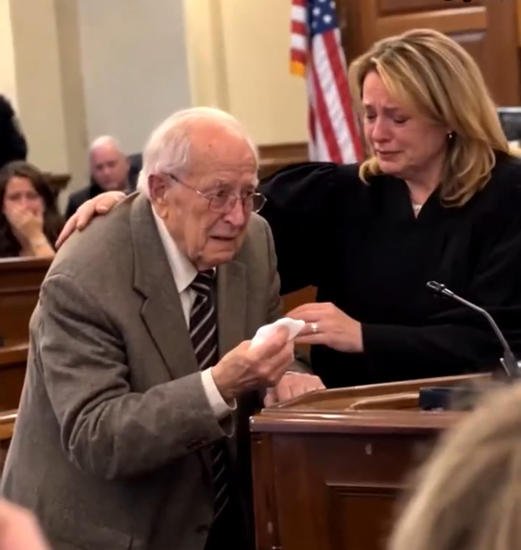
My 101-year-old neighbor was prepared to spend the final years of his life behind bars rather than explain why he had stolen more than $2,000 worth of merchandise. When I first heard about the charges, I couldn’t believe what I was hearing.
Walter had lived next door to me for nearly thirty years. I had watched him grow older, lose his wife, and slowly adjust to a quieter life. He was the kind of man who still waved at people passing his house, remembered birthdays, and insisted on carrying his own groceries even when his hands were shaking.
He wasn’t wealthy.
He wasn’t particularly strong anymore.
And he certainly wasn’t someone I had ever imagined seeing in a courtroom.
Yet there he stood, holding his old wooden cane with both hands, facing a judge who wanted an explanation.
The items listed in the case were unusual.
Baby clothes. Canned vegetables. Children’s shoes. Notebooks. Pencils. School supplies. Basic household necessities.
The total value was more than $2,000.
Walter had been caught taking merchandise from the same store on multiple occasions. Employees had reportedly warned him, but he continued returning. Eventually, the store decided to involve the authorities.
And now, at 101 years old, he was facing the consequences.
But what troubled me most wasn’t the accusation.
It was the fact that Walter refused to defend himself.
“Mr. Walter,” the judge said, looking down at the documents on his desk, “do you understand that these charges could result in a jail sentence?”
Walter slowly lifted his head.
“Yes, Your Honor.”
“Then I need you to explain something to me. Why would a man your age repeatedly steal things he doesn’t appear to need?”
Walter tightened his grip on his cane.
“I took them, sir. I know what I did.”
The judge paused.
“That’s not an explanation.”
Walter looked down at the floor.
“I’m sorry.”
The courtroom became unusually quiet.
The judge examined another photograph.
“These are children’s clothes. Food. School supplies. You weren’t taking expensive jewelry or luxury items. You were taking things that families use every day.”
Walter didn’t answer.
“You were warned more than once. Why didn’t you stop?”
For several seconds, the only sound was the quiet movement of papers.
Then the judge leaned forward.
“Mr. Walter, I am giving you an opportunity to tell this court what was happening. Is there something you want us to know?”
Walter swallowed.
“No, Your Honor.”
I couldn’t listen anymore.
“Yes, there is!”
Several people turned toward me.
Walter’s head snapped in my direction.
“Margaret, please sit down.”
His voice was weak, but I could hear the fear in it.
I had known Walter for thirty years. I had seen him frustrated, embarrassed, lonely, and even angry.
But I had never seen him look quite like that.
“Your Honor,” I said, standing up, “I know he asked me not to say anything. But I cannot watch him accept a punishment without allowing you to understand why he did what he did.”
The judge looked at me carefully.
“Are you related to the defendant?”
“No, Your Honor. I’m his neighbor. I’ve known him for nearly thirty years.”
“Do you have information relevant to these charges?”
I reached into my purse and removed a folded piece of paper.
“Yes. And I believe it changes how this situation needs to be understood, even though it doesn’t excuse what happened.”
Walter closed his eyes.
“Margaret…”
I looked at him.
“I’m sorry, Walter. But you shouldn’t have to carry this secret alone.”
The judge allowed me to continue.
I turned toward the back of the courtroom.
A young woman was sitting there with a little boy asleep against her shoulder. Her clothes were simple, and she looked exhausted. She had been quietly listening since the hearing began.
Her name was Sarah.
She was raising three children on her own.
And the things Walter had been stealing were ending up at her home.
Sarah looked confused when I mentioned her name.
“Me?”
I nodded.
“Yes, Sarah. I’m talking about you and your children.”
She adjusted the little boy in her arms.
“I don’t understand.”
I took a breath.
“Walter has been leaving bags of groceries, children’s clothes, and school supplies at your front door for months.”
Sarah stared at him.
Then she looked back at me.
“Those things were from Walter?”
Walter’s shoulders dropped.
“Margaret, please.”
Sarah slowly shook her head.
“He told me he bought them with his pension.”
Nobody answered immediately.
She looked toward Walter again.
“You said you were using your own money.”
Walter finally raised his eyes.
“I didn’t want you worrying about it.”
The judge interrupted gently.
“Mr. Walter, is what she is saying true?”
Walter nodded.
“Yes, sir.”
“Why didn’t you tell the court?”
Walter looked toward Sarah and then at the sleeping child in her arms.
“Because she already has enough to worry about. I wasn’t going to make her stand here and feel responsible for something I chose to do.”
Sarah covered her mouth.
But there was more to the story.
And the reason Walter had started helping Sarah went back further than anyone in that courtroom realized.
I unfolded the piece of paper in my hand.
“Your Honor, Sarah wasn’t the first person who helped Walter. In fact, this entire situation began because of something she did for him.”
Sarah immediately recognized the handwriting.
It was a short note she had written months earlier.
I held it carefully and began reading.
“Dear Walter, please stop trying to pay me every time I bring you dinner. My children enjoy knowing you’re okay. They ask about you when you’re not around, and they love having you at our table. You’re not a burden to us. You’re family now.”
The judge looked up.
“Bring him dinner?”
I nodded.
“Yes, Your Honor. That’s where everything started.”
Walter’s wife had died several years earlier.
They had shared a long life together, and after her passing, the house gradually became quieter. There were no more conversations across the breakfast table, no familiar voice reminding him to take his medication, and no one waiting for him when he returned from a walk.
He had learned to manage most things independently.
He prepared simple meals, kept his home reasonably tidy, and maintained a routine that helped him get through the day.
But growing older had brought challenges he rarely discussed.
Some mornings, his joints hurt too much for him to move comfortably. Other days, even preparing a proper meal felt like more effort than he wanted to admit.
He didn’t like asking for help.
He had spent most of his life being the person others could depend on. Accepting assistance made him uncomfortable, even when he genuinely needed it.
Then, one winter, Sarah noticed something unusual.
Walter’s curtains had remained closed for two days.
Normally, he opened them every morning. He liked sunlight entering the living room, and he often sat near the window with a cup of tea.
Sarah had noticed the change while taking her children to school.
At first, she assumed he was simply having a quiet day.
But when the curtains remained closed the following morning, she became concerned.
She walked across the yard and knocked on his door.
There was no answer.
She knocked again.
Eventually, Walter opened it.
He looked tired.
His face was pale, and he was moving much more slowly than usual.
Sarah asked whether everything was all right.
Walter insisted that he was fine.
But she noticed that he had barely eaten and was having difficulty preparing anything for himself.
She didn’t argue with him.
Instead, she asked whether he would like something warm to eat.
Walter tried to refuse.
He told her she had three children to look after and shouldn’t spend her time worrying about an old neighbor.
Sarah smiled.
“Making an extra plate isn’t going to hurt anyone.”
That evening, she returned with a container of homemade food.
Walter thanked her repeatedly.
He assumed it was a one-time act of kindness.
It wasn’t.
The following evening, Sarah brought another meal.
And the evening after that, she did the same.
Sometimes it was soup.
Sometimes it was chicken and potatoes.
Other evenings, it was something simple that she had prepared for her children.
Walter began recognizing the sound of her footsteps approaching his front door.
He would open it before she even knocked.
“You’re doing too much for me,” he would tell her.
And Sarah would give him the same answer.
“It’s only dinner, Walter.”
But to him, it was much more than dinner.
It was someone remembering that he existed.
Someone noticing when his curtains stayed closed.
Someone caring enough to knock.
Still, Walter had no idea what those meals were costing Sarah.
He assumed she was bringing him extra food from a meal she had already prepared.
He didn’t want to believe that she might be sacrificing anything for him.
Then, one evening, something happened that changed his understanding completely.
Sarah arrived with a container of chicken and potatoes.
Walter invited her inside, but she explained that the children were waiting at home.
He thanked her and asked a question he had asked many times before.
“Have you eaten yet?”
Sarah smiled.
“I’m not hungry tonight.”
Walter accepted the answer.
But a few days later, Sarah’s oldest daughter came to his house carrying another container.
Walter thanked her and asked whether her mother had eaten.
The girl hesitated.
Then she answered honestly.
“Mom says she’s not hungry again. She says we need the food because we’re still growing.”
Walter looked at the child.
He didn’t know what to say.
He asked her to repeat the answer.
The girl explained that her mother sometimes skipped dinner so there would be enough food for everyone else.
Walter stood silently in his kitchen after the child left.
He looked at the meal Sarah had brought.
For the first time, he wondered how many evenings she had gone without eating properly so that he wouldn’t have to sit alone with an empty plate.
The realization hurt him.
He had spent weeks accepting her kindness without understanding its cost.
And now he knew something he couldn’t ignore.
Sarah had been looking after him while struggling to look after herself.
That night, Walter barely slept.
The next morning, he decided he had to do something.
He began looking through his belongings.
He checked his cupboards, his drawers, and the small amount of money he had saved.
He wasn’t rich, but he had a pension and a few personal possessions that still held value.
He started buying basic groceries.
At first, he purchased only a few things.
A bag of rice.
Canned food.
Milk.
Some vegetables.
He left them quietly outside Sarah’s door.
He didn’t want her to feel uncomfortable.
He didn’t want her to think he was paying her back for every meal.
He simply wanted to make sure the children had something to eat.
When Sarah discovered the first bags, she called him.
“Walter, did you leave these groceries here?”
He pretended not to understand.
“What groceries?”
She laughed softly.
“The bags outside my door.”
“Oh, those. Someone must have left them there.”
“Walter.”
He eventually admitted it.
Sarah thanked him but told him he didn’t need to do that.
He replied that he wanted to.
For a while, that arrangement continued.
Walter brought groceries.
Sarah continued checking on him.
Sometimes she invited him to dinner.
Sometimes he sat with the children for a little while, listening to their stories about school.
Neither of them considered the other a charity case.
They were simply two households looking out for one another.
But there was a problem.
Walter’s pension was limited.
And the more he bought for Sarah’s family, the less money he had left for himself.
He began using some of his savings.
When that wasn’t enough, he sold an old watch that had belonged to him for many years.
It wasn’t an expensive piece of jewelry, but it had sentimental value.
He had received it decades earlier and had kept it carefully stored.
Selling it was not an easy decision.
But he convinced himself that helping the children mattered more.
Eventually, even that money ran out.
And this was when Walter made a decision that would bring him into the courtroom.
He began taking items from the store.
At first, he took small things.
Then the amounts grew.
He knew it was wrong.
He knew the employees could report him.
He knew that his age did not make the behavior acceptable.
But every time he considered stopping, he remembered the little girl who had told him her mother sometimes went without dinner.
He thought about the children’s school supplies.
He thought about the empty cupboards Sarah tried to hide from them.
And he convinced himself that he could keep helping just a little longer.
That did not make the theft right.
It did, however, explain the desperation behind it.
I looked toward the judge.
“Your Honor, I discovered what was happening when I saw Walter carrying several bags one afternoon. He looked uncomfortable when I asked where he had been.”
At first, he told me he had gone shopping.
But something about his answer didn’t sound right.
I knew him too well.
I asked again.
Eventually, he invited me inside and told me everything.
He explained what Sarah had done for him.
He showed me the note.
And then he admitted that some of the things he had been leaving at her house were not paid for.
I was shocked.
I told him he had to stop immediately.
I also told him that there were other ways to help Sarah without risking his freedom.
He agreed.
But he made me promise not to tell her.
He was afraid she would feel ashamed.
He didn’t want her to believe that accepting his help had caused him to break the law.
He wanted her to remember their friendship, not the stolen groceries.
I had kept his confidence for as long as I could.
But now the situation had gone too far.
Sarah was crying.
“Walter, I never asked you to do that.”
He looked at her.
“I know.”
“You could have talked to me.”
“You already had enough problems.”
“And now you’re the one facing problems because of us.”
Walter shook his head.
“No, sweetheart. You didn’t make me do anything. I made those choices.”
The judge listened without interrupting.
Sarah wiped her cheeks.
Then she slowly stood up.
“Your Honor, I would like to say something too.”
The judge nodded.
Sarah looked at Walter.
“There is something he doesn’t know.”
Walter seemed confused.
“What is it?”
Sarah took a breath.
“My children call you Grandpa Walter.”
For the first time that day, Walter’s expression changed.
He blinked several times.
“What?”
“They don’t usually say it directly because they’re afraid you’ll think they’re being silly. But that’s what they call you when you’re not around.”
Walter stared at her.
Sarah continued.
“Every evening, when we sit down to eat, my youngest asks whether you’re coming over.”
She smiled through her tears.
“He always wants to know if we should save you a place.”
Walter’s lips began to tremble.
Sarah explained that the children had grown attached to him long before he started leaving groceries at their door.
They liked hearing his stories.
They liked his gentle jokes.
They liked the way he remembered the little things they told him.
When one of them had a difficult day at school, Walter listened.
When another was excited about a drawing, he took the time to look at every detail.
And when they had questions about the world, he answered as patiently as he could.
He had become part of their routine.
Not because he brought food.
Not because he bought clothes.
Because he was there.
Sarah looked directly at him.
“Walter, my children didn’t start loving you because of what you brought to our house.”
She paused.
“They loved you because you became part of their lives.”
Walter covered his mouth with one trembling hand.
The judge glanced down at his papers.
Then he looked at Walter again.
“Is that true, Mr. Walter?”
Walter struggled to answer.
“I thought they only wanted me around because I helped them.”
Sarah shook her head.
“No. We wanted you around before any of that.”
The little boy who had been sleeping against her shoulder began to stir.
He opened his eyes and looked around the courtroom.
When he noticed Walter, he lifted his head.
“Grandpa Walter?”
Walter froze.
The child reached toward him.
“Are you coming for dinner?”
Nobody in the courtroom moved.
Walter’s eyes filled with tears.
He looked at Sarah, then at the child.
“I don’t know, son.”
Sarah gently answered for him.
“We hope you will.”
The judge allowed a moment of silence before speaking again.
“Mr. Walter, what you have described is deeply troubling. Your reasons may help explain your decisions, but they do not erase the seriousness of taking merchandise without paying for it.”
Walter nodded.
“I understand, Your Honor.”
“The store suffered a financial loss. The court must consider that as well.”
“Yes, sir.”
The judge then looked toward Sarah and me.
“I also hear that there may be people willing to help find a lawful way to address the damage and support the family involved.”
I nodded.
“I will speak with the neighbors, Your Honor. We can look into helping both households with groceries and other necessities. We also want to make sure Walter has the support he needs.”
Sarah added that she would never again allow him to believe he had to solve her family’s problems by himself.
The judge decided to postpone sentencing so that the circumstances could be considered further and a possible restitution arrangement could be explored.
It was not a declaration that Walter had done nothing wrong.
It was an opportunity for the situation to be examined more fully.
But Walter seemed to hear only one thing.
He kept looking toward Sarah.
As if he still couldn’t understand that the family he had tried so hard to help had never wanted him to disappear from their lives.
A few weeks later, I visited Sarah’s home.
I had expected to find everyone discussing the court case.
Instead, I found something much quieter.
Walter was sitting at the kitchen table.
His cane rested against the chair.
A cup of tea was beside his hand.
And in front of him were five plates.
Sarah was preparing dinner.
Her three children were talking over one another, telling stories about school and arguing playfully about who would get the last piece of bread.
Walter was listening.
He looked more relaxed than I had seen him in months.
The youngest boy climbed onto the chair beside him.
“Grandpa Walter?”
Walter turned.
“Yes, son?”
The little boy leaned closer.
“You don’t have to bring us anything anymore.”
Walter smiled gently.
“Is that so?”
The child nodded.
“You don’t need to buy us food or toys. You can just come here.”
Walter looked down at his hands.
For a moment, he seemed unable to speak.
Then he asked a question.
“But what should I bring?”
The little boy thought about it.
Then he smiled.
“Just yourself.”
Walter lowered his head.
His shoulders began to shake.
Sarah walked over and placed a hand gently on his shoulder.
Nobody tried to interrupt him.
Nobody told him to stop crying.
They simply allowed him to feel what he had been holding inside for so long.
That evening, Walter stayed for dinner.
He didn’t bring groceries.
He didn’t bring school supplies.
He didn’t bring anything that could be measured by a receipt.
He brought himself.
And that was enough.
After dinner, the children showed him their drawings.
The youngest asked him to read a story.
The oldest told him about a school project.
Sarah brought him another cup of tea and sat beside him for a while.
I watched from the doorway.
For months, Walter had believed he was helping a struggling family repay a kindness that could never truly be repaid.
He had thought that the only way to show gratitude was to give them something.
But that evening, he finally began to understand what Sarah had been trying to tell him.
He had already given them something valuable.
His time.
His attention.
His stories.
His friendship.
And they had given him something he thought he had lost forever.
A place where he belonged.
The court case still had to be resolved.
The stolen merchandise still had to be accounted for.
And Walter still had to accept responsibility for his actions.
But the people around him were determined to help find a better path forward.
Sarah and her children continued inviting him to dinner.
The neighbors began discussing practical ways to support both households.
And Walter slowly stopped arriving at Sarah’s door with bags of groceries.
Instead, he started arriving with stories.
Sometimes he brought an old photograph.
Sometimes he shared a memory about his wife.
Sometimes he simply sat at the table and listened to the children talk.
One evening, I saw him standing outside Sarah’s house before knocking.
He was holding his cane in one hand and looking through the kitchen window.
Inside, the family was already gathered around the table.
The youngest boy noticed him.
He jumped out of his chair and ran toward the door.
“Grandpa Walter is here!”
Sarah opened it before Walter could knock a second time.
“Come in,” she said.
“We saved your place.”
Walter looked at the table.
Five plates.
Five chairs.
And one place that was waiting for him.
He smiled.
For the first time in a long while, he didn’t look like a man who was afraid of being alone.
He looked like someone who had finally found his way home.
And as he sat down beside the children, I understood something I will never forget.
Sometimes, people believe they must earn their place in someone else’s life by giving, sacrificing, or solving every problem.
But real belonging doesn’t work that way.
Walter had spent months trying to repay Sarah for the meals she had brought him.
He had forgotten that her kindness was never a bill waiting to be paid.
She hadn’t wanted a repayment.
Her children hadn’t wanted another bag of groceries.
They had wanted the old man next door to keep coming to dinner.
And when the little boy reached across the table and took Walter’s hand, the message was finally clear.
He didn’t have to bring anything.
He was already part of the family.