When my wife first noticed the strange things my brother was carrying in his bag, she became convinced that something was wrong. There was a plastic baby doll.
A folded piece of paper. And a few small items he refused to explain. Every time I asked him about them, he gave me the same answer. “It’s a surprise.”
I wanted to believe him. But I couldn’t understand why my twenty-nine-year-old brother, Jamie, was suddenly carrying a baby doll everywhere he went.
My wife, Claire, was even more concerned.
She had already become uncomfortable whenever Jamie came near our newborn daughter, Sophie.
She watched his hands.
She moved fragile objects away from him.
And whenever he offered to help with the baby, she found a reason to say no.
I told her she was being unfair.
I reminded her that Jamie had Down syndrome, but that didn’t mean he couldn’t learn, work, make decisions, or understand responsibility.
She insisted that she was only protecting our daughter.
I thought I understood the disagreement.
I didn’t.
Because one rainy Saturday night, at exactly 2:13 in the morning, a scream came through the baby monitor.
And when we reached the nursery, my brother was on the floor beside our daughter.
His hands were shaking.
Sophie wasn’t making a sound.
What happened next changed the way my wife saw him, the way I understood him, and the way our family remembered that night.
But to understand why Jamie was there, I need to explain what happened thirteen years earlier.
When our mother died, I was twenty-four years old.
Jamie was sixteen.
She suffered a stroke, and her death happened so suddenly that neither of us had time to understand what life would look like without her.
For Jamie, it was especially difficult.
He has Down syndrome, and Mom had been the person who understood his routines, his little habits, his favorite meals, and the things that made him feel comfortable.
She knew when he was worried.
She knew when he was excited.
She could recognize the difference between his ordinary silence and the silence that meant something was bothering him.
She was the center of his world.
At the funeral, relatives and family friends approached us one after another.
They offered condolences.
They hugged us.
They promised to help whenever we needed anything.
“If you need something, just call.”
“Anything at all.”
“You’re not alone.”
I thanked everyone.
But I wasn’t really listening.
My attention kept returning to Jamie.
He was sitting in the front pew, wearing a suit that didn’t quite fit him.
His tie was too long.
His shoes looked uncomfortable.
And he kept pulling at the collar of his shirt.
He had barely spoken all afternoon.
When most of the guests had left, he looked up at me.
“Where do I live now?”
I turned toward him.
“What do you mean, Jamie?”
He looked down at his hands.
“Where do I live?”
I swallowed.
“With me.”
He thought about that answer.
Then he asked another question.
“For how long?”
I didn’t understand immediately.
“What do you mean?”
He shrugged.
“Until you get married?”
I felt something break inside my chest.
He wasn’t asking about an address.
He was asking whether he still had a place in someone’s life.
I put my arm around his shoulders.
“Jamie, listen to me. You’re my brother. You’re not going anywhere.”
He looked at me.
I wanted him to believe every word.
“You’re coming home with me. And you can stay as long as you want.”
He nodded once.
Then he adjusted his oversized tie.
“Okay.”
I kissed the top of his head.
“Come on, Jamie-Bamie. Let’s go home.”
I didn’t know that one sentence would shape the next thirteen years of our lives.
But I would have said it again even if I had known everything that was coming.
The first months after Mom’s death were difficult for both of us.
I was trying to manage my own grief while helping Jamie adjust to a different home and a different routine.
We had to make decisions about practical things that Mom had previously handled.
Shopping.
Appointments.
Transportation.
Work schedules.
Meals.
And the small everyday responsibilities that nobody notices until the person who managed them is no longer there.
I quickly learned that helping Jamie didn’t mean doing everything for him.
He wanted independence.
He wanted to make his own choices.
And he wanted people to recognize what he could do.
One of the first things he insisted on learning was taking the bus alone.
He practiced the route several times with me.
We went through the stops.
We discussed where he needed to get off.
We talked about what he could do if the bus was delayed.
He listened carefully.
Then, one morning, he announced that he was ready.
“I can do it myself.”
I looked at him.
“Are you sure?”
“Yes.”
“All right. Call me when you arrive.”
He frowned.
“You said I do it myself.”
“You can do it yourself and still call me.”
He considered that for a moment.
Then he smiled.
“Okay.”
The first time he took the bus alone, I checked my phone every few minutes.
I knew I needed to give him room.
But being a protective older brother was not something I could simply switch off.
When the phone finally rang, I answered immediately.
“Jamie?”
“I’m here.”
“Everything okay?”
“Yes.”
“Good job.”
He laughed.
“You said call when I get there. I did. I’m calling.”
I smiled.
He was right.
He had done exactly what we agreed.
And I realized that independence didn’t mean he needed me less.
It meant learning when to step back.
A month later, Jamie received his first paycheck from the garden center.
He brought it home in an envelope.
He placed it on the kitchen table and stared at it.
“Something’s wrong.”
I looked up.
“What?”
“They paid me wrong.”
I examined the paper.
“How do you know?”
“Because I can count.”
I laughed.
“All right. Show me.”
He pointed to the hours and the amount.
He had noticed a mistake.
The next morning, he went back to the garden center and spoke with his manager.
They checked the records and corrected the payment.
When he returned, he looked very pleased with himself.
“Fixed.”
“Excellent.”
“I told you.”
“You did.”
He put the envelope away carefully.
That paycheck meant more to him than the amount written on it.
It represented something he had earned through his own work.
He had noticed a problem, spoken up, and helped resolve it.
I was proud of him.
But I tried not to make a huge celebration out of every ordinary accomplishment.
He didn’t want to be treated like a child.
He wanted to be treated like Jamie.
And that was something I tried to remember.
At nineteen, he decided to make soup.
He had watched Mom prepare it many times, but this was the first time he wanted to do everything himself.
I stayed nearby in case he needed help.
He placed the ingredients on the counter.
Then he began talking through the steps.
“Onion.”
He picked it up.
“Pot.”
He placed the pot on the stove.
“Lid.”
He put the lid beside it.
“Spoon.”
He found the spoon.
“Stir.”
I watched him carefully.
He followed his notes, checked the ingredients, and tasted the soup.
When he finally served me a bowl, he stood with his arms crossed.
“Be honest.”
I took a spoonful.
I looked at him.
He was waiting.
“Needs salt.”
He took the bowl from my hands.
“Get out of my house.”
I started laughing.
“It’s my house.”
He pointed toward the door.
“Out.”
I laughed even harder.
For the rest of the evening, he insisted that his soup was perfectly fine.
I never told him otherwise.
And, to be fair, I ate every spoonful.
Jamie also had a small ritual.
Whenever he left a room, he stopped at the doorway and knocked twice on the frame.
Then he waited.
I had to knock back twice.
If I forgot, he didn’t simply walk away.
He stood there until I answered.
One evening, I finally asked him why.
He looked at me as if the answer should have been obvious.
“Two means, are we okay?”
I nodded.
“And when I knock back?”
“Means yes.”
I smiled.
“So you’re checking whether we’re okay?”
“Yes.”
I reached over and knocked twice on the doorframe.
He grinned.
“Good.”
From then on, I never skipped it.
It became our little way of checking in with each other.
Two knocks.
A response.
And the reassurance that we were still there.
At twenty-two, Jamie moved into his own apartment.
It was about ten minutes away by bus.
He worked four mornings a week at the garden center and had developed a routine that suited him.
He knew the bus route.
He knew where to buy his groceries.
He had friends and activities outside the family.
He was proud of his apartment.
The first time I visited, he showed me everything.
The kitchen.
The sofa.
The small table.
The shelves he had arranged himself.
“Look.”
I examined the living room.
“Very nice.”
He smiled.
“I did it.”
“You certainly did.”
He showed me the cupboard where he kept his food.
Everything was arranged carefully.
He had labeled a few containers.
There was even a small notebook with reminders.
I was proud of him.
But I also had to learn that he didn’t need me to check every little thing.
I still called him.
Sometimes too often.
And he occasionally reminded me that he was doing fine.
For a long time, I didn’t allow my own life to move forward.
I dated occasionally.
But whenever a relationship became serious, I found a reason to end it.
I told myself I was busy.
I said the timing wasn’t right.
I convinced myself that there were too many responsibilities.
Jamie noticed.
He noticed more than I expected.
One afternoon, he came to my house and sat across from me.
“You broke up with Emily.”
I looked up.
“It wasn’t working.”
“You said that about Sarah too.”
I laughed.
“Since when are you keeping track?”
He shrugged.
“Since always.”
Then he looked directly at me.
“I don’t want to be your job.”
My smile disappeared.
“You’re not my job.”
“Then stop acting like you can’t have a life because of me.”
I didn’t answer.
He continued.
“You can have a girlfriend.”
I looked at him.
“Jamie…”
“You can get married. You can have a baby. You can do things.”
I stared at him.
He wasn’t saying he wanted me to leave.
He was saying he didn’t want my entire life to revolve around him.
It was one of the most important conversations we had ever had.
And I realized that the person I had spent years trying to protect was also trying to protect me from forgetting myself.
Then Claire came along.
We met through mutual friends, and I liked her almost immediately.
She was confident, independent, and straightforward.
She had a sense of humor that matched mine.
And, most importantly, she didn’t seem uncomfortable when I talked about Jamie.
When I mentioned that I wanted them to meet, she said she would be happy to.
Jamie, meanwhile, had already decided that I was taking too long.
“You like her?”
“Yeah.”
“Then call her.”
“Jamie…”
“Call her.”
I laughed.
“We’ve already been talking.”
“Then talk more.”
I eventually called Claire.
And when Jamie heard that we were arranging another date, he looked extremely pleased.
“Good.”
“What?”
“You like her.”
I shook my head.
“You sound like you’re arranging my wedding.”
He smiled.
“Maybe.”
I had no idea how important his approval would become.
Claire met Jamie at his apartment three months later.
I was nervous.
Not because I thought Jamie would behave badly.
But because I had seen how people sometimes reacted when they met him.
Some spoke over him.
Others used an exaggeratedly gentle voice, as if he couldn’t understand an ordinary conversation.
Some asked me questions about him while he was sitting right beside them.
I hated that.
Claire was different.
She asked about his work at the garden center.
Jamie told her about a manager he didn’t particularly like.
Claire asked what had happened.
Jamie explained.
She listened.
Then he told her a joke.
She laughed.
Then she said it was terrible.
Jamie grinned.
“It’s a good joke.”
“It’s a terrible joke. Tell me another one.”
He laughed.
I watched the two of them.
They seemed comfortable.
Then Claire noticed a bowl of soup on the kitchen counter.
“Did you make that?”
“Yes.”
“Can I try it?”
Jamie handed her a spoon.
She tasted it.
Then she looked at him.
“Needs salt.”
I nearly choked.
Jamie pointed toward the door.
“Get out of my house.”
Claire laughed.
“It’s your apartment.”
He laughed so hard that he had to sit down.
I remember thinking that perhaps things were going to be easier than I had expected.
Claire didn’t treat Jamie as if he were helpless.
She expected him to answer questions.
She listened to his opinions.
And when he made a joke, she responded honestly.
I liked that.
At the end of the visit, Jamie walked us to the door.
He knocked twice on the frame.
I held up two fingers.
Claire looked at us.
Then she knocked back twice.
She didn’t ask for an explanation.
She simply joined in.
When Claire went down to the car, Jamie leaned toward me.
“I like her.”
“Good.”
“You should marry her.”
I laughed.
“We’ve been dating three months.”
He shook his head.
“You’re slow.”
I married Claire eleven months later.
And for a while, the three of us were happy.
But something happened that slowly changed the way she looked at my brother.
It began with an accident.
Jamie had been preparing soup one evening.
He was carrying a pot toward the dining table.
Claire stepped into his path.
They collided.
The hot soup spilled onto her arm and side.
It was a frightening moment.
Claire was in pain, and we immediately focused on getting her appropriate medical attention.
She needed treatment and bandages.
The recovery took time.
Jamie was devastated.
He apologized repeatedly.
“I’m sorry.”
I tried to reassure him.
“It was an accident, Jamie.”
“I’m sorry.”
“I know.”
He looked down.
“I should look.”
I put my hand on his shoulder.
“We all need to be careful. But you didn’t do it on purpose.”
Claire said she forgave him.
At the time, I believed her.
But the accident stayed with her.
I noticed that she became tense whenever Jamie approached while carrying something.
She started taking dishes from his hands.
She moved glasses away from him.
Sometimes she would step between him and whatever he was doing.
“I’ll do it.”
At first, I thought she was simply being cautious after what happened.
I didn’t want to pressure her.
But Jamie noticed the change too.
He didn’t complain.
He just became quieter.
When Claire became pregnant, everything became more complicated.
Jamie was thrilled.
He wanted to know how many weeks remained.
He asked questions about the baby.
He counted the weeks out loud whenever we visited.
He bought tiny socks using his own paycheck.
He was particularly proud of those socks.
He had found them at a shop near the garden center.
When he showed them to me, he smiled.
“For the baby.”
I examined them.
“They’re lovely.”
“Pink.”
“Yes.”
“Because it’s a girl.”
He had already decided that he was going to be the best uncle in the world.
At the garden center, he told customers that his brother was having a baby.
He spoke about the arrival of his niece with enormous excitement.
He even began saving a little money for a present.
I was happy for him.
I thought having Sophie in the family would bring us closer together.
But Claire was becoming increasingly anxious.
Whenever Jamie mentioned the baby, she seemed uncomfortable.
I tried to reassure her.
“He loves her already.”
She answered quietly.
“I know.”
But her expression suggested that she wasn’t convinced.
When Sophie was born, Jamie was waiting at the hospital.
He had changed into a clean blue shirt.
He carried a small gift bag.
Inside were the pink socks he had bought.
When he saw us, his face lit up.
“Is she here?”
I smiled.
“She’s here.”
He looked toward the baby.
For several seconds, he didn’t say anything.
Then he stepped closer.
“She’s little.”
“Very little,” I replied.
He held out his hands.
“Can I hold her?”
Claire pulled Sophie closer to her chest.
“No. Absolutely not.”
Jamie lowered his arms slightly.
I looked at my wife.
“Claire…”
She shook her head.
“What if he squeezes too hard? What if he drops her? What if he gets excited and forgets how delicate she is?”
I was stunned.
“He’s held babies before.”
“That doesn’t mean I’m comfortable with it.”
Jamie stood quietly.
He looked at Sophie.
Then he placed his hands in his pockets.
“Okay.”
I wanted to say something.
I wanted to explain that Down syndrome did not automatically make someone dangerous.
I wanted to remind Claire that Jamie could understand instructions, learn new skills, and behave responsibly.
But I also knew that we needed to discuss our daughter’s safety carefully.
I didn’t want to turn the hospital room into another argument.
Jamie handed me the gift bag.
“For Sophie.”
I thanked him.
He smiled faintly.
And then he stepped back.
After we brought Sophie home, the situation became more uncomfortable.
Jamie continued visiting every Sunday.
He always arrived on time.
He brought little gifts.
Sometimes he brought something from the garden center.
Sometimes he simply wanted to see his niece.
Claire began meeting him at the door with hand sanitizer.
“Hands.”
“I washed already.”
“Wash again. For Sophie.”
Jamie washed again.
He never argued.
One Sunday, he offered to help with the feeding.
“I can feed her.”
Claire laughed.
It wasn’t a friendly laugh.
“I already have one baby to watch. I’m not supervising you, too.”
The room became silent.
Jamie looked at her.
His face went blank.
“Okay.”
He picked up his coat and walked toward the hallway.
I stared at Claire.
“What was that?”
She looked at me.
“I’m protecting my daughter.”
I followed her into the kitchen.
“That was cruel. Don’t ever speak to him like that again.”
She folded her arms.
“You’re not the one he poured boiling water on.”
I stopped.
The kitchen went quiet.
“Claire, it was soup. And it was an accident.”
She shook her head.
“An accident that left me with bandages for weeks.”
“I know you were hurt. I was there.”
“Then why are you acting like it didn’t matter?”
“I’m not. But you’re treating Jamie as if he intentionally hurt you.”
She looked away.
“What happens when he doesn’t mean to drop Sophie?”
I stared at her.
The question was unfair.
She had taken one frightening accident and turned it into a prediction about everything Jamie might do in the future.
“You’re judging him for something that happened years ago.”
Claire’s expression hardened.
“You can pretend he’s capable of everything because he’s your brother. I have to be realistic. This time I’m not risking my skin. I’m risking hers.”
I had no immediate answer.
I understood that parents needed to be careful with newborns.
I understood that Claire had been frightened by the previous accident.
But I also knew that treating Jamie as automatically unsafe because he had Down syndrome was wrong.
We needed sensible safety rules.
We needed to consider specific abilities, training, and supervision.
We didn’t need to humiliate him.
Then I noticed a shadow on the kitchen floor.
Jamie was standing in the doorway.
His coat was on.
I didn’t know how long he had been listening.
He didn’t say anything.
He simply stepped back into the hallway.
Then he knocked twice on the doorframe.
I looked at him.
I knocked back twice.
Claire didn’t move.
Jamie waited a moment.
Then he turned and walked out.
The front door clicked shut.
And something about those two unanswered knocks stayed with me for days.
Sophie’s first family photo session took place later that month.
Jamie arrived wearing a blue shirt.
It was the last shirt Mom had bought him.
He had kept it carefully.
He looked especially excited about the photographs.
He wanted to stand beside Sophie.
We took a few pictures together.
Jamie smiled.
He held the little gift bag he had brought.
Then Claire turned toward the photographer.
“Can we get one with just the immediate family?”
Jamie blinked.
“I am immediate family.”
Claire sighed.
“Jamie, please. I just want one normal picture.”
The photographer looked uncomfortable.
I turned toward Claire.
But Jamie was already stepping away.
He didn’t argue.
He didn’t complain.
He simply moved toward the wall.
I watched him stand there while we took the next photograph.
Afterward, I found him looking at his shoes.
“Are you okay?”
He nodded.
“Yes.”
But he didn’t look at me.
That was the last time he asked to hold Sophie.
He still visited.
He still spoke to her.
He still brought little presents.
But he never reached out to take her into his arms.
Instead, he waved from a distance.
He talked to her as if she were a neighbor across the street.
And I began to realize that the rejection was changing something inside him.
A few weeks later, I noticed another change.
Jamie had started disappearing after work.
His shift at the garden center usually ended around noon.
I called him one afternoon.
“Jamie-Bamie, want to get something to eat?”
“Can’t.”
“Why?”
“I have class.”
I stopped walking.
“What class?”
“Just class.”
“What kind of class?”
He smiled through the phone.
“It’s a surprise.”
I laughed.
“You’re becoming mysterious.”
“Yes.”
“When did this start?”
“Tuesday and Thursday.”
I wanted to ask more.
But he ended the call.
I didn’t think much of it.
Then, the following Sunday, something happened.
Jamie came over as usual.
He placed his bag on the hallway bench while he went to wash his hands.
The zipper had not been closed properly.
Something inside shifted.
The bag fell slightly open.
And I saw it.
A plastic baby doll.
It was lying on top of his sweatshirt, staring upward.
I stared at it.
Claire came around the corner.
She stopped immediately.
“Jamie. Why do you have a baby in your bag?”
He returned from the bathroom.
He looked at the open bag.
Then he zipped it shut quickly.
“I have to give it back.”
Claire looked at me.
“To who?”
Jamie held the bag against his side.
“Someone.”
“Jamie, why are you carrying a baby doll?”
He smiled.
“It’s a surprise.”
Then he walked toward the living room.
Claire turned to me.
“Why is your twenty-nine-year-old brother secretly carrying a baby doll?”
I shrugged.
“I don’t know.”
She lowered her voice.
“And that doesn’t bother you?”
I looked toward the hallway.
It bothered me more than I wanted to admit.
I had no idea what he was doing.
I wondered whether the rejection at the photograph session had affected him more deeply than he admitted.
I wondered whether he was preparing some kind of gift for Sophie.
I wondered whether I should ask him directly.
But every time I tried, he gave me the same answer.
“It’s a surprise.”
And I decided to wait.
I wish I had understood what he was preparing.
The following Saturday, the weather changed dramatically.
Rain began in the afternoon.
By evening, the wind had become stronger, and the roads were increasingly unpleasant.
Jamie had come over for dinner.
We ate together, talked about work, and watched television.
He seemed relaxed.
Claire was polite, although I noticed that she continued keeping a careful distance between Jamie and Sophie.
When it was time for him to leave, I looked outside.
The rain was still coming down heavily.
“You’re not taking the bus home in this.”
Jamie looked out the window.
“I’m okay.”
“Guest room.”
He hesitated.
Then he nodded.
“Okay.”
Claire didn’t argue.
But she became unusually quiet.
I thought she was simply tired.
We went to bed shortly afterward.
I checked the baby monitor.
Sophie was sleeping.
Jamie was in the guest room.
Everything seemed normal.
Until 2:13 in the morning.
The scream came through the baby monitor.
I woke instantly.
It wasn’t one of Sophie’s ordinary cries.
It was loud, sudden, and frightening.
I pushed the covers away.
Claire grabbed my arm.
“What was that?”
Before I could answer, the crying stopped.
There was a rustling sound.
Then a thud.
I jumped out of bed.
Claire was already moving.
We ran down the hallway barefoot.
The nursery door was partly open.
Claire reached it first.
“Jamie! Get away from her!”
I stopped in the doorway.
The crib was empty.
Jamie was on the floor.
He was kneeling beside Sophie, who was lying on the rug.
His hands were shaking.
Something small was clenched in one fist.
For one terrible second, I couldn’t understand what I was seeing.
Claire covered her mouth.
“Oh my God.”
Her expression changed immediately.
She rushed toward the baby.
“What did you do?”
But Jamie looked up.
And his voice was different.
“Don’t pick her up yet!”
Claire froze.
I had never heard him speak with that kind of urgency.
He looked directly at me.
“Call emergency services.”
I grabbed my phone.
My hands were shaking so badly that I nearly dropped it.
I gave the dispatcher our address and explained that our baby appeared to be choking.
Jamie was still beside Sophie.
He was focused.
He was following the emergency response steps he had learned in his class.
I heard him speaking quietly to himself.
“Check. Help. Breathe.”
He wasn’t shouting.
He wasn’t looking at Claire.
He wasn’t looking at me.
He was concentrating on Sophie.
I stayed on the phone with the dispatcher and followed the instructions being given.
The next moments felt impossibly long.
Then Sophie made a small sound.
A cough.
A wet, frightened little noise.
Jamie looked at her.
And suddenly, she began crying.
I cannot describe the relief that came over me.
It was the most beautiful sound I had ever heard.
Claire dropped to her knees.
“Sophie!”
The dispatcher continued guiding us while we waited for emergency responders.
Jamie remained beside the baby.
His hands were trembling.
But he had not left her.
The paramedics arrived within minutes.
They examined Sophie and took over her care.
One of them asked what had happened.
“She was making choking sounds,” I explained.
The paramedic asked whether we had seen anything in her mouth.
Jamie slowly looked down at his closed fist.
He had been holding something the entire time.
He opened his hand.
A tiny wooden bead rested in his palm.
There was a painted letter on it.
The letter P.
Claire stared at it.
Then she looked toward the crib.
Something was hanging from the rail.
A broken clip.
The beads that remained spelled part of Sophie’s name.
S-O-P-H-I-E.
My stomach dropped.
I remembered the object immediately.
A week after Sophie came home, Claire had been sitting on the sofa making something.
She had been stringing small wooden beads together.
I asked what she was doing.
“Making a pacifier clip.”
I looked at the beads.
“Are those loose?”
“It’s a clip, not a necklace.”
I had mentioned that small detachable parts could be dangerous around a baby.
Claire assured me that she would keep it out of Sophie’s reach.
I hadn’t thought about it again.
Now, looking at the broken clip, I understood that the tiny bead had come loose.
The paramedics continued assessing Sophie.
They decided she needed medical evaluation.
We followed their instructions and went with them.
Jamie remained quiet.
He still had the bead in his hand.
And I realized that the secret in his bag was connected to the most frightening moment of our lives.
But I didn’t yet know how.
At the hospital, the doctors examined Sophie.
The waiting felt endless.
Claire sat beside me.
Neither of us spoke much.
Jamie sat across from us.
He had changed out of his pajamas but was still holding his bag.
I looked at him.
“Jamie-Bamie?”
He raised his head.
“Yes?”
“Are you okay?”
He nodded.
“Yes.”
Then he looked toward the treatment room.
“Is Sophie okay?”
“We’re waiting to hear.”
He lowered his eyes.
I wanted to ask him how he had known what to do.
I wanted to ask why he had been so calm.
But I didn’t want to overwhelm him.
A little later, the doctor came out.
He explained that Sophie had been examined and that the medical team would continue monitoring her as needed.
He also explained that the broken clip and the detached bead were important details.
When he asked who had first responded, I pointed toward Jamie.
“He was there.”
The doctor turned to my brother.
“Did you receive infant first-aid training?”
Jamie looked at him.
“Yes.”
I stared.
“Your class?”
Jamie nodded.
“Tuesday and Thursday.”
I felt my heart beating faster.
“Jamie, what class?”
He reached into his bag.
Then he pulled out a folded paper.
It was a course confirmation.
Infant first aid and CPR training.
I read it.
Then I looked at the plastic doll sticking out of his bag.
And suddenly, everything made sense.
The secret.
The classes.
The doll.
The repeated visits.
The reason he had stopped asking to hold Sophie.
It was all connected.
“Why didn’t you tell me?” I asked.
Jamie looked down.
“I wanted it to be a surprise.”
I smiled faintly.
“Why the doll?”
He reached into his bag and carefully took it out.
“I practice.”
I stared at him.
“Practice what?”
“The baby steps.”
He showed me the doll.
It had been used during his training.
He explained that the instructors used practice equipment to teach participants how to respond in emergencies involving infants.
He had been attending the classes twice a week.
He had wanted to understand how to help if Sophie ever needed assistance.
I looked at him.
“You did all this because of Sophie?”
He nodded.
“She’s my niece.”
I felt my eyes filling.
“Why didn’t you tell me?”
He rubbed the back of his neck.
“I didn’t want anyone to laugh.”
I shook my head.
“Jamie, nobody should laugh at you for learning something important.”
He looked toward Claire.
Then he said something that broke my heart.
“You said I’m not safe.”
Claire looked down.
Jamie continued.
“So I learned to be safe.”
He paused.
“I thought maybe then you let me hold Sophie.”
Nobody spoke.
I couldn’t look away from him.
He had not been hiding something dangerous.
He had been trying to become more confident around the baby.
He had heard the criticism.
He had understood that Claire didn’t trust him.
And instead of arguing, he had decided to take a class.
He wanted to prove that he could learn.
He wanted to be prepared.
And he wanted to be included.
I felt a wave of guilt.
I had seen the doll.
I had noticed the secrecy.
But I hadn’t asked enough questions.
I had allowed the situation to remain unclear because I didn’t want another argument with Claire.
Meanwhile, Jamie had been doing something quietly and patiently.
Claire finally spoke.
“You told me about the beads.”
I looked at her.
She was staring at the floor.
“You told me they could come loose.”
She swallowed.
“And I didn’t listen.”
Her voice became quieter.
“I made that clip.”
Jamie didn’t answer.
Claire looked at him.
“I was so focused on the soup accident that I kept seeing you as someone who might hurt Sophie.”
She wiped her eyes.
“But tonight, you were the person who knew how to help.”
Jamie looked uncomfortable.
He didn’t enjoy being the center of attention.
He never had.
Claire sat down beside him.
For a long time, she didn’t speak.
Then she said the words I had hoped to hear for months.
“I’m sorry, Jamie.”
He looked at her.
“I was wrong about you.”
He didn’t immediately say it was okay.
He didn’t rush to make her feel better.
Instead, he asked the only question that mattered to him.
“Is Sophie okay?”
Claire nodded.
“Yes. She’s being looked after.”
“Can I see her?”
A nurse came over and explained that we would need to follow the medical team’s instructions.
After the necessary checks, we were able to see Sophie.
Jamie stood up.
He adjusted his shirt.
Then he walked slowly toward the door.
I watched him stop at the frame.
He lifted his hand.
And knocked twice.
For thirteen years, those two knocks had meant the same thing.
Are we okay?
Are we still together?
Can I trust that you’re there?
I stepped forward and knocked twice in response.
Jamie smiled faintly.
Then Claire looked at him.
She shifted Sophie carefully in her arms.
With her free hand, she knocked twice on the metal bed rail.
Jamie looked at her.
He seemed surprised.
Claire’s eyes were wet.
“Jamie-Bamie,” she said softly.
He looked at her.
“Yes?”
“Would you like to hold your niece?”
He froze.
“Me?”
She nodded.
“If the nurse says it’s okay, and we follow the instructions.”
Jamie looked toward the nurse.
The nurse explained how to support Sophie safely and helped position him.
Jamie listened carefully.
He placed his arms where he was shown.
He looked nervous.
His hands were trembling again.
Claire slowly brought Sophie closer.
Then she placed our daughter into his arms.
Jamie barely moved.
He looked down at her.
“Am I doing it right?”
Claire smiled through her tears.
“You’re doing fine.”
He adjusted his arms slightly.
Sophie made a tiny movement.
Jamie smiled.
“Hello, Sophie.”
I stood beside them.
For months, I had wanted this moment.
I had imagined Jamie holding his niece.
I had imagined him smiling and showing her the little socks he had bought.
I had imagined Claire being comfortable enough to let him be part of our daughter’s life.
But I had never imagined it happening after such a frightening night.
And I wished it hadn’t taken an emergency for us to reach that point.
I took out my phone.
Jamie looked up.
“What are you doing?”
“Taking a picture.”
He glanced at Claire.
For a moment, I thought he might expect her to ask him to step away.
Instead, Claire moved closer.
She sat beside him and leaned toward Sophie.
I raised the phone.
The three of them were together.
My wife.
My daughter.
My brother.
Nobody was standing outside the frame.
Nobody was being asked to move.
I took the picture.
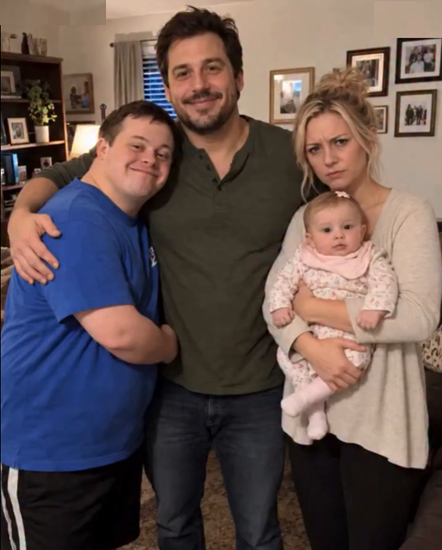
Then I looked at it.
Jamie was smiling.
Claire was crying.
And Sophie was resting peacefully in her uncle’s arms.
It wasn’t a perfect photograph.
The hospital lighting was harsh.
My phone had focused slightly too low.
And everybody looked exhausted.
But it was the most meaningful family photograph I had ever taken.
Later, when things had become quieter, Claire and I spoke privately.
She admitted that the accident with the soup had frightened her more deeply than she had realized.
She had carried that fear into every interaction with Jamie.
But she also admitted that she had allowed one accident to define him.
She had confused caution with exclusion.
And she had forgotten that Jamie deserved the opportunity to learn, grow, and be treated with dignity.
I told her that protecting Sophie was our responsibility.
But protection could not mean making unfair assumptions about someone because of a disability.
We needed to judge specific situations, follow appropriate safety guidance, and communicate honestly.
We also needed to make sure that every adult around Sophie understood the importance of safe baby equipment.
The broken pacifier clip had been a serious reminder that small objects and detachable parts can pose risks to infants.
From that night onward, we would be more careful about anything placed near her.
Claire agreed.
Then she looked at Jamie.
“I should have trusted you enough to talk to you.”
Jamie shrugged.
“It’s okay.”
She shook her head.
“No. It wasn’t okay.”
He looked at her.
Then he smiled slightly.
“Next time, I tell you about class.”
Claire laughed through her tears.
“Next time, I’ll ask.”
A few days later, Jamie visited us again.
He brought the same bag.
The same bag that had once made Claire suspicious.
This time, she smiled when she saw it.
“What’s in there today?”
Jamie opened it.
His practice doll was still inside.
He also had his course notes and a small notebook.
“I have homework.”
Claire laughed.
“Of course you do.”
He took out the notebook and showed us a page.
He had written down some of the things he had learned.
He was proud of his progress.
I looked at him.
“Are you still going to class?”
“Yes.”
“Good.”
He smiled.
“I want to learn more.”
Claire came over.
“Jamie?”
He looked up.
“Yes?”
“Thank you for helping Sophie that night.”
He nodded.
“She’s my niece.”
Claire reached out and touched his shoulder.
“I know.”
Then Jamie walked toward the doorway.
He stopped.
Knocked twice.
I knocked back.
Claire joined us.
Two knocks.
A response.
And this time, all three of us understood exactly what they meant.
We were okay.
I still think about that night.
I think about how quickly fear can change the way people see someone.
I think about how easily one accident can become the only thing a person remembers.
And I think about my brother.
The boy who sat beside me at our mother’s funeral and asked where he would live.
The young man who learned to take the bus alone.
The employee who noticed a mistake on his first paycheck.
The brother who encouraged me to build a life of my own.
And the uncle who quietly attended classes because he wanted to be prepared for the little girl he loved.
He never asked for praise.
He never demanded that anyone recognize what he was doing.
He simply wanted to be included.
That night reminded me that Down syndrome does not define the entirety of a person’s abilities, character, or potential.
People deserve to be understood as individuals.
They deserve the chance to learn.
They deserve respect.
And they deserve to be judged by their actions rather than by assumptions.
Jamie had spent months trying to show us that he could be trusted.
But perhaps the greater lesson was that we should have taken the time to understand him before making up our minds.
I looked at the photograph on my phone again.
Jamie was holding Sophie.
Claire was leaning beside him.
And I was standing just outside the frame, taking the picture.
For once, nobody had asked him to step aside.
Nobody had told him he wasn’t immediate family.
Nobody had treated him as if he didn’t belong.
He was exactly where he had wanted to be.
With us.
And if I could return to that hospital room, I would tell him one thing.
“Jamie-Bamie, you never had to earn your place in this family.”
“You already belonged here.”