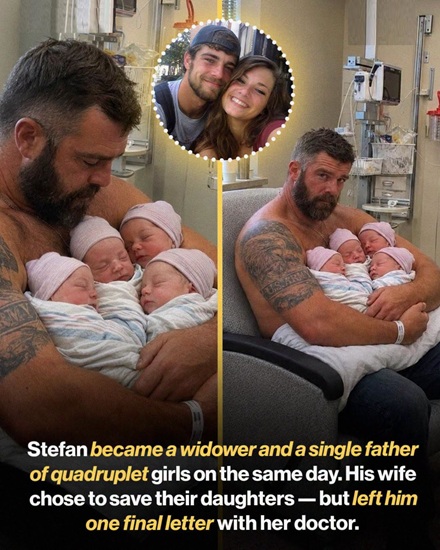
I was 32 years old when I became the father of four little girls and lost my wife on the same day. For months, I had imagined the moment Grace and our daughters would come home from the hospital.
I pictured four tiny car seats arranged in the back of our vehicle, bottles covering the kitchen counter, and baby blankets scattered across the living room.
I imagined Grace laughing at me as I tried to remember which baby I had just fed.
I had even practiced changing diapers using a rolled-up towel because I wanted to be prepared.
But nothing could have prepared me for returning home without her.
And nothing could have prepared me for the letter she had left behind.
At the time, I thought the hardest part of that day would be saying goodbye to my wife.
I didn’t yet know that, before I could even begin to understand my loss, I would discover a secret that would change the way I remembered the final months of our marriage.
I was overseas when Grace first told me she was pregnant.
We had been married for six years, and starting a family was something we had talked about many times.
The video connection was terrible.
Her face kept freezing, and I could barely hear what she was saying.
“Stefan, can you hear me?”
“Most of it. You’re breaking up.”
She held something close to the camera.
It looked like a small photograph, but I couldn’t make out anything.
“Move it farther away,” I said.
She laughed.
“Stop looking at the picture and look at me.”
I did.
She raised four fingers.
I stared at the screen.
“Four?”
“Four babies.”
For a moment, I couldn’t speak.
I thought I had misunderstood her.
“You’re telling me we’re having four babies?”
She nodded, laughing and crying at the same time.
The connection froze again, leaving her hand suspended in the air.
When the picture returned, I was crying too.
I had expected to become a father one day.
I had not expected to become the father of four children at once.
When we later learned they were all girls, I told three soldiers in my unit.
They immediately started calling me the princess commander.
I didn’t mind.
From that day forward, every phone call began the same way.
“How are my five girls?”
Grace would roll her eyes.
“One of us wants ice cream, and four of us want to kick my bladder.”
I laughed every time.
We had originally talked about having two children, perhaps three.
Four babies were frightening, exciting, and almost impossible to imagine.
But we were happy.
The hardest part was knowing I couldn’t be there for every appointment or every difficult day.
My service commitments kept me away, and I hated missing the ordinary moments that make a pregnancy feel real.
I couldn’t help Grace carry groceries.
I couldn’t sit beside her during every medical appointment.
I couldn’t rub her back when she was uncomfortable or bring her something to eat when she suddenly wanted it.
I tried to make up for the distance through calls and messages.
Sometimes we talked for only a few minutes.
Other nights, we stayed connected until one of us fell asleep.
I wanted to be present in every way I could.
That was why I asked my best friend, Nick, to check on her.
Nick and I had known each other since our early twenties.
He had helped me move apartments, stood beside me at my wedding, and been there through some of the most difficult periods of my life.
I trusted him completely.
He lived close to our house and could visit whenever Grace needed something.
Before I left, I gave him our spare key.
“Check on her, okay?” I said. “She hates asking people for help.”
Nick laughed.
“I’ve got her. Worry about your own job.”
I thanked him.
At the time, I believed I was leaving my wife in the hands of someone I could trust like family.
Getting leave for the birth wasn’t simple.
There were schedules to consider and commitments I couldn’t simply ignore.
I eventually agreed to extend my service commitment to help arrange the timing of my return.
Grace kept telling me I didn’t have to sacrifice so much.
“I want to be there,” I told her. “I’ve already missed enough.”
She would smile whenever I said it.
When I finally returned home, it was one week before her scheduled delivery.
Grace looked exhausted.
Her pregnancy had become physically demanding, and carrying four babies made even simple movements difficult.
She struggled to reach her shoes.
Getting comfortable in bed took several attempts.
Sometimes she would stop in the middle of a conversation because one of the babies was kicking hard enough to make her wince.
I tried to make her laugh whenever I could.
That first evening, I sat on the bedroom floor and rubbed lotion into her swollen feet.
She looked down at me.
“Do you miss the quiet?” she asked.
I smiled.
“I haven’t had quiet in months. The guys in my unit snore like broken engines.”
She laughed.
Then her expression became serious.
“Do you ever worry you won’t be good at this?”
I looked up.
“Every day.”
“What if the girls aren’t what you imagined?”
I laughed softly.
“I’m imagining four tiny people who are going to ruin my sleep. Am I close?”
She didn’t laugh.
I stopped rubbing her feet and took her hand.
“Grace, they’re our daughters. I’ll love them even when they hate me for making them clean their rooms.”
She leaned forward and kissed my forehead.
I assumed she was simply nervous about becoming a mother.
I didn’t realize there were other things weighing on her mind.
During those seven days, we prepared everything we could.
We sorted baby clothes by size, arranged the nursery, and checked the supplies repeatedly.
We argued playfully about names.
We had settled on Lily, Rose, Hannah, and Emma, although Grace occasionally threatened to change one of them.
One afternoon, she caught me practicing diaper changes on a rolled towel.
“You know the real ones move, right?”
“I’m starting with the cooperative one,” I replied.
She laughed so hard that she had to sit down.
I remember that laugh more clearly than almost anything else.
The morning of the delivery arrived sooner than I expected.
Because of the risks associated with carrying four babies, Grace’s doctors had monitored her closely throughout the pregnancy.
The medical team had discussed the delivery plan with us, and I knew there could be complications.
Still, I was focused on one thing.
I wanted to meet my daughters.
As nurses prepared Grace for surgery, she squeezed my hand.
“Don’t send everyone pictures before I see them,” she said.
“I promise.”
“And don’t let your mother buy them matching dresses.”
“No promises there.”
She smiled.
Then her eyes became wet.
“Stefan, I love you.”
I leaned toward her.
“I love you too. I’ll be right here.”
The doors closed.
I remained in the waiting area, watching people move through the corridor.
At first, I tried to stay positive.
I imagined four tiny faces and wondered which one would look most like Grace.
I thought about the first time I would hold them.
I thought about the photographs I wanted to send to our families.
But the operation took longer than I expected.
Every time someone walked through the doors, I looked up.
Eventually, a nurse approached me.
She explained that all four girls had been delivered alive and were receiving care in the neonatal unit.
I stood immediately.
“And Grace?”
“The doctors are still working on her.”
I asked whether I could see her.
The nurse explained that the medical team was still treating an emergency.
I called my mother.
I told her the babies had arrived.
Then I couldn’t say anything else.
She kept asking whether I was okay.
I told her I was waiting for news.
I wasn’t okay.
I was terrified.
After some time, a doctor asked me to come into a small room.
I remember the tissue box on the table.
I remember refusing to sit down.
The doctor spoke carefully.
Grace had developed severe bleeding during the delivery.
The medical team had worked to control it and had done everything they could, but she had not survived.
I asked him to repeat what he had said.
He did.
I asked whether there had been another option.
He explained the emergency and the efforts made to save her.
He also told me that Grace had discussed her wishes with the medical team before the procedure, including what she wanted if an emergency threatened her life and the babies’ lives.
She had wanted them to do everything possible for our daughters.
The doctors had also worked to save her.
I heard the words, but I couldn’t make them feel real.
Grace wasn’t coming home.
I would never hear her laugh in the kitchen again.
I would never see her holding our daughters together.
The future I had imagined disappeared in a few sentences.
Then the doctor placed a folded sheet of paper in front of me.
“She wrote this before the procedure,” he said. “She asked me to give it to you.”
I recognized her handwriting immediately.
My name was written at the top.
The doctor left me alone.
For several minutes, I simply held the letter.
I expected it to contain instructions about the girls.
Perhaps a reminder to call her parents, a joke about my diaper-changing skills, or something she wanted me to remember when I brought the babies home.
I had no idea what was waiting inside.
At the top of the page, she had written:
“My Stefan.”
I unfolded it.
“Soon you’ll meet our daughters, but there’s something I need to confess to you. I’m sorry to do it this way.”
My chest tightened.
The next sentence was even harder to read.
“If you’re reading this, I didn’t get the chance to come home.”
I stopped.
I wanted to put the letter down.
I wanted to believe she had written it only because she was frightened about the operation.
Then I read the next paragraph.
“I’ve done something terrible. It happened while you were away. I can’t let you spend your whole life believing a story I know isn’t true.”
I stared at the paper.
My mind began searching for explanations.
Had she hidden something about our finances?
Had she made a decision about the house?
Was she telling me she had wanted to leave?
Then I saw a name.
Nick.
“When you asked Nick to look after me, he did. At first, I was grateful. Then I started waiting for him to visit. I let our friendship become something else.”
I read the paragraph again.
Then I reached the sentence that made my hands go cold.
“I had an affair with Nick.”
I couldn’t breathe normally.
The man I had trusted with our house key.
The man who had stood beside me at my wedding.
The man I had asked to help my pregnant wife because I believed he was my closest friend.
I read on.
“I told myself I was lonely, but loneliness didn’t make me betray you. I chose to do that. I fell in love with him, and I hid it from the man who trusted us both.”
I remembered Nick’s visits.
I remembered him telling me that Grace was doing well.
I remembered thanking him for helping when a pipe had started leaking in the kitchen.
I remembered how relieved I had felt knowing someone was nearby.
I had trusted him without hesitation.
And now I was reading that the trust I had placed in him had been betrayed.
But the letter was not finished.
I forced myself to continue.
“The girls are Nick’s, Stefan.”
I stopped reading.
For a few seconds, I couldn’t understand the words.
I went back to the beginning of the paragraph.
She explained that she had looked at the dates again and again.
According to her, the early ultrasound dating suggested that conception had happened before my visit home, during the period when she had been seeing Nick.
She knew I might question the timing because I had returned home briefly during the deployment.
She said she believed the dates supported her conclusion.
But then she wrote something else.
“I never had a DNA test, and I should not have kept any of this from you.”
I read that sentence several times.
She was telling me what she believed.
But she was also admitting that she had no DNA confirmation.
I couldn’t know whether her conclusion was correct.
I couldn’t know what the girls’ biological relationship to Nick actually was.
All I knew was that my wife had confessed to an affair, and that she believed Nick might be their biological father.
I continued reading.
“Nick doesn’t know. I never told him I believed he was their father. He thinks they’re yours.”
She wrote that she had ended the relationship when she began questioning the kind of man Nick was.
According to her, he had lied easily to people he called friends.
She described a conversation in which she had expressed guilt.
Nick had laughed and suggested I would never suspect them because I trusted him too much.
I paused.
That detail hurt in a different way.
I had spent years believing that Nick’s loyalty was something I could depend on.
Now I was reading that my trust had apparently become part of the reason he felt comfortable continuing the relationship.
Grace continued.
“He said you’d probably thank him for keeping me company. I realized he liked getting away with it.”
She admitted that she had also been dishonest.
She didn’t try to make herself sound innocent.
She didn’t claim that loneliness had forced her into anything.
“I had been just as dishonest, and I hated myself for it.”
Then she wrote:
“I don’t deserve to be excused. If I could change what I did, I would. You should have heard this from me a long time ago.”
I lowered the letter.
The room felt unbearably small.
I had lost my wife that morning.
Now I was being asked to reconsider the entire relationship I thought we had shared.
I wanted to call her.
I wanted to ask why she hadn’t told me while she was alive.
I wanted to know how long she had planned to keep the secret.
But there was nobody who could answer.
I picked up the letter again.
The next paragraph was about Nick.
“Tell Nick if you believe he needs to know.”
She wrote that she had no right to make that decision for me.
Then she added:
“But I am begging you not to let him raise the girls. He doesn’t understand loyalty or responsibility.”
She immediately acknowledged the contradiction.
“I know I failed those same tests myself, so I have no right to judge him. Still, I know you. I know how you love.”
I looked away from the page.
She was asking me to protect our daughters from a man she had once chosen to be with.
I didn’t know what to think.
The final paragraphs were about me.
“I watched you cry when we learned they were girls.”
“You bought tiny shoes while you were thousands of miles away.”
“You changed your service plans so you could meet them.”
“You were their father long before you held them.”
Then came the sentence I would remember for the rest of my life.
“If you can still love them after learning the truth, please do. Don’t punish them for what I did.”
She ended the letter by saying she loved me.
She apologized for not loving me as honestly as I had loved her.
I folded the paper.
Then I unfolded it and read the first line again.
I wanted to call Grace.
I wanted her to tell me that I had misunderstood.
Instead, I was alone with a confession from a woman I could never question again.
My phone was lying on the table.
Nick’s name was still near the top of my recent messages.
That morning, he had sent me a text.
“Tell me when the princesses arrive.”
I almost called him.
I wanted to hear his voice.
I wanted to ask whether he knew what Grace had written.
I wanted to tell him that I knew.
But before I could press the call button, someone knocked.
A nurse stood in the doorway.
“Stefan? Would you like to see your daughters?”
For one awful second, I didn’t know what to say.
The letter had changed everything I thought I knew about their beginning.
But it had not changed the fact that four newborn girls were waiting for someone to hold them.
“Yes,” I said.
The nurse led me toward the neonatal unit.
The room was filled with soft sounds from monitors and medical equipment.
Each baby was in an incubator.
There were four small name cards.
Lily.
Rose.
Hannah.
Emma.
The nurse explained their care and showed me where I could stand without disturbing the equipment.
I tried to listen carefully.
I wanted to remember every instruction.
Lily had a dark patch of hair that stuck up at the back.
Rose wrinkled her nose in a way that reminded me of Grace.
Hannah kept both hands near her cheeks.
Emma was sleeping with her mouth slightly open.
All four were tiny.
All four looked fragile.
I found myself studying their faces.
For a moment, I searched for similarities.
Then I hated myself for doing it.
They were newborn babies.
They had done nothing wrong.
The nurse asked whether I wanted to touch Lily’s hand.
I nodded.
She showed me how to reach through the opening carefully.
Lily’s fingers curled around mine.
I began crying.
“Hi, sweetheart,” I whispered. “It’s Dad.”
The word came naturally.
I didn’t need to understand the letter to know that I loved the little girl holding my finger.
I wanted to be there for all four of them.
I wanted them to grow up feeling safe.
I wanted them to know they were wanted.
Later, the doctor spoke with me again about Grace’s death.
A hospital social worker helped me contact her parents.
I told them the babies were alive.
Then I told them Grace had died.
There was silence on the other end of the phone.
Her mother began crying.
Her father asked when they could come.
I needed them.
I had four newborns receiving hospital care, a home that wasn’t ready for their arrival, and no idea how I was going to manage everything alone.
I couldn’t bring myself to tell them about the letter.
Not that day.
The next afternoon, Nick arrived.
He carried a paper bag containing four stuffed rabbits.
Each one had a different colored ribbon.
I saw him approaching down the corridor and immediately felt my stomach tighten.
“Stefan.”
He hugged me before I could move away.
“I’m so sorry, man.”
He was crying.
I couldn’t tell exactly what he was feeling.
Perhaps he was grieving Grace.
Perhaps he was worried about me.
Perhaps he was carrying guilt that I knew nothing about.
He held up the bag.
“I bought these last week. Grace said the girls would need something soft for their cribs.”
I stared at him.
He knew what she had said last week.
He knew things about her final days that I might never know.
“Can I see them?” he asked.
I wanted to say no.
Instead, I let him look through the nursery window while a nurse checked the monitors.
Nick smiled sadly.
“They look so much like Grace.”
I watched his face.
He looked at the girls with the same gentle interest any family friend might show.
He had no idea that I had read the letter.
Or perhaps he knew more than I could imagine.
“She loved you, Stefan,” he said quietly. “You know that, right?”
My throat tightened.
He was standing beside me, telling me how my wife felt, while I was holding a letter that described their relationship.
I could have taken it from my pocket.
I could have asked him why he had betrayed the man who had given him a house key.
Instead, I said, “I need to get some rest.”
Nick nodded.
“Whatever you need, brother.”
I walked away before he could say anything else.
That night, my mother arrived.
She found me sitting in the hospital family room with an unopened meal beside me.
“Eat something,” she said.
“I’m not hungry.”
“I know. Eat anyway.”
She sat beside me and waited while I managed a few bites.
I thought about telling her.
I knew she would be furious with Nick.
I knew she would have questions about Grace.
But I hadn’t even begun to understand my own feelings.
I didn’t want the secret to become a family argument before I had decided what to do.
“Are you scared?” she asked.
I looked at her.
“Terrified.”
“Of losing the girls?”
I looked toward the neonatal unit.
“Of everything.”
She took my hand.
“You don’t have to figure out the rest of your life tonight.”
I held on to that sentence.
Over the following weeks, the girls grew stronger.
My days became a routine of medical updates, feeding instructions, appointments, and learning how to care for four newborns.
I had to remember which bottle belonged to which baby.
I learned how to prepare supplies before leaving the house.
I practiced holding each daughter safely and recognizing the different sounds they made.
There were difficult nights.
Sometimes two girls cried at once.
Other times, one would finally fall asleep just as another woke up.
My mother and Grace’s parents helped prepare the house for their eventual discharge.
They organized the nursery, washed clothes, and made sure we had enough supplies.
I was grateful for every bit of help.
But the letter remained in my mind.
I kept it inside an envelope in a locked drawer.
Sometimes I would take it out and read a few lines.
Other times, I couldn’t bear to look at it.
Nick continued texting.
At first, I answered politely.
Then my replies became shorter.
Eventually, I stopped responding.
One afternoon, he called.
“Did I do something wrong?” he asked. “You’ve barely spoken to me.”
I stared at Grace’s letter on the table.
“I just lost my wife, Nick. I need some space.”
“From me? I thought we were brothers.”
I closed my eyes.
“I can’t have this conversation right now.”
He started to say something, then stopped.
“Okay. Call when you’re ready.”
I ended the call.
I still hadn’t told him what I knew.
Part of me wanted him to confess without being confronted.
Another part of me was afraid of what he might say.
I didn’t know whether he had been told anything about the pregnancy dates.
I didn’t know whether he believed the girls could be his.
And I didn’t know whether Grace’s conclusion was correct.
The letter was a confession, but it wasn’t a DNA test.
I needed time before making decisions that could affect four children.
Eventually, all four girls came home.
The house was transformed.
Four cribs stood in the nursery.
The kitchen counter was covered with bottles and feeding supplies.
A chart on the refrigerator helped us keep track of feeding times.
There were blankets everywhere.
The quiet house I had returned to after the funeral was no longer quiet.
But it was not the same kind of noise I remembered from before.
It was the sound of four tiny lives beginning their journey.
One evening, my mother found me sitting on the couch with a photograph of Grace.
“Do you regret extending your service commitment?” she asked.
I looked at her.
She knew how much I had sacrificed to be home for the birth.
She knew I had lost my wife and was now raising four daughters.
I thought about the question.
“No,” I replied. “I’d do it again.”
She placed an arm around me.
“I wish Grace could see them.”
“Me too.”
After she went to prepare bottles, I returned the photograph to the table.
Then I took the letter from the drawer.
I read it one more time.
I still didn’t know whether I could forgive Grace.
I still didn’t know what to do about Nick.
I didn’t know whether I would ever receive answers to all the questions that had appeared in my mind.
But I knew one thing.
The girls were not responsible for the choices their parents had made.
They had not chosen the circumstances of their birth.
They had not asked for secrets, betrayal, or complicated questions about their biological history.
They deserved love and stability.
They deserved to grow up without being made to feel guilty for something they had never done.
I also knew that, eventually, I would need to make careful decisions about what to tell them.
If questions about their biological father became important, I would want reliable answers rather than assumptions based only on a letter.
For now, they needed a father who would be there when they cried, when they were hungry, and when they needed someone to hold them.
I put the letter away.
Then I heard Rose beginning to fuss.
I walked into the nursery and lifted her carefully.
She opened her eyes and moved her tiny hands near my chest.
I kissed her soft hair.
“Hey, princess,” I whispered. “Dad’s here.”
I looked toward the other three cribs.
Lily was sleeping.
Hannah had begun moving her arms.
Emma was making the little sounds she often made before waking.
I stood there for a moment, holding Rose.
I had lost the woman I thought I would spend the rest of my life with.
I had discovered a betrayal I never expected.
And I had four daughters whose future depended on the choices I made next.
I didn’t have all the answers.
I didn’t know whether forgiveness would ever come.
But I knew I could not let my anger become the first thing my daughters learned about love.
Grace’s letter had given me painful information, not a complete explanation of everything that had happened.
There would be time to understand the past.
There would be time to make decisions about Nick and the truth surrounding their biological parentage.
But that night, there was only one thing I needed to do.
I held my daughter close and stayed beside her until she fell asleep.
I was their father in the life that mattered every day: the one built through care, responsibility, patience, and love.
And whatever the future revealed, I intended to keep showing up for all four of them.