
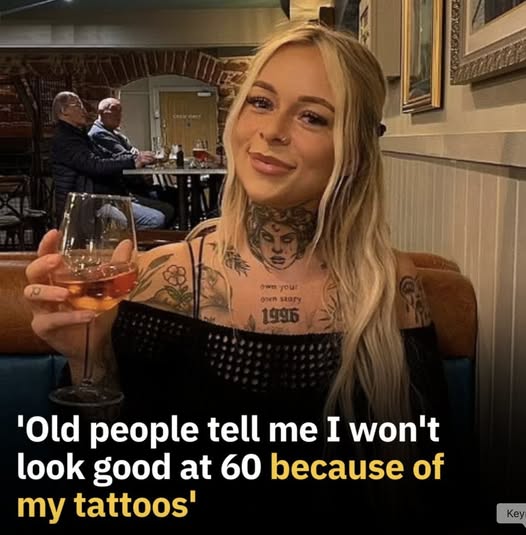
In recent years, the visibility of tattoos has grown significantly, yet social perceptions—especially regarding women with extensive body art—remain complex and often contradictory. Taylor Paige Courtenay, a 27-year-old woman from South Devon, England, has become a prominent figure in this ongoing cultural conversation.
Known for her heavily tattooed body, she has used social media to openly discuss the challenges, judgments, and personal experiences that come with living as a visibly tattooed woman. Her story is not simply about ink on skin; it’s about identity, autonomy, and the courage to live authentically in a world that still imposes rigid standards of beauty.
Courtenay’s tattoos cover large portions of her body, including her neck, arms, stomach, and legs. Each piece, she explains, represents a personal chapter in her life—memories, emotions, struggles, and triumphs rendered permanently in vibrant ink.
In interviews and social media posts, she often emphasizes that her tattoos are not merely decorative but are deeply intertwined with her narrative as an individual. “Every tattoo tells a story,” she has said. “They are moments I’ve lived, choices I’ve made, and experiences I’ve survived. They are as much a part of me as my voice, my thoughts, or my emotions.”
Despite her strong sense of identity, Courtenay acknowledges that living with extensive body art comes with social scrutiny, particularly from older generations who maintain more traditional views of femininity and professionalism. She has described in multiple videos and posts how people often make assumptions about her character, lifestyle, and even her future simply based on her appearance.

Comments suggesting that she might regret her tattoos one day, or that her body art makes her less “presentable” or “acceptable,” are common. In her words, these critiques reflect not just personal opinions but deeply ingrained cultural expectations that equate beauty and respectability with conformity.
One of the central themes Courtenay addresses is the tension between self-expression and societal acceptance. In a widely shared TikTok video, she openly discusses the realization that she may never be perceived in the traditional sense as “that girl”—the type of woman proudly introduced to family, admired in social settings, or regarded as a conventional role model.
While this acknowledgment was initially painful, Courtenay reframed it as an act of liberation rather than limitation. “I’ve had to accept that not everyone will celebrate me the way I hope, and that’s okay,” she explains. “My value is not determined by whether my appearance fits a traditional mold—it’s defined by who I am, how I treat others, and how I express myself.”
Courtenay also confronts the idea that tattoos somehow diminish natural beauty or attractiveness. Many critics, often framing their comments as “concern,” assert that extensive tattooing obscures a woman’s innate features and that she will come to regret these choices as she ages.
Courtenay’s response to this line of reasoning is both blunt and thought-provoking. In a viral video captioned, “Your tattoos are not going to look good when you hit 60,” she addresses the claim directly: aging is inevitable for everyone, tattoos or no tattoos.
She points out that the human body changes over time regardless of personal choices, and that fear of these changes should not dictate how one expresses themselves in the present. Her message underscores the principle that self-expression and authenticity take precedence over societal approval.
The reactions to Courtenay’s posts illustrate the generational and cultural divide surrounding tattoos. Many younger viewers resonate with her perspective, sharing their own experiences of tattooing as a form of self-expression, empowerment, and personal storytelling.
They emphasize that tattoos age with the individual, becoming part of a person’s evolving identity rather than a regrettable mistake. For supporters, Courtenay’s story is a reminder that bodily autonomy is fundamental, and that judging someone’s choices based on traditional norms is both intrusive and unnecessary.
Conversely, critics often maintain that visible tattoos, particularly on women, remain symbols of rebellion or nonconformity, challenging long-established ideals of femininity and propriety. Some commentators argue that sharing one’s tattooed body online invites judgment, framing their critiques as a matter of etiquette, modesty, or aesthetics.

Others describe tattoos as a form of “permanent graffiti,” claiming they detract from natural beauty and implying that women, in particular, should exercise caution in altering their appearance so visibly.
Despite the polarization, Courtenay has cultivated a nuanced approach to handling online criticism. Recognizing the emotional toll of constant public scrutiny, she has occasionally disabled comments on her social media posts, creating safe spaces where she can share her story without being subjected to relentless judgment.
This choice reflects a broader awareness among modern content creators of the psychological impact that social media can have, particularly when discussions revolve around personal appearance, identity, and lifestyle choices.
Importantly, Courtenay’s story is not defined solely by public perception or controversy. Her personal life challenges many of the assumptions made about heavily tattooed women. As of December 2024, she is in a committed relationship and shares a child with her partner.
She has described herself as being “that girl” to her partner—the one celebrated, respected, and loved for who she is, tattoos and all. This milestone adds depth to her narrative, highlighting that meaningful relationships are founded on connection, values, and mutual respect rather than conformity to societal standards of appearance.
Courtenay’s experiences also shed light on a broader cultural shift in how younger generations approach self-expression. Tattoos, once strongly associated with counterculture or rebellion, have become mainstream forms of artistic and personal expression.
For many, they represent resilience, milestones, and a visual record of one’s life story. Older generations may interpret tattoos as rebellious or permanent deviations from accepted norms, but for younger individuals, tattoos are extensions of individuality, self-empowerment, and storytelling.
This generational tension is about more than aesthetics—it reflects differing perspectives on autonomy, risk, and cultural values. Older critics may genuinely believe they are offering wisdom, rooted in life experience, yet younger individuals often perceive such comments as intrusive or dismissive. Courtenay’s response, which emphasizes self-acceptance and authenticity, illustrates a modern negotiation between respecting tradition and embracing personal freedom.

At its core, Courtenay does not claim that her tattoos define her identity entirely. Rather, she frames them as one aspect of a multifaceted self. Her body art is a visual representation of lived experiences, choices, and values.
By sharing her story publicly, she invites dialogue about autonomy, respect, and the limits of unsolicited advice. She demonstrates that while external opinions may be persistent, the authority to determine how one expresses oneself resides with the individual.
As Taylor Paige Courtenay’s story gained traction online, the discussion around her tattoos evolved into a broader cultural debate, reflecting generational divides, gendered perceptions, and the ongoing negotiation of self-expression in a digitally connected world.
Social media platforms, particularly TikTok and Instagram, have allowed Courtenay to share her experiences directly with large audiences, bypassing traditional gatekeepers of beauty, propriety, and social norms. Yet this visibility comes with both opportunity and risk.
Courtenay frequently encounters a duality in online reactions. On one hand, she has amassed a community of supporters who resonate with her message of bodily autonomy and authenticity. Many commenters share personal anecdotes, expressing solidarity and detailing their own journeys with tattoos.
These stories often highlight the therapeutic and expressive value of body art. One supporter recounted receiving their first tattoo as a teenager and gradually covering their arms, torso, and legs with intricate designs over the years. Despite what some might perceive as a risk for future regret, they expressed enduring satisfaction with their tattoos and described them as a living chronicle of their life experiences.
Similarly, other followers praise Courtenay for challenging traditional beauty standards. In their comments, they stress that societal approval is not a prerequisite for self-expression. “I’ve been tattooed for over a decade,” one user wrote. “Every piece represents a story I’ll never forget.
I have no regrets, and I feel more confident and authentic than ever. Taylor’s message resonates with me because it reminds us that our bodies are ours to define.” Another echoed this sentiment, noting that judgments about appearance are often more about the observer’s discomfort than the individual’s choices.
“Just because someone else doesn’t understand or like it doesn’t mean it’s wrong. Personal expression is not a public debate—it’s private ownership of who you are.”
On the other hand, Courtenay’s posts also draw intense criticism, often framed as concern but rooted in rigid cultural norms. Many older commenters express anxiety that heavily tattooed women might face regret later in life or struggle to be accepted in professional or familial settings.

Common refrains include, “What will you do when you’re 50 or 60?” and “Tattoos ruin natural beauty.” These comments frequently reflect generational expectations of femininity, propriety, and social decorum. In some cases, critics suggest that a woman’s worth or credibility is diminished if she visibly defies these standards.
A recurring theme among detractors is the framing of tattoos as permanent and inherently risky. The term “regret” is often invoked, implying that youthful choices are likely to become burdensome with age. Courtenay counters this perspective by emphasizing the inevitability of aging for all individuals.
She points out that the human body changes over time regardless of appearance, whether tattooed or not. Her message reframes the conversation: instead of worrying about hypothetical future regrets, the focus should be on embracing authenticity and living fully in the present.
Gendered assumptions also play a prominent role in the criticism she receives. Heavily tattooed men are often described in terms of artistry, rebellion, or individuality, while heavily tattooed women are more likely to be judged as provocative, unprofessional, or nonconforming.
This double standard highlights the ongoing societal tension around women’s autonomy over their bodies. Courtenay’s visibility challenges these assumptions, showing that self-expression through tattoos is not inherently tied to promiscuity, unprofessionalism, or irresponsibility.
The discussion surrounding Courtenay also reflects broader societal changes in how identity and beauty are understood. Tattoos, once closely associated with counterculture movements or subversive behavior, are now mainstream among younger generations.
Studies in cultural sociology have noted that body art increasingly functions as a form of storytelling, resilience, and empowerment. For many, tattoos represent milestones, personal victories, or memorials of meaningful experiences. Courtenay embodies this shift, using her tattoos not to shock or rebel but to illustrate her narrative in a tangible, visual form.
Social media amplifies these dynamics in unique ways. Platforms like TikTok and Instagram allow individuals to engage with diverse audiences, but they also intensify scrutiny. Courtenay’s decision to occasionally disable comments demonstrates an awareness of the emotional labor involved in navigating public visibility.
Constant judgment, even when framed as constructive, can erode confidence and mental well-being. By controlling how and when her audience can respond, Courtenay prioritizes her own mental health while still engaging meaningfully with supportive communities.
Courtenay’s story also highlights the power of relatability. Many followers relate not only to the experiences of having tattoos but to the broader struggle of navigating societal expectations.
They find validation in seeing someone publicly assert her autonomy, demonstrating that it is possible to live authentically despite criticism. Her posts often spark conversations about the boundaries of unsolicited advice, the role of cultural norms in shaping behavior, and the importance of self-acceptance.
Within the tattoo community, Courtenay’s journey resonates particularly strongly. She represents a growing cohort of women who embrace body art as a form of self-definition, challenging both internalized and external pressures. Tattoo conventions, online forums, and social media groups dedicated to tattoo culture are filled with similar narratives—people sharing experiences of resistance, acceptance, and self-discovery.
Many emphasize that tattoos age alongside the body, acquiring deeper significance as time passes. Far from being “mistakes,” these designs become integrated into the person’s identity, chronicling their journey through life.

The broader cultural debate around Courtenay’s tattoos intersects with conversations about authenticity, visibility, and the limits of societal judgment. Older generations may view her choices as extreme or unconventional, yet younger generations increasingly interpret such expressions as normal, even essential, aspects of individuality.
This generational divide is not merely aesthetic; it encompasses differing attitudes toward autonomy, risk-taking, and the socialization of appearance. Courtenay’s response to criticism—assertive, candid, and unapologetic—exemplifies a modern approach to reconciling personal freedom with public perception.
Moreover, Courtenay’s experience underscores a critical point: the debate over tattoos is often less about the ink itself and more about societal control of the body.
When critics warn of future regret, question professionalism, or assert that certain appearances are unacceptable, they are, intentionally or not, imposing restrictions on how individuals express themselves. Courtenay challenges this notion, asserting that ownership of one’s body and self-expression is not conditional upon public approval. Her tattoos are not acts of rebellion—they are acts of personal truth.
Finally, Courtenay’s story illuminates the evolving relationship between women, visibility, and self-expression. She is both a participant in and a catalyst for broader cultural shifts, questioning long-held assumptions about femininity, beauty, and respectability. Her narrative demonstrates that choices previously seen as radical—such as extensive body art—are increasingly reframed as legitimate expressions of identity.
Through her openness, she invites a wider conversation about the boundaries of judgment, the value of authenticity, and the freedom to define oneself in a society still negotiating its relationship with change.
Taylor Paige Courtenay’s story, while deeply personal, extends far beyond individual choice. It reflects a broader societal conversation about autonomy, the definition of beauty, and the evolving ways in which people navigate identity in a world that often imposes rigid expectations.
For Courtenay, tattoos are not just a form of self-expression—they are a testament to her journey, a visual representation of resilience, and a declaration that one’s body is ultimately one’s own.
Her willingness to speak candidly about criticism, judgment, and the scrutiny she faces has sparked a dialogue about the limits of unsolicited advice and societal interference. Many of her followers and supporters note that they have experienced similar pressures, whether through appearance, lifestyle choices, or career paths.
Courtenay’s message resonates because it validates these experiences: the right to self-expression is not contingent on public approval, and authenticity should not be sacrificed for conformity.
One of the most compelling aspects of Courtenay’s narrative is her ability to reconcile vulnerability with confidence. While she openly acknowledges that some criticisms are painful, she refuses to let them dictate her choices.
She has shared moments of introspection where she questioned whether societal approval would ever come, particularly in formal or traditional settings, and how this might affect her relationships or social standing. Yet, through these reflections, she consistently returns to a central principle: happiness and self-expression are not mutually exclusive with love, respect, and meaningful connection.
Her experience also challenges assumptions about professional and personal success. Contrary to stereotypes that heavily tattooed women may face limitations in careers or relationships, Courtenay demonstrates that life choices, competence, and character are not determined by appearance alone.
By sharing her life as a mother, partner, and content creator, she presents a multidimensional view of what it means to be fully realized in one’s personal and professional life. Her child, born in the summer of 2023, is an integral part of this narrative, emphasizing that meaningful relationships and family life coexist seamlessly with self-expression.
Courtenay’s journey has profound implications for cultural understanding of tattoos, especially regarding women. Historically, women with visible tattoos have been judged more harshly than men, often facing social marginalization or being labeled as unprofessional or socially undesirable.
This gendered double standard reflects long-standing cultural narratives that seek to regulate women’s bodies and appearances. Courtenay’s openness and refusal to conform disrupt these narratives, illustrating that women can exercise full autonomy over their bodies without sacrificing dignity, professionalism, or personal fulfillment.
In addition to challenging gender norms, Courtenay’s story highlights the intergenerational dialogue surrounding tattoos. Older generations frequently view tattoos through the lens of permanence, risk, or social acceptability, while younger generations increasingly interpret them as narratives, forms of self-discovery, and milestones in life.
By engaging directly with both supportive and critical audiences, Courtenay bridges this generational divide, offering insight into why personal choice and artistic expression matter so profoundly.
Her presence on social media has magnified this effect, making her story accessible to a global audience. Through platforms like TikTok, Courtenay not only documents her experiences but also invites broader reflection on how society judges and categorizes people based on appearance.
This democratization of storytelling—where individuals bypass traditional gatekeepers of beauty and propriety—has empowered countless others to assert control over their own narratives. Followers often respond by sharing their journeys, including how tattoos have served as emotional outlets, memorials, or declarations of independence. Collectively, these stories illustrate a cultural shift: the body as canvas, expression as empowerment, and individuality as a right rather than a privilege.
Beyond the digital space, Courtenay’s life serves as a reminder that social narratives about regret, aging, and conformity are often exaggerated or misplaced. Many criticisms she receives are rooted in hypothetical future scenarios, such as warnings that tattoos will look “bad” with age or that certain social opportunities might be limited.
Courtenay’s perspective reframes this concern by emphasizing the universality of aging—everyone experiences physical change, whether tattooed or not. Her stance suggests that choosing authenticity in the present is more meaningful than speculating about potential disapproval decades down the line.
Moreover, Courtenay’s story encourages reflection on the philosophy of beauty itself. Societal standards often present an illusion of permanence and universality, implying that attractiveness and acceptance are fixed measures determined by external validation.
Courtenay challenges this, proposing that beauty is subjective, fluid, and deeply personal. Her tattoos, in this sense, are not only artistic expressions but philosophical statements: they insist that individuality, self-respect, and emotional honesty are fundamental components of true beauty.
The broader implications of her narrative extend into discussions of mental health, empowerment, and self-worth. By asserting control over her body and image, Courtenay provides a model for resisting internalized social pressures and navigating judgment without internalizing shame.
Followers frequently express that seeing her confidence and vulnerability in tandem is inspiring, demonstrating that self-expression does not require perfection, societal approval, or adherence to traditional norms. This modeling effect is particularly important in a digital age, where social comparison and judgment can significantly affect young people’s mental well-being.
Courtenay’s story also intersects with evolving notions of art, storytelling, and memory. Each tattoo represents a lived moment, an emotion, or a decision etched permanently into her skin. This permanence transforms her body into a visual biography—a record of personal growth, resilience, and transformation.
Supporters often echo this sentiment, sharing that their tattoos age alongside them, becoming richer in meaning and significance over time. For many, this perspective reframes what critics label as “regret” into an appreciation of life’s narrative unfolding visibly on the body.
In the end, Taylor Paige Courtenay’s story is less about defiance and more about authenticity. It is about a young woman asserting her right to self-expression, articulating her values, and challenging the assumptions of those who believe physical appearance should dictate social acceptance.
She does not argue that everyone should get tattoos, nor does she dismiss the reality that aging and change are inevitable. Instead, she emphasizes that fear of judgment—whether from older generations, society at large, or even one’s own insecurities—should never limit the freedom to express oneself fully and honestly.
Her journey invites a profound question for society: who truly gets to decide how a person should look, act, or live in their own body? Courtenay’s answer is unequivocal—individual choice, autonomy, and happiness take precedence.
Through her tattoos, her openness, and her public reflections, she encourages others to examine their own assumptions about beauty, conformity, and self-worth. She reminds us that respect, love, and connection are built not on adherence to aesthetic norms but on authenticity, empathy, and shared values.
Ultimately, Courtenay’s legacy is one of courage and inspiration. She exemplifies how personal expression, when embraced fully, can challenge cultural norms, redefine beauty standards, and foster community among those who seek to live authentically.
By asserting her right to own her story, ink and all, Taylor Paige Courtenay encourages a society that values individuality, respects autonomy, and celebrates the diverse ways people choose to inhabit their own skin. Her message transcends tattoos: it is a call to embrace life fully, courageously, and without apology, knowing that time and change are inevitable, but authenticity is timeless.
