
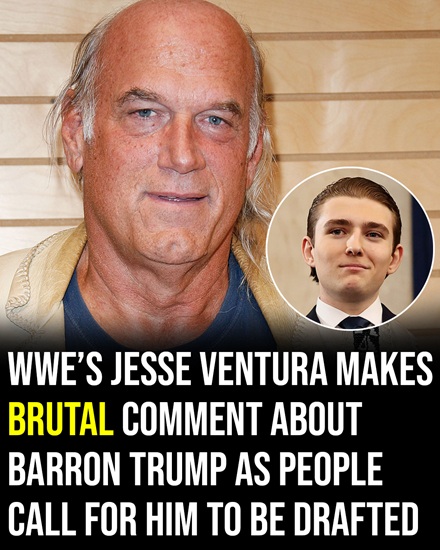
Former professional wrestler, governor, and military veteran Jesse Ventura once again made headlines with provocative remarks during a recent interview that has sparked widespread discussion across the United States and beyond.
Appearing on Piers Morgan Uncensored, Ventura addressed the widely reported 2024 assassination attempt on Donald Trump, questioning aspects of the incident even as federal officials confirmed its authenticity.
The attempt, which took place during a campaign stop in Pennsylvania, left one supporter dead and others injured, prompting a federal investigation and national security responses.
Ventura expressed disbelief about the shooting, suggesting that the lack of a visible scar and other details raised questions in his mind about what actually occurred.

During the interview, he referenced the wrestling term “blade job,” a practice in which performers simulate cuts for dramatic effect — a comparison that drew widespread attention and criticism.
Host Piers Morgan pressed Ventura on the matter, challenging him to explain the basis for his skepticism and whether he truly believed the official account was fabricated.
Ventura’s remarks quickly circulated on social media, prompting reactions from political commentators, journalists, and public figures who weighed in on the delicate balance between free expression and respect for verified events.
In addition to his skepticism about the assassination attempt, Ventura directed sharp criticism at former President Donald Trump regarding military service and leadership responsibility.
Ventura called on Trump’s youngest son, Barron Trump, who is now in his early twenties, to enlist in the United States military — a suggestion that added another layer of controversy to his interview.
Arguing from his own perspective as a military veteran, Ventura said that serving one’s country was a meaningful duty that demonstrated commitment beyond political rhetoric.
Ventura himself served in the U.S. Navy from 1969 to 1975, including time in the Mekong Delta and South China Sea, experiences that earned him multiple service medals.

He was awarded the Vietnam Service Medal, the Republic of Vietnam Campaign Medal, and the Navy Expeditionary Medal for his active duty contributions during a period of geopolitical conflict.
Ventura emphasized that he saw military service as an honorable path that builds character and shared sacrifice, themes he believes are valuable for national leaders and their families.
His comments about Barron Trump referenced the fact that none of Donald Trump’s children have served in the armed forces, a point that Ventura said merited discussion.
He noted that despite Trump’s public prominence and decades in the spotlight, members of his immediate family had not taken part in military service — a reality Ventura sees as a missed opportunity.
Ventura drew on comparisons to public figures like former NBA player David Robinson, who successfully served before pursuing a professional basketball career, to underline his point about service eligibility.
Robinson famously served in the U.S. Navy after graduating from the U.S. Naval Academy, preceding his NBA career with the San Antonio Spurs, a path Ventura cited during the broadcast.
Ventura’s interviews have long blended blunt commentary with his personal worldview, rooted in his varied backgrounds in sports, military, and politics.

As a former governor of Minnesota, Ventura built a reputation for unconventional viewpoints, often diverging from mainstream political discourse and challenging conventional narratives.
His experiences as a Navy veteran have shaped his opinions on national service and civic duty, viewpoints he frequently brings into public debates.
Political analysts note that Ventura’s critique comes at a time of heightened public sensitivity around national leadership, military engagement, and presidential legacy.
At the same time, public response to Ventura’s call for Barron Trump to enlist has been deeply divided, with some seeing it as a patriotic challenge and others viewing it as inappropriate.
Critics argue that military service is voluntary in the United States and that targeting private citizens for public military obligation contradicts core principles of personal freedom.
Others, however, see Ventura’s comments as part of broader conversations about leadership, privilege, and national duty that have resurfaced in recent years.
Groups representing veterans and service members have weighed in with varied perspectives, emphasizing respect for service while acknowledging differing views on enlistment expectations.

Some voices praised Ventura’s military background and his intention to highlight the value of service, even if they disagreed with his specific wording or targets.
Analysts also point to broader geopolitical tensions — including global conflicts and rising international instability — as factors influencing public sensitivity toward military participation and national security.
Increasingly, discussions about the intersections of politics, military service, and personal responsibility have become central themes in media coverage and public debate.
Ventura’s comments about the assassination attempt reflect a longstanding pattern of questioning official narratives — a trait that has defined much of his commentary throughout his post‑political career.
During the interview, Piers Morgan repeatedly pressed Ventura to clarify the basis for his statements, prompting extensive back‑and‑forth exchanges that drew significant viewer engagement.
The Piers Morgan Uncensored episode featuring Ventura quickly became one of the most discussed segments in recent months, with clips circulating widely online.
Social media platforms erupted with responses, reactions, and debates, amplifying the conversation far beyond the original broadcast audience.
Supporters of Ventura praise his willingness to speak boldly, even when tackling sensitive national issues, a trait that has maintained his public profile over decades.

Detractors, however, argue that speculation about violent events and public challenges to private individuals can escalate tensions and distract from verified facts.
Some commentators emphasize the importance of balanced discourse, encouraging respect for official investigations and for the individuals affected by national tragedies.
In response to Ventura’s commentary, official statements from political representatives have reaffirmed support for facts established through law enforcement and federal investigations.
The conversation around military service and presidential legacy continues to evolve, reflecting shifting cultural expectations and political values in the United States.
Experts observe that public debate about whether political leaders or their families should serve in the military has a long history in American politics.
Regardless of perspective, Ventura’s remarks have undeniably sparked renewed interest in national discussions about service, sacrifice, and leadership responsibility.
As public reaction evolves, it remains clear that issues of military participation, political accountability, and national identity will continue to be widely debated.
Ventura’s comments, whether agreed with or criticized, have contributed to a broader national conversation — one that reflects the complex intersection of patriotism, public service, and personal conviction.
Public discourse spurred by high‑profile commentators like Ventura increasingly influences how Americans think about leadership, duty, and national commitment.
Whatever the long‑term impact, Ventura’s interview illustrates the continuing role of celebrity voices in shaping political dialogue and public opinion.
Through this episode and its aftermath, Americans reflect on how politics, military service, and personal responsibility intersect in defining national values and expectations.
The reaction to Ventura’s words underscores how deeply issues of service and leadership resonate with people from all walks of life across the country.
As the debate continues, one thing remains certain: public figures who speak passionately about national issues will continue to generate attention — and vigorous discussion — in the years ahead.
