
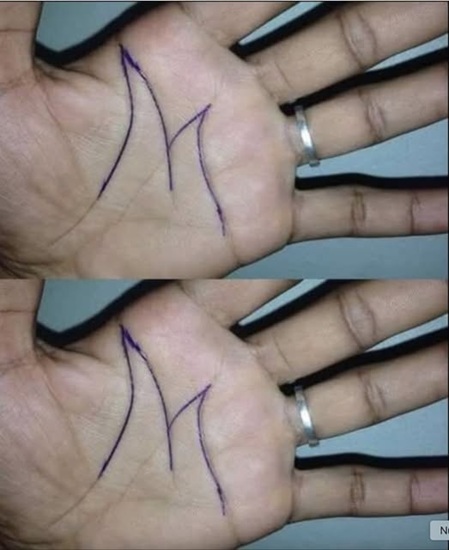
Have you ever paused for a moment to examine your hands closely and wondered about the intricate lines etched into your palms? The human hand is an extraordinary structure, a blend of biomechanics, genetics, and personal experience.
Its remarkable complexity extends beyond mere physical function: the patterns and creases on our palms have fascinated humans for thousands of years.
Across cultures and centuries, these lines have been interpreted in countless ways—ranging from practical studies of hand anatomy to symbolic readings believed to reflect personality traits, emotional tendencies, and even life experiences.
For some, these palm lines are simply the result of natural skin creases formed by hand movement and genetic development. For others, particularly those with an interest in palmistry—also known as chiromancy—they are seen as windows into the human soul, offering insights into character, strengths, challenges, and potential life paths.
Among the many markings that can appear on the palm, one of the most discussed and celebrated is a formation that resembles the letter “M.” This marking has generated widespread curiosity, particularly in popular culture, and is often associated with heightened intuition, leadership qualities, and a sense of purpose.

Notable figures such as Meghan Markle, Hillary Clinton, and Robert De Niro are frequently cited as having this symbolic formation, although these associations are largely anecdotal.
To understand the origins and meanings of these beliefs, it is essential to examine both the historical context of palmistry and the scientific perspective on palm lines.
Palmistry: An Ancient Art Rooted in Culture
Palmistry is one of the oldest interpretive practices in human history, with documented origins spanning India, China, Greece, Egypt, and the Middle East. Historical evidence suggests that palm reading was often practiced alongside astrology, numerology, and other symbolic systems to provide a framework for understanding human nature, behavior, and destiny.
In ancient India, for example, palm reading was considered a vital part of personal assessment and counseling, with texts like the Hasta Samudrika Shastra offering detailed guidelines for interpreting hand features. Similarly, Chinese traditions incorporated hand lines into broader systems of divination, linking them to energy flow and life balance.
It is crucial to emphasize that palmistry is not a science. There is no empirical or medical evidence supporting the notion that the lines of the hand can predict specific events, success, or personal traits.
Modern palmists often acknowledge this, framing their practice as an interpretive art rather than a predictive science. In this sense, palm reading serves more as a tool for reflection, insight, and self-exploration than as a method for foretelling the future.

Despite this, the fascination with palm lines persists. Humans are naturally drawn to patterns and symbols, and the hands provide a unique canvas for projecting meaning. Each person’s palms are unique, shaped by genetics, prenatal development, and lifelong movement.
Much like fingerprints, the exact arrangement of lines is one-of-a-kind, though unlike fingerprints, there is no standardized way to categorize or measure them scientifically.
Understanding the Major Lines of the Palm
In palmistry, attention is typically focused on several major lines, each of which is believed to correspond to different aspects of life and personality. While interpretations vary by tradition, the following are widely recognized:
1. The Heart Line
The heart line runs horizontally across the upper portion of the palm, just below the base of the fingers. It is traditionally associated with emotions, love, and interpersonal relationships.
- A curved or arched heart line is often interpreted as a sign of openness, warmth, and emotional expressiveness.
- A straight or more horizontal heart line may suggest caution, emotional reserve, or a pragmatic approach to relationships.
- Breaks, chains, or forks in the line are interpreted as symbolic markers of emotional experiences or changes in relationships over time.
2. The Head Line
Situated below the heart line, the head line is thought to reflect intellectual tendencies, cognitive style, and decision-making abilities.
- A long, straight head line might indicate analytical thinking, focus, and logical reasoning.
- A curved or wavy head line is associated with creativity, imagination, and intuition.
- Intersection points between the head and heart lines are often seen as indications of how emotions and intellect interact in a person’s life.
3. The Life Line
One of the most misunderstood palm lines, the life line curves around the base of the thumb, encircling the ball of the hand. Contrary to popular belief, it does not indicate lifespan. Instead, palmists traditionally interpret it as a reflection of vitality, resilience, and the ability to adapt to life changes.
- A deep, pronounced life line is thought to signify strong physical energy and determination.
- A fainter or segmented line may indicate periods of significant change, adaptation, or fluctuating energy levels.
4. The Fate Line
The fate line, also called the career or destiny line, runs vertically from the base of the palm toward the middle finger. Not everyone has a visible fate line.
- A prominent fate line is interpreted as a sign of strong career focus or life purpose.
- A weak or absent fate line is seen by palmists as indicating flexibility and openness in life paths, rather than a lack of direction.
- Breaks or changes in the fate line may suggest shifts in career or life circumstances.
5. The Sun Line (Apollo Line)
The sun line runs vertically, usually parallel to the fate line, and is associated with creativity, recognition, and personal fulfillment.
- A clear, strong sun line is often linked to artistic talent, satisfaction in achievements, or public recognition.
- Fainter or fragmented lines may symbolize delayed recognition or a more private form of fulfillment.
The “M” Formation: Symbolism and Interpretation
One of the most intriguing and talked-about formations in palmistry is the so-called “M” shape. This marking typically occurs when the heart line, head line, life line, and sometimes the fate or sun line intersect in a way that visually resembles the letter “M.”

According to palmistry traditions, the “M” formation is believed to signify:
- Strong intuition and insight into people and situations
- Leadership potential and decision-making confidence
- Determination and personal drive
- Potential for career success and public recognition
In popular culture, media articles and social media posts often claim that only 1–2% of people possess this marking, though there is no scientific basis for this statistic.
It is a symbolic interpretation rather than a verified fact. Nevertheless, the association of this marking with prominent figures, such as Meghan Markle or Hillary Clinton, has fueled curiosity and fascination.
Common Misconceptions: The Simian Line
It is important to distinguish the “M” formation from the Simian line, which is a single transverse palmar crease. The Simian line occurs when the heart line and head line merge into one continuous crease across the palm.
- This anatomical variation is present in a small percentage of the population and has been studied in medical contexts.
- It can sometimes appear in genetic syndromes but is also found in perfectly healthy individuals.
- Palmistry interpretations may link the Simian line to intense focus or willpower, but these are cultural interpretations rather than scientific conclusions.
Dominant vs. Non-Dominant Hand in Palmistry
Another key concept in traditional palmistry is the difference between the dominant and non-dominant hand.

- The non-dominant hand is believed to represent inherited traits, potential, and innate characteristics.
- The dominant hand reflects how those traits are expressed in actions, decisions, and life experiences.
For right-handed individuals, this framework means the left hand represents inner tendencies, while the right hand shows outward manifestation. Left-handed individuals reverse this interpretation.
While this notion is meaningful within palmistry, it should not be confused with scientific evidence regarding personality or life outcomes.
Public fascination with palmistry often intensifies when celebrities are involved. The so-called “M” marking, in particular, has captured widespread attention, largely due to its association with high-profile figures.
Meghan Markle, the Duchess of Sussex, is frequently cited by palmistry enthusiasts as someone with a prominent “M” formation on her palms.
Palm reader Gary Markwick, who has worked with several public figures, has suggested that individuals with such markings are often highly intuitive, goal-oriented, and sensitive to the dynamics of people and situations.
Other well-known personalities, such as Hillary Clinton and Robert De Niro, are similarly said to display this formation, reinforcing the perception of a link between the “M” marking and leadership, determination, and influence.
However, it is critical to underscore that these claims are interpretive rather than empirical. Public achievements are the product of a combination of education, opportunity, determination, work ethic, and sometimes luck—not palm markings.
The fascination with celebrity palms demonstrates the human tendency to find patterns and symbolic meaning in visible traits. Just as fans analyze handwriting, fashion choices, or body language, palm lines become a canvas for storytelling about character and potential.

Psychological and Sociological Perspectives
Why does palmistry remain compelling, despite a lack of scientific support? Psychologists and sociologists offer several explanations:
- Pattern Recognition and Meaning-Making
Humans are naturally predisposed to seek patterns in the environment. This cognitive bias, known as apophenia, can make lines on the palm appear meaningful. When we interpret these lines as symbols of personality or destiny, it provides a narrative framework for understanding ourselves and others. - Self-Reflection and Insight
Palmistry encourages self-reflection in a way similar to personality tests, journaling, or meditation. Even if the interpretations are symbolic rather than factual, thinking about the qualities a line is said to represent can promote introspection and self-awareness. - Storytelling and Cultural Resonance
Cultural traditions around palmistry provide shared stories that can be comforting or inspiring. From India to China to Europe, reading palms has historically been a means of exploring identity, relationships, and personal development. These practices continue today in a more symbolic form. - The Desire for Connection
Palm readings are often personal experiences. A reader examining someone’s hand creates a direct, intimate interaction. People may feel understood or recognized during this process, enhancing the appeal of the practice.
Scientific Understanding of Palm Lines
From a biological and anatomical perspective, palm lines are formed during fetal development. Genetics, movement, and skin folding in the womb contribute to the unique patterns seen on every hand.
- Genetics: Family traits influence the overall shape of the hand, finger length, and the presence or absence of certain lines.
- Movement: Repeated hand movements and the function of joints and muscles create creases over time.
- Developmental Variation: Minor variations in skin tension during growth can produce subtle differences in line shape, depth, and intersection.
Unlike fingerprints, which are scientifically categorized and used for identification, palm lines are not standardized or predictable. They do not provide reliable information about personality, intelligence, or life outcomes.
Medical research occasionally studies palm creases, such as the Simian line, because of its association with certain genetic syndromes (e.g., Down syndrome or other chromosomal variations). Even then, the presence of such lines is not determinative: many healthy individuals naturally have a single transverse crease.
Interpreting Palmistry Responsibly
For those interested in palmistry, it is essential to approach it as a symbolic and interpretive tool rather than a predictive one. Responsible interpretations involve:
- Treating readings as reflective insights, not literal predictions.
- Avoiding the assumption that any marking guarantees a particular trait, success, or destiny.
- Using palmistry as a springboard for self-reflection, goal setting, and personal growth.
- Consulting professionals for medical, psychological, or financial guidance rather than relying on palm readings.
This balanced perspective allows palmistry to remain meaningful as a cultural practice, creative framework, or self-exploration tool without spreading misinformation.
The “M” Mark: Practical Symbolism
Even if we treat the “M” formation symbolically, it can inspire reflection on qualities that are universally valuable:
- Intuition – Noticing subtle cues in interactions, understanding complex dynamics, and trusting one’s instincts.
- Leadership – Taking initiative, guiding others, and navigating challenges with confidence.
- Focus and Determination – Maintaining commitment to goals while adapting to obstacles.
- Empathy and Awareness – Recognizing emotional nuances and responding thoughtfully to others.
By reflecting on these qualities in the context of palm markings, individuals may cultivate self-awareness and a clearer sense of purpose—without relying on deterministic interpretations.
Cultural Variations in Palmistry
Palmistry practices differ across the world, highlighting the rich diversity of interpretation:
- Indian Palmistry: Emphasizes Hasta Samudrika Shastra, connecting hand shapes and lines with personality, health, and life stages.
- Chinese Palmistry: Integrates with Traditional Chinese Medicine, linking lines to energy flow (Qi) and meridian points.
- Western Palmistry: Often emphasizes personality traits, life direction, and predictive readings, popularized in Europe in the 19th and 20th centuries.
Despite variations, a common theme emerges: palmistry is symbolic and interpretive, deeply rooted in cultural history rather than empirical science.
The Lasting Appeal of Palmistry
Palmistry continues to fascinate people for several reasons:
- Uniqueness of Hands: Each set of palms is distinct, offering a personalized “map” for interpretation.
- Immediate Connection: Looking at one’s own hands or someone else’s creates instant engagement.
- Symbolic Reflection: Lines and shapes function as mirrors for personal traits, ambitions, and challenges.
- Curiosity and Storytelling: Humans enjoy exploring patterns, legends, and symbolic frameworks.
Even skeptics often admit that the practice can be meaningful as a tool for introspection and conversation, not as a scientific predictor.
What Your Hands Really Tell You
While the lines on your palms do not provide empirical evidence of personality or destiny, they are fascinating records of your biological development, movement patterns, and individual growth. Every crease and intersection represents the story of your body’s development over time.
Rather than seeking absolute answers, consider using palmistry as a reflective practice:
- Notice which lines stand out and what they might symbolically represent.
- Reflect on your traits, goals, and relationships.
- Appreciate the uniqueness of your hands as a blend of genetics, experience, and individuality.
In this way, palm lines become more than simple skin creases; they are prompts for curiosity, self-reflection, and even creativity.
Looking at Your Palm Today
Next time you glance at your palm, notice the major lines, the intersections, and perhaps even the elusive “M” formation. Consider what they might symbolize in terms of your intuition, resilience, and purpose, while remembering that these interpretations are symbolic, not deterministic.
Your palms tell a story—not of destiny predetermined by fate—but of life lived through movement, growth, and individuality. They are maps of your unique human experience, waiting for you to explore, reflect, and draw inspiration from.
So what do you see when you look at your hands? Are they simply fascinating anatomical features, or do they inspire you to reflect on the qualities and choices that shape your life? The answer is entirely yours, and the journey of discovery begins with a single glance at your palms.
he “M” Mark: Practical Symbolism
Even if we treat the “M” formation symbolically, it can inspire reflection on qualities that are universally valuable:
- Intuition – Noticing subtle cues in interactions, understanding complex dynamics, and trusting one’s instincts.
- Leadership – Taking initiative, guiding others, and navigating challenges with confidence.
- Focus and Determination – Maintaining commitment to goals while adapting to obstacles.
- Empathy and Awareness – Recognizing emotional nuances and responding thoughtfully to others.
By reflecting on these qualities in the context of palm markings, individuals may cultivate self-awareness and a clearer sense of purpose—without relying on deterministic interpretations.
Cultural Variations in Palmistry
Palmistry practices differ across the world, highlighting the rich diversity of interpretation:
- Indian Palmistry: Emphasizes Hasta Samudrika Shastra, connecting hand shapes and lines with personality, health, and life stages.
- Chinese Palmistry: Integrates with Traditional Chinese Medicine, linking lines to energy flow (Qi) and meridian points.
- Western Palmistry: Often emphasizes personality traits, life direction, and predictive readings, popularized in Europe in the 19th and 20th centuries.
Despite variations, a common theme emerges: palmistry is symbolic and interpretive, deeply rooted in cultural history rather than empirical science.
The Lasting Appeal of Palmistry
Palmistry continues to fascinate people for several reasons:
- Uniqueness of Hands: Each set of palms is distinct, offering a personalized “map” for interpretation.
- Immediate Connection: Looking at one’s own hands or someone else’s creates instant engagement.
- Symbolic Reflection: Lines and shapes function as mirrors for personal traits, ambitions, and challenges.
- Curiosity and Storytelling: Humans enjoy exploring patterns, legends, and symbolic frameworks.
Even skeptics often admit that the practice can be meaningful as a tool for introspection and conversation, not as a scientific predictor.
