
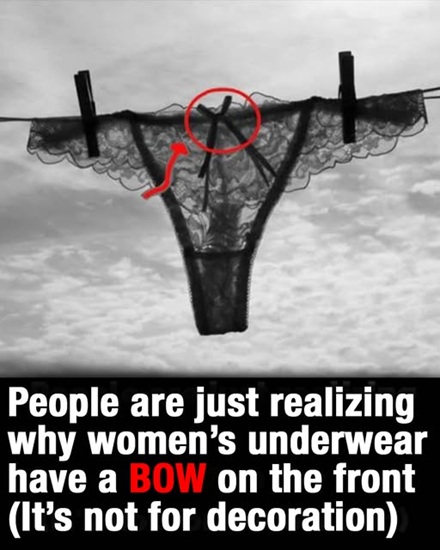
Ever noticed the small bow on the front of women’s underwear and wondered why it’s there? Many people see it every day but rarely think about the fascinating history and practical purpose behind it.
While today it may appear purely decorative, the tiny bow has roots that go back centuries. Before elastic waistbands existed, undergarments required different methods to secure them, making bows a clever and practical feature.
Almost every brand of women’s underwear includes a small bow at the center front. This classic design detail has survived decades of fashion changes, quietly linking modern lingerie to its historical origins.
Some people overlook the bow, assuming it exists solely for aesthetics. Yet online communities and fashion enthusiasts have explored its purpose, revealing both practical and symbolic reasons for its placement.

One popular explanation is functional: the bow marks the front of the garment. Before modern underwear designs with fly openings or visible tags, this simple loop helped women orient the garment quickly and correctly.
Another reason is aesthetic. Many describe the bow as cute, feminine, and dainty. It subtly enhances the visual appeal of underwear, adding charm without sacrificing comfort or functionality.
The bow’s origin dates to pre-elastic times, when women’s underwear was held in place with ribbons threaded through small eyelets at the waistband. The bow signified the tied ribbon’s end and made it look elegant.
Historical accounts also describe early underwear, often called “drawers,” as two separate fabric panels tied together around the waist. Pulling the ribbon or string together created a small bow, usually positioned at the front for ease.

This front placement was practical, as it allowed women to secure the garment without assistance. Over time, the bow evolved from a purely functional element into a decorative feature that symbolizes tradition.
Even when elastic replaced ribbons, the bow remained as a subtle nod to historical undergarments. Modern lingerie continues to incorporate this design detail, linking contemporary fashion to centuries-old practices.
Some readers online express surprise at the functional history of the bow. Many note that it once helped dressers identify the front in dim light, demonstrating that small design elements often had very practical purposes.
Others highlight the aesthetic significance. The bow’s presence conveys femininity, innocence, and elegance. It acts as a miniature accessory, transforming an otherwise simple garment into a visually appealing piece.
In early centuries, women often dressed by candlelight or in poorly lit rooms. The bow allowed them to orient their underwear quickly, reducing mistakes and adding convenience during the morning routine.

As underwear design evolved, the bow’s practical function decreased, but its symbolic and decorative value remained. Designers retained it as a cultural and stylistic tradition that continues to resonate today.
Modern lingerie brands experiment with bow size, shape, and color, but the central front location remains the most common. This placement preserves both visual symmetry and historical authenticity in garment design.
The bow has also influenced lingerie culture beyond functionality. In matching underwear sets, it provides visual cohesion, while in luxury lingerie, it acts as a subtle indicator of craftsmanship and attention to detail.
Fashion historians note that small details like bows illustrate the balance between functionality and ornamentation. They show how garments evolve, preserving old design elements even after their original purpose is no longer required.
For many consumers, the bow also reflects careful design. Even if the wearer doesn’t consciously notice it, the presence of the bow signals thoughtful construction and attention to traditional fashion cues.

Some people remove the bow from their underwear for personal comfort or aesthetic preference. Others embrace it, seeing it as a charming reminder of historical undergarment practices and design continuity.
Even today, the bow serves as a marker of identity and style. It differentiates feminine underwear from other garments and adds a sense of personal elegance, no matter the fabric, color, or style.
In addition to marking the front, the bow enhances the garment’s tactile experience. Soft ribbons or tiny satin loops provide a subtle contrast against the fabric, contributing to a sense of luxury and detail.
The bow also highlights how fashion preserves history. From practical ribbon closures to modern decorative touches, small elements like this carry stories of innovation, adaptation, and cultural shifts across centuries.
Consumer studies suggest that small design elements, such as bows, influence perception. People often associate these details with quality, femininity, and care in manufacturing, showing the enduring value of seemingly minor features.
Even minimalistic underwear styles often retain a bow, emphasizing continuity with tradition. It demonstrates how subtle embellishments maintain cultural and historical connections, bridging practical origins with contemporary aesthetics.
Fashion educators highlight that the bow exemplifies design thinking, combining practical orientation cues, decorative appeal, and historical continuity in one small, elegant feature. It represents how functional fashion can also be beautiful.

The bow also reflects craftsmanship. Whether sewn, glued, or embroidered, it demonstrates careful construction and attention to symmetry, contributing to the overall appeal of the garment and reinforcing brand identity.
Cultural influences also play a role. In many countries, the bow is seen as a classic feature of femininity, representing innocence, elegance, and tradition in women’s undergarments.
Despite appearing minor, the bow carries historical, functional, and aesthetic significance. It tells the story of how clothing evolved to balance practicality, decoration, and cultural expression through centuries of fashion innovation.
From pre-elastic ribbons to modern lace and satin, the bow symbolizes continuity in lingerie design. It connects contemporary consumers with historical garment traditions while offering a charming visual accent to everyday clothing.
In conclusion, the bow on women’s underwear is much more than a decorative flourish. It has roots in practicality, historical fashion, and cultural symbolism, combining functionality with elegance in one small yet significant detail.
Whether viewed as functional, decorative, or symbolic, the bow continues to link modern lingerie to its historical origins. It remains a small but meaningful part of fashion design and feminine tradition worldwide.
Next time you see a tiny bow on your underwear, remember it represents centuries of thoughtful design. From guiding the front of garments to adding elegance, it is a small yet enduring symbol of fashion history.
