
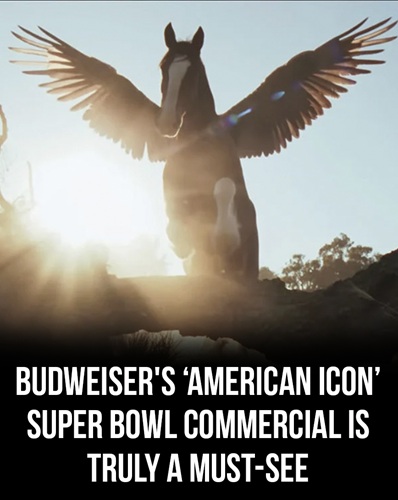
For decades, Budweiser has maintained a unique and almost unrivaled position in the cultural landscape of Super Bowl advertising. The brand’s commercials have become as anticipated as the game itself, with millions of viewers across the nation and around the globe tuning in not just for football, halftime performances, or celebrity appearances, but also for the stories Budweiser chooses to tell.
These stories transcend the traditional boundaries of marketing, blending cinematic excellence, emotional resonance, and cultural symbolism. In 2026, Budweiser continued this tradition with a 60-second commercial titled “American Icons,” a cinematic tribute that intertwined nostalgia, patriotism, and the emotional weight of America’s most cherished symbols: the Clydesdale horses and the bald eagle.
The stakes were high for Super Bowl LX. Over 125 million viewers tuned in to watch the Seattle Seahawks secure a decisive victory over the New England Patriots, while Puerto Rican superstar Bad Bunny delivered a halftime performance that would dominate social media conversations for weeks.
Yet, amid this whirlwind of athletic achievement, music, and spectacle, Budweiser’s commercial immediately stood out, demonstrating the company’s mastery in capturing attention through storytelling rather than relying solely on celebrity endorsements or comedic gimmicks.

The commercial’s central narrative—a deeply emotional and visually arresting portrayal of a young Clydesdale foal and a baby bald eagle forging a friendship—resonated across generations, evoking both a sense of wonder and a subtle yet powerful exploration of American identity.
The Concept and Symbolism Behind “American Icons”
Budweiser has long cultivated a brand identity rooted in narrative excellence. Its commercials are not mere advertisements—they are short films, crafted with a director’s eye, that evoke nostalgia, pride, and emotion.
In 2026, Budweiser’s marketing team aimed to commemorate two monumental milestones: the brand’s 150th anniversary and the United States’ upcoming 250th birthday. The challenge was clear: create a narrative that honors American history, culture, and values while remaining universally engaging.
“American Icons” achieves this by focusing on the unlikely friendship between a Clydesdale foal and a baby bald eagle, using the animals’ symbolic characteristics to convey broader messages about growth, perseverance, and unity. From the moment the ad begins, viewers are invited into the animals’ world at its most vulnerable stage.
The foal struggles with its first tentative steps, embodying grounded strength yet youthful uncertainty, while the eagle’s fledgling wings tremble as it attempts to navigate the air, representing freedom and aspiration in equal measure. Through these early moments, the commercial establishes a profound narrative parallel: the challenges of childhood, the forging of relationships, and the journey from vulnerability to maturity.
This allegorical storytelling mirrors the broader American experience. The juxtaposition of the grounded, steadfast Clydesdale with the soaring, free-spirited bald eagle is far from coincidental.
The Clydesdale embodies the pioneering strength, reliability, and endurance that have historically defined American work ethic and resilience, while the bald eagle represents the aspirational values of freedom, vision, and courage. Together, they offer a symbolic portrait of a nation defined by its ability to blend diverse strengths toward common goals.
Cinematic Execution and Production Excellence
From a production perspective, Budweiser’s commitment to excellence is evident in every frame of “American Icons.” The commercial opens with a sweeping aerial panorama of an American countryside bathed in golden morning light, immediately establishing both grandeur and emotional warmth. This is not a mere establishing shot—it is a deliberate visual cue, signaling the start of a narrative steeped in scale, hope, and the vast potential inherent in America’s landscapes.
Close-up shots of the foal and eagle reveal minute expressions of curiosity, hesitation, and wonder. Every detail—from the subtle flutter of the eagle’s fledgling wings to the tremor in the foal’s first unsteady steps—is captured with meticulous attention, conveying emotion without a single line of dialogue.
The cinematography is enhanced by a carefully designed musical score, composed to elicit a spectrum of feelings: awe, nostalgia, tenderness, and inspiration. The interplay of visuals and sound works synergistically, guiding viewers through an emotional journey that mirrors the growth of the animals themselves.
Throughout the commercial, moments of play, exploration, and tentative connection between the animals are interspersed with subtle moments of challenge—a stumble on uneven terrain, a hesitant approach to one another, or a pause before flight.
These small but meaningful sequences communicate universal truths about learning, trust, and companionship, underscoring the ad’s central theme: greatness is often forged through shared experiences, patience, and perseverance.
As the narrative crescendos, viewers witness one of the most visually arresting moments of the commercial: the fully grown Clydesdale galloping majestically across a wide-open field, perfectly synchronized with the bald eagle soaring overhead.
This iconic imagery serves as a metaphorical representation of America itself, harmonizing grounded resilience with aspirational freedom, and illustrating that true strength emerges not from isolation, but from the synergy of diverse, complementary forces.
Themes of Friendship, Growth, and National Identity
At its core, “American Icons” is more than an advertisement—it is a meditation on friendship, resilience, and personal development. The choice of animals is deliberate and loaded with symbolic weight. Clydesdales have been part of Budweiser’s identity since the 1930s, consistently representing reliability, hard work, and enduring strength. Bald eagles, as the national bird of the United States, symbolize freedom, courage, and vision.
The narrative’s focus on the growing bond between these two creatures allows Budweiser to craft a story that is deeply patriotic yet universally relatable. Audiences see in these animals reflections of themselves, their own experiences of growth, the forging of meaningful relationships, and the pursuit of dreams against uncertainty.
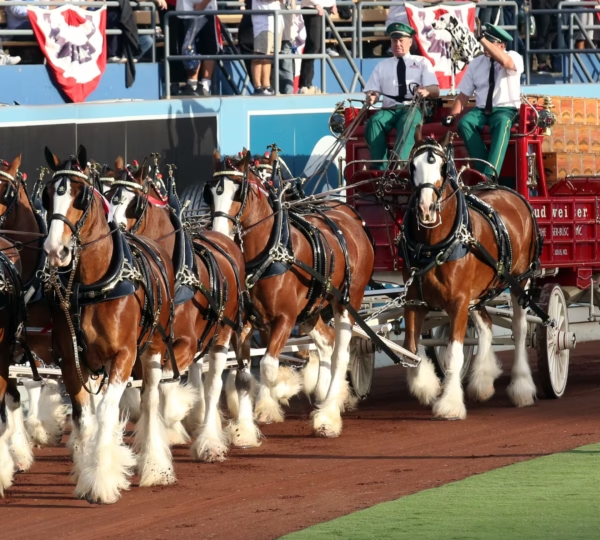
This subtle coming-of-age story resonates because it mirrors real human experiences: the challenges of childhood, the formation of friendships, and the journey toward confidence and independence. Through this lens, the commercial speaks not only to American viewers nostalgic for the brand’s iconic past but also to younger audiences who are drawn to emotionally compelling narratives and visually striking cinematography.
As soon as “American Icons” aired during Super Bowl LX, the commercial sparked an immediate wave of engagement that reflected both its emotional resonance and Budweiser’s mastery of modern marketing dynamics. In an era where audiences frequently fast-forward through commercials or use streaming platforms to skip ads, Budweiser achieved the rare feat of capturing the undivided attention of millions.
Social media platforms were flooded within minutes: Twitter, Instagram, TikTok, and Facebook became virtual forums for admiration, analysis, and emotional reactions. Hashtags like #AmericanIcons and #BudweiserSuperBowl began trending almost instantaneously, generating a multi-layered conversation that extended far beyond the traditional boundaries of advertising.
Viewers responded not only to the visual beauty of the commercial but also to its emotional storytelling. Many shared personal reflections about friendship, growth, and resilience, connecting the narrative of a foal and a bald eagle to their own life experiences.
One Twitter user commented, “Watching the foal and the eagle grow together reminded me of my best friend and me—different, yet always supporting each other. I’ve watched this ad 5 times already.” On Instagram, posts and stories featured screenshots and clips of the iconic finale—the Clydesdale galloping beneath the eagle in synchronized motion—accompanied by captions praising the storytelling and emotional impact.
YouTube analytics mirrored this enthusiasm: Budweiser’s official upload of the ad reached over 3 million views in less than 24 hours, with user engagement steadily climbing as viewers shared, commented, and re-watched the spot, demonstrating that the commercial had transcended its 60-second runtime to become a conversation piece in its own right.
The Art of Digital Virality and Audience Engagement
Part of the commercial’s immediate success lay in Budweiser’s strategic use of digital media. By releasing “American Icons” simultaneously across multiple online platforms, the brand ensured that audiences who had DVR’d the Super Bowl or were watching highlights on social media could engage with the story.
Unlike conventional commercials that fade into memory, this ad invited active participation: viewers dissected the symbolism of the animals, commented on the cinematography, and shared personal anecdotes inspired by the story.

The design of the narrative also contributed to its virality. The baby Clydesdale and eagle evoke an almost universal instinct to protect and empathize with young, vulnerable creatures. From the foal’s tentative first steps to the eagle’s hesitant wing stretches, audiences were emotionally invested from the first second.
The commercial’s pacing—alternating between quiet, tender moments and soaring, cinematic sequences—created a rhythm that encouraged repeated viewing. Emotional resonance, in this case, became the driver of digital engagement, demonstrating the timeless principle that storytelling remains more powerful than mere visual spectacle or celebrity cameo in forging connections.
Cultural Relevance in a Shifting Media Landscape
Super Bowl commercials are often judged not only by their entertainment value but also by their cultural resonance. In 2026, Budweiser succeeded in achieving both. By tying “American Icons” to significant milestones—its own 150th anniversary and America’s approaching 250th birthday—the commercial positioned itself as more than an advertisement: it became a cultural event, a celebration of history, values, and identity.
The symbolism of the foal and eagle was particularly relevant in the context of a nation reflecting on its past and future. At a time when political discourse, social change, and national introspection were increasingly prevalent in public conversation, the ad offered a unifying narrative.
By focusing on friendship, growth, and mutual support, Budweiser reminded viewers of shared ideals that transcend differences: resilience, aspiration, and unity. In a world saturated with media noise, the commercial’s simplicity—anchored in nature, animals, and subtle storytelling—created a rare pause for reflection, allowing audiences to absorb both beauty and meaning simultaneously.
Media analysts quickly noted that “American Icons” struck a balance between sentimentality and sophistication. Unlike other Super Bowl spots that rely heavily on humor, celebrity endorsements, or shock value, Budweiser leaned on universal themes, cinematic technique, and emotive storytelling. This strategy distinguished the commercial as timeless rather than trendy: it wasn’t designed to go viral only for a weekend but to linger in the cultural memory of viewers for years to come.
Behind the Scenes: Crafting Emotional Authenticity
Creating a commercial of this caliber required months of careful planning, collaboration, and technical expertise. Budweiser partnered with professional animal trainers and wildlife specialists to ensure the safety, comfort, and well-being of both the Clydesdale foals and the young eagle. The production process involved intensive rehearsals, ensuring that interactions between two species with vastly different temperaments felt organic and emotionally authentic.
The cinematography alone demanded meticulous attention. Filmmakers employed a combination of aerial drones, stabilized ground cameras, and macro lenses to capture the animals’ subtle movements, from the gentle flicker of the eagle’s feathers to the foal’s unsteady hooves on dewy grass.
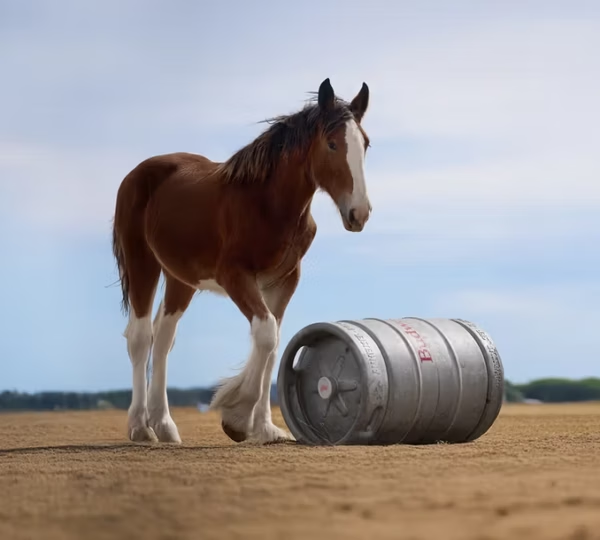
Lighting designers timed shots to coincide with golden hour, producing warm, evocative tones that enhanced both realism and emotional impact. Every frame was designed to tell a story: no gesture was incidental, no angle arbitrary. Even the sound design was carefully curated—soft rustling of leaves, the foal’s tentative steps, the eagle’s quiet wingbeats—all overlaid with a musical score composed to inspire awe, wonder, and heartfelt emotion.
The team faced particular challenges in synchronizing the foal and eagle in the final sequence. Capturing the moment where the fully grown Clydesdale gallops beneath the soaring eagle required careful choreography, patience, and multiple takes, highlighting the extraordinary lengths the brand went to in order to achieve authenticity. This dedication not only ensured visual perfection but also reinforced the emotional resonance: viewers genuinely felt the bond between the animals, rather than seeing it as manufactured or staged.
Critical Reception and Early Legacy
Critics and viewers alike responded with overwhelming praise. Marketing analysts highlighted Budweiser’s continued ability to create content that resonates across generations. Older audiences, familiar with the iconic Clydesdales of past decades, were drawn to the nostalgic elements, while younger viewers appreciated the visually compelling storytelling and universal themes of friendship and growth.
Commentators frequently noted that the commercial succeeded in evoking both tears and smiles, a testament to the power of emotionally intelligent marketing.
The commercial also sparked meaningful discussions about American values. Editorials and social media conversations explored the allegorical nature of the foal and eagle, with many emphasizing the representation of resilience, freedom, and mutual support.
In a time when advertising often prioritizes shock, humor, or celebrity, Budweiser demonstrated that emotional storytelling, cultural symbolism, and cinematic artistry can not only capture attention but also inspire reflection, dialogue, and genuine emotional connection.
Budweiser’s “American Icons” is not merely a 60-second Super Bowl commercial; it is the latest chapter in a remarkable legacy of storytelling that has defined the brand for nearly a century. From the earliest days of the company’s advertising in the 1930s, Budweiser has understood the power of narrative, emotion, and cultural symbolism in connecting with audiences.
The brand’s legendary Clydesdales, first introduced in the midst of the Great Depression, were designed to convey stability, trust, and American resilience at a time when the nation faced tremendous uncertainty. Decades later, those same animals would become an enduring symbol of celebration, nostalgia, and national pride, appearing in countless Super Bowl ads that transcend mere product promotion.
“American Icons” builds on this heritage while introducing a new dimension: a narrative of interspecies friendship that mirrors the complexity and diversity of America itself. The decision to pair a Clydesdale foal with a baby bald eagle was both innovative and deeply symbolic.
The Clydesdales, grounded, powerful, and dependable, represent tradition and strength, while the bald eagle, soaring, free, and aspirational, embodies vision, freedom, and courage. Together, their journey from uncertain beginnings to majestic maturity reflects not only personal growth and resilience but also the broader narrative of the nation—a nation built on the union of different strengths, values, and perspectives.
The Cinematic Triumph of “American Icons”
The commercial’s cinematography and production design deserve special attention, as they elevate the piece from a standard ad to a cinematic experience. Every frame was carefully composed to maximize emotional resonance and narrative clarity.
The sweeping aerial shots of the American countryside evoke a sense of scale and majesty, while intimate close-ups of the foal’s hesitant first steps or the eagle’s trembling wings invite viewers to connect personally with the story. The pacing of the commercial, alternating between quiet, tender moments and grand, sweeping sequences, mirrors the narrative arc of growth, emphasizing patience, perseverance, and the beauty of gradual development.
The musical score, subtly layered with natural sounds—rustling grass, the heartbeat-like rhythm of hooves, and the soft wingbeats of the eagle—serves as an emotional guide, drawing audiences into the experience. Unlike many contemporary commercials that rely on quick cuts, humor, or celebrity cameos, “American Icons” allows viewers time to absorb, reflect, and feel, demonstrating that in the realm of advertising, restraint and craftsmanship can produce a far more enduring impact than spectacle alone.

Technical excellence was matched by logistical precision. Coordinating a young Clydesdale and a baby eagle—a feat requiring months of training, rehearsals, and expert handling—was no small achievement.
Trainers and filmmakers worked tirelessly to ensure that the interactions felt natural, authentic, and emotionally compelling. The climax, showing the fully grown Clydesdale galloping in perfect sync with the eagle soaring overhead, required careful timing, choreography, and multiple takes, yet the result appears effortless—a testament to the dedication and expertise of the production team.
Comparison with Previous Super Bowl Classics
To fully appreciate “American Icons,” it is helpful to compare it with previous landmark Budweiser campaigns. In 1986, the first major Clydesdale Super Bowl commercial captivated audiences with the horses’ majestic presence in snow-covered towns, emphasizing grace, strength, and reliability.
The 2002 “Brotherhood” commercial depicted a foal’s journey to joining the adult Clydesdales, a story of growth and belonging. In 2014, the “Puppy Love” campaign paired a puppy with a Clydesdale, a heartwarming narrative that became one of the most beloved ads in Super Bowl history, winning multiple awards and inspiring viral sharing across social media.
“American Icons” stands out even among these iconic campaigns because it pairs two of America’s most powerful symbols—the Clydesdale and the bald eagle—while telling a story that is simultaneously patriotic, universal, and deeply emotional.
Where previous ads emphasized tradition, loyalty, or companionship, this commercial adds layers of allegory, suggesting that strength and freedom, groundedness and aspiration, are not opposing qualities but complementary forces that together define the American spirit. In doing so, it elevates the narrative from heartwarming to transcendent, providing a story that resonates not only in the moment but also in cultural memory.
Cultural and Emotional Significance
The cultural impact of “American Icons” extends beyond immediate viewership numbers or social media metrics. By airing the commercial during a widely viewed, national event like the Super Bowl, Budweiser leveraged the opportunity to create a shared experience—one that millions of Americans watched simultaneously, providing a moment of collective reflection and emotional connection.
This communal aspect is significant: while social media allows for individualized engagement, the live broadcast of the commercial during such a culturally important event transforms it into a national touchstone.
Many commentators noted that the commercial achieved a rare form of emotional universality. People from different generations, regions, and backgrounds could find meaning in the story. Older viewers appreciated the nostalgia and continuity of the Clydesdales, while younger audiences were drawn to the compelling visual storytelling and the aspirational journey of the eagle.
The narrative also invited metaphorical interpretations: some saw the foal and eagle as symbols of teamwork and friendship, others as allegories of personal growth, while many interpreted the story as a celebration of America itself, embracing both tradition and innovation, groundedness and ambition.
By combining these layers of meaning, Budweiser not only reinforced its brand identity but also created a work that encourages reflection on the values and ideals central to American culture. In a time of societal polarization, rapid technological change, and constant media saturation, a commercial that can inspire empathy, conversation, and a sense of shared humanity is rare—and powerful.
Legacy and Lasting Impact
The long-term legacy of “American Icons” is likely to be profound. Super Bowl commercials are frequently remembered for humor, celebrity appearances, or viral novelty, yet Budweiser has consistently proven that emotional resonance and narrative integrity leave the most enduring mark.
Over time, this commercial will likely be referenced alongside the brand’s previous classics, studied in marketing courses, and cited as an example of how advertising can transcend commerce to become cultural storytelling.
The commercial also serves as a benchmark for future campaigns. By demonstrating that audiences respond powerfully to authentic narratives, meticulous craftsmanship, and emotionally intelligent storytelling, “American Icons” sets a high standard for both Budweiser and the wider advertising industry. It reinforces the notion that marketing need not sacrifice substance for spectacle—that enduring emotional connections, grounded in authenticity and creative vision, are the ultimate drivers of engagement and cultural relevance.
Moreover, the commercial’s allegorical depth ensures its place in the public imagination. The story of a foal and eagle growing together symbolizes resilience, friendship, and the potential for greatness from humble beginnings.
It celebrates the duality of human experience: groundedness and aspiration, strength and freedom, patience and courage. By embedding these values into a universally accessible story, Budweiser created a piece of media that is simultaneously entertaining, emotionally moving, and culturally significant.
Conclusion: A New Standard for Super Bowl Storytelling
In conclusion, Budweiser’s “American Icons” is far more than a Super Bowl commercial; it is a cultural artifact, a short film, and a celebration of both the brand’s storied history and the enduring ideals of America. By pairing a Clydesdale foal with a baby bald eagle, the brand delivered a narrative of growth, friendship, and unity that resonates across age, nationality, and background. Its cinematic mastery, emotional depth, and symbolic richness ensure that it will be remembered long after the confetti has settled on the football field.
Celebrating Budweiser’s 150th anniversary alongside the nation’s approaching 250th birthday, the commercial reminds viewers that greatness emerges from diversity, perseverance, and connection. It illustrates the enduring power of storytelling in advertising, proving that emotion, authenticity, and craftsmanship remain the most effective tools for capturing hearts and minds.
Whether audiences tuned in for football, halftime performances, or simply the commercials, “American Icons” ensured that Budweiser’s legacy as a pioneer of emotionally intelligent Super Bowl advertising continues to thrive—an enduring testament to the power of narrative, culture, and shared experience.
In the annals of Super Bowl history, the story of a foal and an eagle growing together is now etched into the hearts of millions, standing as a powerful reminder that even in a fast-paced, digitally saturated world, authentic storytelling retains the ability to move, inspire, and unite. Budweiser has once again demonstrated that a commercial can do more than sell a product: it can capture the imagination of a nation, honor its values, and leave a lasting imprint on cultural memory.
