
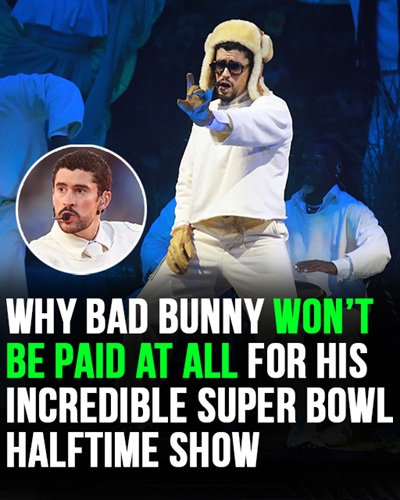
Bad Bunny’s recent Super Bowl LVIII halftime performance quickly became one of the most talked-about cultural moments of the year, sparking conversation across social media, news outlets, and music industry circles worldwide.
Fans celebrated his innovative set, electrifying energy, and creative visuals, while critics praised the way he blended reggaeton and Latin trap influences with mainstream pop spectacle. Despite this massive global attention and the cultural resonance of his performance, one fact often surprises casual observers: Bad Bunny, like all Super Bowl halftime performers, did not receive a direct paycheck for the show.
While this may seem counterintuitive—especially given his status as one of the highest-grossing, most streamed, and most commercially successful artists in the world—it is, in fact, standard industry practice.
The Super Bowl halftime show occupies a unique place in live entertainment. Unlike a traditional concert, festival appearance, or private event, the halftime show is part of one of the largest sporting events in the world, broadcast live to tens of millions of viewers in the United States alone, and hundreds of millions globally through television, streaming platforms, and social media channels.

The 2026 halftime performance, headlined by Bad Bunny, was no exception. The spectacle is watched not just by dedicated music fans, but by a cross-section of viewers who may have little familiarity with the performing artists, making it a singular platform for exposure that few other events can match.
Why Super Bowl Halftime Performers Are Not Paid
The question of compensation—or lack thereof—has generated discussion for decades. To most, it seems puzzling that artists capable of selling out stadiums worldwide and commanding multimillion-dollar concert fees would appear on such a high-profile stage without direct remuneration.
The explanation lies in the structure and historical context of the halftime show. The event is not treated as a conventional performance but as an unparalleled promotional opportunity.
Unlike other music industry appearances where an artist’s paycheck comes directly from ticket sales or event promoters, the Super Bowl halftime show operates under a distinct model. The National Football League (NFL), which produces the halftime show, does not pay artists a traditional performance fee.
Instead, the NFL absorbs all costs associated with production—including stage construction, technical crews, lighting, sound systems, and travel—ensuring that performers are not out-of-pocket. This approach guarantees that artists can focus entirely on creative execution without assuming the substantial financial burden that a live show of this scale would otherwise require.
Critics sometimes describe this arrangement as being “paid in exposure,” a concept that is usually controversial in the broader music industry. Emerging musicians are often warned against accepting unpaid gigs in the hope of visibility, as it rarely translates into tangible career growth.
In most scenarios, the promise of exposure is insufficient to justify the artist’s effort or financial risk. However, the Super Bowl halftime show represents a distinct exception. The audience is so large, diverse, and global that performing at the event can have transformative effects on an artist’s career, from chart performance to long-term brand recognition.
Exposure and the Value of Visibility
In modern music industry economics, visibility often equates to revenue, even in the absence of a direct paycheck. Artists who headline the Super Bowl halftime show typically experience measurable surges in streaming activity, album sales, and social media engagement immediately after the event.
This effect is documented repeatedly: songs performed during the halftime show often re-enter the charts, digital downloads spike, and concert tickets for upcoming tours sell out faster than they would have otherwise.
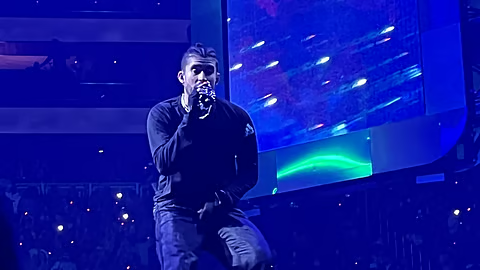
Bad Bunny, who had already achieved global superstardom before his Super Bowl performance, illustrates the power of this exposure.
With multiple chart-topping albums, billions of streams on platforms like Spotify and YouTube, and a devoted fan base that spans multiple continents, the halftime show offered him an opportunity not only to entertain but also to solidify his global influence. For him, the performance was not a job to be paid for in dollars, but a strategic career move that reinforced his cultural footprint on a scale few artists ever achieve.
Sponsorship and Production Budgets
The financial mechanics behind the halftime show further clarify why artists do not receive a paycheck. In recent years, corporate sponsorship has played a significant role in the production of the event.
For example, Apple Music holds the naming rights for the halftime show, reportedly paying the NFL tens of millions of dollars annually for branding, advertising integration, and sponsorship rights. These sponsorships underwrite the massive production budgets that make halftime performances possible.
Industry estimates place the production budget for a halftime show in the range of $10–15 million, covering elaborate stage setups, pyrotechnics, specialized lighting, advanced sound engineering, choreography, costumes, and the wages of hundreds, if not thousands, of support staff who ensure the performance runs flawlessly.
Crucially, while these funds enable a spectacular show, they are not transferred to the artist as income. Instead, they are designed to allow performers like Bad Bunny to execute ambitious creative visions without personal financial liability. In many cases, high-profile artists even choose to augment these budgets with personal investment to enhance the scale or artistic direction of their set.
Strategic Career Gains Beyond Immediate Payment
The real value of performing at the Super Bowl is strategic, long-term, and multifaceted. Artists gain access to an audience that crosses demographic boundaries—casual viewers, sports fans, and music listeners who might not otherwise engage with their work.
This exposure often translates into tangible metrics: increased streaming numbers, album sales, merchandise revenue, and greater demand for concert tickets. For globally recognized performers, the effect is amplified, reinforcing existing popularity while introducing them to new fans and markets.
In addition, the cultural prestige of performing on the halftime stage cannot be overstated. Being selected to headline is widely considered a career milestone, affirming an artist’s relevance and influence. Historically, only a select number of performers have had the honor of shaping the narrative and aesthetic of a Super Bowl halftime show.

Artists who have previously held this platform—ranging from Michael Jackson and Beyoncé to Shakira and The Weeknd—have all seen substantial career impacts following their appearances, including spikes in media attention, music consumption, and social influence.
Bad Bunny’s Super Bowl performance was not merely a single-night spectacle; it represented a carefully positioned strategic move capable of shaping the trajectory of his career for months, if not years, to come.
Historically, Super Bowl halftime performances have acted as catalysts for surges in music consumption, social media visibility, and live tour engagement, and Bad Bunny’s appearance followed this pattern in striking ways.
Streaming Surges and Chart Re-entry
One of the most immediate measurable effects of a Super Bowl halftime performance is its impact on streaming platforms. Data from previous halftime shows consistently show spikes in plays for songs performed during the event, as well as for older tracks in an artist’s catalog.
For example, after Shakira and Jennifer Lopez performed in 2020, Spotify streams for their top songs reportedly jumped between 200–300% within the first 48 hours. Similarly, after The Weeknd’s 2022 halftime show, tracks from his previous albums experienced significant increases in plays globally.
For Bad Bunny, whose music is already among the most streamed worldwide, the halftime show amplified these effects exponentially. In the days following the performance, platforms like Spotify, Apple Music, YouTube, and TikTok saw dramatic surges in streams for songs featured in his set.
Fans, casual viewers, and curious new listeners flocked to explore his catalog, resulting in both quantitative and qualitative boosts to his engagement metrics. Early reports indicated millions of incremental streams within 24–48 hours, a figure that translates into both higher visibility and tangible revenue through streaming royalties.
Chart re-entry is another notable consequence. Songs performed during the halftime show often return to national and global charts, even if they had previously declined in popularity. This creates a ripple effect: renewed radio play, playlist placements, and algorithmic promotion on music platforms.
For an artist like Bad Bunny, whose career spans multiple genres and languages, this effect ensures cross-market penetration, reaching audiences that may not follow Latin music regularly but were captivated by the halftime show spectacle.
Social Media Engagement and Follower Growth
Beyond streaming numbers, the Super Bowl provides an unmatched opportunity for social media expansion. Bad Bunny’s performance generated enormous digital chatter, with hashtags, clips, and memes spreading across Instagram, TikTok, Twitter, and YouTube.

This digital virality translated directly into new followers across platforms, increasing his influence and providing a broader base for future releases, brand partnerships, and marketing campaigns.
Social media analytics show that halftime performers often experience a surge of hundreds of thousands, or even millions, of new followers within days of the show.
Engagement rates—likes, shares, comments—also spike, reinforcing the artist’s visibility and strengthening their algorithmic presence. For Bad Bunny, these metrics represent more than vanity numbers: they are indicators of expanded reach, audience diversification, and future revenue potential from music releases, collaborations, and sponsored content.
Tour and Merchandise Benefits
Another major advantage of the halftime show is its effect on live performances and merchandise sales. Artists often announce tours around the Super Bowl or experience heightened demand for tickets that were previously on sale. For example, after Beyoncé’s 2013 halftime performance, her subsequent tour saw record-breaking ticket sales, demonstrating the halo effect of the event on live entertainment revenue.
For Bad Bunny, performing at the Super Bowl provided a comparable boost. Even if a tour had been planned months in advance, public interest intensified after the performance, leading to faster sellouts and the potential for additional shows or stadium upgrades.
Merchandise, too, benefits from increased visibility. Limited-edition items related to the performance, iconic visual motifs from the show, or simply branded gear tied to the artist’s larger persona often experience a spike in sales immediately after the event. These indirect revenue streams frequently surpass what a direct performance fee might have been.
Cultural Relevance and Brand Partnerships
Beyond numerical gains, the Super Bowl halftime show strengthens an artist’s cultural relevance. Being selected is a signal to the public and industry that the artist is at the forefront of popular culture. This recognition can open doors to high-profile collaborations, brand endorsements, and partnerships that extend well beyond music.
Bad Bunny’s appeal already spans multiple sectors, from fashion and media to lifestyle branding. The Super Bowl exposure amplifies his credibility as a cultural icon, not just a musician. Companies seeking to collaborate with artists who possess broad, global influence often prioritize those who have demonstrated the ability to perform on massive stages with impact.
In this sense, the halftime show functions as both marketing and proof-of-relevance, reinforcing Bad Bunny’s position in the upper echelon of global entertainment.
Long-term Career Momentum
The benefits of the halftime show are cumulative and long-lasting. While immediate streaming, social media growth, and merchandise revenue are quantifiable, the intangible effects—cultural imprint, brand reinforcement, and career legitimacy—are equally significant.
Artists who perform on the Super Bowl stage often reference the event as a milestone for years afterward, leveraging it in interviews, promotional campaigns, and public appearances.
In Bad Bunny’s case, the performance consolidates a trajectory that had been steadily ascending. Already a global streaming powerhouse, he now enjoys the enhanced visibility, recognition, and public discourse that accompanies one of the most-watched live events in the world.

This combination of factors ensures that the performance will continue to provide career dividends far beyond the night itself, cementing his status as a defining figure in contemporary music and culture.
Strategic Trade-Offs and Professional Considerations
While skeptics sometimes question why artists would forego a direct paycheck, it is crucial to understand that the decision is rarely about immediate compensation. Instead, it is a calculated trade-off: artists gain unparalleled exposure, professional prestige, and long-term revenue potential, while avoiding the immense costs of staging a performance at this scale.
Furthermore, the NFL carefully curates halftime performers, considering cultural impact, popularity, and ability to deliver a complex live show. Being selected is thus a mark of distinction, signaling to fans, industry professionals, and media outlets that the artist has achieved a level of professional recognition few ever attain.
For an artist of Bad Bunny’s caliber, the decision to participate is less about the paycheck and more about strategic positioning in a competitive and rapidly evolving global entertainment landscape.
The Super Bowl halftime show is not only a music event; it is a multi-million-dollar production and a carefully orchestrated media spectacle. Beyond the performance itself, understanding the financial, logistical, and cultural mechanics behind the show clarifies why artists like Bad Bunny perform without a direct paycheck and why the exposure they gain is worth far more than a traditional fee.
Sponsorship Deals and Financial Structure
In recent years, corporate sponsorship has become a defining feature of the halftime show. Apple Music, which currently holds the naming rights, reportedly pays the NFL tens of millions of dollars annually for branding, advertising integration, and rights to associate the halftime show with its platform.
This sponsorship money does not go directly to the artists but instead funds the event’s production, ensuring that performers can stage a visually spectacular show without personal financial risk.
The NFL uses these sponsorship dollars to cover everything from high-tech stage construction and aerial rigs to pyrotechnics, sound engineering, and advanced lighting systems.
Security, crew wages, transportation of equipment, and specialized technical support also fall under the production budget. Industry estimates place the total production cost for a single halftime show in the range of $10–15 million, depending on the scale and creative ambitions of the performing artist.
It is worth noting that while the artist does not receive a performance fee, sponsorship exposure itself can create future earning opportunities. Brands often seek collaborations with artists who have demonstrated the ability to engage massive audiences, and the Super Bowl provides clear proof of an artist’s cultural relevance.
In Bad Bunny’s case, post-performance sponsorship opportunities—ranging from fashion campaigns to lifestyle endorsements—may generate revenue far exceeding a single-night paycheck.
Production Complexity and Creative Freedom
A Super Bowl halftime performance is logistically far more complex than a traditional concert. The time constraint of roughly 12–15 minutes forces precise choreography, rapid stage assembly, and tight coordination among performers, dancers, and technical crews.
Multiple stages, mobile platforms, or aerial elements are often incorporated, each requiring expert engineering and rehearsal.
For Bad Bunny, this complexity provided an opportunity to showcase not only his musical talent but also his artistic vision. He was able to integrate high-concept visuals, synchronized choreography, and cutting-edge technology to deliver a show that reflected his identity and resonated across cultures.
While some artists may choose to add personal investment to expand the spectacle, the baseline production costs are fully covered by the NFL, mitigating financial risk while enabling maximum creative expression.
Historical Comparisons
Looking at previous halftime shows provides perspective on the unique nature of this event. Michael Jackson’s 1993 performance is widely credited with transforming the halftime show from a routine football intermission into a must-watch entertainment spectacle.
Subsequent performances by U2, Beyoncé, Katy Perry, and The Weeknd each demonstrated the event’s ability to boost music sales, digital engagement, and global visibility.
Bad Bunny’s performance continues this legacy, but with a distinctive Latin influence, representing one of the most significant cultural statements in halftime history.
By blending reggaeton, trap, and mainstream pop with visually dynamic stagecraft, he expanded the scope of what the halftime show can represent, reaching audiences who may have previously engaged minimally with Latin music. This is an example of the Super Bowl functioning as a platform not merely for entertainment but for cultural storytelling, social influence, and genre expansion.
Long-Term Cultural Impact
The halftime show carries enduring cultural weight. Performers are remembered not only for the spectacle itself but for the broader narrative of their artistic identity and influence. For Bad Bunny, the performance reinforced his role as a global cultural icon, capable of transcending language and geographic boundaries.
It is not just a moment of entertainment; it is a statement of relevance, influence, and creative authority.
Cultural analysts often note that the halftime show can redefine an artist’s brand. In addition to increased streaming and social media engagement, it can influence fashion trends, inspire viral challenges, and spark discussions around music and cultural identity.
For example, Bad Bunny’s style, set design, and song choices were widely discussed across news outlets, blogs, and fan communities, reinforcing his cultural footprint.
Strategic Exchange: Exposure vs. Immediate Compensation
The decision to perform without a direct paycheck should be understood as a calculated trade-off. Artists accept the role in exchange for unparalleled exposure, professional prestige, and long-term brand growth. The combination of NFL sponsorship, media amplification, global audience reach, and social media virality creates a career-impacting event.
Even though critics sometimes argue that direct payment would be fair given the revenue generated by the Super Bowl, the mutually beneficial nature of the arrangement has persisted for decades.
The NFL ensures that performers receive a top-tier production environment, while artists gain access to a global stage that few other events could provide. For Bad Bunny, this strategic choice reinforced his marketability, expanded his fanbase, and enhanced his cultural relevance.
Conclusion: Legacy, Reach, and Influence
Bad Bunny’s Super Bowl halftime performance exemplifies the modern entertainment landscape, where visibility, cultural resonance, and strategic branding can outweigh traditional compensation.
While he did not receive a paycheck for the event, the performance delivered value in multiple dimensions: increased streaming and chart activity, expanded social media reach, heightened tour and merchandise demand, and enhanced cultural credibility.
The Super Bowl halftime show remains a unique intersection of sport, music, and spectacle. For artists at the top of their field, it is not merely a performance but a career milestone. Bad Bunny’s appearance illustrates how modern musicians leverage high-profile events not for immediate financial gain but for long-term strategic advantage.
In essence, the halftime show is about legacy, influence, and sustained impact. For an artist like Bad Bunny, performing at the Super Bowl is less about a paycheck and more about cementing a place in cultural history.
The exposure is tangible, measurable, and often far more valuable than a conventional performance fee could ever be. It is a rare opportunity where being “paid in exposure” is not only fair but exceptionally lucrative when measured in career growth, fan engagement, and cultural footprint.
