
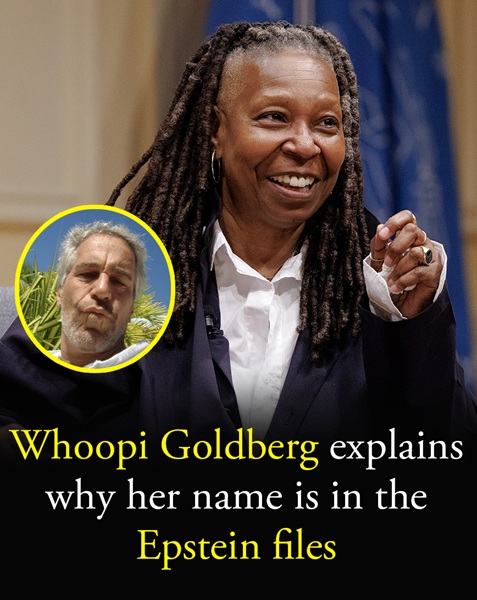
The renewed attention to Whoopi Goldberg’s name in relation to Jeffrey Epstein stems from court documents and legal filings that were made public as part of ongoing civil litigation connected to Epstein’s network of associates.
These documents include emails, flight logs, contact lists, and other forms of communication that, when released, have generated widespread public interest.
Legal experts have consistently emphasized that the mere presence of a person’s name in these materials does not automatically imply involvement in illegal activity, criminal liability, or any personal association with Epstein. Court documents can include names for a variety of reasons, ranging from logistical coordination to peripheral mentions, without any link to wrongdoing.
In a recent episode of The View, Goldberg addressed the issue openly and transparently. She acknowledged that her name appears in the publicly released court files. “In the name of transparency, my name is in the files. Yes,” Goldberg stated on air. She further read aloud the relevant excerpt to provide viewers with context, illustrating the importance of understanding the precise nature of her mention rather than relying on speculation or incomplete interpretations.
According to Goldberg, the document in question referenced a 2013 email discussing travel arrangements for a charity event in Monaco. The email included a line stating, “Whoopi needs a plane to get to Monaco,” and it referenced that the costs for this travel would be covered by a charitable organization.

The message then asked whether Epstein or someone in his network could potentially provide access to a private jet. Goldberg emphasized that this was the entirety of her mention in the materials. She clarified emphatically: “I wasn’t his girlfriend, I wasn’t his friend,” underscoring the complete lack of any personal or social relationship with Epstein.
The 2013 Email in Detail
Goldberg explained that the email arose in the context of a fundraising event connected to musician Julian Lennon, the son of Beatles legend John Lennon. Julian Lennon has been actively involved in numerous philanthropic initiatives over the years, including charitable events and benefit concerts. The email in question was part of a logistical inquiry about transportation arrangements to attend the charity function.
Crucially, Goldberg noted that the request for assistance with travel did not originate from her personally. She emphasized that she had no involvement in initiating the communication and that it should not be interpreted as evidence of travel with Epstein. “I never flew on Epstein’s plane,” Goldberg stated clearly on air, reinforcing that her inclusion in the email was purely incidental and logistical in nature. This distinction is particularly important, as many public figures’ names appear in Epstein-related records simply because of peripheral or professional connections that are unrelated to any criminal conduct.
Legal authorities and media analysts have highlighted that Epstein maintained professional and social contact with numerous public figures over decades. As a result, flight logs, address books, and email chains often include names for administrative or social reasons rather than criminal participation. In these contexts, being mentioned in a document does not constitute evidence of illegal activity. Goldberg’s explanation aimed to correct widespread online misinterpretations, which had circulated extensively on social media platforms.
Addressing the Spread of Online Speculation
In today’s digital environment, court filings are frequently shared widely across social media, often without providing full context. When celebrities’ names appear, even tangentially, they can become the focus of viral speculation. Goldberg expressed frustration over what she described as exaggerated and misleading conclusions drawn from the documents. “People actually believe that I was with him. It’s like, ‘honey, come on,’” she remarked during the broadcast, highlighting how misinformation can quickly proliferate online.

Her co-host, Joy Behar, added perspective by noting that the situation illustrates how easily a person can be mentioned in documents without implying any guilt. “So in other words, anyone can be on this list,” Behar said, reinforcing that inclusion in legal materials is not synonymous with criminal involvement.
Goldberg also pointed out that her personal life and relationships have been extensively publicized throughout her decades-long career. As a prominent actress, comedian, and television personality, her history in the public eye is well-documented, making it unlikely that any significant romantic relationship could have occurred in secret.
To fully understand the context surrounding Whoopi Goldberg’s name in Epstein-related court documents, it is important to review the history of Jeffrey Epstein’s legal proceedings and the nature of the public records that have been released. Epstein, a financier with extensive social connections, was arrested in July 2019 on federal sex trafficking charges involving minors. Prior to this, he had already pleaded guilty in 2008 to state charges in Florida related to soliciting prostitution from a minor, which resulted in a controversial plea agreement that allowed him to avoid federal prison time and minimized public scrutiny.
Epstein’s 2019 arrest and subsequent death while in custody—ruled a suicide by the New York City medical examiner—triggered widespread media attention and renewed public interest in his extensive network of associates. In the aftermath, numerous civil lawsuits, depositions, and court filings have remained active, many of which involve claims against individuals connected to Epstein, either professionally or socially. As part of these proceedings, courts unsealed thousands of documents, including emails, flight logs, phone records, and contact lists.
Understanding Court Records and Public Perception
It is critical to recognize that court filings often contain unverified statements, logistical details, and documents submitted for procedural purposes. Legal experts have repeatedly emphasized several key points:
- Mention does not imply guilt: Inclusion in a document does not equate to criminal involvement, accusations, or evidence of wrongdoing. Many names appear in peripheral contexts, such as travel logistics, charitable activities, or social introductions.
- Context matters: Isolated lines or excerpts can be misleading when stripped from the broader conversation or the intent of the correspondence. Without context, the public may misinterpret routine communications as evidence of complicity.
- Public figures are particularly vulnerable: Celebrities, philanthropists, and business figures often appear in records simply due to the breadth of their professional engagements, attendance at public events, or charitable collaborations.
Goldberg’s name, for example, appears in the context of an email about transportation to a charitable event in Monaco, a context far removed from any illicit activity. The email asked whether Epstein or an associate could provide logistical assistance, but it did not indicate that Goldberg requested such help personally or that she traveled with Epstein in any capacity.

Clarifying Goldberg’s Travel History
During the broadcast on The View, Goldberg highlighted another factor often overlooked by those speculating online: her well-documented fear of flying. Goldberg has publicly stated in interviews and appearances that she frequently avoids air travel whenever possible and prefers alternative transportation. This personal detail further undermines claims that she regularly traveled on private jets associated with Epstein.
“I don’t like flying,” Goldberg said humorously during the discussion, reinforcing that traveling on Epstein’s plane would be inconsistent with her longstanding personal habits. This point serves as a reminder that understanding the individual circumstances of a person’s life is crucial when evaluating the significance of their mention in court records.
Denial of Visiting Epstein’s Private Island
Another persistent rumor circulating online claimed that Goldberg visited Epstein’s private island in the U.S. Virgin Islands, a location often referenced in media coverage due to its association with criminal activity. Goldberg firmly rejected this assertion, noting that official records do not show her presence on the island. Legal experts have pointed out that social media posts often blend verified details with conjecture, creating narratives that are not supported by factual evidence. Being named in an email or document is insufficient grounds for assuming participation in illegal conduct, particularly in the absence of corroborating evidence.
The Broader Implications for Public Figures
Goldberg’s situation highlights a widespread challenge for public figures: navigating the fine line between transparency and misinformation in the digital age. Viral content frequently extracts fragments of court documents, divorces them from context, and spreads them rapidly across social media platforms. Without careful analysis, these fragments can create misleading impressions, sometimes causing reputational harm even when the information is technically accurate.
Legal analysts emphasize that the Epstein case serves as a case study in how documents can be misinterpreted:
- Court filings may include witness statements or depositions that are unverified and sometimes contradictory.
- Inclusion in a list, flight log, or email chain does not indicate personal acquaintance or endorsement of criminal conduct.
- Prosecutors have clarified that the majority of individuals named in unsealed documents were not implicated in criminal acts.
Goldberg, by addressing the issue directly on national television, sought to clarify the nature of her involvement and distinguish documented fact from unfounded speculation. Her transparency demonstrates an understanding of both the legal and ethical implications of being named in high-profile court records.

Media Responsibility and Ethical Reporting
Goldberg’s decision to quote the document on The View reflects a commitment to transparency and journalistic responsibility. By providing the full excerpt, she allowed viewers to see the limited scope of her mention and counteract misinterpretation. Media organizations covering similar stories have adopted a standard practice of including disclaimers that appearance in legal records does not imply criminal conduct, aligning with journalistic ethics designed to protect due process and prevent the spread of misinformation.
Experts in defamation law and media ethics note that viral posts and sensational headlines can damage reputations, particularly when context is omitted. Goldberg’s response serves as a model for how public figures can address potentially harmful narratives responsibly, ensuring that the public receives accurate information supported by evidence.
Whoopi Goldberg has maintained a decades-long presence in the entertainment industry, achieving recognition as one of the few individuals to earn the prestigious EGOT status—winning an Emmy, Grammy, Oscar, and Tony Award. Her career spans film, theater, and television, and she has consistently been a prominent public figure for over four decades. As an actress, comedian, and television personality, Goldberg’s professional life has included frequent interactions with charities, public events, fellow performers, and industry executives. Consequently, her name naturally appears in numerous professional and logistical records over the years.
Goldberg’s extensive public profile underscores why peripheral references to her in court documents should not be interpreted as evidence of misconduct. In professional environments, prominent figures are routinely involved in organizing or attending charitable events, media appearances, and industry gatherings. These engagements often require coordination with multiple parties, including travel planners, event organizers, and benefactors. It is within this context that her name appeared in the 2013 email discussing potential travel arrangements to a Monaco charity event—a routine logistical consideration rather than a reflection of a personal connection to Jeffrey Epstein.
Professional Logistics vs. Personal Relationships
Goldberg stressed on The View that professional correspondence should not be conflated with social or romantic associations. The distinction is critical: court filings and emails often contain names for organizational reasons, such as arranging transportation, confirming schedules, or discussing event logistics. Such mentions do not imply consent, participation, or complicity in any wrongdoing.
She explicitly noted that she never personally requested assistance from Epstein, nor did she travel on his private jet. Moreover, she consistently avoided locations associated with him, including his private island in the U.S. Virgin Islands, which has been incorrectly cited in viral social media speculation. Goldberg’s statements reinforce the importance of carefully analyzing legal documents in their entirety before forming conclusions about the individuals referenced.

Legal Safeguards and Public Misinterpretation
Legal experts emphasize that the Epstein documents illuminate the risks of misinterpretation in the digital age. Court filings and unsealed materials are complex and frequently include:
- Depositions that record individual testimony, which may be unverified or incomplete.
- Email chains that capture logistical or administrative communication without implying criminal involvement.
- Lists of contacts or flight logs that contain names for operational purposes rather than evidentiary reasons.
The inclusion of a name in these contexts does not equate to accusation or guilt. Nevertheless, when fragments of these documents circulate online, they are often stripped of context, giving rise to inaccurate narratives that can spread rapidly. Social media amplifies this effect, mixing speculation with partial truths and creating confusion among audiences unfamiliar with legal conventions.
Goldberg’s proactive approach—reading the excerpt on air and explaining the circumstances—demonstrates a responsible method of combating misinformation. By providing viewers with the complete text, she allowed them to understand the limited scope of her involvement and distinguish between documented fact and online conjecture.
Media Responsibility and Ethical Reporting
The Goldberg situation highlights the broader responsibility of media organizations in handling sensitive legal documents. Best practices in journalism emphasize:
- Including disclaimers when reporting on unsealed court materials to clarify that mention does not imply wrongdoing.
- Contextualizing names within the purpose of the document rather than presenting fragments that may mislead the audience.
- Fact-checking claims and consulting legal experts to ensure accurate reporting.
These practices are critical in preventing reputational harm, particularly for high-profile public figures whose lives are already under intense scrutiny. Goldberg’s example demonstrates how transparency, coupled with context, can counter misinformation effectively.
Lessons from the Epstein Case
The release of Epstein-related documents has reignited discussions about how information should be interpreted when legal filings enter the public domain. Key takeaways include:
- Context is everything: Isolated lines from emails, flight logs, or contact lists are insufficient to establish personal connections or criminal behavior.
- Public figures are especially vulnerable: Celebrities’ names frequently appear in documents for professional or charitable reasons, not because of illicit involvement.
- Transparency matters: Addressing potential misunderstandings openly and with factual evidence helps mitigate reputational damage.
- Misinformation spreads quickly: Online speculation often distorts the facts, making it crucial for audiences to critically evaluate sources and understand legal conventions.
Conclusion
In summary, Whoopi Goldberg has consistently and publicly denied any romantic or personal relationship with Jeffrey Epstein. Her name appears in a 2013 email referencing logistical arrangements for a charitable event in Monaco, yet she emphasizes that she neither requested travel assistance from Epstein nor ever flew on his private jet. Records and verified statements confirm that Goldberg did not visit Epstein’s private island or participate in any activity associated with his criminal conduct.
Legal authorities and media analysts reiterate that the mere presence of a person’s name in unsealed court documents is not evidence of wrongdoing. In Goldberg’s case, her mention was incidental, arising purely from professional or logistical contexts. By discussing the matter openly on The View, she provided clarity and countered the online speculation that had circulated widely, reinforcing the principle that careful analysis and full context are essential when interpreting public legal records.
Her experience serves as an important reminder: in the era of rapid information dissemination, separating verified facts from rumor is crucial to protecting reputations, respecting due process, and ensuring ethical reporting. Goldberg’s proactive response exemplifies the responsible management of public perception and demonstrates how transparency, context, and factual clarity can counter misinformation in complex legal situations.
