
In today’s digital age, discussions surrounding space exploration and scientific missions often spread rapidly across social media platforms.
Alongside genuine interest, there is also an increase in speculation, misunderstanding, and alternative interpretations of public broadcasts.
This pattern is not new, but it has become significantly more visible due to global internet connectivity. Information now travels instantly, and audiences from different backgrounds interpret the same content in very different ways.
Major space programs, especially those led by NASA, frequently attract public attention. These missions are not only scientific milestones but also global media events that are broadcast to millions of viewers in real time.

One of the most discussed recent developments is NASA’s Artemis program, which aims to return humans to deep space and eventually establish long-term exploration beyond Earth’s orbit. Artemis II plays a key role in this progression.
The Artemis II mission involves a crewed flight designed to test spacecraft systems in conditions beyond low Earth orbit. It serves as an important preparation step for future lunar landing missions under the broader Artemis initiative.
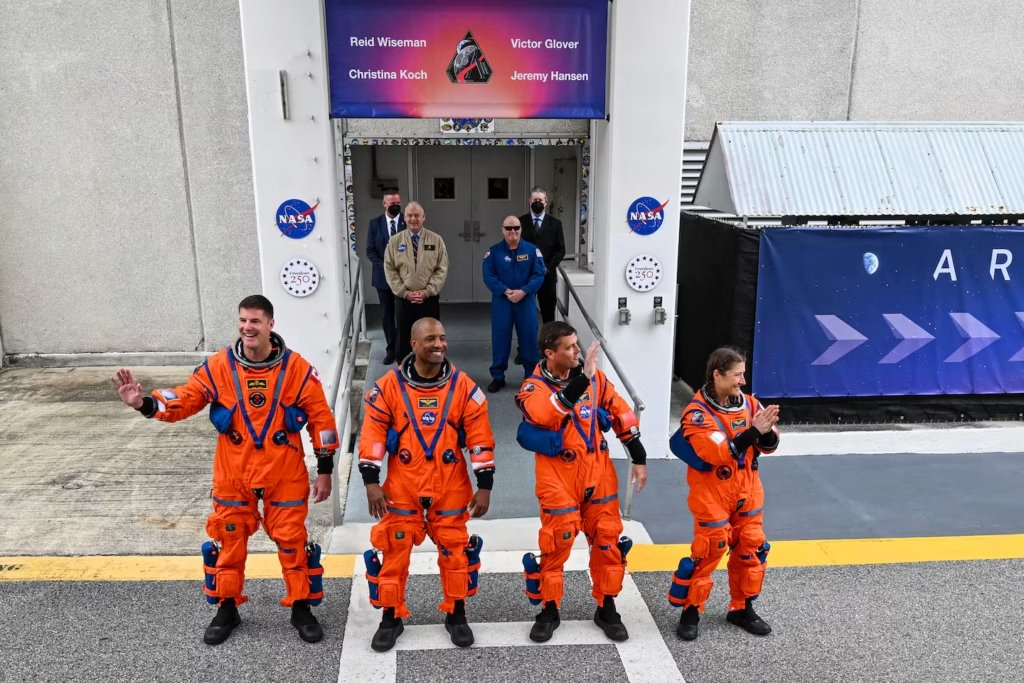
The crew includes NASA astronauts Christina Koch, Reid Wiseman, Victor Glover, and Canadian Space Agency astronaut Jeremy Hansen. Their participation represents an international collaboration in modern space exploration efforts.
The mission launched aboard NASA’s Space Launch System (SLS), one of the most powerful rockets ever developed. Standing at approximately 322 feet, it is designed to carry astronauts farther into space than previous systems.
Following launch, the spacecraft entered an initial phase of Earth orbit. During this period, the crew conducted system checks, monitored onboard equipment, and communicated with mission control to ensure operational stability.

According to NASA updates, the astronauts reported that the experience of viewing Earth from space was remarkable. Such descriptions are common among astronauts who experience orbital flight for the first time.
After completing the Earth-orbit phase, the spacecraft continued its trajectory toward the Moon. The mission is not designed for a lunar landing but rather for a controlled flyby beyond lunar orbit.
This flyby is a critical test of deep-space navigation, communication systems, and life support technologies. It is intended to ensure readiness for future missions involving lunar surface exploration.
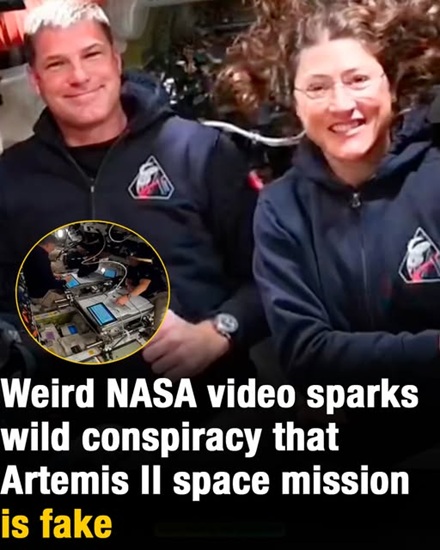
During the mission coverage, NASA and its media partners conducted live interviews with astronauts onboard. These broadcasts are intended to provide public transparency and educational insight into space missions.
In one of these live interviews, a small plush toy was shown floating inside the spacecraft. This object is commonly included in space missions to demonstrate microgravity in a simple and relatable way.
The presence of the floating toy attracted attention from online viewers, leading to widespread discussion on social media platforms. Many users focused on visual details seen in the broadcast.
Some viewers pointed out what appeared to be unusual visual artifacts behind the floating object during the live feed. These observations quickly circulated online, generating various interpretations.

It is important to understand that live space broadcasts rely on complex video production systems. These systems often include overlays, captions, and real-time graphical elements added during transmission.
Production techniques such as chroma key compositing and digital overlays are commonly used in modern broadcasting. These tools allow broadcasters to combine live video with informational graphics.
In live transmissions, slight timing differences between video feeds and overlay graphics can sometimes occur. These minor delays may create temporary visual inconsistencies on screen.
Such visual effects are typically the result of technical synchronization rather than intentional alteration. They are well-known challenges in live broadcasting environments, especially in remote or high-latency conditions.
NASA’s mission broadcasts are produced in collaboration with multiple media organizations to ensure global accessibility. The goal is to share scientific progress with audiences around the world in real time.
Public reactions to space missions often vary widely. While many viewers focus on scientific achievements, others may concentrate on visual or technical aspects of the broadcast.
Experts in communication and media studies note that online platforms can amplify misunderstandings when technical content is viewed without context. This can lead to speculation that spreads quickly.
Space agencies like NASA consistently emphasize transparency in their missions. They regularly release data, images, and live coverage to provide accurate information to the public.
The Artemis program is part of a long-term strategy to advance human space exploration. It builds on decades of research and previous missions, including the Apollo program.
Each stage of the Artemis initiative is designed to test and improve technologies required for sustained deep-space travel. This includes navigation, communication, and crew safety systems.
As public interest in space exploration continues to grow, so does the volume of online discussion surrounding it. These conversations often reflect both enthusiasm and curiosity.
Understanding the technology behind live space broadcasts helps explain many of the visual effects seen during transmissions. What may appear unusual is often a normal part of production processes.
Overall, the Artemis II mission remains an important milestone in NASA’s exploration goals. It continues to contribute valuable data and experience for future missions beyond Earth orbit.
