
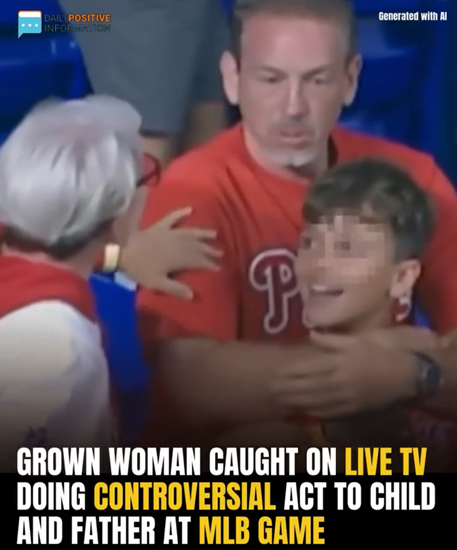
What was meant to be a simple, joyful father‑son outing to celebrate a birthday became an unforgettable moment that captivated baseball fans nationwide.
On September 5, 2025, at loanDepot Park in Miami, Florida, the Philadelphia Phillies were visiting the Miami Marlins in a matchup that promised the excitement typical of a September baseball game: passionate fans, high stakes for playoff positioning, and the drama that naturally unfolds under stadium lights.
For Drew Feltwell and his son Lincoln, who was turning 10 that week, the night was intended to be a special, once-a-year memory: a chance to enjoy America’s pastime together, cheer for their team, and maybe, just maybe, catch a home run ball — a childhood dream many fans share.
The first innings of the game went by like any other: the players were sharp on the field, the pitchers executed their strategies, and the crowd’s energy ebbed and flowed with each pitch.
Families cheered from the stands, vendors sold peanuts and ice-cold sodas, and the warm Florida night held the familiar scents of ballpark popcorn and the salty breeze drifting in from the Atlantic. For Lincoln, every pitch was a thrill, every crack of the bat an opportunity for magic, and every cheer from his father an affirmation that this was exactly how a birthday should feel.
The Home Run That Set Everything in Motion
It was during the fourth inning when the night took an extraordinary turn. Harrison Bader, the Phillies’ talented outfielder known for his speed and keen batting eye, stepped up to the plate. With the count in his favor and a well-placed pitch approaching, Bader connected with a clean, powerful swing.

The ball rocketed off his bat and soared high toward the left-field stands, curving gracefully over the outfield wall in a textbook home run trajectory. Fans in the section erupted instantly: arms stretched upward, eyes following the arcing ball, and cheers blending into a roar that echoed across the stadium.
In baseball, there is a cherished tradition: if a ball is hit into the stands on the fly, any spectator who catches it legally gets to keep it. It’s a small but treasured part of the game, one that adds a personal, almost magical layer for children experiencing a live MLB game. For many kids, catching a home run ball is a once-in-a-lifetime thrill — a tangible memory of a perfect evening spent at the ballpark. For Drew and Lincoln Feltwell, the moment seemed poised to deliver exactly that kind of joy.
Securing the Prize
As the ball descended toward the fans, dozens of people surged forward, each hoping to claim the souvenir. Among the sea of reaching hands, Drew Feltwell, a devoted father intent on making his son’s birthday unforgettable, managed to snag the ball. The moment of triumph was brief but intense. Drew quickly turned, smiled at Lincoln, and handed the prized ball into his son’s glove.
Lincoln’s eyes widened with disbelief and delight. For a moment, the father and son shared pure, unfiltered happiness: the kind that reminds us why sports can create lifelong memories. Drew wrapped his son in a hug, careful not to drop the ball, and Lincoln’s laughter mingled with the cheers around them. To onlookers in that section, it was a perfect scene — a snapshot of baseball at its best, where excitement, family, and community intersect in a single instant.
The Unexpected Challenge
But just as quickly as the joy began, the moment took a surprising turn. A woman, middle-aged and wearing Phillies apparel, approached the father-son duo. Social media later nicknamed her “Phillies Karen” for her assertive and insistent behavior.
Video footage from multiple angles captured the encounter: the woman claimed that the ball had been “in her hands” before Drew secured it, insisting that it rightfully belonged to her. Her tone was loud and confrontational, and she was clearly not content to let the situation pass quietly.
The exchange lasted only moments but left a significant impression on those nearby. Drew, aware of the growing crowd and concerned about escalating tension in front of his young son, chose to step back.
In a demonstration of parental calm under pressure, he removed the ball from Lincoln’s glove and handed it to the woman, prioritizing his son’s emotional safety over the material prize. The small act of surrender — though heartbreaking in the moment — exemplified a father’s instinct to protect and maintain peace during a potentially volatile situation.

Going Viral: The Story Explodes Online
Before the game even ended, multiple video clips of the incident were circulating online, shared on platforms like X (formerly Twitter), Reddit, and Instagram. The footage quickly amassed millions of views, sparking debates among fans across the country. Comments poured in, many criticizing the woman rather than Drew or Lincoln. Social media users debated the ethics of challenging a child for a home run ball, questioning what constitutes appropriate behavior at family-friendly sporting events.
Discussions quickly expanded into broader conversations about baseball traditions. Some users emphasized the unwritten rule that a ball belongs to the first person who catches it legally, especially when it lands in a child’s glove. Others reflected on how live sporting events serve as spaces for families to create lasting memories, suggesting that adults should step aside in such scenarios to allow young fans to experience the magic firsthand.
Importantly, responsible reporting and commentary avoided doxxing or personal attacks. While speculation about the woman’s identity appeared online, there were no verified reports confirming who she was, and commentators emphasized respecting privacy despite public behavior that many found inappropriate.
For a child, nothing dampens excitement faster than seeing a hard-earned treasure — like a home run ball — slip away. For Lincoln Feltwell, the initial joy of catching a ball that soared off Harrison Bader’s bat had quickly turned into confusion and disappointment. His eyes, once wide with wonder, reflected the fleeting sadness that many children feel when a moment they thought would be theirs suddenly changes. Yet, while the viral video highlighted the confrontation, it did not capture everything that would make this night truly unforgettable.
Teams Take Notice
In the stands, representatives from both the Miami Marlins and the Philadelphia Phillies were closely watching the interaction. The moment was brief, but its significance was unmistakable: a child’s special birthday experience had been disrupted. Recognizing the emotional impact, the Marlins’ staff quickly decided to step in. Within minutes, an usher approached Drew and Lincoln with a small but thoughtful gesture: a goodie bag containing official Marlins merchandise.

Inside the bag were a few items designed to delight a young fan: branded baseballs, a team cap, stickers, and other memorabilia. The gesture was simple but meaningful — an immediate acknowledgment that the organization valued Lincoln as part of the game experience. Witnesses recalled the boy’s face lighting up again, the corners of his mouth turning upward as he clutched the baseballs. While it couldn’t replace the home run ball itself, the Marlins’ intervention softened the sting of disappointment and demonstrated that both teams were committed to making sure every child could leave the stadium happy.
The Phillies’ Generous Response
While the Marlins had offered a quick solution, the Phillies organization went even further. Shortly after the final out, Drew and Lincoln were invited to the Phillies’ clubhouse, a privilege normally reserved for special guests. Harrison Bader, whose bat had started the entire chain of events, personally greeted Lincoln. With a warm smile and a handshake, Bader handed Lincoln a signed bat — an item far more substantial than a single baseball, representing not just the team’s generosity but a tangible connection to the player who made the moment possible.
The Phillies made sure the experience was memorable in every detail: photos were taken of Lincoln holding the bat, beaming from ear to ear, while Drew captured the scene for family memories. Bader paused to chat with Lincoln about the game, asking him if he enjoyed the match and even pointing out highlights from his own at-bats that night. For Lincoln, the interaction was magical — a child’s dream of meeting a professional player made real.
The Emotional Impact
The gestures from both teams had an immediate effect: what had begun as a viral story of frustration turned into a narrative of kindness and community. Lincoln’s initial disappointment faded, replaced by pride and excitement. For Drew, the evening became a case study in how challenges can be reframed into positive experiences. In interviews following the game, he reflected on the moment, explaining that while he initially felt heartbroken for his son, he was grateful for the thoughtful responses from the teams.
He described handing over the ball to the woman not as a defeat, but as a conscious choice to protect Lincoln’s birthday experience from escalating into a stressful conflict. “It wasn’t about winning or losing the ball,” Drew explained. “It was about making sure my son enjoyed his special day. That’s always the priority for me.”
The Phillies’ signed bat and the Marlins’ goodie bag were more than just gifts — they were symbols of how organizations can turn an awkward, disappointing, or tense moment into something memorable and uplifting. Fans watching the videos online quickly noticed this, and many expressed admiration for the way both teams handled the situation. Commenters highlighted that the story showed the importance of empathy, foresight, and community support in sports.
Social Media Celebrates the Outcome
As the story continued to circulate online, new videos and photos of Lincoln with his signed bat and the Marlins’ goodie bag emerged. Social media users began to share the positive side of the story, praising both organizations for responding thoughtfully and quickly. Headlines and posts shifted from outrage over the confrontation to admiration for the gestures of goodwill. Fans described the Phillies’ actions as “a class act” and “a perfect example of how to make a young fan feel valued,” while the Marlins were celebrated for stepping in immediately to support a disappointed child.
Across platforms like X, Instagram, and Reddit, the conversation became one of appreciation rather than criticism. Users reflected on their own childhood experiences at baseball games and shared stories of similar acts of kindness from players, stadium staff, or other fans. The narrative expanded beyond a single incident, highlighting the broader culture of sportsmanship, community involvement, and the significance of creating positive experiences for young fans.
A Learning Moment About Sportsmanship
The entire incident — from the initial catch, through the confrontation, and culminating in the teams’ interventions — sparked discussions about fan etiquette and ethics in sports. In baseball, as in many sports, there’s an unwritten code: fans are expected to respect the rights of others, particularly children, when it comes to memorabilia like home run balls. When adults challenge children for items, it’s often seen as a breach of community spirit and respect.

Commentators emphasized that while disagreements at games are not uncommon, the best response is one that preserves the joy of the experience rather than escalating tensions. The Phillies-Marlins incident illustrated how organizations can mediate difficult situations, demonstrating empathy and ensuring that every fan leaves with a positive memory. For parents, it offered a reminder that sometimes stepping back and prioritizing a child’s emotional experience can turn disappointment into a teachable, even inspiring, moment.
While the viral confrontation over the home run ball initially captured the attention of fans nationwide, the story’s resolution ultimately became what people remembered most: a narrative about empathy, community, and the power of small gestures to create lasting memories. For Lincoln Feltwell, his 10th birthday had transformed from a momentary disappointment into a night he — and his family — would never forget.
Reflections from Lincoln and His Father
In interviews following the game, Lincoln’s father, Drew Feltwell, spoke openly about the evening, sharing both the highs and lows. He recounted the thrill when Harrison Bader’s ball landed in his son’s glove, a moment filled with pure joy that he described as “priceless.” Even the brief moment of tension with the woman did not overshadow the fact that Lincoln had experienced something special: the excitement of a live MLB game, the wonder of a home run, and the joy of holding a ball that, for a fleeting moment, seemed entirely his.
Drew emphasized the importance of perspective. By choosing to hand over the ball, he prioritized his son’s emotional well-being over the material possession. “It’s easy to focus on what’s lost,” Drew said, “but what matters most is the memory, the excitement, and the experience we share as a family. That’s what I want Lincoln to remember.”
Lincoln himself shared the impact of the teams’ responses. Holding his signed bat from Harrison Bader and exploring the goodies from the Marlins, he described the evening as “the best birthday ever.” He didn’t dwell on the momentary disappointment; instead, he embraced the surprises that came afterward. For a young fan, receiving direct attention from a professional athlete, along with gifts thoughtfully selected to bring joy, was a memory that would likely last a lifetime.
Broader Fan Reactions and Social Media Support
As the story continued to circulate online, fan reactions shifted dramatically from outrage over the confrontation to admiration for how the Phillies and Marlins handled the situation. Across X, Reddit, Instagram, and other platforms, people praised the organizations for recognizing a teachable moment and turning it into a positive experience for a young fan.
Many commenters highlighted that moments like these — small acts of kindness and consideration — are what make live sports experiences meaningful. The Phillies’ gesture of a signed bat, combined with the Marlins’ quick goodie bag, resonated deeply with viewers. Fans shared personal anecdotes of similar experiences, creating a sense of shared culture and community around the love of baseball. Posts about Lincoln’s experience were often accompanied by hashtags like #MLBKindness, #BaseballMagic, and #FansFirst, reflecting a widespread appreciation for the empathy demonstrated by both organizations.
Sports commentators also weighed in, framing the incident as a reminder of the “unwritten rules” of baseball fandom. Catching a ball legally at a game is a celebrated tradition, particularly when children are involved. Many agreed that adults should exercise restraint and allow kids to experience the thrill, while the teams’ proactive steps illustrated the positive influence organizations can have in ensuring those moments remain joyful.
The Lasting Significance
This story is more than just a viral clip or a moment of social media debate — it’s a case study in how a community-oriented response can transform disappointment into joy. From a father’s thoughtful decision to avoid conflict, to the Marlins’ immediate goodie bag, to Harrison Bader personally signing a bat for Lincoln, every step contributed to a night that ended on a high note.
For Drew and Lincoln, the story became a family legend. Photos of Lincoln holding the signed bat were framed and displayed at home, capturing not only the thrill of the moment but also the resilience, patience, and kindness that defined the evening. Lincoln’s birthday, initially threatened by an unexpected confrontation, became a lasting memory not just because of the gifts but because of the warmth, generosity, and empathy that surrounded him.
Lessons for Fans and Families
The Phillies-Marlins incident sparked broader conversations about sportsmanship, respect, and community involvement. Observers noted several key takeaways:
- Prioritize Experience Over Possessions: Drew’s decision to protect Lincoln’s emotional experience highlighted the importance of placing human connection above material gain.
- Small Gestures Matter: The Phillies’ signed bat and the Marlins’ goodie bag demonstrate how thoughtful, timely actions can turn disappointment into joy.
- Community and Respect: Fans online recognized that respecting children’s experiences, following traditions, and promoting kindness are crucial components of the sports culture.
- Turning Viral Moments Positive: While social media often amplifies conflict, this incident became an example of how organizations and individuals can use visibility to reinforce empathy and goodwill.
How the Night Ended
By the time the stadium emptied, Lincoln had transformed what could have been a disappointing story into one of wonder and happiness. He left loanDepot Park not just with memorabilia but with an unforgettable memory of a father who prioritized love over confrontation, two teams that went above and beyond to support a young fan, and a personal interaction with a professional athlete that would likely inspire him for years to come.
Fans, commentators, and social media users who followed the story echoed a common sentiment: while adults may sometimes forget the magic of the game, moments like these remind everyone why baseball has a special place in the hearts of families and communities alike. A lost ball, a viral video, and a tense exchange became a story celebrated for its resolution — proving that empathy, generosity, and shared joy can outshine conflict.
In the end, Lincoln’s 10th birthday was not defined by a single home run ball, but by a series of thoughtful, meaningful gestures that exemplified the very best of baseball culture: excitement, family, tradition, and above all, humanity.

