
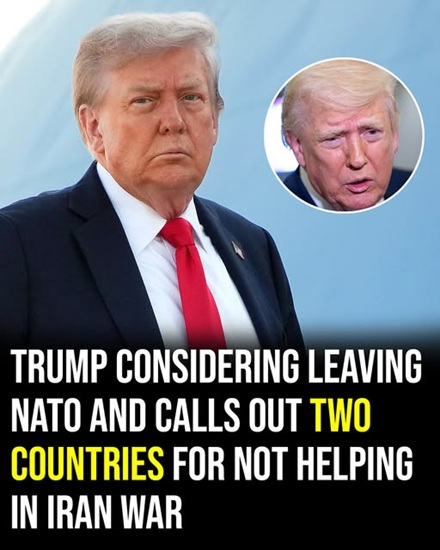
In the midst of the United States’ intensifying conflict with Iran, President Donald J. Trump has unleashed a new wave of criticism against the North Atlantic Treaty Organization (NATO) and its European member states.
In an interview published in The Telegraph, Trump said he is “strongly considering” withdrawing the United States from NATO once the Iran war concludes, a remark that has sent shockwaves through global diplomatic circles.
Trump described the alliance as a “paper tiger”, reiterating a long‑held viewpoint that NATO is overstated in capability and lacking in collective resolve — even suggesting that Russia’s president, Vladimir Putin, similarly sees NATO as weak.
Created in 1949 after World War II, NATO was designed to deter aggression against Western Europe by ensuring that an attack on one member would be treated as an attack on all.

Over nearly eight decades, the alliance has expanded from its original 12 members to 32 countries including the United States, United Kingdom, France, Germany, Italy, and Canada.
Trump’s latest comments are rooted in deep frustration with NATO allies’ reluctance to support the U.S. military campaign against Iran — a war many countries view as outside the alliance’s traditional mission.
Several key NATO members have refused to allow American aircraft to use their airspace, bases, or logistics infrastructure for offensive actions directly tied to the Iran conflict.
That refusal has particularly irked Trump, who believes allies have offered only rhetorical support or conditional assistance after the fighting has already unfolded.
Trump has publicly said NATO’s inaction in the conflict demonstrates that the alliance cannot be relied on when the United States needs support in distant theaters.
He argues that while the U.S. has repeatedly come to NATO’s defense, its allies have failed to reciprocate — an assertion that has sparked heated debate among policymakers and analysts.
Trump’s criticism has extended beyond general NATO commentary to sharp comments about specific allies, including the United Kingdom and France, who have opted out of military operational roles related to the Iran war.
British officials, including Prime Minister Keir Starmer, have consistently stated they will not commit the U.K. to military action in the Strait of Hormuz or Iran without clear legal or strategic mandates.

Similarly, French leaders have emphasized diplomatic approaches to the crisis and questioned the legal basis for NATO participation in operations outside collective defense.
Trump’s remarks have been met with significant pushback from both U.S. lawmakers and European capitals, many of whom view NATO as essential to continental and trans‑Atlantic security.
A bipartisan group of U.S. senators publicly reaffirmed America’s commitment to NATO, noting that unilateral withdrawal would undermine national security and embolden global adversaries.
Under U.S. law passed in 2023, the president cannot unilaterally withdraw the United States from NATO without Congressional approval, posing a legal check on any attempt to exit the alliance.
That legislation was enacted specifically to prevent a sitting president from removing the U.S. from the treaty without broad legislative backing.
Even so, Trump has insisted in private and public remarks that he believes he could make such a decision independently, a claim legal experts dispute.
European leaders have also responded forcefully to Trump’s rhetoric, emphasizing the importance of unity and collective defense as Russia’s war in Ukraine continues to strain global security.
French President Emmanuel Macron has publicly criticized the United States for its mixed messaging, warning that frequent doubts about NATO’s value erode its foundation and collective credibility.

Germany, Italy, Spain and other NATO members have highlighted that their strategic focus on territorial defense does not legally extend to joining offensive operations far from the alliance’s geographic mandates.
Several capitals also emphasize the need for a negotiated diplomatic resolution to the Iran conflict rather than unilateral military escalation or extended combat deployments.
Many allied governments point out that the core concept of NATO — mutual defense under Article 5 — remains intact and separate from individual member states’ choices about participating in extraneous conflicts.
Trump’s comments come as the Iran war has triggered global economic concerns, especially elevated oil prices due to Iran’s disruption of the Strait of Hormuz, a vital global shipping route.
The conflict has also strained U.S. relationships with the Gulf States, Europe, and other global partners who prefer diplomatic solutions over broad military coalitions.
Public opinion in NATO member states varies, with many citizens skeptical of new foreign wars yet supportive of collective defense guarantees against direct threats to their nations.
In the United States, a Reuters/Ipsos poll suggests a strong majority of Americans want the country to end the Iran war quickly, even if objectives remain unmet.
Trump has also signaled that U.S. forces will “leave Iran pretty quickly” once certain conditions are met, though he may maintain the option for limited future actions.

Many experts believe Trump’s NATO rhetoric is partly intended as leverage over allies, attempting to force them into cost‑sharing or coercive roles in regional crises.
Still, critics argue that attacking allied commitments publicly could weaken Western cohesion and give adversaries like Russia and China diplomatic openings.
Some analysts suggest Trump’s comments reflect broader dissatisfaction with longstanding U.S. defense obligations while downplaying the strategic importance of alliances forged after World War II.
NATO has previously faced existential questions, such as after the Soviet Union’s collapse and after the 9/11 attack, yet it has endured as a central pillar of Western deterrence.
Any decision to withdraw the United States from NATO would mark a historic rupture in global security structures and invite debate about U.S. leadership in the post‑war order.

For now, Trump’s statements have not resulted in formal NATO withdrawal steps, and many diplomats say no formal process has begun inside the alliance or Pentagon.
However, the rhetoric has heightened anxiety among NATO members and foreign policy officials about future U.S. commitments and the alliance’s long‑term viability.
How NATO adapts to these internal strains — and whether the alliance can reconcile divergent member priorities — remains a central question for trans‑Atlantic security in the 21st century.
Whether the U.S. stays in NATO, reforms the alliance, or redefines its role, Trump’s remarks have ensured that the debate over NATO’s future has moved to the forefront of international relations discussions.
