
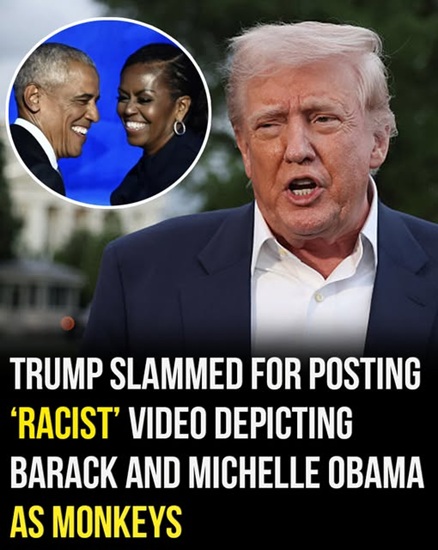
In early February 2026, former President Donald Trump sparked one of the most widely discussed political controversies of his ongoing post-presidency when a brief post on his social media platform, Truth Social, drew immediate and widespread condemnation.
The post, which depicted former President Barack Obama and former First Lady Michelle Obama as apes for a fleeting moment, ignited debates about race, political responsibility, and the influence of social media in modern civic life.
What began as part of a late-night flurry of posts regarding Trump’s claims about the 2020 presidential election quickly escalated into a national conversation. Leaders from across the political spectrum weighed in, civil rights organizations voiced concerns, and commentators analyzed the deeper historical and cultural implications of racially charged imagery.
The incident not only raised questions about the actions of a former president but also served as a reflection of ongoing societal challenges surrounding race, public communication, and accountability.

The Post That Sparked Outrage
On a Thursday evening, Donald Trump shared a video on Truth Social that, at its core, was intended to highlight his longstanding allegations regarding the 2020 election, including debunked claims about Dominion Voting Systems and purported manipulation of voting machines. The majority of the video focused on these election-related claims, framing them in a familiar narrative of alleged fraud.
However, the controversy centered on a brief segment near the end of the 62-second clip. For only a second or two, the faces of Barack and Michelle Obama were superimposed onto the bodies of apes, set against a jungle backdrop.
This imagery was accompanied by the song “The Lion Sleeps Tonight,” adding a layer of performative parody. Though fleeting, the clip immediately evoked profound reactions due to the historical context of comparing Black individuals to primates—a practice with deep roots in dehumanization and racial discrimination.
Civil rights experts were quick to contextualize the harm. The association of Black individuals with apes has been a recurring method of racial denigration for centuries, used historically to justify slavery, segregation, and systemic discrimination.
For many, the short video was not merely a crude joke but a continuation of a pattern of harmful imagery with real-world effects, particularly for children and communities of color who have historically faced such demeaning portrayals.
Immediate Response and Political Backlash
The public response was swift and multifaceted. Within minutes of the post going live, elected officials, civil rights organizations, and social media users expressed outrage.
Unlike many other online memes that circulate without consequence, this post was viewed through the lens of Trump’s status as a former president and public figure. The imagery’s historical weight transformed it from an ephemeral social media clip into a nationally significant event.

Democratic leaders were among the first to issue statements condemning the post. Several described it as an overtly racist act, emphasizing that the use of such imagery by a public figure carries symbolic and societal consequences. One prominent Democratic lawmaker characterized Trump’s action as “part of a broader, bigoted pattern that harms the very fabric of American civic life,” highlighting both its immediate and long-term implications.
On the Republican side, reactions were complex and divided. Senator Tim Scott, a Black Republican and a frequent Trump ally, called the depiction “the most racist thing I’ve seen from the White House,” urging Trump to remove the post and issue an apology. Other GOP lawmakers echoed concerns, balancing loyalty to the former president with recognition of the cultural insensitivity and potential damage caused by the imagery.
Social media discussions reflected similar polarization. Supporters of Trump defended the post as satire or political parody, often framing the outrage as politically motivated. Critics, however, underscored the racial implications, highlighting that even intended humor cannot erase the decades-long harm caused by dehumanizing depictions of Black people.
White House Defense and Post Deletion
In the immediate hours following the post, the Trump administration sought to frame the controversy as a misunderstanding. Press Secretary Karoline Leavitt described the video as part of an “internet meme” portraying Trump as the “King of the Jungle” alongside various political figures as characters from “The Lion King.” She characterized the backlash as “fake outrage,” urging the media and public to prioritize other issues instead.
Yet as criticism intensified—including bipartisan concern and public attention—the White House ultimately removed the post roughly 12 hours after it was published.
Officials attributed the posting to a staffer who allegedly shared the video without proper oversight. Trump acknowledged the deletion but consistently refused to apologize, stating that he had only watched the portion of the video related to election claims and was unaware of the offensive segment.
When pressed by reporters on whether he regretted the post, Trump reiterated, “I didn’t make a mistake,” maintaining that he did not view the full content. This refusal to apologize, even as calls for accountability intensified, fueled further debate about leadership, responsibility, and the cultural impact of presidential communications.
Historical Context: Why the Imagery Matters
The response to the Truth Social post is inseparable from the historical associations of the imagery. Comparing Black individuals to primates has been used for centuries as a tool of systemic oppression, aimed at dehumanizing and delegitimizing African Americans in the United States. Such depictions were prevalent in political propaganda, newspapers, and entertainment, often reinforcing societal hierarchies and racial prejudices.

Civil rights organizations stressed that these historical connotations amplify the harm of even brief or satirical depictions. The power of imagery lies not just in intent but in interpretation: symbols rooted in racial discrimination evoke lived experiences of marginalization, exclusion, and trauma.
The timing of the post—during Black History Month—further heightened sensitivity, as the juxtaposition of celebration and remembrance with offensive imagery underscored the enduring relevance of racial justice advocacy.
Broader Implications for Public Discourse
The controversy surrounding Trump’s post illuminates broader challenges in modern political communication. Social media platforms have blurred the boundaries between private expression, public messaging, and official conduct. When high-profile figures share content online, even momentarily, the reach and influence are immense, amplifying both intended and unintended consequences.
Critics argue that leaders have a responsibility to account for historical and social context in their communications. The Truth Social incident demonstrates that imagery—even when framed as parody—cannot be divorced from centuries of racial meaning.
Advocates for civil rights and media ethics have emphasized that unchecked or unreviewed social media activity by prominent figures can perpetuate harm, normalizing stereotypes, and undermining social cohesion.
The aftermath of the Truth Social post revealed sharp divisions within the Republican Party. While some lawmakers condemned the imagery outright, others defended or downplayed the incident, framing it as satirical commentary on Democratic leadership. This division reflected broader tensions in American politics between loyalty to party leadership and the ethical expectations associated with public office, even after leaving the presidency.
Senator Tim Scott’s criticism, for instance, highlighted a critical tension: how should Republican leaders reconcile historical racial sensitivities with political alignment? Scott emphasized that the imagery was “not only inappropriate but harmful” and called for accountability. Yet other Republicans echoed the administration’s framing, arguing that the outrage was politically manufactured and part of a broader campaign to discredit Trump.
This split illustrated the challenge of maintaining cohesion in a polarized political environment. Lawmakers and party officials faced a dual pressure: addressing the ethical concerns raised by civil rights advocates and managing the expectations of a base that continues to strongly support Trump. The incident thus became a microcosm of a larger debate about political ethics, party loyalty, and the boundaries of acceptable political expression in the digital era.

Civil Rights Organizations and Public Accountability
Civil rights organizations reacted swiftly and decisively, viewing the post as symptomatic of the ongoing struggle against racially demeaning imagery in American society. Groups such as the NAACP, the Leadership Conference on Civil and Human Rights, and other advocacy organizations condemned the post and called for both immediate corrective action and long-term vigilance in political communications.
These organizations underscored several key points:
- Historical Responsibility: Public figures, particularly those with national influence, must understand the historical connotations of racialized imagery. Depicting Black individuals as primates taps into centuries of dehumanization that has contributed to systemic inequality.
- Symbolic Consequences: Even brief exposure to harmful imagery can reinforce stereotypes and contribute to societal desensitization. Civil rights leaders emphasized that seemingly minor online content has real-world implications for public perception and cultural norms.
- Institutional Oversight: Advocates called for clearer protocols and oversight mechanisms for social media posts originating from former or current political offices. Ensuring content review and sensitivity training for staffers could mitigate similar incidents in the future.
By framing the post as more than a simple political misstep, civil rights groups elevated the conversation about accountability, highlighting the intersection of technology, politics, and social responsibility.
Media Ethics and Public Perception
The incident also sparked extensive discussions about media responsibility and public discourse. News outlets, social media platforms, and commentators debated how to cover the story without amplifying the harmful imagery. Ethical questions arose about whether reproducing the images in news coverage could perpetuate the same harms the post had caused.
Some media organizations adopted careful editorial strategies:
- Using descriptive language without publishing the image itself
- Contextualizing the post within historical patterns of racial dehumanization
- Providing expert commentary to educate audiences about the implications
These strategies underscored the importance of responsible journalism in shaping public understanding while minimizing harm.
Social media, as the original vector for the controversy, came under scrutiny for its role in amplifying content. Truth Social’s architecture, lacking robust content moderation and review protocols, allowed a high-profile post with harmful imagery to reach millions within hours. Critics argued that platforms facilitating political communication bear some responsibility for ensuring that content, especially from influential users, adheres to ethical standards and does not contribute to societal harm.
Cultural Implications and Symbolism
Beyond the immediate political fallout, the post prompted a broader cultural reckoning. The depiction of the Obamas as apes served as a stark reminder that historical symbols of racism continue to resonate in modern society. The incident highlighted the fragility of cultural understanding in an era where digital content can spread rapidly and widely, often without contextualization.
The timing of the post—during Black History Month—further intensified its significance. For many Americans, Black History Month is a period of reflection on the struggles and achievements of African Americans. The juxtaposition of a racially offensive meme with a time dedicated to education, remembrance, and celebration of Black contributions underscored the dissonance between public messaging and cultural sensitivity.
Educators, historians, and public commentators pointed out that public figures must consider not only intent but also interpretation. In a society where racial stereotypes have been deeply internalized over generations, even satirical or joking content can have tangible psychological and social consequences.
Lessons in Leadership and Responsibility
The Truth Social controversy illustrates a critical lesson about leadership and public responsibility: influence extends beyond direct statements. Every public message carries weight, shaping perceptions, norms, and expectations. Leaders—current or former—bear an ethical responsibility to ensure their communications do not perpetuate harm or reinforce systemic biases.
This episode also demonstrates the importance of accountability structures within political operations. The post was allegedly shared by a staffer without full review, raising questions about oversight and procedural safeguards. Clear policies, sensitivity training, and multi-tiered review mechanisms could prevent similar lapses, particularly when content may have far-reaching social implications.
Public Dialogue and the Role of Social Media
The incident reinforced ongoing debates about the role of social media in political communication. Digital platforms can amplify messages instantaneously, crossing geographical, social, and cultural boundaries. While this enables engagement, it also increases the stakes for miscommunication, insensitivity, or error.
Public dialogue following the post reflected this dynamic. On one hand, social media enabled widespread criticism and discussion, giving civil rights organizations, commentators, and concerned citizens a platform to educate and raise awareness. On the other hand, it allowed misinformation, partisan spin, and polarized narratives to spread, complicating efforts to achieve constructive discourse.
Experts suggested that this duality—platforms as both tools for accountability and vectors for harm—requires ongoing evaluation. Leaders, users, and platform operators all play a role in shaping a digital environment that balances free expression with ethical responsibility.
The Broader National Conversation
Ultimately, the Truth Social incident sparked a broader conversation about race, symbolism, and leadership in the United States. It highlighted the persistent relevance of historical injustices and the need for sensitivity in all forms of public messaging. It also illustrated that the boundaries of accountability extend beyond immediate actions to encompass systemic, structural, and cultural considerations.
The post’s fleeting nature did not diminish its impact. In a country where race remains a central and sensitive aspect of social identity, the imagery became a lens through which Americans assessed not only Trump’s personal judgment but also broader questions about political norms, media ethics, and collective memory.
Conclusion: Beyond a Meme
While some might dismiss the Truth Social post as a brief digital misstep or an attempt at humor, the episode demonstrates that symbolism, history, and context cannot be separated from public communication. The national conversation that followed underscores the importance of ethical leadership, historical awareness, and media literacy.
The incident illustrates that modern political discourse is inseparable from the platforms it inhabits. Leaders must understand that social media magnifies both intent and impact. Civil rights considerations, public sensitivity, and historical context are not optional—they are essential for responsible communication.
As the United States continues to navigate complex questions of race, leadership, and digital culture, moments like this serve as reminders that even short, seemingly trivial actions can have profound consequences. The controversy invites reflection on how society educates its leaders, regulates its platforms, and holds individuals accountable for the messages they amplify.
By examining the Truth Social post in full context—historical, political, ethical, and social—Americans are reminded that public figures’ statements are never isolated. They are part of an ongoing dialogue about values, justice, and national identity. And in a nation grappling with the legacies of racial inequality, such dialogues are both urgent and necessary.
The aftermath of the Truth Social post revealed sharp divisions within the Republican Party. While some lawmakers condemned the imagery outright, others defended or downplayed the incident, framing it as satirical commentary on Democratic leadership. This division reflected broader tensions in American politics between loyalty to party leadership and the ethical expectations associated with public office, even after leaving the presidency.
Senator Tim Scott’s criticism, for instance, highlighted a critical tension: how should Republican leaders reconcile historical racial sensitivities with political alignment? Scott emphasized that the imagery was “not only inappropriate but harmful” and called for accountability. Yet other Republicans echoed the administration’s framing, arguing that the outrage was politically manufactured and part of a broader campaign to discredit Trump.
This split illustrated the challenge of maintaining cohesion in a polarized political environment. Lawmakers and party officials faced a dual pressure: addressing the ethical concerns raised by civil rights advocates and managing the expectations of a base that continues to strongly support Trump. The incident thus became a microcosm of a larger debate about political ethics, party loyalty, and the boundaries of acceptable political expression in the digital era.
Civil Rights Organizations and Public Accountability
Civil rights organizations reacted swiftly and decisively, viewing the post as symptomatic of the ongoing struggle against racially demeaning imagery in American society. Groups such as the NAACP, the Leadership Conference on Civil and Human Rights, and other advocacy organizations condemned the post and called for both immediate corrective action and long-term vigilance in political communications.
These organizations underscored several key points:
- Historical Responsibility: Public figures, particularly those with national influence, must understand the historical connotations of racialized imagery. Depicting Black individuals as primates taps into centuries of dehumanization that has contributed to systemic inequality.
- Symbolic Consequences: Even brief exposure to harmful imagery can reinforce stereotypes and contribute to societal desensitization. Civil rights leaders emphasized that seemingly minor online content has real-world implications for public perception and cultural norms.
- Institutional Oversight: Advocates called for clearer protocols and oversight mechanisms for social media posts originating from former or current political offices. Ensuring content review and sensitivity training for staffers could mitigate similar incidents in the future.
By framing the post as more than a simple political misstep, civil rights groups elevated the conversation about accountability, highlighting the intersection of technology, politics, and social responsibility.
Media Ethics and Public Perception
The incident also sparked extensive discussions about media responsibility and public discourse. News outlets, social media platforms, and commentators debated how to cover the story without amplifying the harmful imagery. Ethical questions arose about whether reproducing the images in news coverage could perpetuate the same harms the post had caused.
Some media organizations adopted careful editorial strategies:
- Using descriptive language without publishing the image itself
- Contextualizing the post within historical patterns of racial dehumanization
- Providing expert commentary to educate audiences about the implications
These strategies underscored the importance of responsible journalism in shaping public understanding while minimizing harm.
Social media, as the original vector for the controversy, came under scrutiny for its role in amplifying content. Truth Social’s architecture, lacking robust content moderation and review protocols, allowed a high-profile post with harmful imagery to reach millions within hours.
Critics argued that platforms facilitating political communication bear some responsibility for ensuring that content, especially from influential users, adheres to ethical standards and does not contribute to societal harm.
Cultural Implications and Symbolism
Beyond the immediate political fallout, the post prompted a broader cultural reckoning. The depiction of the Obamas as apes served as a stark reminder that historical symbols of racism continue to resonate in modern society. The incident highlighted the fragility of cultural understanding in an era where digital content can spread rapidly and widely, often without contextualization.
The timing of the post—during Black History Month—further intensified its significance. For many Americans, Black History Month is a period of reflection on the struggles and achievements of African Americans. The juxtaposition of a racially offensive meme with a time dedicated to education, remembrance, and celebration of Black contributions underscored the dissonance between public messaging and cultural sensitivity.
Educators, historians, and public commentators pointed out that public figures must consider not only intent but also interpretation. In a society where racial stereotypes have been deeply internalized over generations, even satirical or joking content can have tangible psychological and social consequences.
Lessons in Leadership and Responsibility
The Truth Social controversy illustrates a critical lesson about leadership and public responsibility: influence extends beyond direct statements. Every public message carries weight, shaping perceptions, norms, and expectations. Leaders—current or former—bear an ethical responsibility to ensure their communications do not perpetuate harm or reinforce systemic biases.
This episode also demonstrates the importance of accountability structures within political operations. The post was allegedly shared by a staffer without full review, raising questions about oversight and procedural safeguards. Clear policies, sensitivity training, and multi-tiered review mechanisms could prevent similar lapses, particularly when content may have far-reaching social implications.
Public Dialogue and the Role of Social Media
The incident reinforced ongoing debates about the role of social media in political communication. Digital platforms can amplify messages instantaneously, crossing geographical, social, and cultural boundaries. While this enables engagement, it also increases the stakes for miscommunication, insensitivity, or error.
Public dialogue following the post reflected this dynamic. On one hand, social media enabled widespread criticism and discussion, giving civil rights organizations, commentators, and concerned citizens a platform to educate and raise awareness. On the other hand, it allowed misinformation, partisan spin, and polarized narratives to spread, complicating efforts to achieve constructive discourse.
Experts suggested that this duality—platforms as both tools for accountability and vectors for harm—requires ongoing evaluation. Leaders, users, and platform operators all play a role in shaping a digital environment that balances free expression with ethical responsibility.
The Broader National Conversation
Ultimately, the Truth Social incident sparked a broader conversation about race, symbolism, and leadership in the United States. It highlighted the persistent relevance of historical injustices and the need for sensitivity in all forms of public messaging. It also illustrated that the boundaries of accountability extend beyond immediate actions to encompass systemic, structural, and cultural considerations.
The post’s fleeting nature did not diminish its impact. In a country where race remains a central and sensitive aspect of social identity, the imagery became a lens through which Americans assessed not only Trump’s personal judgment but also broader questions about political norms, media ethics, and collective memory.
Conclusion: Beyond a Meme
While some might dismiss the Truth Social post as a brief digital misstep or an attempt at humor, the episode demonstrates that symbolism, history, and context cannot be separated from public communication. The national conversation that followed underscores the importance of ethical leadership, historical awareness, and media literacy.
The incident illustrates that modern political discourse is inseparable from the platforms it inhabits. Leaders must understand that social media magnifies both intent and impact. Civil rights considerations, public sensitivity, and historical context are not optional—they are essential for responsible communication.
As the United States continues to navigate complex questions of race, leadership, and digital culture, moments like this serve as reminders that even short, seemingly trivial actions can have profound consequences. The controversy invites reflection on how society educates its leaders, regulates its platforms, and holds individuals accountable for the messages they amplify.
By examining the Truth Social post in full context—historical, political, ethical, and social—Americans are reminded that public figures’ statements are never isolated. They are part of an ongoing dialogue about values, justice, and national identity. And in a nation grappling with the legacies of racial inequality, such dialogues are both urgent and necessary.
