In the early days of March 2026, the geopolitical landscape of the Middle East was marked by heightened tension and military escalation.
The United States, in coordination with allied forces, had initiated a large-scale military operation against Iran, aiming to curtail its expanding missile program and regional military influence.
Amid this fraught backdrop, American forces deployed across the Persian Gulf faced risks not only in direct combat zones but also at strategic support facilities that served as logistical and operational hubs hundreds of miles from the front lines.
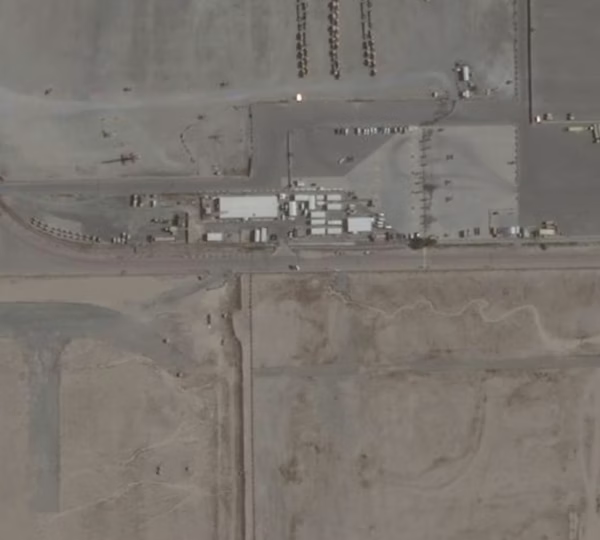
On March 1, 2026, that risk became a grim reality when six American service members were killed in a devastating drone attack at Port Shuaiba, a civilian seaport in Kuwait that also functions as a critical military logistics hub.
The attack, carried out by an unmanned aircraft system (UAS) attributed to Iranian forces, struck a prefabricated tactical operations center within the port. While the facility was fortified against ground-based threats, including checkpoints and defensive barriers, it lacked overhead protection sufficient to withstand an aerial assault of this kind.
The UAS penetrated air defenses and detonated upon impact, killing six soldiers instantly and causing significant damage to the support infrastructure used by U.S. forces in the region. The deaths marked the first American fatalities in the unfolding Operation Epic Fury, the coordinated campaign by U.S. and Israeli forces against Iranian targets.
The strike underscored the vulnerability of even rear-echelon units—those assigned primarily to logistical, technical, and operational support—demonstrating that the dangers of modern warfare extend far beyond the front lines.
Identification of the Fallen
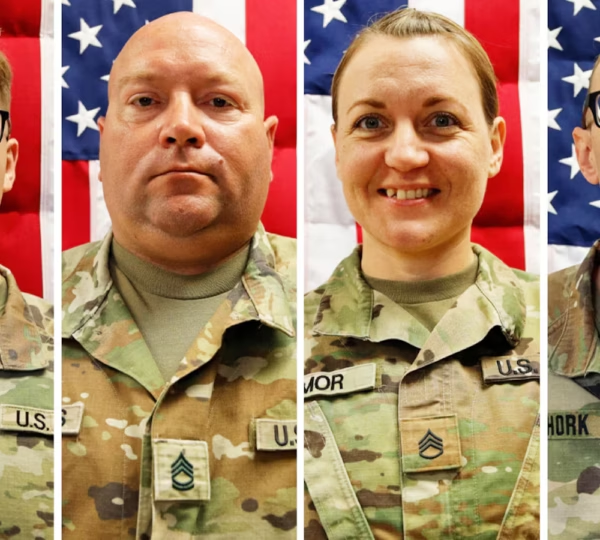
In the days following the attack, the U.S. Department of War publicly identified four of the six service members killed. All four were assigned to the 103rd Sustainment Command (Expeditionary), a unit headquartered in Des Moines, Iowa, responsible for providing essential supplies, logistical coordination, and operational support to deployed forces. The soldiers identified were:
- Capt. Cody A. Khork, 35, of Lakeland, Florida, a commissioned officer with multiple deployments who had dedicated more than a decade of service to the National Guard and Army Reserve.
- Sgt. 1st Class Nicole M. Amor, 39, of White Bear Lake, Minnesota, a highly experienced soldier whose career encompassed numerous overseas assignments and who was only days from returning home to her family.
- Sgt. 1st Class Noah L. Tietjens, 42, of Bellevue, Nebraska, a seasoned Army Reserve mechanic and mentor known for his technical expertise and guidance to younger troops.
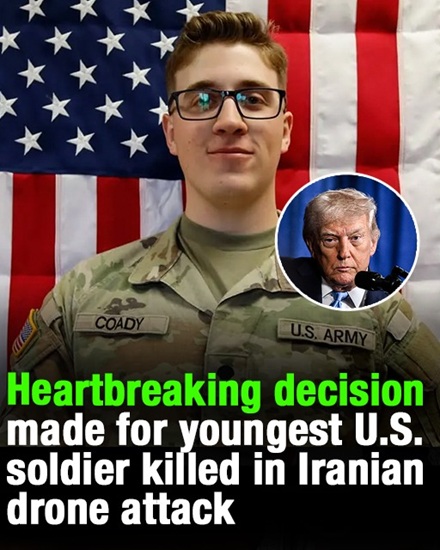
- Sgt. Declan J. Coady, 20, of West Des Moines, Iowa, one of the youngest soldiers killed, whose life and promising future reflected the human cost of the conflict in profound ways.
The identities of the remaining two soldiers were confirmed later, completing the full accounting of the six lives lost. The announcement brought widespread attention not only to the tactical circumstances of the strike but also to the individual stories of courage, service, and sacrifice that each soldier represented.
Sgt. Declan J. Coady: A Young Life of Promise
Sgt. Declan J. Coady’s story resonates as a poignant reminder of the human dimension of military service. Born and raised in West Des Moines, Iowa, Coady grew up in a community where family, education, and civic responsibility were central values. From an early age, he exhibited intellectual curiosity, a strong work ethic, and a commitment to serving others—qualities that would later shape both his academic and military pursuits.
In 2023, Coady made the decision to enlist in the U.S. Army Reserve, joining the 103rd Sustainment Command as an information technology specialist. This role placed him at the intersection of modern military operations and advanced technical systems, ensuring the operational integrity of communications, logistics software, and information networks essential for contemporary warfare.
Coady’s assignment involved maintaining secure communication channels, troubleshooting critical hardware and software systems, and supporting mission planning and coordination across multiple units. His responsibilities, while not directly combative, were indispensable to the functioning of U.S. forces in the region—a reality tragically highlighted by the vulnerability of support personnel in modern conflicts.
Academic Ambitions and Dual Commitments
Alongside his military service, Coady pursued higher education as a sophomore at Drake University in Des Moines, focusing on cybersecurity, information systems, and computer science. Balancing military deployment with online coursework, he demonstrated exceptional discipline and ambition.
His goal was to integrate technical expertise with leadership capability, aspiring to one day commission as an officer in the Army. Friends and family recalled his dedication to both his studies and service, noting that he approached every task—academic, technical, and military—with meticulous care and unwavering focus.
Just a week before the tragic attack in Kuwait, Coady shared promising news with his father, Andrew Coady: he was being considered for promotion from specialist to sergeant. This advancement was a recognition of his diligence, technical proficiency, and leadership potential. Following his death, the Army posthumously promoted him, honoring the milestone he had strived toward and ensuring that his commitment to service would be formally recognized despite the brevity of his life.
Family and Community Impact
The suddenness of Coady’s death sent shockwaves through both his family and the wider Iowa community. His older sister, Kiera, publicly shared the disbelief and grief that came with receiving the news, describing the difficulty of reconciling his last communication—simply reassuring his family that he was safe—with the devastating reality of his loss. She remembered Declan as “smart, kind, and amazing,” emphasizing that his life had been marked by thoughtfulness, intellectual curiosity, and a desire to make a meaningful impact on the world.
In Des Moines, local officials and lawmakers formally recognized his sacrifice. The Iowa Senate held a moment of silence, honoring Coady alongside other soldiers from the state. Governor Kim Reynolds issued a statement expressing condolences and acknowledging both the personal and communal grief caused by his death. The tribute highlighted the broader societal recognition of the essential, often understated contributions of reserve and support units to military operations worldwide.
While Sgt. Declan J. Coady’s story highlights the personal sacrifice of one young soldier, it is inseparable from the broader experiences of his fellow service members in the 103rd Sustainment Command (Expeditionary). This Army Reserve unit, based in Des Moines, Iowa, plays a critical role in ensuring that U.S. forces deployed overseas are fully equipped, supplied, and operationally supported.
Known for its disciplined approach to logistics, communications, and sustainment, the 103rd has a history of deployments across both training exercises and real-world operations, demonstrating the indispensable role of support units in modern warfare.

Capt. Cody A. Khork: Leadership and Dedication
Capt. Cody A. Khork, 35, of Lakeland, Florida, was a seasoned officer who exemplified leadership and commitment to service. Enlisting in the National Guard in 2009, Khork later commissioned as an officer in the Army Reserve and undertook multiple overseas deployments throughout his career. Known among peers as a decisive and conscientious leader, Khork had the responsibility of coordinating logistical operations for a large segment of U.S. forces in Kuwait. His duties involved planning transportation routes, ensuring the timely delivery of essential equipment, and maintaining communications across units operating in complex, high-risk environments.
Khork’s family and colleagues remembered him for his unwavering patriotism and attention to detail, both in administrative and field operations. He had a reputation for mentoring younger officers and enlisted personnel, emphasizing the importance of professionalism, technical proficiency, and accountability. His death in the March 1 drone strike marked not only the loss of a capable officer but also the sudden removal of a guiding presence whose work directly supported frontline troops.
Sgt. 1st Class Nicole M. Amor: Service and Sacrifice
Sgt. 1st Class Nicole M. Amor, 39, from White Bear Lake, Minnesota, was a highly experienced soldier and a mother who had devoted her life to both family and service. Amor’s military career spanned multiple deployments, including prior assignments to the Middle East, where she provided essential operational support and logistical expertise. Her role in the 103rd Sustainment Command involved coordinating tactical operations, supervising equipment distribution, and ensuring the welfare of soldiers under her supervision.
Tragically, Amor was only days away from returning home to her husband and children when the drone strike claimed her life. Her family publicly expressed their grief, emphasizing that while her professional dedication had always demanded sacrifice, her loss resonated deeply on a personal level.
Friends and colleagues highlighted her mentorship, her patience in training younger soldiers, and her unwavering commitment to mission success. Amor’s death underscored the human cost of conflict and the unique vulnerability faced by service members in support roles who, while not engaged in direct combat, remain exposed to lethal threats in operational environments.
Sgt. 1st Class Noah L. Tietjens: Technical Expertise and Mentorship
Sgt. 1st Class Noah L. Tietjens, 42, of Bellevue, Nebraska, brought decades of technical knowledge and hands-on experience to the 103rd Sustainment Command. Serving in the Army Reserve since 2006, Tietjens had multiple deployments, including previous assignments to Kuwait and other operational theaters. As a mechanic and logistics technician, he was responsible for maintaining critical vehicles, generators, and communications hardware, ensuring that operational readiness was never compromised.

Beyond his technical role, Tietjens was widely respected for his mentorship. Younger soldiers often described him as a patient guide who could troubleshoot both machinery and procedural challenges with equal skill. He frequently balanced hands-on work with informal teaching moments, imparting practical knowledge that would allow the next generation of soldiers to operate effectively in high-pressure environments. The loss of Tietjens represented both a professional and personal void, affecting not only the unit’s operational capabilities but also the social cohesion and morale of his peers.
The Operational Role of the 103rd Sustainment Command
The 103rd Sustainment Command is tasked with ensuring that deployed troops are provided with essential supplies—food, fuel, ammunition, equipment, and technical support—across vast operational areas.
During the March 2026 deployment, the unit supported Operation Epic Fury, a complex, multi-national campaign targeting Iranian military infrastructure. The soldiers at Port Shuaiba were stationed at a tactical operations center that coordinated shipments, maintained communications, and facilitated command-and-control functions for U.S. and allied forces.
While the unit primarily focused on logistics, their work was integral to mission success. Without secure supply lines, functioning communications, and rapid problem-solving for technical or operational challenges, frontline units would face severe limitations in operational readiness.
The March 1 drone strike exposed the vulnerabilities inherent in modern warfare, where even non-combat personnel stationed far from active combat zones face life-threatening risk. The loss of six soldiers, including Coady, Khork, Amor, and Tietjens, illustrated that modern threats do not distinguish between frontlines and support operations.
Immediate Aftermath: Response and Support
In the immediate hours following the drone strike, U.S. military personnel at Port Shuaiba initiated emergency response protocols, securing the site, attending to the injured, and conducting an initial assessment of damage. Combat medics and logistics officers worked under difficult conditions to stabilize surviving personnel, coordinate evacuation, and preserve critical operational data. The attack disrupted supply chains temporarily, highlighting the challenges of sustaining operations in high-threat environments.
Senior U.S. military leaders, including Lt. Gen. Robert Harter, Chief of the Army Reserve, quickly released statements praising the courage and professionalism of the soldiers on site. Harter emphasized that these service members “served fearlessly and selflessly in defense of our nation,” acknowledging the extraordinary risks undertaken by troops in support capacities.
The Pentagon coordinated with coalition partners in Kuwait to reinforce defenses, deploy additional personnel, and prevent further operational disruption while simultaneously conducting a thorough investigation into the strike’s execution and the vulnerabilities it revealed.
The Human Cost Beyond the Battlefield
While operational reports focus on logistics, casualty figures, and strategic implications, the personal impact of the March 1 strike extended far beyond military metrics. Families received notifications in the following days, often learning of the losses with shock and disbelief.
For the Coady family, the sudden loss of Declan meant reconciling the ordinary moments of their daily lives with an extraordinary tragedy—a young life and promising future abruptly ended. Similarly, the families of Khork, Amor, and Tietjens faced the emotional toll of losing loved ones who had dedicated their professional lives to protecting and serving others.
Communities across Iowa, Minnesota, Florida, and Nebraska rallied to honor the fallen. Local and state governments issued proclamations, moments of silence were observed in public spaces, and memorial services provided spaces for collective mourning.
These gestures, while small in the context of global military operations, were vital in humanizing the loss, ensuring that the sacrifices of these soldiers were remembered not merely as statistics but as integral parts of families and communities.
The deaths of Sgt. Declan J. Coady and his five fellow service members on March 1, 2026, in Port Shuaiba, Kuwait, represent more than a tragic footnote in the history of Operation Epic Fury—they stand as a stark reminder of the complexity and human cost of modern warfare.
While military strategy, geopolitical analysis, and operational logistics often dominate headlines, the lived experiences of these soldiers, their families, and their communities reveal the profound sacrifices required by service, even for those assigned to roles far from direct combat.
Remembering the Fallen as Individuals
Each of the six soldiers lost that day carried with them personal stories of ambition, dedication, and community ties. Sgt. Coady, at just 20 years old, embodied a blend of youthful promise and disciplined professionalism. His simultaneous pursuit of a cybersecurity degree at Drake University and a career in the Army Reserve reflects the dual commitment many modern soldiers carry—balancing education, civilian responsibilities, and military service.
His posthumous promotion to sergeant highlighted not only his personal achievements but also the recognition of his peers and superiors for his leadership potential and technical skill.
Similarly, Capt. Cody A. Khork represented experienced leadership, mentorship, and the practical knowledge gained from years of deployment in various operational theaters. Sgt. 1st Class Nicole M. Amor’s career combined professional excellence with personal devotion to family, illustrating the sacrifices service members make to protect their country while managing personal commitments.
Sgt. 1st Class Noah L. Tietjens, with decades of technical expertise, exemplified the critical role of mentorship and the often unseen work that sustains operational success. Together, these soldiers reflect the multifaceted nature of modern military service, in which strategic impact is inseparable from human dedication and personal sacrifice.
The Role of Support Units in Modern Conflict
The March 1 drone strike underscored the vulnerability of military support units in contemporary conflicts. Unlike conventional battlefield engagements, where frontlines and rear areas are relatively distinct, modern warfare frequently exposes logistical and technical personnel to direct threats, including precision drone attacks. Units such as the 103rd Sustainment Command are essential to sustaining combat operations, coordinating supply chains, maintaining communications infrastructure, and ensuring that frontline forces have the resources required to execute their missions.
Operational analysts have noted that the loss of even a small number of personnel in critical sustainment roles can create cascading effects, from delayed resupply and maintenance issues to increased operational risk for combat units. In this context, the sacrifice of the six soldiers in Kuwait highlights not only the personal toll of war but also the strategic importance of safeguarding support functions in conflict zones.
Community Response and Collective Mourning
The immediate impact of the strike resonated far beyond military circles. Communities in Iowa, Minnesota, Nebraska, and Florida grappled with the sudden loss of citizens who had dedicated themselves to national service. Public memorials, moments of silence, and tributes in state legislatures provided collective spaces for grief, recognition, and remembrance. Local media chronicled the personal lives, aspirations, and achievements of the fallen soldiers, emphasizing that these individuals were more than military personnel—they were students, parents, siblings, mentors, and friends.
In West Des Moines, Iowa, Sgt. Coady’s life and sacrifice were commemorated through memorial services attended by local officials, community members, and fellow soldiers.
Governor Kim Reynolds, speaking to the press, highlighted the dual nature of military sacrifice: the public duty of defending the nation and the private loss felt by families and communities. Such commemorations serve not only as a way to honor the fallen but also as a tangible acknowledgment of the broader societal cost of armed conflict.
The Broader Implications of the 2026 Conflict
Operation Epic Fury and the early 2026 U.S.-led military action against Iran brought forward complex geopolitical dynamics, including the risk of escalation, the strategic use of unmanned systems, and the role of allied coordination.
The attack at Port Shuaiba exemplified the increasing use of precision drones and other unmanned systems in modern warfare, capable of striking critical nodes deep within supposedly secure areas. Analysts argue that the growing prevalence of such technologies heightens the importance of robust intelligence, defense, and counter-drone capabilities, as well as the human resilience of support units operating under threat.
Furthermore, these events draw attention to the personal dimensions of military service. Soldiers are more than instruments of strategy—they are individuals with ambitions, families, and communities dependent on their well-being. Recognizing this reality is crucial for policymakers, military planners, and the public when evaluating both tactical success and the human cost of conflict.
Legacy and Lessons Learned
The legacy of Sgt. Declan J. Coady and his fellow soldiers extends beyond their immediate operational contributions. Their sacrifice illuminates several enduring truths about military service:
- The Importance of Support Personnel: Modern operations rely on complex networks of logistical, technical, and communications specialists. Protecting these roles is as essential as safeguarding frontline combat troops.
- The Human Cost of War: Behind every casualty statistic is a family, a community, and an unrealized potential. Recognizing this personal dimension ensures that national conversations about conflict remain grounded in human experience.
- Preparedness and Innovation: The drone strike highlighted both vulnerabilities and areas for innovation in force protection, counter-drone measures, and tactical infrastructure. Lessons learned from such attacks inform future operational planning and risk mitigation.
- Community and National Mourning: Collective remembrance reinforces societal cohesion and acknowledges that military sacrifice resonates far beyond military bases or political debates.
Continuing Memory and Recognition
In the months following the attack, memorials and tributes continued across the United States. The Iowa Senate and other state legislatures held commemorative sessions honoring the fallen soldiers, and families established scholarships and community initiatives in their names. These efforts ensure that their contributions—both to national security and to their local communities—are not forgotten.
Sgt. Coady’s pursuit of education, his dedication to service, and his personal qualities continue to inspire peers, students, and fellow service members. Capt. Khork, Sgt. Amor, and Sgt. Tietjens are remembered not only for their professional expertise but also for the personal impact they had on the lives of those around them. Together, their stories serve as a testament to courage, dedication, and the often unseen sacrifices of those who sustain military operations worldwide.
Conclusion: Honoring Service in Modern Warfare
The events of March 1, 2026, at Port Shuaiba, Kuwait, crystallize the dual realities of modern military conflict: operational complexity and profound human cost. Sgt. Declan J. Coady and his fellow service members represent the dedication, courage, and sacrifice required to maintain operational readiness in dangerous environments. Their lives remind the nation that even roles far from the frontline are vital, that technical and logistical support personnel are exposed to grave risks, and that every military casualty represents a ripple of loss felt by families, friends, and communities.
As the United States and its allies continue to navigate the complexities of regional conflict, the memory of these soldiers serves as both a moral compass and a solemn reminder. By honoring their service, reflecting on their personal stories, and acknowledging the human cost of military operations, society preserves their legacy and reaffirms the essential truth that national defense relies on both extraordinary courage and everyday dedication.