
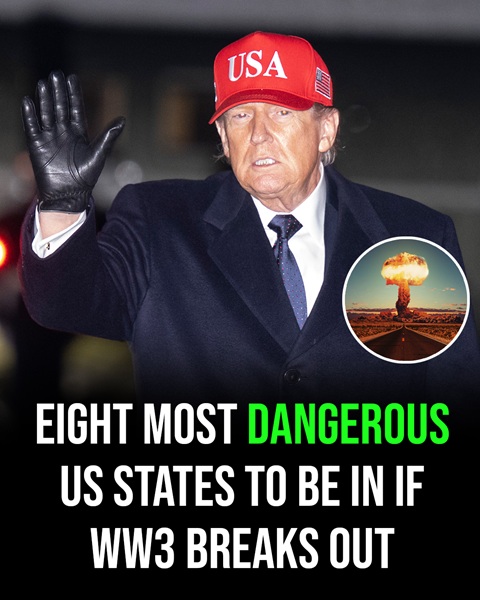
As tensions escalate around the globe, many people are increasingly anxious about the possibility of a major world conflict erupting — especially amid recent hostilities involving the United States, Iran, and other nations in the Middle East.
In early March 2026, President Donald Trump acknowledged the real possibility that Iran could attempt retaliation that affects the United States, saying that when the country engages in war, “some people will die.”
In an interview with TIME magazine, Trump was asked whether Americans should worry about retaliatory attacks on U.S. soil, and he responded with uncertainty, saying, “I guess,” before noting that planning for such risks is constant.
Trump added that such risks are something the government regularly considers and prepares for, but he tempered expectations by acknowledging that conflict always brings casualties.
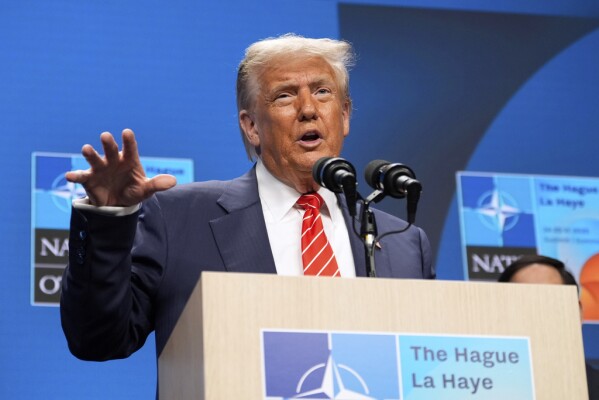
His comments sparked renewed discussion about global security and whether existing tensions in the Middle East could spiral into a broader, more dangerous conflict that affects life far beyond that region.
After the initial U.S. and allied strikes against Iranian targets, Iran responded with a series of drone and missile attacks on military bases and allied territory in the region, including areas in the Persian Gulf and nearby nations.
The conflict has already led to confirmed deaths of U.S. service members and heightened fears that continued retaliation could escalate into something larger, with implications for global security.
The ongoing war in the Middle East has spread beyond its original borders, with incidents reported in Mediterranean and Gulf states — further feeding fears about broader instability.
U.S. officials have not ruled out further military action, including broader operations or additional airstrikes in response to further attacks, even as diplomacy and regional alliances continue under strain.
In the midst of this volatile climate, some world leaders have voiced concerns that the current conflicts could represent the beginnings of a much more widespread confrontation.
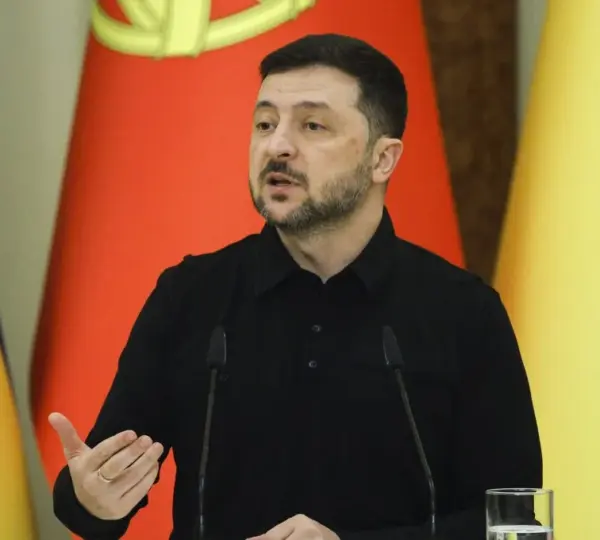
For example, Ukrainian President Volodymyr Zelensky has suggested that conflicts already underway — including Russia’s invasion of Ukraine — resemble elements of a larger global struggle that could shape future world geopolitics.

His comments reflect a broader sentiment among international observers that modern wars, although different from the past, have interconnected dimensions that transcend regional boundaries.
Public opinion surveys also show rising fear about another world war. In multiple European countries, many respondents now believe a major global conflict could occur within the next decade.
In the United States, similar polls show nearly half of Americans believe a world war — possibly even involving nuclear weapons — could erupt under certain conditions.
These opinions often reflect deep anxieties about nuclear weaponry and international tensions — even if actual risk remains statistically low.
Many respondents report that a future large‑scale war would likely involve nuclear weapons, a belief shared across age groups and nationalities.
The concern over nuclear escalation highlights just how serious public fear has become as international disputes intensify.
Amid this anxiety, some analysts have examined which places might be safer if a massive global conflict — such as a hypothetical World War III — were to occur.
Crucially, experts caution that in the event of a full‑scale nuclear exchange, no location would be truly safe, as secondary effects like radioactive fallout and global disruption would affect every region.
Even so, comparative risk assessments suggest that some areas might face lower immediate exposure in a nuclear war scenario, depending on geography and proximity to potential targets.
One key factor in these assessments is distance from major military installations and critical infrastructure — such as missile bases, large metropolitan areas, and defense centers that could be strategic targets.
States with major population centers, large military bases, or critical industrial facilities are generally considered more vulnerable in most nuclear war projections.
By contrast, areas that are far from such strategic targets are often viewed as comparatively lower risk in the initial stage of a hypothetical conflict.
One group of analyses identifies a broad band of states along the East Coast and Southeast that could have relatively lower risk of direct targeting early in a conflict — at least in some modeled scenarios.
These “safer” states include Maine, New Hampshire, Vermont, Massachusetts, Rhode Island, Connecticut, New York, New Jersey, Pennsylvania, Delaware, Maryland, Virginia, West Virginia, North Carolina, South Carolina, Georgia, and Florida.
Additional states in the Midwest and Great Lakes area — such as Ohio, Indiana, Michigan, Kentucky, Tennessee, Alabama, Mississippi and others — are also sometimes included in lists of relatively lower‑risk areas.
The rationale is that these regions are often distant from strategic missile silos or primary nuclear infrastructure and therefore might receive lower direct blast or fallout exposure in some modeled strikes.
By contrast, central states such as Montana, North Dakota, Wyoming, Nebraska, Colorado, South Dakota, Iowa and Minnesota are often considered higher risk because many missile silos and related Cold War‑era infrastructure are located there.
These sites would likely be targeted in a large‑scale exchange simply because disabling a nuclear arsenal’s launch capability is among the first strategic objectives in a nuclear conflict.
Missile silos and hardened military installations attract higher‑order targeting in most nuclear exchange simulations, which is why surrounding regions are often seen as more exposed.
However, the presence of missile silos does not guarantee a strike — nor does distance guarantee absolute safety. All scenarios are inherently speculative and based on modeling, not inevitable outcomes.
Analysts emphasize that even if initial strikes bypass certain areas, fallout patterns, wind direction changes, and atmospheric effects could later expose regions previously thought safer.
Wind and weather patterns, particularly prevailing west‑to‑east winds across North America, could carry radioactive particles far from an initial blast site, potentially affecting distant states.
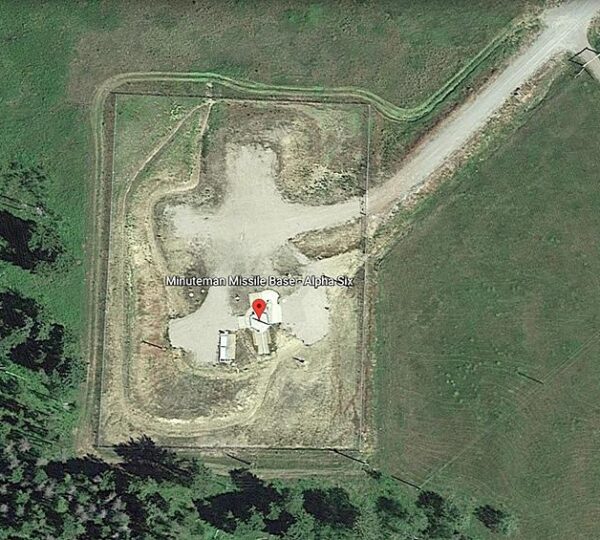
Another factor in perceived safety is population density. Rural areas may face fewer direct hits simply because fewer strategic targets are present, though fallout could still be a threat.
On the other hand, major metropolitan areas are more likely to be high‑order targets because of their economic, political, and logistical importance.
Even so, experts remind the public that nuclear war would have consequences far beyond immediate detonation zones, including long‑term disruptions to infrastructure, food supply, and international relations.
Beyond geographical considerations, preparedness and resilience planning — such as access to shelter, food, fresh water, and medical care — will deeply influence survivability in any large‑scale catastrophe.
Geopolitical analysts also stress that the better global leaders manage tensions through diplomacy, the less likely any hypothetical World War III scenario becomes a reality.
Worldwide diplomatic efforts, arms control agreements, and conflict prevention mechanisms have historically reduced the likelihood of direct large‑scale confrontations between nuclear‑armed powers.
Nevertheless, fear and uncertainty can grow quickly as conflicts escalate in the Middle East and elsewhere, prompting people to think about distant possibilities with urgency and concern.
Public anxiety reflects the fact that war is inherently unpredictable, and modern complexities like cyber warfare, regional alliances, and nuclear deterrence add layers of uncertainty not seen in previous global conflicts.
While official U.S. policy remains focused on defending the nation and mitigating threats abroad, domestic preparedness efforts — including civil defense planning and emergency response coordination — continue in the background.
Despite these efforts, most experts agree that no place would be truly safe in a full‑scale world war with nuclear exchange, underscoring the importance of preventing conflict altogether.
In the end, discussions about “safest places” are largely theoretical and reflect comparative risk assessments, not guarantees of survival in any catastrophic scenario.
Political leaders, scholars, and citizens alike often emphasize that diplomacy, cooperation, and restraint are the best paths away from the devastation of future wars.
Reducing global tension requires sustained engagement, negotiation, and conflict resolution, which remains a priority for governments and international institutions.
Today’s fears about world war echo similar anxieties from historic eras — such as the Cold War — when nuclear strategy and geopolitical rivalry made global war worries widespread.
Yet humanity endured those tense decades without a comprehensive nuclear exchange, thanks in part to diplomacy and international frameworks designed to prevent escalation.
That history reminds us that while conflict is always a risk, proactive peacebuilding and global cooperation can reduce fear and prevent worst‑case scenarios.
For now, discussions about where might be safest in a hypothetical future war serve partly as a sobering reminder of the stakes involved in international relations.
But they also highlight that human lives, communities, and nations share a common interest in avoiding any conflict that could escalate into global catastrophe.
No matter where one lives, the best way to contribute to safety is through support for peaceful solutions, stability, and conflict prevention around the world.
While uncertainty remains about the future, most experts agree that prioritizing diplomacy and avoiding military escalation are essential to global survival and prosperity.
Ultimately, today’s debates about safety in a hypothetical World War III underscore the importance of pursuing peace — not preparing for war.
